Do I Need Track Day Insurance for HPDE Events?
Yes, buy HPDE insurance when your car’s replacement cost plus your deductible is more than you can comfortably self-insure, and confirm the policy covers your event before you register. Skip that check and you can be stuck paying a total-loss repair or replacement out of pocket after a track incident. This guide explains what standard auto insurance usually excludes, how HPDE policies work, and how to decide whether the premium is worth it.
Why standard policies miss HPDE
Most personal auto policies are written for street driving, not approved track sessions. RLI says standard auto policies exclude HPDE events, and Marshall+Sterling says most personal auto policies exclude track use. That gap matters because an HPDE car can be damaged while the street policy still says no.
Track use and racing exclusions
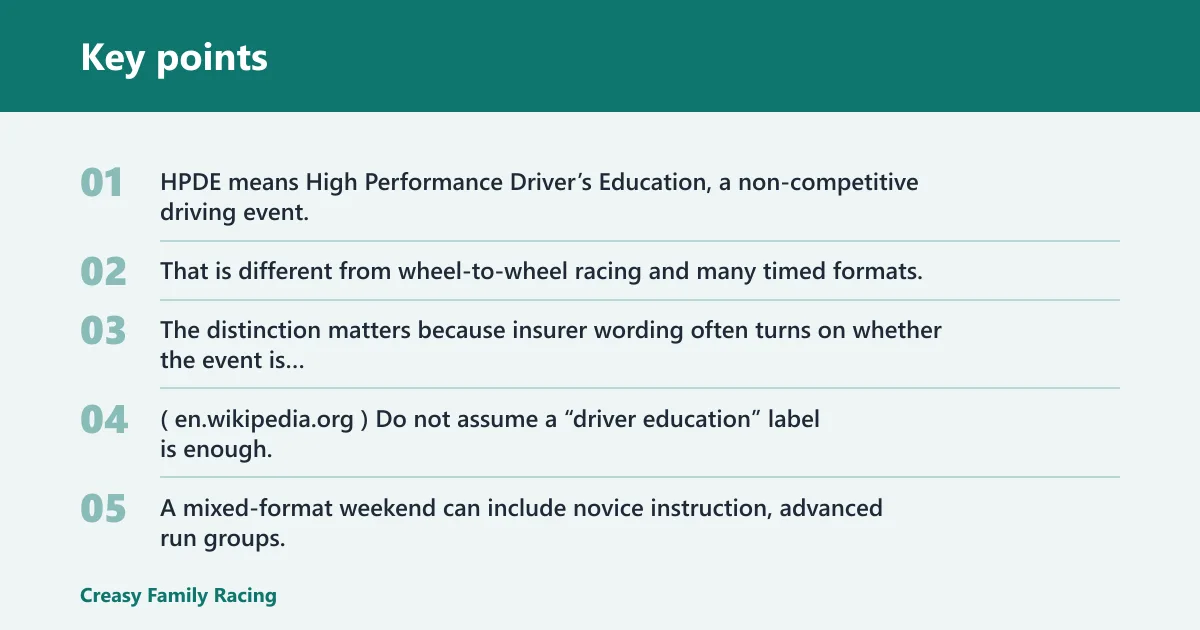
HPDE means High Performance Driver’s Education, a non-competitive driving event. That is different from wheel-to-wheel racing and many timed formats. The distinction matters because insurer wording often turns on whether the event is sanctioned as non-competitive, timed, or racing. (Wikipedia)
Do not assume a “driver education” label is enough. A mixed-format weekend can include novice instruction, advanced run groups, and timed segments in the same venue, and the policy may only respond to the approved non-competitive portion.
Why written confirmation matters
Ask for the answer in writing. A phone call that sounds reassuring is weaker than a written confirmation that names the event type, the sanctioning body, and the exact coverage terms. If the carrier will not confirm track use in writing, treat that as a warning sign.
Street coverage usually ends where the track language begins. That boundary can be clear on paper and fuzzy in practice, especially when the event has instructors, ride-alongs, paddock staging, or optional advanced sessions. Written wording is the safest way to close that gap.
What track day insurance covers
Track day insurance is event-specific coverage for physical damage to your own car. It is commonly sold for a single day or a single event, and RLI provides single-event coverage for HPDE events. Marshall+Sterling also says annual track day insurance may be available.
Physical damage to your car
The same source says its policy is designed for HPDE events only, and it applies to damage while on the track and in the paddock. Marshall+Sterling describes the coverage as on-track physical damage coverage. In plain terms, it is there for repair or total-loss exposure to your car, not the other driver’s car.
What liability coverage usually excludes
The same source says the policy protects physical damage only, not liability. That means track day insurance usually does not pay for damage to other people or their property. Liability is a separate issue from your own car’s repair bill, and you should not buy an HPDE policy expecting both.
Single-event and single-day options
Single-event purchase is common because many drivers only need coverage for one weekend. That is useful if you are trying a first HPDE, testing a freshly repaired car, or driving a borrowed car that you do not want to risk uninsured on track.
Suppose your coupe is worth about $18,000 and the policy deductible is about $1,800. If an insured incident totals the car, your out-of-pocket exposure is still the deductible plus any excluded costs. That simple math helps you decide whether the premium protects enough value to matter.
Track day insurance decision table
Use this table as a plain decision aid. It is not a quote tool, and it does not replace the event rules or the policy wording. The point is to compare car value, deductible exposure, and event type before you buy.
| Car value band | Deductible band | Event type | Practical call |
|---|---|---|---|
| Under $10,000 | 5% to 10% | Approved non-competitive HPDE | Usually self-insure unless replacement would strain cash flow |
| Under $10,000 | 15% | Approved non-competitive HPDE | Self-insure more often; the deductible can be a large share of the car’s value |
| $10,000 to $30,000 | 5% | Approved non-competitive HPDE | Buy if you want lower out-of-pocket risk after a loss |
| $10,000 to $30,000 | 10% | Approved non-competitive HPDE | Middle ground; buy if a several-thousand-dollar hit is uncomfortable |
| $10,000 to $30,000 | 15% | Approved non-competitive HPDE | Self-insure if you can absorb the higher deductible without stress |
| Above $30,000 | 5% to 10% | Approved non-competitive HPDE | Buy in most cases unless you can replace the car without hesitation |
| Above $30,000 | 10% to 15% | Timed, racing, or wheel-to-wheel event | Do not assume eligibility; many programs exclude it |
Do you actually need it?
Buy track day insurance when the car’s replacement cost plus the deductible is more than you can comfortably self-insure. For a cheap street car, the premium may be hard to justify if you could replace the car without changing your finances. For a higher-value car, the same premium can make sense quickly.
Cheap street car versus high-value car
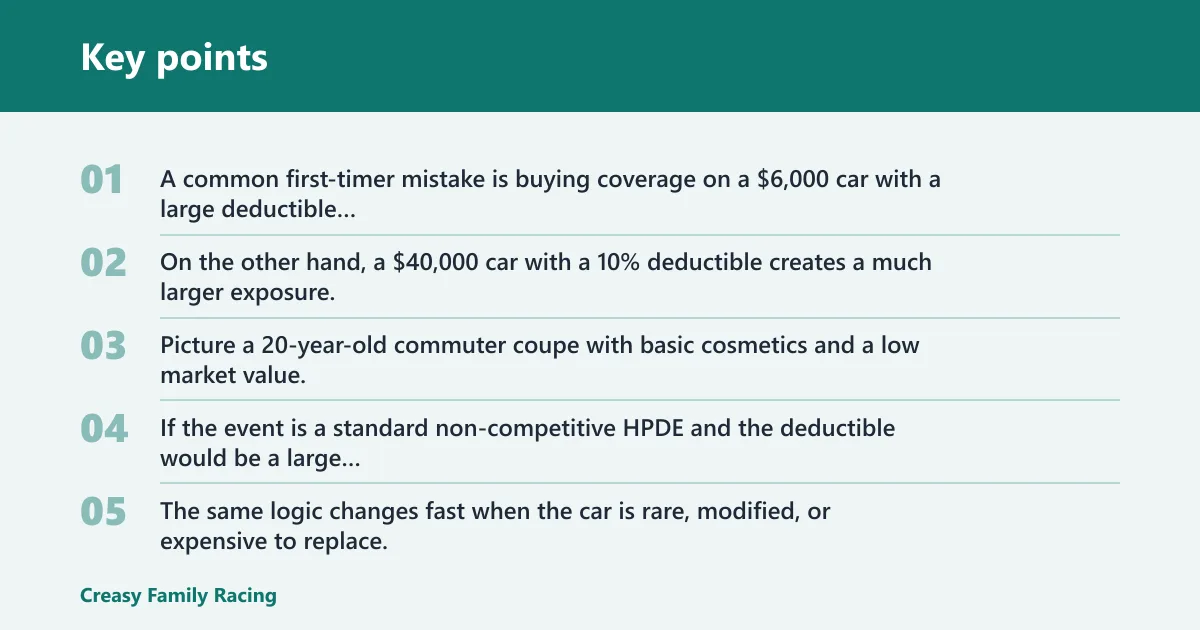
A common first-timer mistake is buying coverage on a $6,000 car with a large deductible and then paying more for protection than the likely benefit. On the other hand, a $40,000 car with a 10% deductible creates a much larger exposure, so the premium can buy real peace of mind.
Picture a 20-year-old commuter coupe with basic cosmetics and a low market value. If the event is a standard non-competitive HPDE and the deductible would be a large slice of the car’s value, self-insuring can be reasonable. The same logic changes fast when the car is rare, modified, or expensive to replace.
How much loss you can absorb?
The key question is not whether damage is possible. It is whether you could absorb the loss without raiding emergency cash, selling another car, or delaying needed repairs on something else. If the answer is no, event-specific coverage deserves a hard look.
Modified cars need extra caution. Changes to suspension, engine output, bodywork, or agreed value can affect pricing and eligibility, and some policies care about how the car is described on the application. If the insurer values the car differently than you do, your premium and claim math may change.
What should you verify before buying?
Check event eligibility before you register. Approved non-competitive HPDE events are often covered, but wheel-to-wheel racing, timed competition, and other competitive formats are often excluded. The event rules and the insurer’s wording both matter.
Sanctioning and non-competitive status
Confirm that the event is sanctioned as a non-competitive HPDE or driver education event. If the weekend includes time trials, competitive run groups, or timed segments, ask whether those sessions are excluded. Do not rely on the event flyer alone.
Instructor seat time and rider rules
Ask whether instructor driving, ride-alongs, or coaching laps are allowed under the policy. Some claims fail when the car is being driven by someone other than the named participant, even if the event itself is an HPDE. If the rules allow an instructor in the right seat, verify that the insurer accepts that format too.
Paddock exposure and written insurer confirmation
The same source says coverage applies to damage while on the track and in the paddock. That is helpful, but do not assume every program matches that wording. Ask the insurer to confirm, in writing, whether paddock damage is included, whether towing is covered, and whether borrowed cars or enclosed trailers change the decision.
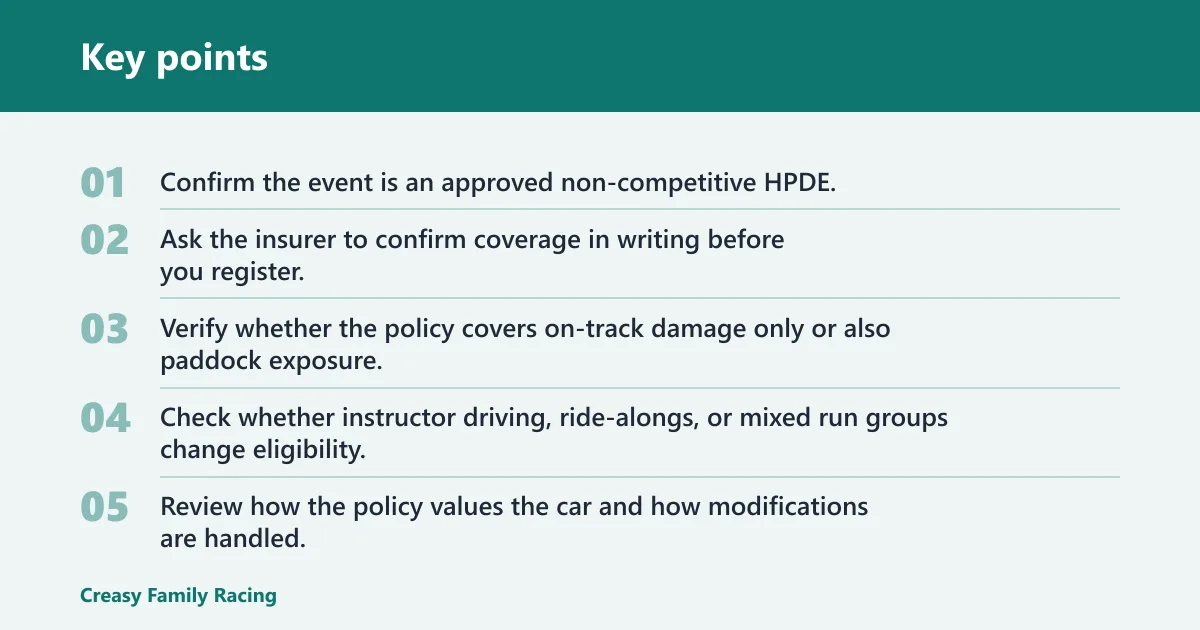
- Confirm the event is an approved non-competitive HPDE, not racing or time trial competition.
- Ask the insurer to confirm coverage in writing before you register.
- Verify whether the policy covers on-track damage only or also paddock exposure.
- Check whether instructor driving, ride-alongs, or mixed run groups change eligibility.
- Review how the policy values the car and how modifications are handled.
- Compare the deductible with the amount you could comfortably absorb yourself.
How deductibles change your risk
Deductibles are often percentage-based, and a common rule of thumb is around 10% of the car’s value. Lower deductibles usually raise the premium. That tradeoff is simple: smaller out-of-pocket exposure costs more up front.
5% versus 10% versus 15%
If the car is valued at about $20,000, a 5% deductible means about $1,000, a 10% deductible means about $2,000, and a 15% deductible means about $3,000. Those are very different risk levels. The right choice depends on how much loss you can live with, not just on the premium.
Lower deductibles make the policy feel safer, but the price usually rises with that choice. If a 5% deductible premium is too high and 15% feels too risky, 10% is often the middle point drivers compare first.
Agreed value and mods
Car value is central to premium and claim math. Some policies use an agreed value concept, while others price off the vehicle’s stated value. Either way, the insurer needs a number that matches the car’s actual replacement cost, not a casual guess.
Modifications can affect both cost and eligibility. A street car with stock parts is usually easier to place than a heavily modified build with expensive aero, engine work, or custom panels. If the insurer asks for details, answer them carefully and keep the paperwork aligned with the car.
Frequently asked questions
Do I need track day insurance for an HPDE event?
Buy it when the car’s replacement cost plus the deductible is more than you can comfortably self-insure. If the car is cheap enough that you could replace it without strain, self-insuring may make more sense. For expensive or modified cars, event-specific coverage is easier to justify.
Does my regular car insurance cover HPDE or track days?
Usually no. The same source says standard auto policies exclude HPDE events, and Marshall+Sterling says most personal auto policies exclude track use. Do not guess based on the policy title; check the actual wording and get written confirmation from the insurer before you enter the track.
What does track day insurance actually cover at an HPDE?
It usually covers physical damage to your own car during an approved non-competitive HPDE. The same source says its policy is for HPDE events only and protects physical damage only, not liability. That means repair or total-loss exposure for your car, not damage you cause to someone else.
Does track day insurance cover damage in the paddock too?
Sometimes. The same source says its coverage applies to damage while on the track and in the paddock. That wording is not universal, so you should confirm paddock exposure in writing before buying. If the policy does not say it clearly, do not assume it is included.
Does track day insurance include liability coverage?
No, not usually. The same source says the policy protects physical damage only, not liability. Liability for injury or damage to other people or property is a separate issue and may not be addressed by the track day policy at all. Read that part closely before you buy.
Can I buy track day insurance for a single event?
Yes. RLI provides single-event coverage for HPDE events, and single-day or single-event purchase is common in the market. That makes sense for drivers who only want protection for one weekend, one car, or one event with a higher-than-usual risk profile.