First Track Day: Beginner Guide for Street Cars
A first beginner track day in a street car usually comes down to about six pass/fail checks: brakes, tires, fluids, wheel torque, battery security, and helmet compliance. Miss one, and you may fail tech, boil brake fluid, cord a tire, or end the day on a tow truck instead of on track. This guide covers the go/no-go call, what to bring, what happens at HPDE, and what to inspect before and after every session.
The key choice is event format. A beginner should start with HPDE, not open lapping, because HPDE uses classroom instruction, controlled run groups, and a step-by-step path from instructor-led laps to solo sign-off only when the organizer decides the driver is ready. That structure matters more than power, mods, or lap-time goals.
Start with the right event format
Why HPDE fits a first day
HPDE stands for High Performance Driver Education, and that education piece is what separates a solid first event from a stressful one. Beginner days often place classroom sessions before the first run and between later sessions, with instructors covering flags, pit procedures, passing rules, and the mistakes novices make most often. (Wikipedia)
Most track-day events divide drivers into beginner, intermediate, and advanced groups. That matters because the beginner group is paced for learning, while advanced formats may expect track awareness, constant mirror checks, and comfort with wider passing rules.
How novice groups differ from open lapping
A novice or beginner run group is usually more structured than open lapping. Passing is limited to specific zones. Point-bys are mandatory. Some groups begin with lead-follow laps so nobody spends lap one guessing where pit-out is or where the flag stations sit.
Beginner run groups often use a small group of up to four drivers with one instructor. That smaller format helps the organizer monitor spacing, line discipline, and whether each driver is applying the classroom material on track.
What instructor-led and lead-follow sessions look like
The first session may feel slower than expected. That is normal. The goal is to learn worker stations, braking markers, and pit-lane entry and exit without crossing blend lines or surprising faster traffic.
Suppose the first novice session starts behind an instructor car. The pace stays moderate, but the value is real: every driver sees the same turn-in points, the same pit-in route, and the same no-passing areas before speeds rise later in the day.
How solo sign-off usually works
Many programs let a beginner move to solo only after an instructor or chief coach is satisfied with awareness, consistency, and rule compliance. That sign-off is not automatic. It is a judgment based on traffic behavior, point-bys, mirror use, flags, and predictable car placement.
That is another reason not to treat all track events as interchangeable. A first-timer usually wants the event where someone is actively managing the learning process, not the one where everyone is simply released onto the track.
Can you bring a stock street car?
Yes, most first HPDE events accept a stock street car if it is mechanically sound, passes tech, and meets the organizer’s gear rules. Condition matters more than modifications. A newer stock car with healthy brakes and tires is often a better first-day choice than a modified car with unknown maintenance.
What mechanically sound actually means
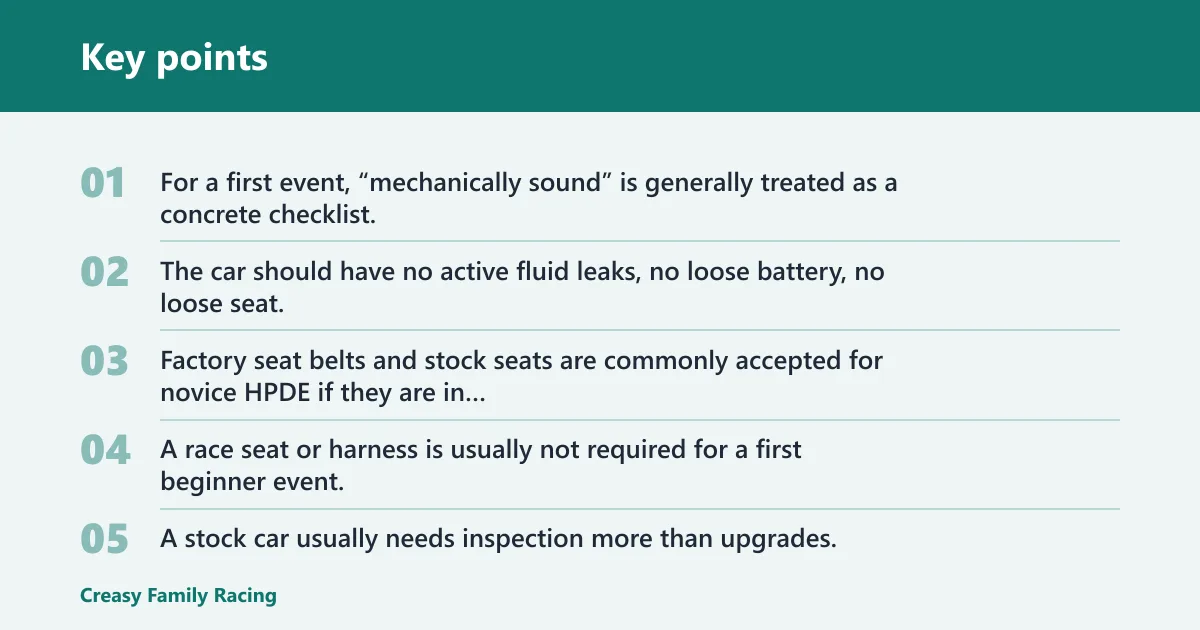
For a first event, “mechanically sound” is generally treated as a concrete checklist. The car should have no active fluid leaks, no loose battery, no loose seat, no missing or loose lug nuts, normal throttle return, no major warning lights that point to unresolved faults, and brakes that feel firm and consistent.
Factory seat belts and stock seats are commonly accepted for novice HPDE if they are in good condition and approved by the organizer. A race seat or harness is usually not required for a first beginner event, and adding harnesses without the rest of the safety system can create its own problems.
Stock, lightly modified, and older cars need different priorities
A stock car usually needs inspection more than upgrades. A lightly modified car needs proof that the work is actually finished: wheel studs torqued correctly, brake parts bedded and leak-free, alignment stable, and nothing rubbing under compression.
An older or high-mileage street car needs a stricter go/no-go review. Age by itself is not the problem. Deferred maintenance is. Track heat exposes weak hoses, old fluid, marginal wheel bearings, tired pads, and tires that looked fine in traffic but overheat quickly after repeated laps.
Say your daily driver has 6/32-inch tread, a firm pedal on the street, and stock suspension, but the brake fluid has been in the car for years and the right-front caliper pin is sticking. That is not “send it and see.” That is a fix-before-you-go car.
When a daily driver is fine and when it is not
A daily driver is usually fine when the maintenance baseline is known and the car shows no warning signs. It is not fine when the owner is already making excuses for a soft pedal, a seep at the valve cover that drips onto hot parts, or a check-engine light that “has been there forever.”
Do not normalize driving to the track with known faults. If the car is questionable in normal commuting, it is a poor candidate for sustained braking, repeated heat cycles, and long periods at full load.
What should you check before your first track day?
Check the car in this order: brakes first, then tires and wheels, then fluids and leaks, then battery and seats, then cabin cleanup and paperwork. That order matches the items most likely to ruin a first day. A stock car can pass easily, but it cannot hide weak brakes or damaged tires once heat builds.
Brake system: pads, rotors, fluid, and pedal feel
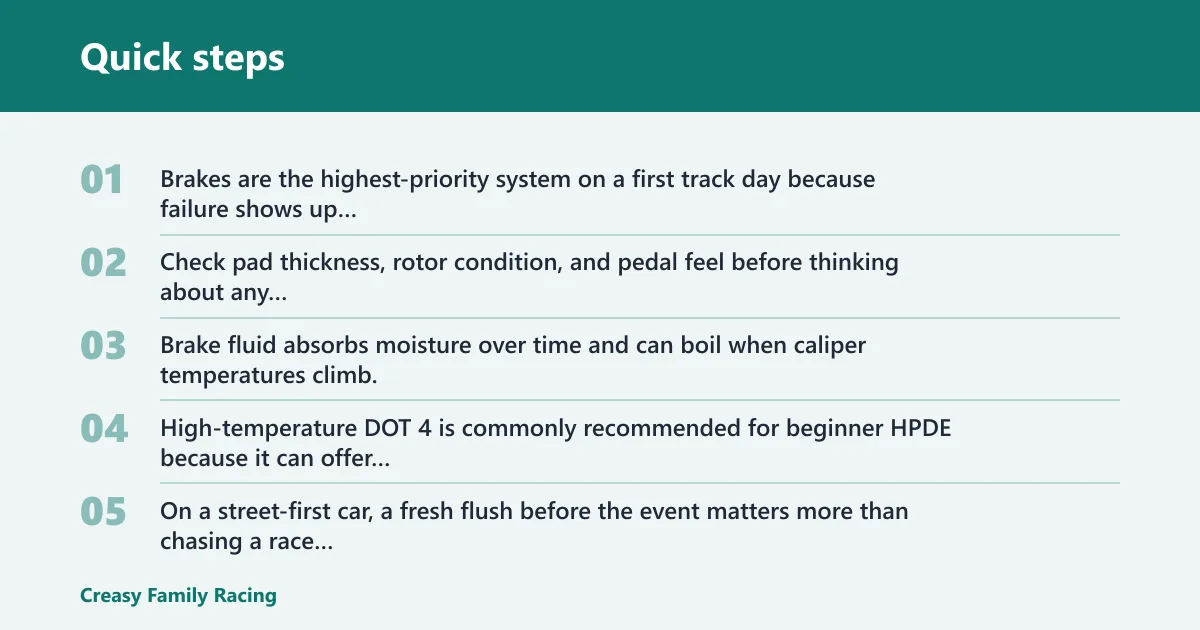
Brakes are the highest-priority system on a first track day because failure shows up quickly and usually under heat. Check pad thickness, rotor condition, and pedal feel before thinking about any performance upgrade.
Pad material wears. Rotor cracks spread. Brake fluid absorbs moisture over time and can boil when caliper temperatures climb. High-temperature DOT 4 is commonly recommended for beginner HPDE because it can offer more margin under track heat than older or unknown fluid. On a street-first car, a fresh flush before the event matters more than chasing a race pad.
Separate the failure modes. Brake fade can mean the pads are overheating and losing friction. Fluid boil often feels like a longer or suddenly soft pedal because vapor compresses. Worn pads or damaged rotors can cause grinding, pulsing, or metal-to-metal damage that should end the day.
Picture a car that feels fine for one hard stop on the road. After several laps, the pedal starts firm, then travels farther at the end of the straight, and recovers in the paddock. That points more toward heat-soaked fluid than a simple “driver braked too late” issue.
Tires and wheels: tread, sidewalls, age, and torque
Street tires are acceptable for a first event if they are in good condition. Inspect tread depth across the tire, look for uneven wear, check the sidewalls for cuts, bubbles, or cords, and verify the tires are not aged out or heat-damaged from prior use.
Track-day tires are not required for a first-timer. In fact, a normal max-performance or summer street tire can be easier to manage than an aggressive setup the driver does not understand. What matters is tire health and regular pressure checks through the day because hot pressures climb with heat.
Wheel hardware is simple but non-negotiable. Lug nuts should all be present and tight. If the car uses wheel locks, make sure the key is in the paddock bag, not at home on a workbench.
Fluids, leaks, battery, and warning lights
Check engine oil level, coolant level, brake fluid level, and power-steering fluid if the car uses hydraulic steering. Then look underneath. A damp stain is worth tracing; an active drip is a stop sign until fixed.
A secured battery is a common tech item because a loose battery can shift under cornering or braking. Seats should also be secure, with no loose rails or obvious movement under load. Warning lights need judgment, but a first event is not the place to ignore ABS, brake, overheating, or engine-management faults that may affect safety or trigger limp mode.
Loose items, cleanup, and paperwork
Everything loose comes out of the cabin and trunk: floor mats, bottles, chargers, tools, camera mounts, cargo, and anything in door pockets or center consoles. Organizers usually want the car empty because small objects become projectiles under braking.
Also verify registration, tech form if required, and the event email. Some events use self-tech paperwork, while others inspect on site. Read the organizer’s rules before the night before.
Street car decision checklist
| Pass now | Fix before you go | Do not attend yet |
|---|---|---|
| Brakes have solid pedal feel, usable pad thickness, smooth rotors, and fresh enough fluid for repeated heat. | Brake fluid is old or unknown, pads are getting thin, or rotors show light surface issues that need inspection. | Soft pedal, fluid leak, grinding, severe rotor cracking, metal-to-metal wear, or any doubt about stopping from speed. |
| Tires have healthy tread, clean sidewalls, no punctures, no cords, and wheels have all lug nuts present and tight. | Uneven wear, aging tires, minor vibration, or unknown torque that should be checked before loading up. | Cords showing, bubbles, sidewall cuts, major cracks, repeated air loss, or damaged wheels. |
| Fluid levels are correct and the car is dry underneath after parking. | Seep to inspect, overdue oil change, coolant service due, or brake fluid flush needed. | Active leaks, overheating history, contaminated brake fluid, or any warning sign that worsens with heat. |
| No warning lights tied to brakes, engine protection, temperature, or stability systems required by the organizer. | Intermittent non-safety fault that the organizer says is acceptable after review. | Brake, ABS, overheating, or unresolved engine-management warning lights. |
| Battery and seats are secured; throttle returns normally. | Battery clamp or seat hardware needs tightening before departure. | Loose battery, loose seat, sticking throttle, or any control issue. |
| Cabin and trunk are empty; nothing can roll or fly around. | Track bag still needs sorting and the car still has daily-driver clutter to remove. | Loose heavy items left in the car with no plan to unload them before tech. |
| Helmet meets organizer rules, commonly Snell SA2020 or newer, with clothing packed and confirmed. | Acceptance window needs confirmation, such as SA2015 in 2025 or an FIA-rated helmet allowed by that group. | M-rated motorcycle helmet rejected by the organizer, damaged helmet, or no approved helmet at all. |
| Post-session plan is ready: cooling lap, hot pressure check, quick tire and brake inspection, parking brake left off when hot. | No gauge, no note pad, or no simple routine yet for between-session checks. | No plan to inspect the car between sessions despite changing pedal feel, noise, smoke, or pressure rise. |
What safety gear do you need?
For a first beginner event, the usual minimum is an organizer-approved helmet, closed-toe shoes, long pants, and often long sleeves. Helmet rules are the part to verify before registering. Many beginner events require closed-toe shoes, long pants, long sleeves, and a racing helmet with Snell certification.
Helmet ratings to verify before registration
A common first-step helmet requirement is Snell SA2020 or newer. Snell certifications are updated every 5 years, which is why event pages often list a current acceptance window instead of saying “any Snell helmet.”
The example acceptance window mentioned is SA2020 and SA2015 in 2025. Some programs also allow FIA-rated helmets, but that is organizer-specific, so the event page controls.
Why M-rated helmets can be a problem
Some organizers do not accept M-rated motorcycle helmets. Do not assume a street motorcycle helmet will pass because it looks similar or carries a recent date label. Track-day registration pages usually state the accepted standards plainly, and those standards decide what appears at tech.
Shoes, pants, sleeves, and simple comfort items
Clothing rules are less complicated, but still worth reading. Closed-toe shoes are common. So are long pants and long sleeves. Bring water, a tire pressure gauge, and tape or a marker if the organizer wants numbers on the car. Comfort matters because many track days run as full-day events from 9am to 5pm.
What does track-day tech inspection work?
Track-day tech inspection is a readiness check, not a performance contest. Organizers usually look for secure wheels, healthy brakes, no fluid leaks, a secured battery, secured seats, normal throttle return, and an empty cabin. Most first-timer failures come from obvious maintenance or safety misses, not from missing race parts.
What organizers usually inspect
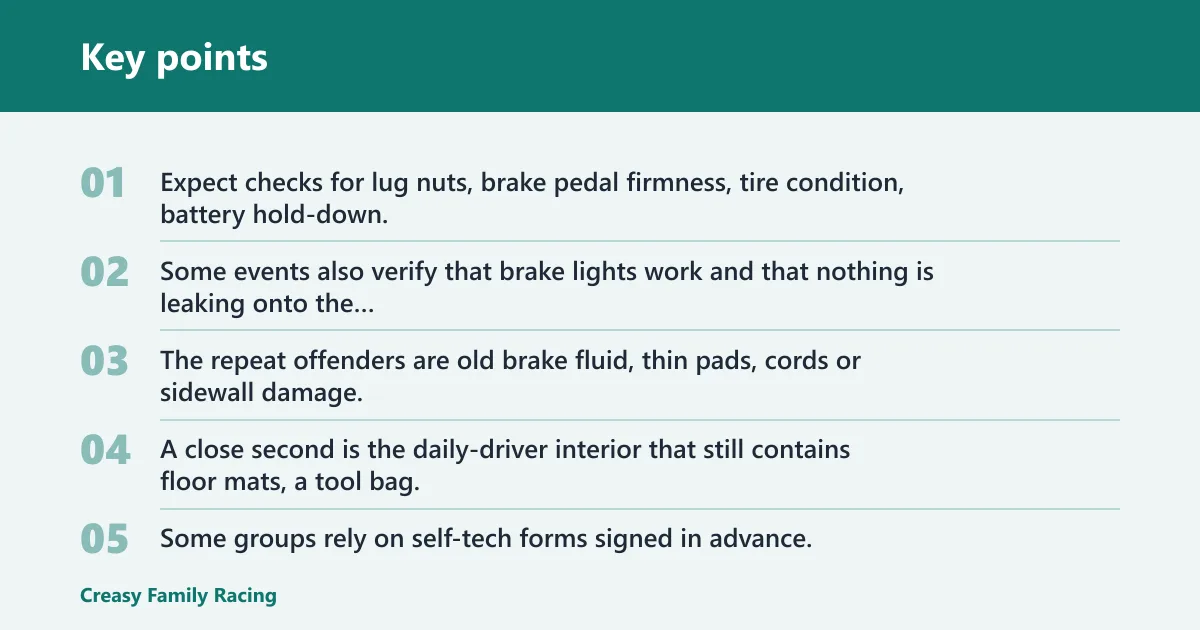
Expect checks for lug nuts, brake pedal firmness, tire condition, battery hold-down, seat security, helmet label, and loose-item removal. Some events also verify that brake lights work and that nothing is leaking onto the ground in the paddock.
Common fail points that stop beginners
The repeat offenders are old brake fluid, thin pads, cords or sidewall damage, active leaks, and helmets that do not meet the rule set. A close second is the daily-driver interior that still contains floor mats, a tool bag, a laptop, or a trunk full of household cargo.
Self-tech versus on-site inspection
Some groups rely on self-tech forms signed in advance. Others perform inspection at the track. Self-tech does not lower the standard. It only moves responsibility earlier, which is better for a first-timer because problems are easier to fix in a driveway than in a crowded paddock.
What happens during the day?
Most beginner days follow the same order: arrive early, unload loose items, check in, pass tech, attend the drivers meeting or classroom, then run short sessions with checks between them. Typical on-track sessions are 15-30 minutes long, and many beginner programs build instruction into each block rather than chasing maximum lap count.
Arrival, unloading, registration, and tech
- Park and unload the cabin and trunk first.
- Check tire pressures cold and look once more for leaks.
- Register, sign any remaining paperwork, and get wristbands or car numbers.
- Go through tech before the line gets long.
- Attend the novice meeting with a notebook if the organizer offers classroom time.
Some events offer evening lapping sessions from 5pm to sunset. Those can be useful later, but a true first event is still best done in the structured beginner format.
Drivers meeting and classroom basics
The drivers meeting covers session groups, pit entry and exit, passing rules, flags, conduct, and what to do if something goes wrong on track. The classroom usually slows the process further for novices so they know the sequence before they ever leave pit lane.
A common first-timer mistake is treating the meeting as filler and arriving late with the helmet still in the trunk. That is where the organizer explains the exact passing zones, the blend line, and whether novices will start with lead-follow laps.
First novice session: pit-out, warm-up, and spacing
The first session is about being tidy. Leave room. Bring the car and brakes up to temperature gradually. Watch every station. If the organizer allows point-bys only in certain areas, follow that exactly even if a faster car fills the mirrors somewhere else.
Many tracks build the day around repeatable cycles of classroom, session, cooldown, and debrief. That rhythm helps because it gives the car time to cool and gives the driver time to process what just happened.
How much seat time beginners usually get
Schedules vary by organizer and track, so exact totals should not be promised. Still, a beginner in HPDE usually gets several sessions in one day rather than one long stint. That is a good thing. Early learning works better in repeat exposures than in one extended, overheated run.
What do flags and passing rules mean?
Beginners need to know flags before the first lap because flags control speed, passing, and where to stop if the session changes suddenly. Track flags commonly include green, yellow, red, black, blue with yellow stripe, white, and checkered. Corner workers use them to communicate hazards long before a driver reaches the problem.
Flag meanings beginners must know
Green means the course is live. A yellow flag means caution, slow down, and no passing. A red flag means an emergency stop off the driving line near a flag station. Black usually means a specific car must come in. White commonly signals a slow vehicle or service vehicle on course. Checkered ends the session.
Blue with yellow stripe means a faster car is approaching and you should give a point-by. In a novice group, that point-by still happens only where the organizer says passing is allowed.
How corner workers control the session
Corner workers are the track’s communication system. If a station shows yellow, the driver should already be lifting and scanning for the issue ahead. If a session goes red, stop smoothly and predictably off line where instructed, not in the middle of a blind turn or at the apex.
Passing zones, point-bys, and line discipline
Novice passing rules are simple on purpose. Passing is limited to designated zones. The slower car gives the point-by. No passing happens in caution zones. The driver being passed should stay on line and be predictable, because sudden moves create more risk than a slower pace.
What should you check after each session?
After each session, cool the car down, park without setting the parking brake if the brakes are hot, and inspect the same systems that change most under heat: tire pressures, visible tire wear, brake feel, fluid signs, and leaks. This is where small problems show up before they become end-of-day failures.
Run a cooling lap before you stop
If the organizer allows it, use the end of the session to cool the car with a steady lap rather than diving straight into the paddock at full heat. That helps brakes, tires, and under-hood temperatures settle before the car stops moving.
Hot tire pressures and visible tire wear
Pressures rise after a session, sometimes more than a beginner expects, which is why “set them once and forget them” is poor track-day practice. Recheck pressures hot, then inspect the shoulders and sidewalls for rollover marks, chunking, or fresh damage.
Brake smell, pedal change, leaks, and rotor condition
A strong brake smell alone does not always mean failure, but a longer pedal, smoke from one corner, fluid level drop, or fresh wetness near a caliper deserves immediate attention. Also look at rotors again. Heat can reveal cracks and discoloration that were not obvious in the morning.
Why the parking brake stays off when hot
When brakes are very hot, leaving the parking brake off after parking helps avoid trapping heat at one part of the rear rotor or drum. Use wheel chocks if needed and the paddock surface allows it. Then let the car cool before packing up.
Frequently asked questions
What should I do before my first track day with a street car?
Register for a beginner HPDE, read the event rules, inspect brakes, tires, fluids, wheel hardware, battery hold-down, and helmet approval, then remove all loose items before leaving home. The best first-day prep is a clean pass at tech and a simple between-session inspection routine already planned.
Do I need a special car or can I bring a stock car to a track day?
A special car is usually not required for beginner HPDE. A stock car is commonly accepted if it is mechanically sound and meets the organizer’s rules. For a first event, condition beats modifications. Healthy brakes, good tires, no leaks, and secure safety equipment matter more than power or aftermarket parts.
What does a novice group do at a track day?
A novice group usually combines classroom instruction with tightly managed on-track sessions. The organizer may use lead-follow laps, instructor ride-alongs, strict passing zones, and mandatory point-bys. The goal is to build awareness and consistency first, then consider solo sign-off later if the driver is ready.
How does a track day drivers meeting work?
The drivers meeting explains run groups, pit procedures, passing zones, point-bys, flags, conduct rules, and what to do under yellow or red. Beginners should treat it as part of the event, not downtime, because track-specific details there often decide whether the first session feels calm or chaotic.
Can I run my first track day without a race seat or harness?
Usually yes. Most novice HPDE events commonly accept factory three-point belts and stock seats if they are in good condition and approved by the organizer. A race seat or harness is not a default first-day requirement, and safety gear changes should match the event rules and the rest of the restraint system.
What should I check after each session at a track day?
Check hot tire pressures, visible tire wear, brake pedal feel, brake fluid signs, rotor condition, and any new leaks or smells. Give the car a cooling lap if allowed, then park with the parking brake off if the brakes are hot. Repeating that routine each session catches most preventable problems early.