How Long Is a Drag Strip and Where Is the Finish Line?
A drag strip’s timed distance is usually 1/4 mile, or 1,320 feet, though many tracks run 1,000-foot or 1/8-mile races. The finish line is the beam at the end of that timed section, not the end of the shutdown area. That distinction matters because the car can still be traveling very fast after the timer stops. Official drag-racing rulebooks and track timing docs describe the race as a measured run from the start beams to the finish beams, with the shutdown area handled separately by the facility.
How is a drag strip laid out?
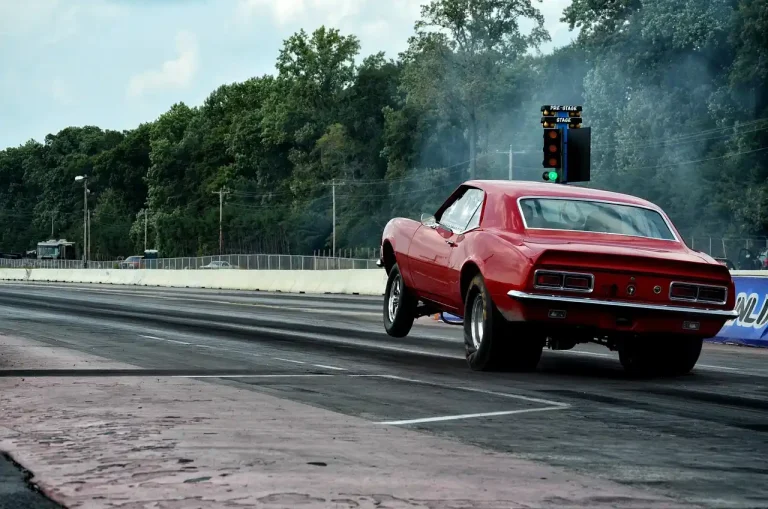
A drag strip has three basic zones: staging at the starting line, the timed racing distance, and the shutdown area after the finish line. The finish line is part of the timing system, not the end of the pavement. NHRA and IHRA track and timing documents describe the run as beginning at the start beams and ending at the finish beams.
That separation helps explain why the visible end of the strip can be misleading. The racing surface may continue beyond the finish beam, and the space available for slowing down depends on the venue’s design, the class being run, and the sanctioning body’s safety requirements.
For related basics, see staging basics for first-time drag racers, ET vs trap speed explained, and drag racing safety and return-road procedure.
| Distance type | Total timed feet | Finish beam, speed-trap area, or shutdown start | Typical shutdown considerations | What a beginner should watch for on the return road |
|---|---|---|---|---|
| 1/8 mile | 660 ft, about 201 m | Finish beam at 660 ft; speed-trap timing is taken at the finish, and shutdown begins after the beam | Usually shorter than a 1/4-mile shutdown; braking begins after the beam, with track-specific length and surface grip | Watch for the first turnoff, lane merge instructions, and any cross-traffic or service vehicles |
| 1/4 mile | 1,320 ft, about 402 m | Finish beam at 1,320 ft; speed-trap timing is taken at the finish, and shutdown begins after the beam | Often needs more deceleration space than a shorter race; the track surface and runoff length vary by facility | Watch for the exit lane, return-road markings, and instructions from track workers before turning around |
| 1,000-foot racing | 1,000 ft, about 305 m | Finish beam at 1,000 ft; speed-trap timing is taken at the finish, and shutdown begins after the beam | Common in some faster classes; shutdown needs can be substantial because vehicles may reach high speed before the beam | Watch for a longer braking zone expectation, the correct exit point, and any class-specific return-road instructions |
Many people say “the track is a quarter mile,” but that phrase can hide the more important detail: the timed distance is only the race section between the start beam and the finish beam. The property itself may be longer because it also includes shutdown pavement, access roads, staging lanes, and spectator areas.
How long is a drag strip?
Many drag strips run 1/4-mile timed passes, which equals 1,320 feet, or about 402 meters. Others run 1/8-mile passes, which equals 660 feet, or about 201 meters. Some categories use 1,000 feet, or about 305 meters. The total facility may be much longer than any of those distances because the shutdown area and return road are separate from the race distance.
That is why two venues can feel very different even when both are called drag strips. One may have a short, compact layout with a brief shutdown. Another may spread the same race distance across a larger property, with more room before the exit road and scoreboard area.
Track length can also vary by race class. A facility may offer 1/4-mile passes for one event and shorter timed runs for another, even on the same strip. The distance on the scoreboard is the official one; the paved space beyond it is there for safety and traffic flow, not for elapsed time.
How long is a 1/4-mile drag strip?
That number describes the run from the starting beams to the finish beams. It does not include the shutdown area after the finish line.
How long is a 1/8-mile drag strip?
Many beginner-friendly and bracket formats use this distance because the run is shorter, the braking point arrives sooner, and the venue can fit the event into a smaller space.
How long is a 1,000-foot drag strip?
A 1,000-foot drag strip is 1,000 feet long in timed distance, which is about 305 meters. Some faster classes use this distance because it gives a shorter run than a full 1/4 mile while still allowing competitive elapsed-time and speed measurement.
Where is the finish line on a drag strip?
The finish line is typically the official timing point, where electronic beams are used to measure elapsed time and speed. The painted end of pavement is not the same thing as the finish line.
The beam location is what matters to the timing system. Scoreboards, timing equipment, and lane sensors use that beam to stop elapsed time and record trap speed. Track timing systems and rulebooks treat the finish beam as the end of the timed run, even if the shutdown pavement continues past it.
A common first-timer mistake is assuming the finish line is wherever the visible pavement ends. On many tracks, the racing surface continues beyond the beam, and the shutdown area begins after that point. If a driver lifts early because the pavement seems to end, the run will still be short on speed and time.
How do the beams set elapsed time?
The starting beams begin the clock when the car leaves the staged position, and the finish beams stop it at the end of the timed section. That separation is why staging and finishing are different parts of the track. The system is counting time between those two electronic points, not between the start line and a painted stripe.
Why can the painted end be misleading?
Paint, cones, and lane markings help drivers orient themselves, but they can be misleading if you treat them as the finish. The visual edge of the lane may sit before or after nearby markings, and the exact beam location is the official line. Beginners should learn the track’s signs and scoreboard placement before making a pass.
What happens at the starting line and during the timed run?
Staging is the process of positioning the car at the starting line so it is ready for the launch. The staging beams are separate from the finish line and sit at the start of the timed run. Once the car launches, the clock is running from that starting point to the finish beams.
The start and finish are separate for a reason. A drag race is measured from one fixed electronic point to another fixed electronic point, and the shutdown area starts only after the finish beam. That separation helps keep timing consistent across classes and tracks. See also what happens in the burnout box and how bracket racing works.
- Roll into the staging beams and stop in the staged position.
- Wait for the launch signal and leave cleanly.
- Hold your lane and watch the finish markers, not the pavement edge.
- Stay in the throttle until the finish line unless the event rules or track staff say otherwise.
- Lift only after the finish beam, then brake in the shutdown area.
Say your first run is on a 1/8-mile track and you expect the finish to feel far away. The beam comes sooner than a 1/4-mile pass, so the car reaches the braking zone earlier too. That shorter run changes the rhythm of the pass, but the timing principle stays the same.
Why do some drag strips use 1/8 mile, 1/4 mile, or 1,000 feet?
Tracks use 1/8-mile, 1/4-mile, or 1,000-foot distances for practical reasons. Shorter tracks can fit into smaller facilities, suit certain sanctioning rules, and make it easier for newer drivers to learn launch, gear changes, and braking. Longer tracks are common when the venue has the space and the classes call for the full distance.
A 1/8-mile run also changes what beginners notice from the seat. The finish arrives sooner, the scoreboard updates faster, and the shutdown decision comes earlier. A 1/4-mile run gives more time to build speed, but it also asks for more attention to lane position and the braking point after the line.
Suppose a track runs 1/8-mile bracket racing on a busy weekend. The shorter distance can make scheduling easier and reduce the amount of shutdown pavement needed. On another weekend, the same facility may use a longer format if the event rules call for it and the setup allows it.
How far is the shutdown area?
The shutdown area is not a fixed distance. It can be short at one facility and much longer at another, depending on track design, speed potential, class requirements, runoff room, and sanctioning-body rules. A safer way to think about it is that shutdown length must fit the event, not the other way around.
In practical terms, a lower-speed local program may use a shorter deceleration zone, while a higher-speed class may need more room after the finish beam. The exact length is set by the facility layout and the rules governing that event, so drivers should never assume one track’s shutdown area is the same as another’s.
The best rule for beginners is simple: treat the finish beam as the point where the timed run ends, then expect the shutdown area to begin immediately after it. If the venue gives a driver briefing, follow that briefing exactly because it reflects the local pavement, exit road, and lane configuration.
What affects shutdown length?
Shutdown length varies with vehicle speed potential, lane width, track surface, available runoff, and the event’s safety requirements. Some facilities also adjust procedures for different classes or weather conditions. That is why track officials brief drivers before passes instead of relying on a universal shutdown number.
What should a beginner do in the shutdown area?
Keep the car straight, lift smoothly after the finish beam, brake in a controlled way, and follow the track’s turnoff instructions. Do not change lanes abruptly or assume the return road is clear. The shutdown area is still part of driving, even though the elapsed time is already over.
What happens after the finish line?
After the finish line, the car enters the shutdown area, where the driver lifts, brakes, and slows to a safe speed before turning off the racing surface. The length of that area is track-specific. Surface grip, straightaway width, and the layout of the return road all affect how it feels from the cockpit.
This is the most safety-relevant part for beginners. The finish line ends the timed run, but it does not end the driving task. You still need to keep the car straight, decelerate in a controlled way, and follow the track’s exit instructions.
The shutdown area is not fixed across all strips. One venue may have a long, open deceleration zone. Another may have a shorter, tighter one with the return road closer to the racing surface. That is why event officials brief drivers on local procedures before passes begin.
How does the return road work?
Once the car is clear of the racing lane, the return road becomes the next concern. Watch for the designated exit point, merge markings, and any track workers directing traffic. Do not cut across lanes or assume the route is obvious in low light, because visibility can change near the scoreboard and the turnoff.
For more on the exit flow, see drag racing safety and return-road procedure.
How do you spot finish markers from the lane?
Finish markers are easier to read if you study them before the run. Left and right lanes may have different sightlines, lane prep, and surface markings, so the finish can appear slightly different from each side. The lane itself, not just the center of the track, affects what you see at speed.
Beginners should look for the scoreboard, lane markers, and any overhead or side-mounted timing hardware before staging. Track width and lighting can change how visible those markers are from the cockpit, especially if one lane is darker or has different painted reference points.
Left lane and right lane can also feel different under the tires. Prep and traction may vary a little from side to side, and that can change how quickly the car settles as it approaches the finish. Knowing which lane you are in helps you find the markers sooner and keep the run straight.
How can you tell where the timing beams are at the strip? Start by asking the track crew before your run, then use the lane markers, scoreboards, and staging instructions they give you. If the venue uses different distances for different classes, the staff will point out the correct finish location and the proper shutdown route.
Frequently asked questions
How long is a drag strip in feet and meters?
Some classes use 1,000 feet, which equals about 305 meters. The total facility is longer than the race distance because it also includes shutdown pavement, access roads, and staging areas.
Where exactly is the finish line on a drag strip?
The finish line is the electronic timing point at the end of the official timed distance. It is where the beams stop elapsed time and record speed. It is not the same as the painted end of the racing surface, and it may sit before the physical end of the pavement.
Is the finish line at the end of the track or before it?
It is at the end of the timed section, but not necessarily at the end of the pavement. The racing surface usually continues into the shutdown area after the finish beams. That is why drivers keep accelerating to the line, then slow down only after they cross it.
Why do some drag strips seem longer than others?
They may have the same timed distance but different shutdown space, return-road layouts, and facility footprints. A 1/8-mile strip can feel compact, while a 1/4-mile venue with a long shutdown zone can feel much larger. The visible property is not the same as the timed run.
How do 1/8-mile and 1/4-mile drag strips differ?
A 1/8-mile run is 660 feet and ends sooner, so it usually feels quicker and gives less time before braking. A 1/4-mile run is 1,320 feet and keeps the car on the strip longer. Both are timed from the starting beams to the finish beams.
What happens after the finish line at the drag strip?
The car enters the shutdown area, where the driver lifts, brakes, and slows before turning onto the return road. That area varies by track and class, so there is no single shutdown length to memorize. Learn the local exit plan before making a pass.