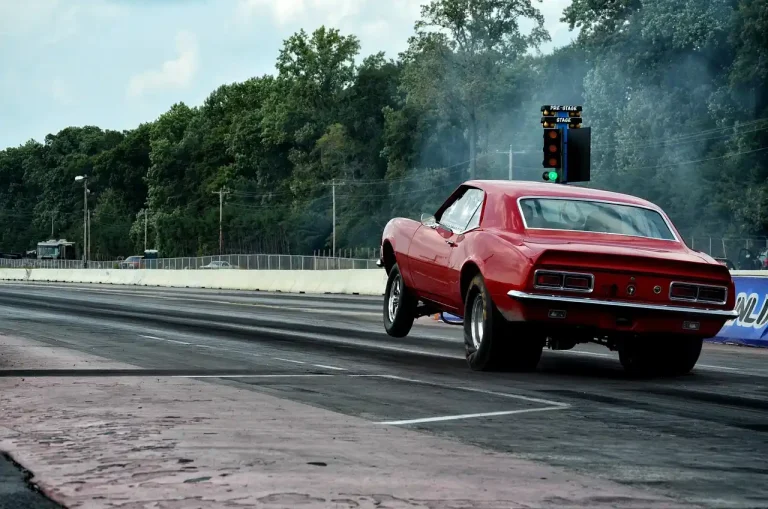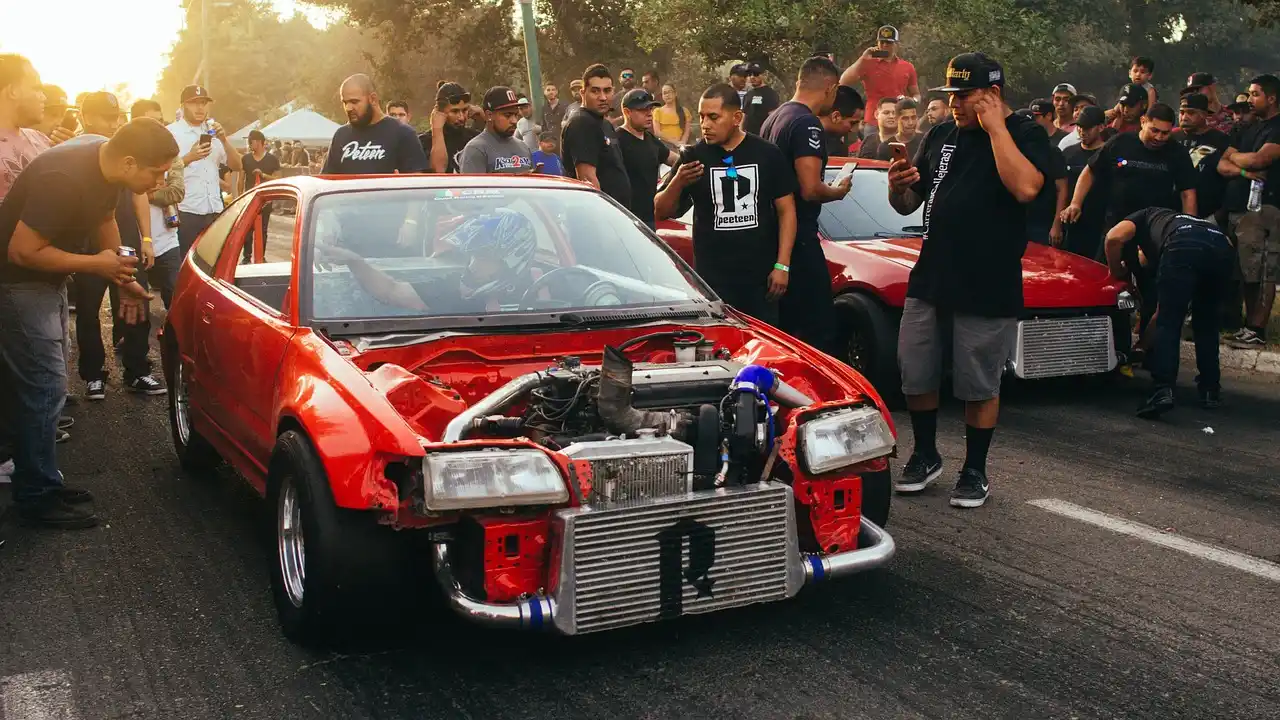
Why Is My Reaction Time Inconsistent at the Drag Strip?
Your reaction time is usually inconsistent because one of three variables changes: your launch routine, your staging depth, or the beam and track conditions; fix the variable, not the number on the slip. Ignore that split, and you end up chasing a false driver error, missing rounds, and wasting passes. This guide breaks inconsistency into a simple fault-tree so you can isolate driver timing, staging geometry, and beam or track issues. Written from bracket-race and test-and-tune observation patterns, the diagnosis framework here was built by comparing repeated slips, staging depth changes, and lane-by-lane beam behavior instead of treating one bad RT as a complete verdict.
Why reaction times swing
Reaction time versus elapsed time
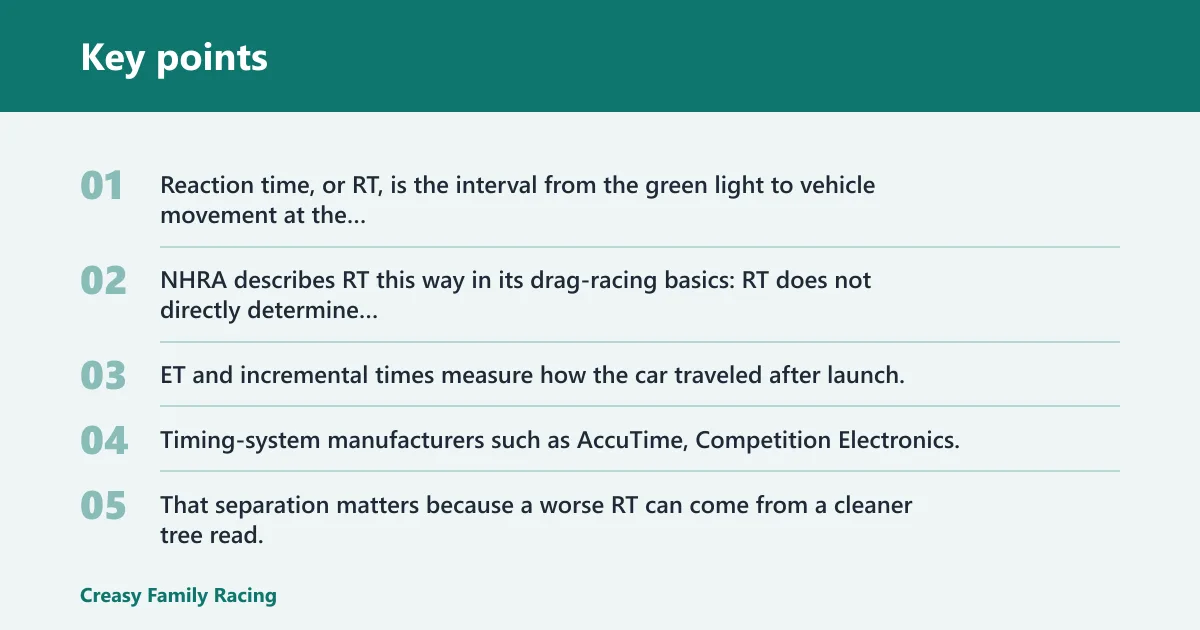
Reaction time, or RT, is the interval from the green light to vehicle movement at the start line. NHRA describes RT this way in its drag-racing basics: RT does not directly determine elapsed time. ET and incremental times measure how the car traveled after launch, while RT tells you how fast the car left when the light changed. Timing-system manufacturers such as AccuTime, Competition Electronics, and Bracketmaster describe the same basic separation between start-line response and downtrack performance in their tree and timer documentation.
That separation matters because a worse RT can come from a cleaner tree read, deeper staging, a different rollout, or a beam that triggers differently from pass to pass. A good time slip should be read as a pattern sheet, not a moral scorecard. For a deeper breakdown of what each number means, see reading a time slip.
What a time slip can and cannot tell you
A time slip can show whether RT drifted while 60-foot, ET, and incremental times stayed steady. That points away from chassis speed and toward launch timing, staging, or beam behavior. If RT and 60-foot move together, the launch itself needs attention.
Suppose the RT varies by about .04 while the 60-foot number stays within about .01 and ET stays steady. That usually points to driver timing or beam behavior, not power delivery. If the 60-foot also swings, the launch release, clutch, converter, or traction is part of the problem.
How the Christmas tree changes the launch
The Christmas tree matters because the amber sequence sets the timing window you are reacting to. NHRA’s Sportsman tree and Pro tree rules show different amber sequencing and delay characteristics, and timing-system manufacturers document the same distinction in their race controllers. Sportsman trees and pro trees use different amber timing, so the same driver cue can produce very different RTs when the tree type changes. A release that works on one tree can be late on another.
Sportsman tree and pro tree timing
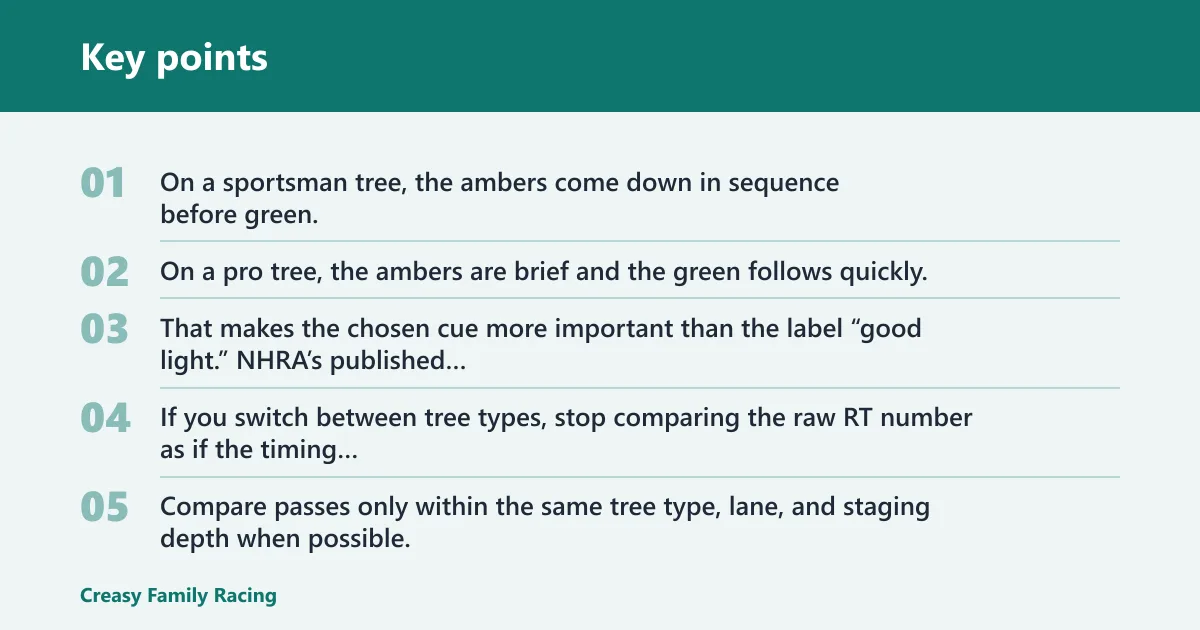
On a sportsman tree, the ambers come down in sequence before green. On a pro tree, the ambers are brief and the green follows quickly, so the launch cue is tighter. That makes the chosen cue more important than the label “good light.” NHRA’s published tree formats and manufacturer setup guides both emphasize that a driver must match the cue to the tree type, not to a generic mental timer.
If you switch between tree types, stop comparing the raw RT number as if the timing window were identical. Compare passes only within the same tree type, lane, and staging depth when possible. Use the same comparison standard described in Sportsman vs Pro tree.
Should I watch the last amber or leave on instinct?
On a Sportsman tree, most bracket drivers do better by keying off the last amber with a repeatable visual cue; on a Pro tree, experienced drivers often use a trained instinct that is still anchored to a specific amber or flash point, because the window is much tighter. Beginners should not chase green on either tree. Intermediate drivers should build consistency on Sportsman first, then transition to Pro with a fixed cue. Advanced drivers can leave on instinct, but only if the instinct is repeatable pass after pass and verified by the slip. The practical recommendation is simple: watch the last amber on Sportsman, use a pre-trained cue on Pro, and do not “free-react” to green unless your setup and reaction window are already proven.
Last amber versus green release timing
Watching the last amber or leaving on a repeatable visual cue often produces better consistency than waiting for the green itself. The key is repeatability. A visual cue that is too late on one tree and too early on another will look like inconsistency even when the driver’s hand or foot timing is steady.
A common first-timer mistake is trying to “chase green” on every pass. That usually adds variation because the driver reacts after the light appears, instead of timing a known cue within the tree’s sequence.
Does deep staging change reaction time?
Deep staging changes the car’s starting line position, reduces rollout, and can affect RT even when the driver’s release timing does not change. It may help one pass and hurt the next if the driver does not keep the depth and cue identical. It also changes the ET tradeoff because the car starts closer to the beam break point. For setup detail, see deep staging and rollout.
How deep staging changes rollout
Rollout is the distance the tire travels before the stage beam breaks and the car is considered “started” by the system. Deep staging shortens that distance. Less rollout usually means the car responds sooner to the same release timing, which can improve RT but can also change ET slightly. Timing-system makers explain this in their beam geometry notes: move the car deeper in the beams, and the effective launch point moves with it.
The effect is mechanical, not mystical. If the front tire is staged deeper into the beam, the car needs less forward motion before the sensor sees movement. That is why a driver can see a better RT from deep staging even with the same hand or foot timing.
Why starting line position can move the number
Two passes can have the same release timing and different RTs if one is staged deeper. The starting point moved. The beam did not. That difference is often mistaken for a random driver problem when it is really a geometry change.
Keep staging depth consistent before you judge the RT trend. If the number changes when the car is staged a few inches deeper or shallower, that is a setup clue, not proof of a bad launch. If you are trying to stabilize the number, compare the same pass conditions with deep staging and rollout held constant.
Rollout and beam break
Rollout changes RT because the tire must travel far enough to clear the beam before the timer sees movement. Tire diameter, loaded radius, tire pressure, and the exact staging point all affect that distance. Rollout is one of the most overlooked reasons a driver feels “off” when the release timing did not change. NHRA guidance and timing-system manuals both treat rollout as a setup variable, not a driver opinion.
Tire diameter and loaded radius
A taller tire does not change RT simply because it is taller. What matters is how far the tire must roll from the staged position before it breaks the beam, which depends on the loaded radius and where the car sits in the beam. Smaller changes in tire pressure and car load can shift that effective position too.
That is why a tire swap can change the number even if the driver’s hands, feet, and tree reading stay the same. The car may need more or less travel to trip the beam.
Staging depth and repeatability
Repeatable staging depth is the easiest way to control rollout. If the car creeps a little farther forward on one pass, the effective starting point changes. That can make RT look inconsistent even when the driver is trying to repeat the same release.
Keep the pre-stage and stage lights, final stop point, and release cue as repeatable as possible. Small changes at the line can move RT enough to matter in a tight bracket race. If the car is set up differently from pass to pass, use lane/track prep diagnostics to separate surface change from staging change.
Starting line beams and staging errors
Starting line beams can create false inconsistency when the pre-stage and stage sensors are not aligned, are too sensitive, or are triggered by creep. If the car is close to the edge of beam sensitivity, small movement, tire growth, or slight steering input can change the reading. Timing-system manufacturers note that sensor placement, reflectivity, and beam height can alter where the system thinks the launch begins.
Pre-stage and stage beam alignment
The pre-stage beam tells you the car is close. The stage beam marks the launch reference. If the car is angled, rolling, or not centered the same way on every pass, the sensors may see a different starting point. That changes the measured RT without changing the driver’s release time.
Beam alignment issues are easy to miss because the slip still prints a number. The number can be real and still not mean what the driver thinks it means.
Beam sensitivity, creep, and false inconsistency
Some lanes and tracks set beam sensitivity differently, and that can change how much movement it takes to break the beam. A car that creeps a fraction of an inch before the driver commits can show a different RT than the same car held perfectly still. That looks like inconsistency because it is inconsistency at the beam.
Track staff and timing-system setup control some of this, but the driver can reduce the effect by staging the same way every pass. If the car is moving before the release cue, you have already changed the measurement.
Manual or automatic?
A manual transmission can sometimes produce more variable RTs than an automatic because the driver must coordinate clutch release, engine speed, and throttle movement at the same instant. An automatic still needs timing discipline, but a torque converter usually removes one major variable from the launch.
Clutch, converter, and release timing
In a manual car, clutch release speed is part of the launch timing. If the pedal comes up faster on one pass and slower on the next, RT and 60-foot can both move. In an automatic, the converter and brake release are usually the bigger launch variables, so the driver often has one less timing input to manage. For a deeper setup comparison, see clutch vs converter launch.
That does not make automatics effortless. It just means the repeatability demands are different.
Launch rpm and repeatability
Launch rpm matters because engine speed at release changes how the car leaves the line. In a manual car, a few hundred rpm can change clutch behavior and wheel speed at the hit. In an automatic, consistent brake release and throttle position matter more than chasing a perfect-number launch every time. See also launch rpm setup.
Keep the launch rpm, staging depth, and release cue as close together as the car will allow. If the launch rpm wanders, the RT trend may wander with it.
Reaction time checklist
Use this symptom-first checklist to separate driver timing, staging geometry, and track or beam conditions. Log the same items on the next pass so the pattern is visible. For drag-strip logging, note whether the car is manual or automatic, the tree type, stage depth, launch rpm, clutch release or brake release method, tire pressure, lane number, and any change in track prep or beam behavior before you judge the slip.
| symptom observed | probable cause | what to test next | what to log on the next pass |
|---|---|---|---|
| RT swings while 60-foot and ET stay close | Driver timing, staging depth, or beam sensitivity | Repeat the same staging depth and use one visual cue | Tree type, stage depth, cue used, RT |
| RT improves when the car is staged deeper | Rollout changed, not driver speed | Hold the deeper stage point for three passes | Deep or shallow stage, RT, 60-foot, ET |
| RT changes after a tire swap or pressure change | Loaded radius and rollout changed | Return to the same tire pressure and staging depth | Tire size, pressure, stage depth, RT |
| RT varies more in one lane than another | Lane surface, bite, or beam setup differs | Compare both lanes with the same staging routine | Lane number, lane surface feel, RT, 60-foot |
| RT is late only on tree changes | Tree timing or cue choice mismatch | Match the cue to the same tree type | Sportsman or pro tree, cue choice, RT |
| Manual car RT swings with the same tree | Clutch release or launch rpm changed | Repeat launch rpm and pedal release timing | Launch rpm, clutch release feel, RT, 60-foot |
| Automatic car RT swings without obvious driver change | Brake release, converter flash, or creep changed | Stabilize brake release and staging position | Brake release method, stage depth, RT, 60-foot |
What to read on the slip
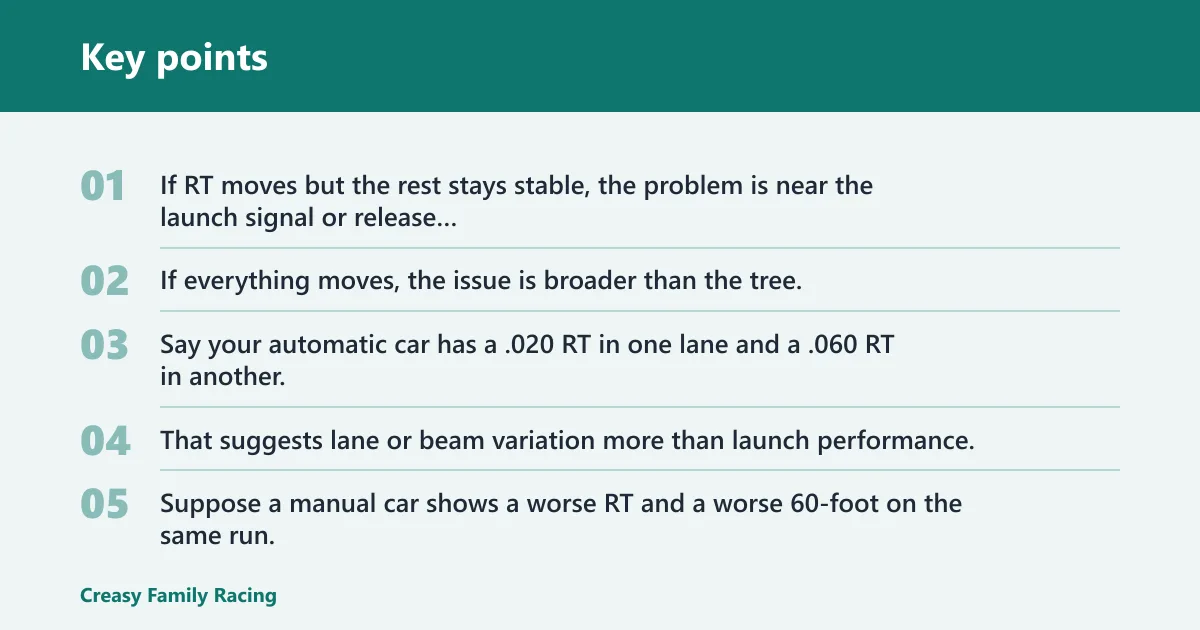
Use the slip in layers. First, compare RT alone across passes. Then compare 60-foot. Then compare ET and incremental times. If RT moves but the rest stays stable, the problem is near the launch signal or release timing. If everything moves, the issue is broader than the tree.
Say your automatic car has a .020 RT in one lane and a .060 RT in another, with the same 60-foot and ET. That suggests lane or beam variation more than launch performance. Suppose a manual car shows a worse RT and a worse 60-foot on the same run; clutch or launch rpm changed, and the slip is telling you so.
Driver focus and staging routine
Keep the pre-race routine short and identical. Same approach speed, same brake pressure, same final stop, same visual cue, same release. That sequence reduces the chance that pressure or distraction changes the launch timing.
Practice on the same tree and lane when possible because that removes some of the unknowns. If the result changes only when one of those variables changes, you have found the source instead of guessing.
Frequently asked questions
Why is my reaction time inconsistent at the drag strip?
Most inconsistent RTs come from a change in one of three places: the driver’s launch timing, the staging depth, or the beam or track setup. The slip is showing the result, not the cause. Compare RT against 60-foot, ET, tree type, lane, and staging depth before calling it a driver mistake.
Is my inconsistency caused by the tree, my launch, or the car?
Start with the pattern on the slip. If RT moves but 60-foot and ET stay steady, look at tree timing, staging depth, or beam sensitivity. If RT and 60-foot move together, look at launch rpm, clutch or brake release, converter behavior, or traction. If lane-to-lane changes are obvious, the track is part of the diagnosis.
Does deep staging make reaction time more inconsistent?
It can, if the depth is not repeated exactly. Deep staging reduces rollout, which changes how soon the beam breaks and can move RT. If the driver cannot hold the same stage point every pass, the car may look inconsistent even though the release timing is steady.
Can a manual transmission cause more variable reaction times than an automatic?
Yes. A manual car usually asks the driver to coordinate clutch release, throttle, and timing at once, so small differences can show up as RT swings. An automatic removes clutch timing from the launch, but the driver still has to control brake release, staging, and launch consistency.
How much does rollout change reaction time?
Enough to matter. Rollout is the distance the tire travels before the stage beam breaks, and it changes with tire diameter, loaded radius, tire pressure, and staging depth. A small shift in any of those can change the measured RT even when the driver’s release feels the same.
How do I diagnose a reaction time problem from my time slip?
Look for the pattern, not the single number. If RT changes and 60-foot does not, focus on staging depth, tree timing, and beam behavior. If RT and 60-foot both change, look at launch rpm, clutch or converter behavior, and traction. Use several slips, not one pass.