How Do SCCA Autocross Classes Differ From Local Classes?
SCCA autocross classes are rule-based prep categories. Local club classes often compress, rename, or split them, so the same car can land in different buckets unless you match the local label to SCCA legality, prep, and tire rules. Miss that translation, and you can buy the wrong parts, run in the wrong group, or take a protest or penalty. This guide maps common local shorthand back to SCCA class rules and points out the mismatches that surprise drivers most.
| Quick question | Short answer | What to check first |
|---|---|---|
| Does a local “street” class equal SCCA Street? | Not always. It may be a true Street mirror, or it may allow parts that move the car to Street Touring or higher. | Tires, springs, dampers, wheels, intake, and exhaust against the event supplement and current Solo Rules. |
| Can one mod bump the car out of Street? | Yes. A single allowed change can push the car into Street Touring, Street Prepared, or a local open class depending on the rules. | The first mod that crosses the written threshold, not the overall build style. |
| What should you verify before registration? | Confirm class, helmet standard, driver-document requirements, and tech items before you pay. | The event supplement, local rulebook, and SCCA Solo Rules current edition. |
How national and local rules are organized
SCCA Solo uses a national rule set for autocross, while local clubs often build shorthand classes that are easier to score, easier to explain, or easier to fill. That means a local label may group cars by streetability, driver experience, or simple “street versus prepared” buckets instead of matching SCCA prep rules line for line.
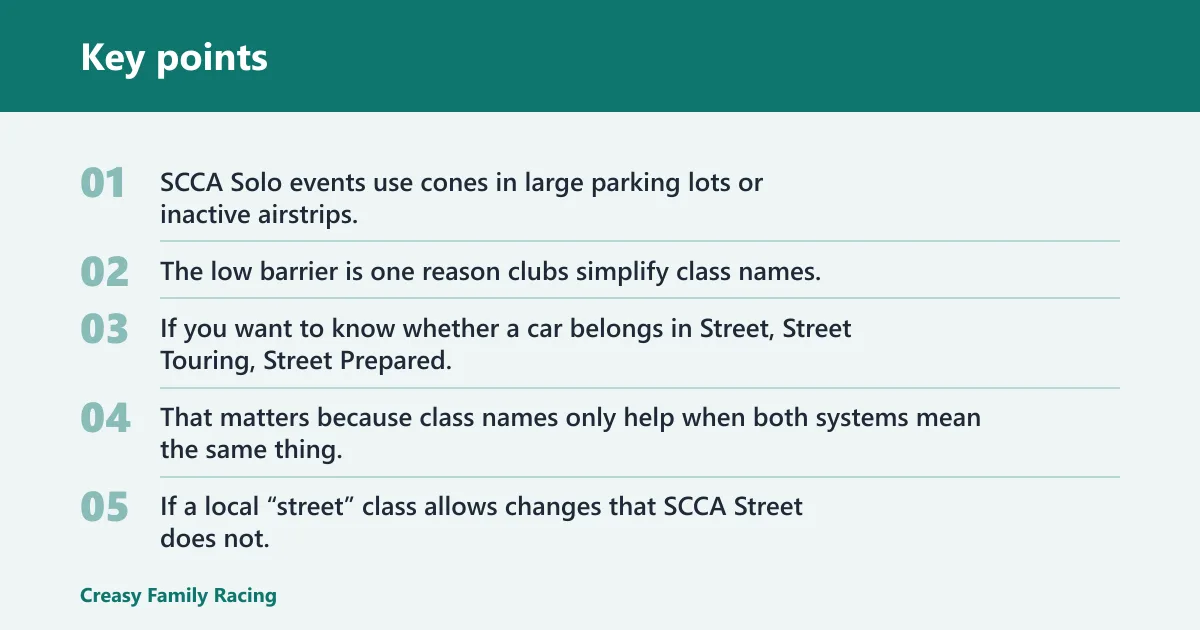
SCCA Solo events use cones in large parking lots or inactive airstrips, and event fees commonly vary by region, day format, and local support; organizer entry pages are the best source for current pricing rather than a fixed national range. The low barrier is one reason clubs simplify class names, but the class label still has to be translated against the written rules.
SCCA Solo is the reference point
SCCA Solo classing is rule-based. If you want to know whether a car belongs in Street, Street Touring, Street Prepared, or a more modified category, you have to compare the car’s parts against the written allowances in the current SCCA Solo Rules, not against a local label that sounds similar.
That matters because class names only help when both systems mean the same thing. If a local “street” class allows changes that SCCA Street does not, the label is shorthand, not a guarantee. Check the current rule book and the event supplement together.
Local classing is a shortcut system
Local autocross classing is often organizer-defined. A club may group cars by simple categories, by novice and experienced splits, by streetable versus highly modified builds, or by whatever keeps the grid moving on event day.
That is useful, but it creates translation work. You still have to ask: “What SCCA prep level does this local class actually mirror?” The answer usually lives in the organizer’s rulebook, supplemental regulations, or class chart, not the class name alone.
Where mixed-mod cars create surprises
Surprises usually show up when a car has a mixed list of parts. One local class may allow coilovers, a cat-back exhaust, and stickier tires together. Another may allow only one of those without moving the car into a different group. A car that looks mild by appearance can fail an SCCA Street check if the local rules are looser than SCCA’s.
Say your local event has a “street” class and a driver brings a car on upgraded tires and aftermarket springs. That may still be legal locally, but it is not safe to assume it stays in SCCA Street until the tire and suspension rules are checked against the current Solo Rules and the event supplement.
How to translate a local class label
Start with the organizer’s written rules, not the class name. Then match the allowed modifications to the nearest SCCA category and look for the first place the car crosses the threshold. The right question is not “What does the class sound like?” but “What parts are allowed before this car moves out of that SCCA bucket?”
Start with the organizer’s written rules
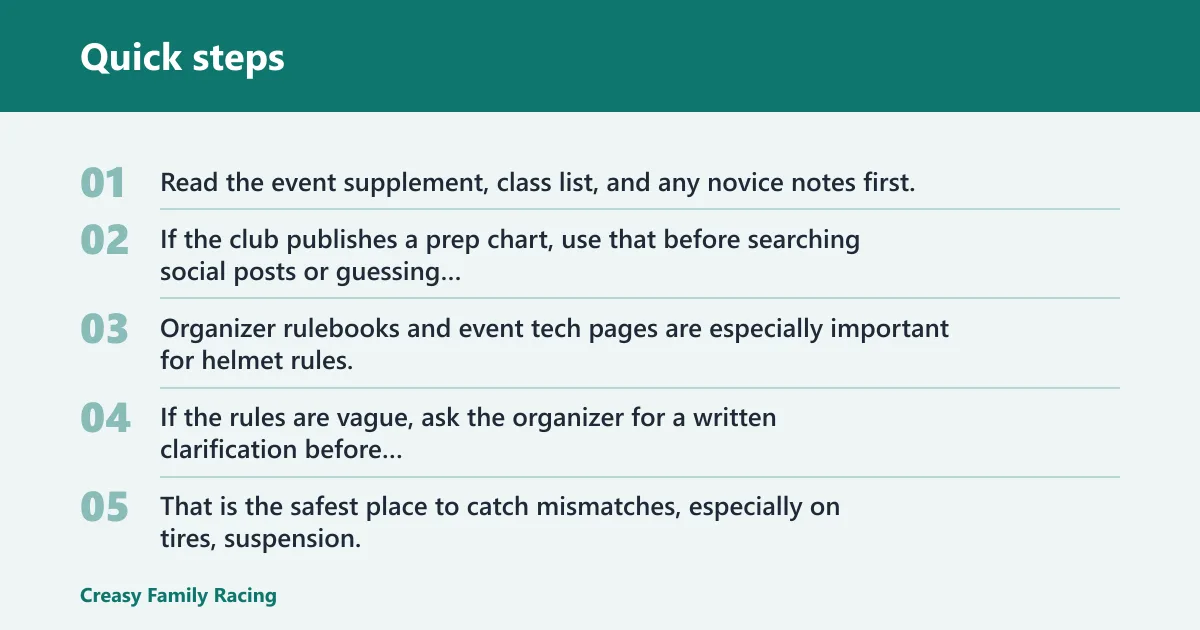
Read the event supplement, class list, and any novice notes first. If the club publishes a prep chart, use that before searching social posts or guessing from the class title. Organizer rulebooks and event tech pages are especially important for helmet rules, safety items, and driver documentation because clubs can add stricter local requirements on top of the national baseline.
If the rules are vague, ask the organizer for a written clarification before registration closes. That is the safest place to catch mismatches, especially on tires, suspension, and helmet approval.
Match allowed parts to an SCCA category
Use SCCA Street as the baseline for near-stock street cars, Street Touring as the next step up for more modifications, and Street Prepared for a more modified build. Street Mod is generally treated as a separate high-modification lane and is usually not grouped with Street Prepared. Verify the current Solo Rules before using any shorthand, because the exact allowances can shift by edition and by local supplement.
That separation matters. Local open classes often look like “anything goes,” but some are closer to Street Prepared, while others are closer to Street Mod or a true catch-all. A club’s own prep chart should be treated as the deciding document for the event, with SCCA rules as the comparison point.
Check where the car crosses the threshold
The key question is the first modification that the local class allows beyond the SCCA category you had in mind. Tires, springs, wheel width, damper type, alignment parts, and intake changes are common trip points. A single part can move a car out of Street and into a higher SCCA class, so the threshold matters more than the overall build vibe.
A common first-timer mistake is assuming “street tire” means “Street class.” It does not. Tire limits and suspension limits need their own check against the written rule set.
SCCA vs local classing by modification level
The real difference is not the label. It is the prep threshold under the label. SCCA categories are built around what the car is allowed to change, while many local systems collapse several prep levels into one club class. A plain “street” bucket locally may map cleanly to SCCA Street, or it may quietly allow parts that push the car higher.
| Local label pattern | Likely SCCA equivalent | What to verify first |
|---|---|---|
| Street, Stock, Daily Driver | Street | Check tire model and compound, wheel size, springs, dampers, and alignment limits; the first common mod that usually bumps the car out is a non-allowed suspension change or tire that exceeds the Street allowance. |
| Street Touring, Touring, Modified Street | Street Touring | Check intake, exhaust, suspension, wheel width, and tire allowances before assuming it fits Street; the first common mod that usually bumps the car out of Street is a Street Touring-allowed intake, tire, or suspension change. |
| Prepared Street, Prepped, Pro Street | Street Prepared | Check how far the club allows suspension, aero, engine, and wheel changes before the car moves beyond Street Prepared; the first common mod that usually bumps the car out of Street Touring is a Street Prepared-level wheel/tire or suspension allowance. |
| Open, Unlimited Street, Run-what-you-brung | Street Mod or local catch-all | Check whether the class is truly open or if it still bans some major chassis, engine, or tire changes; the first common mod that moves a car out of the earlier prep buckets is usually any change that the local chart expressly permits but SCCA would not. |
| Novice Street, Fun Street, Index Street | Varies by organizer | Check whether the label is a class, a novice grouping, or an index format layered on top of classing; the first common trigger is often not a mod at all, but the driver’s status or the event’s scoring format. |
Street and local street classes
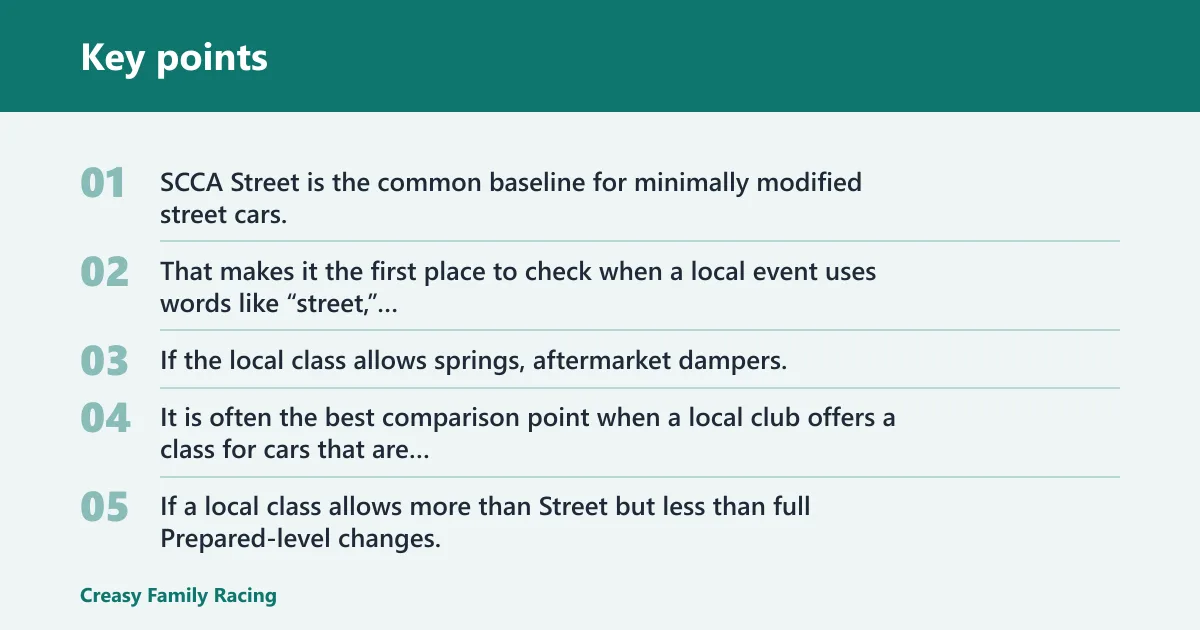
SCCA Street is the common baseline for minimally modified street cars. That makes it the first place to check when a local event uses words like “street,” “stock,” or “daily driver.”
Do not assume the name tells the whole story. If the local class allows springs, aftermarket dampers, or tire changes beyond SCCA Street allowances, the car may no longer fit SCCA Street even if the local label still says “street.”
Street Touring as a middle step
Street Touring sits above Street and allows more modifications than Street. It is often the best comparison point when a local club offers a class for cars that are clearly beyond stock but not close to a prepared build.
If a local class allows more than Street but less than full Prepared-level changes, Street Touring is often the closest SCCA lens. The exact parts still need a rules check, especially on tire size, wheel width, and suspension components.
Street Prepared and higher-prep local classes
Street Prepared allows more modification than Street Touring and is a separate category from Street Mod. That distinction matters because some local “prepared” or “pro” classes are actually closer to Street Prepared, while others go straight into open-mod territory.
When a club uses “prepared” in the class name, read the parts list. A local class can be more permissive than Street Prepared in one area and tighter in another, so verify the first part that pushes the car beyond the category you expected.
Open or catch-all local classes
Open local classes are often not SCCA classes at all. They may be designed to keep highly modified cars on track without forcing a fine-grained prep review.
That does not make them wrong. It means the class is a club tool, not a mirror of SCCA Street Mod or Street Prepared. If you need SCCA legality, the open label is only a starting point, and the organizer’s tech sheet is still the deciding document.
What changes before registration?
Registration should be the last check, not the first. Tires, suspension, brakes, battery security, helmet standard, and class decals can all affect whether the car is allowed to run and which grid spot it receives. Tech inspection checks safety items before runs, and a failure there can stop the day cold.
Tires, wheels, and suspension
Tires are the most common mismatch point because some local groups are looser than SCCA on compound or size. Wheels and suspension changes can move a car from Street to Street Touring, or from Street Touring to a prepared class, depending on the rule set.
If the car has coilovers, changed spring rates, camber plates, or wider wheels, verify those parts against the written class list before you assume the local name matches SCCA. Those parts are exactly where local shorthand and the current Solo Rules tend to diverge.
Brakes, battery, and safety gear
Tech inspection checks tires, suspension, helmet, and battery security. SCCA guidance also expects the battery to be secured properly, and organizer tech pages may add details such as terminal cover expectations or hold-down requirements. Review the event checklist before arrival so you do not discover a missing item at tech.
Brakes and seatbelts matter too. If the event staff sees a safety issue, the car may be held out even if the classing looks right on paper.
Helmet standard and class decals
SCCA helmet acceptance is based on the current Solo Rules and event tech guidance. Many events look for a current or accepted Snell-rated helmet or another standard named in the rule set; some local organizers also publish their own approved list, so the safest approach is to confirm helmet approval on the event tech page and in the current SCCA helmet standard guidance. A useful place to cross-check helmet terms is the site’s helmet guide: Snell M and SA helmets.
Class letters or decals must be displayed on the car for grid identification. At some events, drivers write them with shoe polish or painter’s tape. That is a practical grid aid, not a substitute for correct classing.
How scca autocross classes checklist
Use this checklist before registration. It is a translation tool, not a shortcut around the written rules. If any answer is unclear, ask the organizer to confirm the class in writing or at least in the event message thread.
| Local class label | Likely SCCA equivalent | Exact mod threshold to verify before registration |
|---|---|---|
| Street / Stock / Daily Driver | Street | Confirm whether tires, springs, shocks, intake, and wheel changes are all still within Street limits. |
| Street Touring / Touring / Modified Street | Street Touring | Check whether the club allows the same tire and suspension changes that SCCA Street Touring allows, and whether any engine or aero part pushes the car higher. |
| Prepared Street / Pro Street | Street Prepared | Verify whether the local class allows the same broader suspension, wheel, and body changes that define Street Prepared rather than Street Touring. |
| Open / Unlimited / Run-what-you-brung | Street Mod or local catch-all | Check whether the class is truly open or whether the club still limits major chassis, engine, or tire changes. |
| Novice / Fun / Index street label | Varies | Confirm whether this is a class, a grouped novice lane, or an index format layered on top of real classing. |
Choose SCCA classes if… / Choose local classes if…
Pick the SCCA lens when you want a precise prep check. Pick the local lens when the event is built around club categories, novice grouping, or a simpler scoring system. The same car can be legal in both, but the reason it fits may differ.
Choose SCCA classes if you want a prep-accurate answer
- The car’s parts list is close to stock and you want to know whether it belongs in Street.
- You are comparing tire, suspension, or wheel changes against a national rule set.
- You may run the car at several events and want one prep label that travels well.
Choose local classes if the organizer built the event around club labels
- The event supplement gives its own class chart and does not mirror SCCA line for line.
- The club uses novice, fun, or index groupings on top of its class list.
- The organizer says the local system is a simplified grouping, not an SCCA clone.
When to ask for a rules check
Ask the organizer before registration if the car has mixed mods, if the class name is vague, or if the event note says “similar to” instead of “same as” a known SCCA class. That is the point where a quick question saves a wrong entry.
Suppose a car has a cat-back exhaust, coilovers, and wider wheels, and the local event calls it “street.” That label may be fine for the club, but the car could belong in a different SCCA category once the prep rules are checked one by one.
How beginners should confirm class before arriving
Beginners do not need to memorize every SCCA rule before a first event, but they do need to confirm class before arrival. Read the event supplement, compare the car’s modifications to the local chart, and ask the organizer for help if the match is unclear. That is the cleanest way to avoid an on-site reclass or tech delay.
Read the event supplement first
Look for the class list, novice notes, tire rules, helmet rule, and any local exceptions. Some events include a short clarification on whether the class system mirrors SCCA or uses its own categories.
Compare the car’s mods to the local
Write down the car’s changes in plain language: tires, wheels, suspension, brakes, intake, exhaust, and safety gear. Then compare those parts to the event’s written class guide. The goal is to catch the first part that moves the car out of the expected bucket.
Ask for help before tech
Ask the organizer or class captain if the chart is unclear. If possible, send the mod list before event day. That gives staff time to answer classing questions before the car reaches grid or tech.
A current driver’s license is required for SCCA Solo events unless entering Karting classes, so bring the right documents as well as the right helmet. Verify the requirement in the current Solo Rules and the event’s registration or tech page, because local supplements may add their own identification or waiver requirements.
What to do if you are classed differently than expected
- Stop and ask which written rule is driving the decision.
- Compare the car’s first questionable mod against the event supplement and current Solo Rules.
- Ask whether the decision is based on a local exception, a safety concern, or a class-structure shortcut.
- If needed, move to the class the organizer specifies and keep the written explanation for future events.
Frequently asked questions
How do SCCA autocross classes differ from local classes?
SCCA autocross classes follow a national rule set, while local classes are defined by the club or region. A local “street” or “open” label may compress several SCCA prep levels into one bucket, so you have to translate the local name back to actual allowed modifications.
Why does my local autocross class not match SCCA?
Local clubs often simplify classing to make registration, scoring, and grid flow easier. They may group cars by simplicity, streetability, or driver experience instead of matching SCCA exactly. The label may look familiar, but the mod threshold can be different.
Can I run the same car in different classes at different events?
Yes. The same car can be classed differently if one event uses SCCA rules and another uses a local shortcut system. That is normal when the club’s prep chart does not mirror SCCA Street, Street Touring, Street Prepared, or Street Mod one-to-one.
What makes a car legal for an SCCA class but not a local class?
A local class may ban a part that SCCA allows, or it may split cars by experience instead of prep. The reverse can happen too: a local “street” class may allow changes that would bump the car out of SCCA Street. Always check the club’s written limits.
How do I find my class before showing up to an event?
Read the supplement, list every modification, and match those parts to the event’s class chart. If the class name is vague, ask the organizer before registration closes. That is the best time to confirm whether the local label really maps to SCCA Street, Street Touring, or something else.
Do beginners need to know SCCA class rules before their first event?
No, not in full detail. They do need to know enough to confirm the event class, helmet rule, and basic safety items before arriving. If the rules are unclear, ask for help early. That is better than guessing and discovering the mismatch at tech or on grid.
Sources
SCCA Solo Rules, current edition. SCCA Solo Safety and Technical Inspection guidance. SCCA and event organizer helmet policy pages. Event registration, tech inspection, and supplemental regulations pages from local organizers.