
Do Racing Harnesses Expire, and How Do You Check the Date?
Yes, racing harnesses can expire, and the cutoff depends on the tag: FIA 8853-2016 belts are governed by the homologation label’s validity wording and the event’s tech rules, while SFI 16.1 belts are generally controlled by SFI’s two-year recertification window. Miss it, and tech can reject the car before you run. This guide shows which standard applies, how to read the date tag, how to calculate the real cutoff, and when to retire a safety belt early.
How to read the belt’s date label
Yes. A racing safety belt can be out of date even if the webbing still looks clean and the buckles still latch. The inspection starts with the sewn-in label, then moves to physical condition, because legal validity and material condition are separate checks. The rule depends on the standard and the event.
Most official racing safety belts are available in 4-point, 5-point, and 6-point configurations. A 4-point safety belt is found in some road sportscars and classic/historic racing. A 6-point safety belt is described as the industry standard for motorsport use.
Which rule set controls your answer?
Start with the event rule book, then confirm the standard printed on the label. FIA 8853-2016 and SFI 16.1 are not read the same way, and a belt that passes one event may fail another. Track days, autocross, and race series may each use different date rules. For example, FIA’s technical list and homologation labeling govern standard-level validity, while a specific sanctioning body may still impose a tighter in-event cutoff or disallow a belt that is otherwise still within the standard’s label window.
That matters because the date tag is the first thing a scrutineer checks. The label is not a suggestion. It is the proof that the safety belt is still inside its allowed service window, and it is also the fastest way to spot a missing or altered belt. FIA 8853-2016 labels use the homologation/valid-until wording found on the product tag or technical list entry; SFI 16.1 labels use SFI’s recertification control and the date code on the harness label.
FIA vs SFI harness rules
FIA 8853-2016 and SFI 16.1 are two standards drivers commonly compare when asking about expiration. FIA products are governed by the label’s stated validity window and event rules, while SFI products are governed by SFI’s recertification window and the manufacturer/service-center path for renewal. Event rules can be stricter.
FIA 8853-2016 in club and international motorsport
FIA safety belt labels include a manufacture date and a “not valid after” year. FIA technical documentation and current series regulations may treat FIA 8853-2016 belts as valid only through the end of the year shown on the label, and some series also require the belt to remain in date on the day of competition rather than merely at purchase.
If the tag says “not valid after” a year, the practical cutoff is the end of that year, not the anniversary of purchase. In stricter series, the belt can still be rejected even if the standard’s year window has not closed, because the event rule book always controls the final call.
SFI 16.1 in oval and drag applications
SFI 16.1 is a U.S. racing safety belt standard commonly seen in oval and drag racing. SFI Foundation guidance uses a two-year recertification cycle for compliant restraints, and many tech forms expect the belt to be within that cycle at the time of inspection. No grace period should be assumed unless the sanctioning body publishes one.
The label must be readable, intact, and attached to the belt assembly. If the label is replaced, the replacement must still be the approved SFI or manufacturer service-center label for that exact standard; otherwise, tech can reject it.
Where is the date tag?
The date tag is sewn into the webbing or shoulder strap area. It is the primary inspection point for scrutineers because it shows the standard, the date information, and often the homologation details. If the tag is hidden, cut, painted over, or unreadable, that is already a problem.
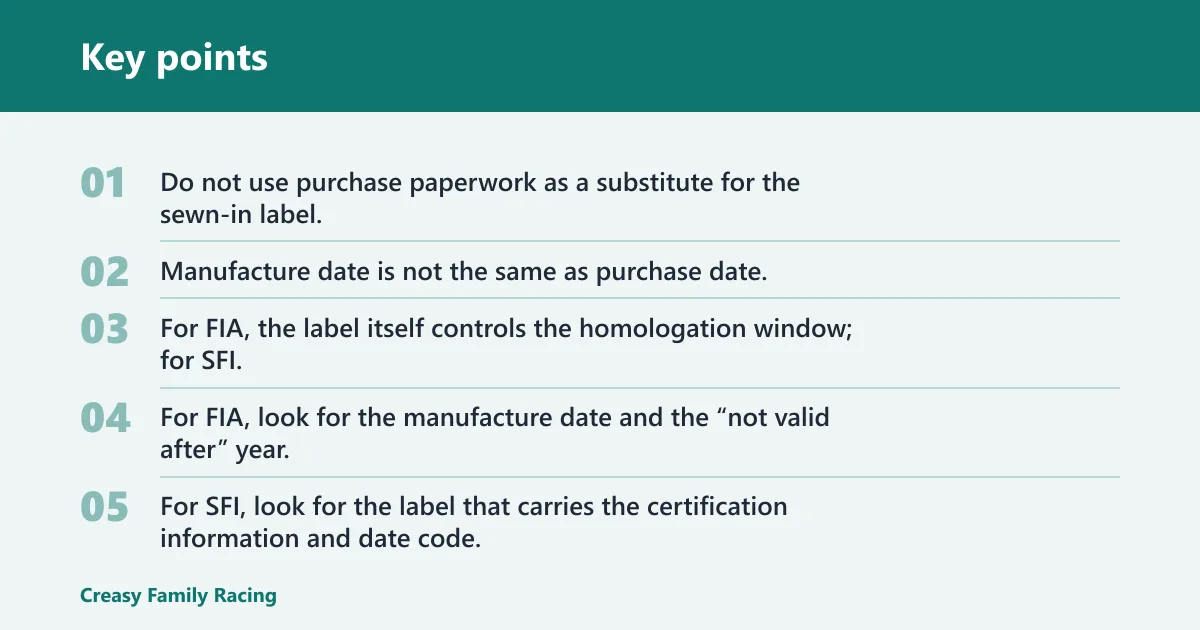
Do not use purchase paperwork as a substitute for the sewn-in label. Manufacture date is not the same as purchase date, and the event inspector will usually care about what is on the safety belt, not what is on the receipt. For FIA, the label itself controls the homologation window; for SFI, the label and any approved recertification marking or replacement label from the manufacturer/service center control the continued legality.
What the scrutineer needs to read
For FIA, look for the manufacture date and the “not valid after” year. For SFI, look for the label that carries the certification information and date code. A clean, legible tag lets the inspector verify the belt in seconds. An altered or missing tag usually ends the conversation there.
Why a missing or altered tag is a problem
If the label is gone, cut away, or impossible to read, the safety belt cannot be confirmed as valid. That is a tech risk even if the webbing is unused. A safety belt without a readable tag is usually treated as noncompliant until the sanctioning body says otherwise.
What if the tag is missing or illegible?
The outcome depends on the standard and the event. For FIA 8853-2016, the original homologation label is the normal proof of validity; replacement labels or photocopies usually do not substitute for the sewn-in tag unless the specific rule book explicitly allows them. For SFI 16.1, a missing original tag is often only salvageable if the manufacturer or an approved service center can document the belt’s recertification and attach the correct replacement label. If that documentation does not exist, tech typically treats the belt as unverified.
How do you read the tag?
Read the standard first, then the date code. FIA labels may show a manufacture date or a “not valid after” year, while some SFI labels use month-year style dating or a visible punch. The key point is simple: the date on the tag, not the purchase date, drives the expiry decision.
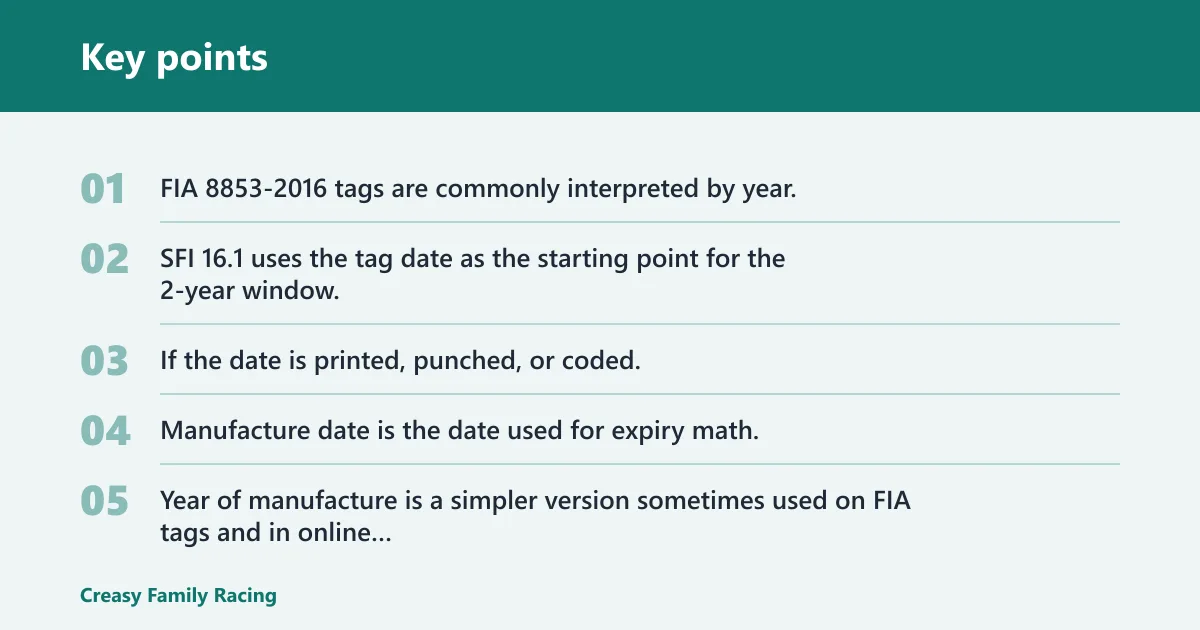
FIA 8853-2016 tags are commonly interpreted by year, with the belt allowed through the end of the listed year. SFI 16.1 uses the tag date as the starting point for the 2-year window, and recertification documentation only counts if the manufacturer or approved service center issued it for that harness. If the date is printed, punched, or coded, read the format exactly as the manufacturer presents it.
Manufacture date versus year of manufacture
Manufacture date is the date used for expiry math. Year of manufacture is a simpler version sometimes used on FIA tags and in online calculators. Either way, the belt’s age starts from the production date on the label, not from the date you bought it or bolted it in.
Suppose a belt is sold new from old stock. It may still be close to its deadline because the service clock started before you ever opened the box. That is why the tag matters more than the packaging.
Not-valid-after wording and calendar-year cutoff
For FIA products, the commonly cited rule is a calendar-year cutoff. If the tag says the belt is not valid after a specific year, it is generally treated as good until December 31 of that year. FIA technical documents and current series rules are the better source than resale listings, because some series interpret the label more strictly at event tech.
That same calendar logic is why a belt made late in the year can still have nearly a full season of legal life, while one made early in the same year may expire sooner. The tag year, not the sale date, controls the math.
How do you calculate expiry?
Calculate expiry from the tag, then compare that date to your event. For FIA 8853-2016, the standard-level validity is tied to the label’s listed year, while the event-level enforcement may be stricter. For SFI 16.1, the standard-level validity is tied to a two-year recertification window, and the event may enforce that window without any grace period.
FIA 8853-2016 date math
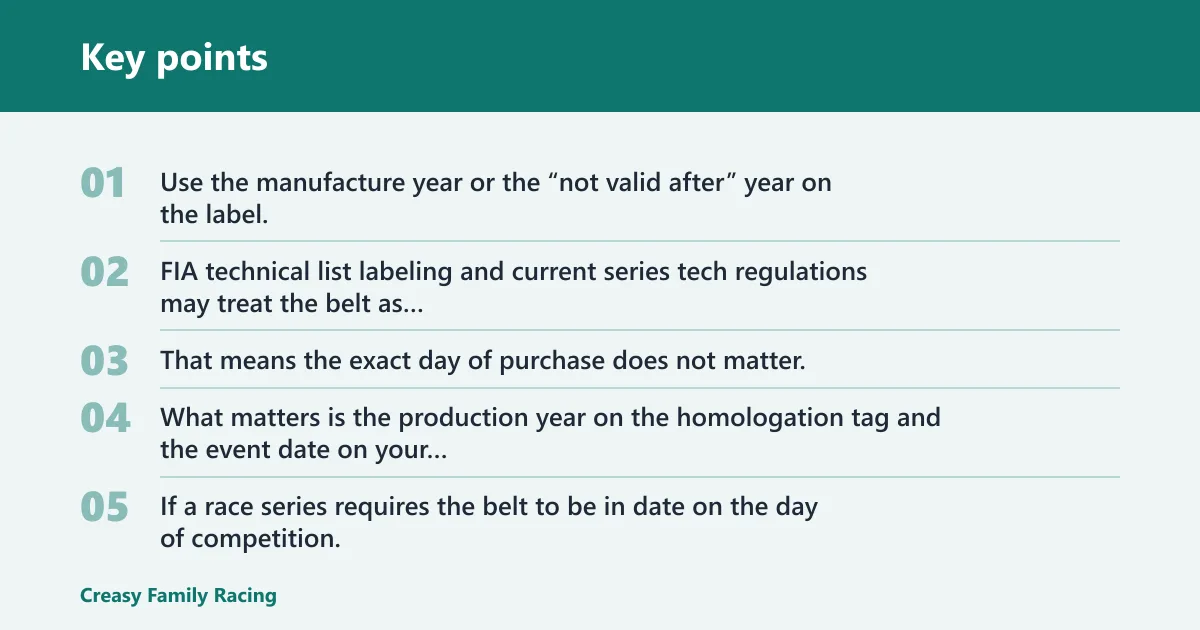
Use the manufacture year or the “not valid after” year on the label. FIA technical list labeling and current series tech regulations may treat the belt as valid through December 31 of the final year.
That means the exact day of purchase does not matter. What matters is the production year on the homologation tag and the event date on your entry list or tech inspection day. If a race series requires the belt to be in date on the day of competition, the calendar-year rule still loses to the series rule.
SFI 16.1 date math
For SFI 16.1, use the label date or the manufacture date shown on the safety belt and add the 2-year window used by SFI’s recertification program and many tech checklists. If the belt is beyond that period, it is a likely rejection at inspection. Treat the cutoff as strict unless the event rule says otherwise.
The label gives inspectors multiple points to verify the same safety belt. If one label is missing or damaged, the belt can still fail even if the other labels are present. If the only surviving marking is a replacement label, tech may require the matching manufacturer/service-center paperwork to confirm that the belt was actually recertified.
How to handle end-of-year deadlines
For FIA safety belts, the important detail is the year-end cutoff. If the label points to a final valid year, the belt is generally accepted through December 31 of that year. Do not assume the belt remains legal into January unless the rulebook says so.
A common first-timer mistake is reading “5 years” as 60 months from purchase. That is not how most event tech checks the belt. The event usually follows the label and the applicable standard, not the sale receipt.
Harness date check
Use this table as a fast pre-tech check. Read the standard, find the date on the sewn-in tag, calculate the real cutoff, and look for anything that would justify early retirement. If the tag is missing, unreadable, or altered, treat the safety belt as a tech risk.
| Standard | Tag wording | Where to find the date | How to calculate expiry | Event-use implication | Immediate red-flag conditions |
|---|---|---|---|---|---|
| FIA 8853-2016 | Manufacture date and/or “not valid after” year | Sewn into the webbing or shoulder strap area | Use the listed year and treat validity as ending on December 31 of the final year | Commonly accepted in international motorsport when still within the listed year window | Missing tag, unreadable print, altered label, fraying, cuts, burns, corrosion, bent buckle parts |
| SFI 16.1 | Label with certification data and date code | Tag sewn into the harness webbing; often on shoulder, lap, and sub strap locations | Use the manufacture or tag date and apply the 2-year replacement window | Common in oval and drag racing; strict tech rejection after expiry is common | Missing label, unreadable date, damaged webbing, corrosion, worn adjusters, cracked buckle, poor release or latch action |
Decision tree: if the tag is missing, unreadable, or altered, stop there and treat the safety belt as unverified for tech. If the tag is readable but the webbing has fraying, cuts, burns, discoloration, stiffness, or brittleness, retire it early. If the buckle, adjusters, or mounting hardware show corrosion, bends, cracks, or poor action, do not rely on the date alone.
60-second checklist
- Find the sewn-in label on every leg of the harness.
- Confirm the standard: FIA 8853-2016 or SFI 16.1.
- Read the manufacture date or “not valid after” year exactly as printed.
- Apply the right rule: FIA year-end validity or SFI two-year recertification window.
- Check the event rule book for stricter timing.
- Inspect webbing, adjusters, buckle, and mounting hardware for damage.
- If the label is missing, unreadable, or altered, treat the belt as unverified.
Can you keep using an old harness?
Sometimes, but only if it still meets the event rule and still passes the physical inspection. An unused safety belt still ages from the manufacture date, so storage does not reset the clock. If the tag is current and the hardware is sound, it may remain legal; if not, retire it.
Some belts can be reworked or recertified through the standard-specific process, but only when the governing documents and the event regulations allow it. For FIA belts, replacement labels or re-webbing generally are not accepted as a workaround unless the current FIA technical documents and the event regulations specifically say otherwise. For SFI belts, recertification may be possible through the manufacturer or approved service center, but only official documentation and the correct replacement label count.
What inspectors check beyond the date
Tech and scrutineering look at more than the label. They also check webbing condition, hardware, buckle release, adjusters, and mounting points. A belt can be within date and still fail if the webbing is damaged or the hardware does not work cleanly.
Visible wear is not the only reason to retire a safety belt. A belt can age out before it looks bad, and it can also fail early if the webbing stiffens, the hardware corrodes, or the buckle does not latch and release as it should.
Signs that call for early replacement
- Fraying at the edges of the webbing
- Cuts, burns, or melted areas
- Discoloration that suggests heat or chemical exposure
- Stiffness or brittleness in the straps
- Corrosion on buckles or adjusters
- Bent tongues, cracked hardware, or rough release action
Picture a 6-point safety belt on a weekend road-race car with a readable FIA tag still inside the year window, but the sub strap has a stiff, shiny section near the buckle. That strap can still fail inspection before the date does. The tag and the webbing both matter.
How do FIA and SFI exceptions work?
Exceptions come from the event rule book, not from the belt seller. A sanctioning body can allow a different standard, shorten the usable date window, require a current homologation or recertification proof, or reject a belt that technically still falls inside the standard’s date window. FIA technical lists, SFI Foundation documents, and current series regulations are the documents that control those exceptions.
When the sanctioning body can override the standard
A series can require a belt to be in date on the exact day of competition, even if a calendar-year FIA label would otherwise still look valid. A series can also demand a particular buckle style, a specific anchor arrangement, or a current belt tag format. If the rule book is stricter than the standard, the rule book wins.
When replacement labels are accepted
Replacement labels are not automatically accepted. For FIA belts, the original homologation tag is usually required, and replacement stickers or owner-added labels are not a substitute unless the rule book explicitly allows them. For SFI belts, a replacement label can be acceptable only when it comes from the manufacturer or approved service center as part of a documented recertification.
When re-webbing is permitted
Re-webbing is standard-specific. For FIA belts, the governing documents and event regulations control whether any replacement or reworking is allowed. For SFI 16.1, re-webbing may be available through an approved manufacturer or service-center process, but only if the belt is recertified under the proper program and carries the correct new documentation. If the standard or the event rules do not expressly allow it, do not assume it is legal.
Frequently asked questions
Do racing harnesses expire?
Yes. Racing safety belts have time-based service limits, and the event rule usually points to a specific standard on the sewn-in label. FIA and SFI are the two main standards drivers compare, but the inspection outcome also depends on visible condition, readable labeling, and the sanctioning body’s own rule book.
How do I check the date on a racing harness?
Find the sewn-in tag on the webbing or shoulder strap area, then read the standard and date information printed or punched on it. Use the manufacture date or year of manufacture, not the purchase date. If the label is missing or unreadable, do not assume the safety belt will pass tech.
Where is the manufacture date on FIA and SFI harnesses?
FIA tags commonly show a manufacture date and a “not valid after” year. SFI labels carry certification data and a date code, often on the shoulder, lap, and sub strap areas. In both cases, the tag is sewn into the harness webbing and is the first inspection point.
How long are FIA racing harnesses good for?
Competitor guidance commonly treats FIA safety belts as good for 5 years, with validity ending on December 31 of the final year. That means the listed year on the tag matters more than the purchase date. Check the specific event rules, because some series may be stricter than the standard alone.
How long are SFI racing harnesses good for?
Competitor guidance commonly treats SFI 16.1 safety belts as a 2-year standard. The expiry is tied to the manufacture or tag date, and tech inspection can reject the belt after that point. Do not count on a grace period unless the sanctioning body publishes one in writing.
What happens if the tag is missing or unreadable?
A missing or unreadable tag is usually a tech problem right away. Without a readable label, the inspector cannot confirm the standard or the date, so the belt may be rejected even if the webbing looks fine. If the label has been cut, painted over, or altered, retire the safety belt.
Can an expired harness be recertified or re-webbed?
Sometimes, but only if the standard and manufacturer allow it. For FIA belts, replacement labels or re-webbing are not a workaround unless the governing documents and the event regulations explicitly allow them. For SFI 16.1, recertification or re-webbing may be possible only through the manufacturer or an approved service center, and only with the proper paperwork and replacement label. If the exact standard does not allow it, the harness stays out of service.
Does a harness expire if it was never installed?
Yes. Unused webbing still ages from the manufacture date printed on the label. Shelf time does not stop the clock, and a sealed package does not guarantee full service life. If the tag is old, the safety belt may already be near or past its allowed window.
Do track days, autocross, and race series use the same harness dates?
No. Event rules vary, and some organizations accept different standards or different date windows. A belt that passes one track-day tech check may fail a club-racing scrutineer. Always confirm the rule for the specific event before you arrive at tech.
Should I replace a harness even if it looks new?
Yes, if the tag says it is out of date or if the webbing or hardware shows damage. A safety belt can look clean and still be too old for competition. Date validity, readable labeling, and physical condition all matter, and any one of them can end the belt early.
Sources
- FIA 8853-2016 homologation and technical list labeling
- SFI Foundation 16.1 specifications and recertification requirements
- Current series and sanctioning-body tech regulations for harness legality and in-event enforcement
- OG Racing technical guidance on FIA and SFI harness labeling, validity, and re-webbing
- Summit Racing consumer guidance on FIA belt validity windows and calendar-year cutoff interpretation