
Helmet Safety Ratings: How They’re Tested and Set
By the editorial staff | Reviewed for technical accuracy by a motorsports safety editor | Published 2026-10-29 | Updated 2026-10-29
Methodology note: This article compares helmet standards by primary-source rule text and approval logic, not by brand reputation. Citations below point to the governing regulation or standard text: FMVSS No. 218 / NHTSA for U.S. motorcycle helmets, Snell standard documents for voluntary certification, and UNECE Regulation No. 22.06 for ECE-approved motorcycle helmets. Motorsport acceptance examples are drawn from series and sanctioning-body rulebooks.
Helmet safety ratings are written by standards bodies, checked through lab protocols, and accepted by your sanctioning body; a helmet is only “legal” if it carries the exact label your series or track requires. Buy the wrong standard and tech may refuse it, or the helmet may not protect as expected in a crash. This guide explains who writes the rule, how helmets are tested, and how to read the label before you buy. For fit guidance, see our helmet fit guide, our helmet replacement intervals guide, and our motorsport gear rules page.
What safety standards and racing rules require
Helmet ratings try to catch three main failure types: too much impact force reaching the head, a strap or retention system that lets the helmet come off, and shell or liner behavior that fails under penetration or coverage checks. Different standards weight those risks differently, so one sticker rarely answers every use case. For motorcycle helmets, the governing details are in FMVSS No. 218 (49 CFR §571.218; NHTSA compliance material), Snell’s current motorcycle standards, and UNECE Regulation No. 22.06. (49 CFR §571.218; NHTSA, FMVSS No. 218; Snell M2020D/M2020R standard documents; UNECE Reg. No. 22.06)
For racers and track-day drivers, that difference matters. A helmet can meet a road-use regulation and still be turned away by a racing series, because the series may want a different impact energy, a different test angle, or a newer rule set. Acceptance is set by the event rulebook, not by the helmet label alone. (Rulebook examples cited below: FIA / FIA-affiliated regulations, SCCA General Competition Rules, NHRA rulebook, and SFI Foundation standards referenced by sanctioning bodies)
Why certification exists
Certification is a pass-fail gate, not a marketing score. It tells a regulator, distributor, tech inspector, or buyer that a helmet met a specific test protocol at the time of approval. Independent ratings can help compare models, but they are not the same thing as certification. FMVSS 218 is a self-certification regime for manufacturers, while NHTSA performs compliance testing and enforcement after the fact. (49 CFR §571.218; NHTSA FMVSS No. 218 consumer/compliance materials)
That difference is easy to miss. A star rating or consumer score may compare helmets within a program, while a certification mark says the helmet meets a rule written for a legal market or a motorsport class. For example, Snell certification is voluntary, but rulebooks in motorsport classes may still require a current Snell label. (Snell standard documents; SCCA GCR / NHRA / FIA examples)
The three basic failure types
Impact attenuation is the main drop test. Retention checks whether the helmet stays on the head. Penetration and coverage checks look for shell weakness, opening size, or edge areas that may leave the wearer exposed. Each standard chooses its own mix of those checks. For motorcycles, UNECE R22.06 and FMVSS 218 both include impact and retention-related requirements, while Snell documents add more severe impact and penetration-style evaluation in their certification protocol. (49 CFR §571.218; Snell standard documents; UNECE Reg. No. 22.06)
Say your helmet has a strong outer shell but a weak chin strap. It may still absorb a drop well, yet fail because the retention system cannot hold it in place.
How helmet safety tests work

Most helmet standards use instrumented headforms, accelerometers, and controlled drops to measure how much force reaches the test head. The setup is simple in concept and strict in execution: the helmet is fitted to the correct headform size, dropped or struck in a defined way, and the data are compared to the rule’s limit. The exact limits and impact arrangements depend on the standard text. (49 CFR §571.218; Snell standard documents; UNECE Reg. No. 22.06)
Headforms matter because fit affects the result. Standards often use multiple sizes so the helmet is tested on the headform that matches its intended fit range, rather than a single one-size-fits-all dummy head. UNECE R22.06 and Snell both define detailed test headforms and conditions, and FMVSS 218 specifies its own test headforms and procedures. (49 CFR §571.218; Snell standard documents; UNECE Reg. No. 22.06)
Headforms and accelerometers
Headforms are instrumented test heads. The accelerometer inside them records transmitted acceleration, which is often reported as g-force. Motorcycle standards use instrumented headforms and data channels adapted to their own protocol, while bicycle standards use a different regulatory framework and are not the focus of this motorcycle-first comparison. (49 CFR §571.218; Snell standard documents; UNECE Reg. No. 22.06)
That setup measures the injury load that gets through the helmet, not the blow itself. The point is to compare the helmet’s result against the standard’s limit for that test.
Impact attenuation drop tests
Impact attenuation is the main drop test in helmet certification. The helmeted headform is dropped onto an anvil or struck in a controlled configuration so the lab can measure transmitted force or g-force. The exact height, speed, anvil shape, and pass threshold depend on the standard. (49 CFR §571.218; Snell standard documents; UNECE Reg. No. 22.06)
For motorcycle helmets, FMVSS 218 sets impact attenuation requirements and testing procedures in the U.S. motorcycle standard. Snell motorcycle standards use higher-severity impact conditions and additional penetration-oriented checks. UNECE Regulation No. 22.06 includes impact attenuation plus expanded test coverage compared with earlier ECE rules.
Retention system checks
Retention tests check the chin strap and fastener system. The goal is simple: keep the helmet on the head during a crash, not just during a fit check in the store. Retention system testing appears in both motorcycle and other helmet standards, though the exact load and pass criteria differ. For motorcycle helmets, retention requirements are part of FMVSS 218 and UNECE 22.06. (49 CFR §571.218; UNECE Reg. No. 22.06)
A loose or weak strap can turn a good shell into a poor result. If the helmet shifts, rotates, or comes off, the other protections matter less.
Where oblique and rotational testing fits
Oblique testing strikes the helmet at an angle instead of only straight down. That matters because many real crashes include angled contact, which can create rotational motion linked to concussion-relevant forces. UNECE Regulation No. 22.06 added oblique testing and broadened its test matrix when it replaced UNECE 22.05. (UNECE Reg. No. 22.06)
Older linear-only standards can still be useful, but they do not always probe the same kind of head motion. That is one reason a helmet may pass one rule and still be rejected by another.
Dot FMVSS 218, Snell, and ECE 22.06 compared
These three names are often grouped together, but they come from different systems. Snell is a voluntary, non-government standard set. ECE 22.06 is a regional motorcycle regulation used widely outside the U.S. road market.
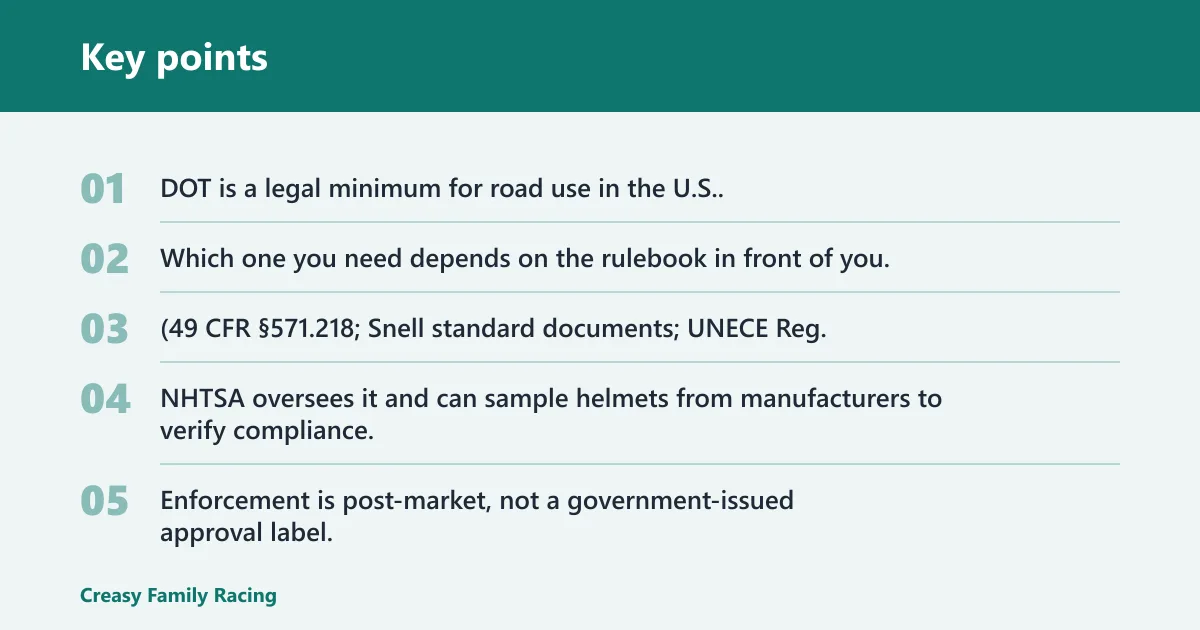
The practical difference is structural. DOT is a legal minimum for road use in the U.S.; Snell is a private benchmark used heavily in motorsport; ECE is a regulatory homologation system with its own approval path and labels. Which one you need depends on the rulebook in front of you. (49 CFR §571.218; Snell standard documents; UNECE Reg. No. 22.06)
| Standard | Who writes the rule | Who tests / certifies | Rotational / oblique coverage | Label location | Named motorsport acceptance examples |
|---|---|---|---|---|---|
| DOT FMVSS 218 | U.S. federal regulation, 49 CFR §571.218 | Manufacturer self-certifies; NHTSA conducts compliance testing and enforcement | Primarily linear impact and retention requirements in the federal motorcycle standard | Certification label on the helmet; exact location depends on the model and construction, but the mark must be on the product | Accepted in some track-day or club settings, but many racing rules require more than DOT; series-specific acceptance varies by rulebook |
| Snell | Snell Memorial Foundation | Snell certification program and its accredited test process | Not marketed as a full rotational standard; emphasis is on high-energy linear impacts and additional penetration-oriented checks | Snell certification label inside the helmet / under the lining per Snell marking guidance | Used or required in many motorsport contexts, including SCCA classes that list Snell SA2020 or current equivalents and NHRA categories that require Snell-rated helmets; FIA-related categories may also reference Snell in specific class rules |
| ECE 22.06 | UNECE Regulation No. 22.06 | Type approval / homologation through an approved authority and laboratory system | Yes: includes oblique impact testing and expanded test coverage versus earlier ECE rules | E-mark / approval label on the helmet, typically on a sewn or fixed label area | Commonly accepted in international motorsport and track-day rulebooks where the organizer allows ECE; some FIA-adjacent events and club tracks accept it, but class rules still control |
What the table means in practice
DOT FMVSS 218 is the U.S. legal requirement for motorcycle road use. NHTSA oversees it and can sample helmets from manufacturers to verify compliance; the rule is based on manufacturer certification rather than premarket government approval. Enforcement is post-market, not a government-issued approval label.
Snell is different. It is voluntary, non-government, and known for higher-energy impact testing plus additional penetration-oriented checks. It updates on a multi-year revision cycle, which is why many motorsport buyers still look for it when a rulebook calls for a stricter benchmark than the road minimum. (Snell standard documents; SCCA GCR; NHRA rulebook examples)
ECE 22.06 replaced ECE 22.05 and took effect in 2022 under UNECE’s motorcycle helmet regulation. Its oblique testing matters because it aims at the kind of angled impact that can create rotational head motion, something older linear-only standards did not fully address. (UNECE Reg. No. 22.06)
Who sets the standards?
Standards come from different kinds of authority. Some are government regulations, some are voluntary private standards, and some are regional approval systems that sit between law and product testing. That structure determines who writes the rule, who runs the test, and who can reject the helmet. (49 CFR §571.218; Snell standard documents; UNECE Reg. No. 22.06)
For a buyer, that is the real question. The sticker matters only after you know which system issued it and which use case accepts it.
Government regulation versus voluntary standards
DOT FMVSS 218 is a government rule for U.S. motorcycle road use. NHTSA oversees it, samples helmets from manufacturers, and can penalize noncompliance through the federal enforcement process; the standard itself is not a pre-approval program. Snell is a private standard set, so it does not carry legal force by itself. ECE is a regional homologation regulation accepted by many markets and series.
That means the same helmet can be legal for road use in one region, certified under a private benchmark, and still not match a track’s rulebook. The tech inspector cares about the last step.
Why motorsport rules may ask for more
Motorsport accepts risk differently than road use. A series may require a newer Snell revision, an ECE approval, or both, depending on class and venue. Examples include SCCA General Competition Rules that specify helmet standards by class, NHRA rules that require SFI or Snell-listed helmets in defined categories, and FIA-related regulations that call for approved helmet standards in specific disciplines. (SCCA GCR; NHRA rulebook; FIA / FIA-linked sporting regulations)
Suppose a helmet has a DOT mark and a strong street reputation, but the club requires an ECE 22.06 label or a current Snell approval. It can still be a legal road helmet and still be rejected at tech.
What helmet labels and stickers mean
The legally relevant certification mark is normally on the helmet itself, not just on packaging or in a manual. That mark tells you which standard the helmet was built to meet. It does not tell you whether your race group, track day organizer, or local road law will accept it. For motorcycle helmets, the mark is part of the standard’s identification and approval system under FMVSS 218, Snell, or UNECE 22.06. (49 CFR §571.218; Snell standard documents; UNECE Reg. No. 22.06)
Used helmets deserve extra caution. A label can be present even when the helmet has taken a hit, aged out of its service life, or been modified in a way the original approval did not cover.
How to check the helmet before you buy
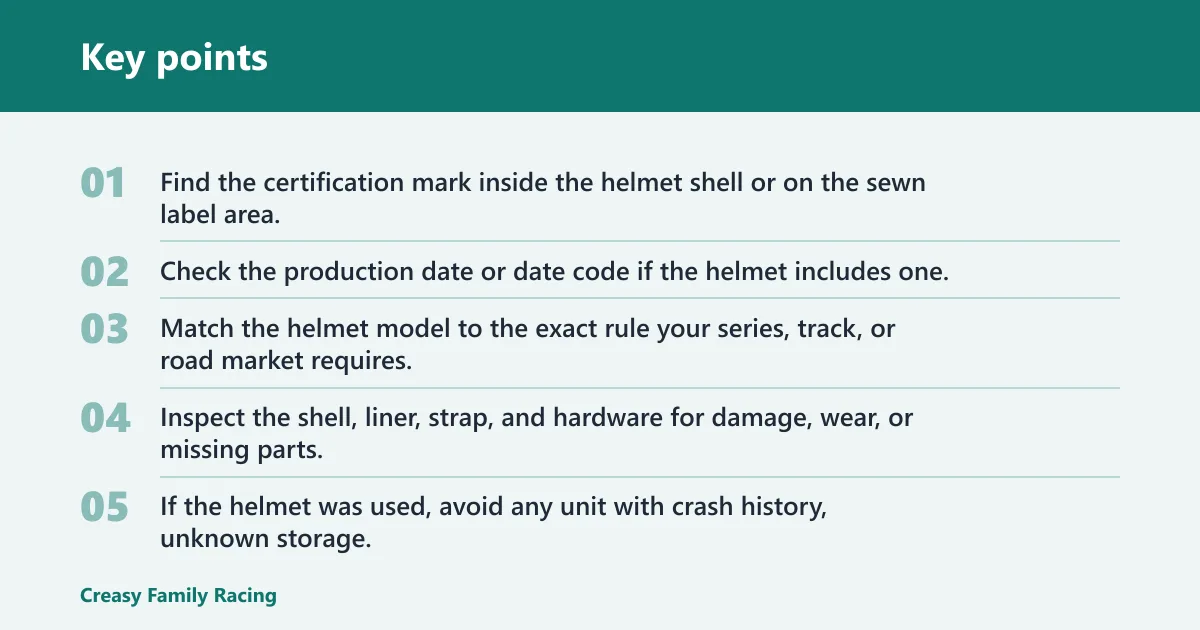
- Find the certification mark inside the helmet shell or on the sewn label area, and confirm the standard name exactly.
- Check the production date or date code if the helmet includes one.
- Match the helmet model to the exact rule your series, track, or road market requires.
- Inspect the shell, liner, strap, and hardware for damage, wear, or missing parts.
- If the helmet was used, avoid any unit with crash history, unknown storage, or altered padding.
A common first-timer mistake is to shop by logo alone. A helmet can carry a valid label and still fail your event’s rulebook because the wrong standard was listed on the inside label.
Certification versus consumer rating systems
SHARP and STAR are rating systems, not the same thing as certification marks. They help compare helmets after the legal standard has already been met, or they rank models within a testing program. They do not replace the certification label your event or road law requires. For motorcycle buyers, those ratings are best treated as a comparison layer on top of the governing standard, not a substitute for it. (SHARP program materials; STAR program materials; 49 CFR §571.218; UNECE Reg. No. 22.06)
That is why “who sets the standard” has two answers. One body writes the pass-fail rule, and another may publish comparative ratings on top of it.
Frequently asked questions
How are helmet safety ratings tested?
They are tested with instrumented headforms, accelerometers, and controlled impact or retention protocols. The lab measures transmitted acceleration or force after a drop or strike, then compares the result with the standard’s limit. Some motorcycle standards also add penetration, coverage, or oblique impact checks. (49 CFR §571.218; Snell standard documents; UNECE Reg. No. 22.06)
Who sets helmet safety standards?
It depends on the system. DOT FMVSS 218 is a U.S. federal rule enforced by NHTSA through post-market compliance. Snell is a voluntary non-government standard. ECE 22.06 is a regional regulation with its own approval process. Your sport or road market decides which one you need.
What do helmet certification labels actually mean?
A certification label means that exact helmet model met a specific rule set at the time of approval. It is not a general promise that the helmet is best for every use case. The label must match the standard required by your road market, track, or series rulebook.
What is the difference between DOT, Snell, and ECE testing?
DOT is the U.S. legal minimum for motorcycle road use and relies on manufacturer self-certification with NHTSA enforcement. Snell is voluntary and uses higher-energy impact testing and additional penetration-oriented checks. ECE 22.06 adds oblique testing and is widely accepted internationally, subject to the event rulebook. (49 CFR §571.218; Snell standard documents; UNECE Reg. No. 22.06)
Do helmet standards test for rotational impact?
Some do, and some older ones do not. ECE 22.06 includes oblique testing to address angled impacts that can create rotational motion. Older linear-only standards focus more on straight impact attenuation, so they may miss that part of the crash picture. (UNECE Reg. No. 22.06)
How can I tell if a helmet is actually certified?
Look for the certification mark on the helmet itself and confirm that the exact standard matches the rule you need. Then check the production date, model designation, and overall condition. If the helmet is used, any crash history, damage, or missing label details should be treated as a warning sign. (49 CFR §571.218; Snell standard documents; UNECE Reg. No. 22.06)
Sources
- 49 CFR §571.218, Federal Motor Vehicle Safety Standard No. 218, Motorcycle Helmets.
- NHTSA, FMVSS No. 218 compliance and consumer guidance materials.
- Snell Memorial Foundation motorcycle standard documents for current revision(s) referenced in the article.
- UNECE Regulation No. 22.06, Uniform provisions concerning the approval of protective helmets and of their visors for drivers and passengers of motorcycles and mopeds.
- FIA / FIA-linked sporting regulations and helmet approval references used by specific sanctioned disciplines.
- SCCA General Competition Rules.
- NHRA rulebook sections governing helmet approvals in relevant categories.
- SHARP and STAR program materials for comparative rating-system context.