Nomex vs Leather Driving Gloves: Which Should You Buy?
Buy Nomex driving gloves only if heat or flame protection, or a sanctioning rule, matters; buy leather gloves if you want better steering feel, more comfort, and easier daily use. Choose wrong and you may carry extra bulk, lose tactile feedback, or miss the protection your event requires. This guide compares Nomex and leather by track days, autocross, hot weather, and daily driving so you can pick the right pair.
| Factor | Nomex | leather driving gloves | Winner |
|---|---|---|---|
| Fire protection | Heat- and flame-resistant meta-aramid; used in SFI-rated racing gloves | No fire-protection claim on its own | Nomex |
| Steering feel | Usually softer, less direct, and more fabric-like at the wheel | Usually better tactile feedback and palm grip when snug and unlined | leather driving gloves |
| Breathability | Varies by knit and construction; less dependent on perforation | Best in perforated leather, mesh backs, or crochet knit backs | leather driving gloves |
| Track-day fit with rules | Matches sanctioning and safety-focused use | Good only when the event does not require fire protection | Nomex |
| Daily usability | More specialized for motorsport use | Easier for regular driving, comfort, and quick on-and-off wear | leather driving gloves |
| Touchscreen convenience | Depends on fingertip construction; not guaranteed | Can include conductive thumb and index tips or three-finger touch zones | leather driving gloves |
What changes between Nomex and leather?
Nomex is the safety-first option. It is a heat- and flame-resistant meta-aramid fiber that was first developed in the 1960s, became commercially available in 1967, and was first used as fabric for race-car driver suits. Leather is the feel-first option: it is usually the better choice for tactile feedback, everyday comfort, and easy use.
Nomex brings protection, not comfort-first feel
Nomex has material properties that suit motorsport use, including a specific gravity of 1.38, elongation at break of 30.0%, and tensile modulus of 125 g/d. Those figures help explain why it belongs in racing gear rather than casual fashion gloves. For the driver, the practical takeaway is simple: choose it when the event rules or heat exposure matter more than soft steering feel.
Leather fits the hands more naturally for road use
Leather driving gloves usually come in unlined and lined versions. Unlined gloves give better tactile feedback, while lined gloves feel softer but can add bulk. Lambskin, deerskin, and goatskin are common materials for leather driving gloves, and goatskin is commonly chosen for flexibility and breathability.
Driving gloves decision matrix
This matrix is the quickest way to sort the two materials by use case. Pick by event type, cabin heat, and any fire-rule requirement.
| Use case | Track-day use | Autocross use | Hot-weather road use | Fire-protection priority | Steering feel | Breathability | Touchscreen convenience | Likely best choice | Do not buy if |
|---|---|---|---|---|---|---|---|---|---|
| Primary need is event compliance | Yes, if the event requires safety gear | Sometimes, depending on rules | No | High | Secondary | Moderate | Low to moderate | Nomex | Do not buy if you want the softest wheel feel for street use |
| Primary need is road comfort | Only if no fire rule applies | Yes, for casual event use | Yes | Low | High | High with perforation or mesh | Moderate to high | leather driving gloves | Do not buy if your series requires SFI-rated gear |
| Hands get sweaty fast | Works if glove fit and lining are right | Works if airflow is good | Often best with perforated leather | Low to moderate | High in unlined leather | High with perforated leather or mesh back | Variable | leather driving gloves | Do not buy if you need flame resistance first |
Track-day use points to Nomex
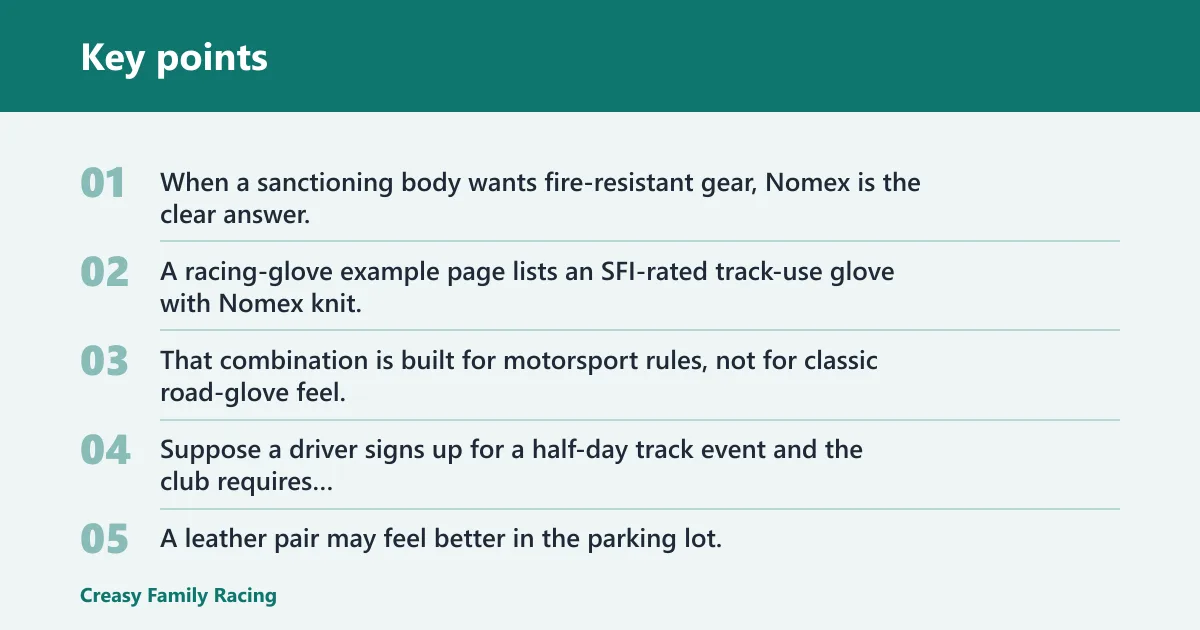
When a sanctioning body wants fire-resistant gear, Nomex is the clear answer. A racing-glove example page lists an SFI-rated track-use glove with Nomex knit, a suede palm, and a hook-loop strap. That combination is built for motorsport rules, not for classic road-glove feel.
Suppose a driver signs up for a half-day track event and the club requires fire-resistant gloves. A leather pair may feel better in the parking lot, but it does not answer the rule that matters on track. Nomex does.
Autocross is a split decision
Autocross often rewards quick hand movement, clear feedback, and easy entry and exit. If the event allows it and heat protection is not required, leather driving gloves usually make more sense because they keep the wheel feel cleaner. If the club or venue requires fire protection, Nomex becomes the right choice immediately.
Hot-weather road use usually favors leather
For street driving in summer, airflow matters more than sales copy. Perforated leather, mesh panels, and crochet knit backs all help air move, and they usually beat a dense glove construction for daily cabin use. Nomex can work, but it is not the default pick for someone who wants the coolest-feeling glove on ordinary roads.
Which feels better at the wheel?
Leather driving gloves usually feel better at the wheel because they transmit more tactile feedback through the palm and fingers. They also tend to give better palm grip without the same level of fabric bulk. Nomex can feel softer, but softness is not the same as precision.
Finger dexterity and bunching matter more than branding
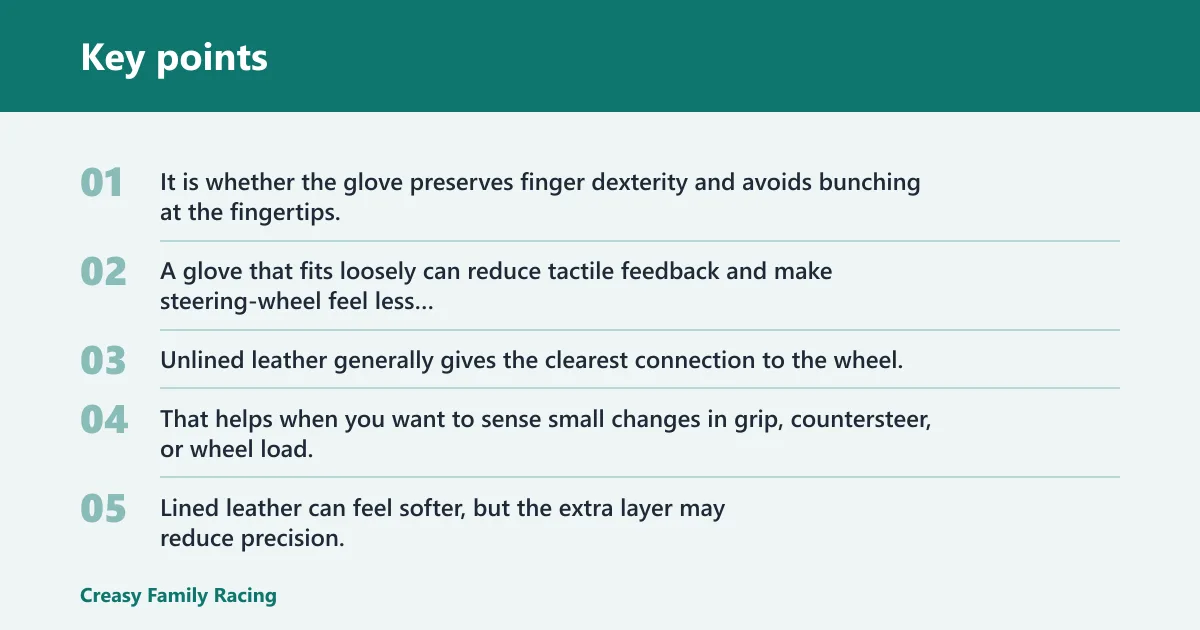
The main feel issue is not the logo. It is whether the glove preserves finger dexterity and avoids bunching at the fingertips. A glove that fits loosely can reduce tactile feedback and make steering-wheel feel less precise, which is why a snug fit matters more than an easy-on size.
Leather usually wins for tactile feedback
Unlined leather generally gives the clearest connection to the wheel. That helps when you want to sense small changes in grip, countersteer, or wheel load. Lined leather can feel softer, but the extra layer may reduce precision.
Picture a driver who prefers a thick, padded glove because it feels comfortable at first touch. After a few steering corrections, the extra material can make the wheel feel less exact, especially at the fingertips. That is the trade-off.
Which stays cooler in hot weather?
Leather driving gloves usually stay cooler in hot weather when they have perforation, mesh panels, or a crochet knit back. Nomex is chosen for protection first, so it is not the automatic winner for airflow. For sweaty hands, the real question is how the glove moves air and how tightly it fits.
Ventilation strategy matters
Perforated leather is the most straightforward option for road use because it lets air pass through the fingers and back of the hand. Mesh backs and crochet knit backs add more airflow. Those details matter more than leather versus Nomex alone, because a poorly vented glove of either type will feel warmer than a well-vented one.
Nomex can work, but it is not built around airflow
Nomex’s material profile supports protection, not maximum ventilation. Its equilibrium moisture regain at 55% RH is 4.5%, and its dry-air shrinkage at 177° for 30 minutes is 0.4%. Those are material facts, but the buying decision still comes down to use case: choose Nomex for safety, not because it is the coolest-feeling option in traffic or on a long summer drive.
Choose Nomex if… / Choose leather driving gloves if…
Choose Nomex if the event requires fire-resistant gloves, the organizer names SFI-rated gear, or you want a motorsport glove built around safety first. Choose leather driving gloves if you want the best steering feel, better day-to-day comfort, and easier use on road drives or casual events where fire protection is not the point.
Choose Nomex if your priority is safety
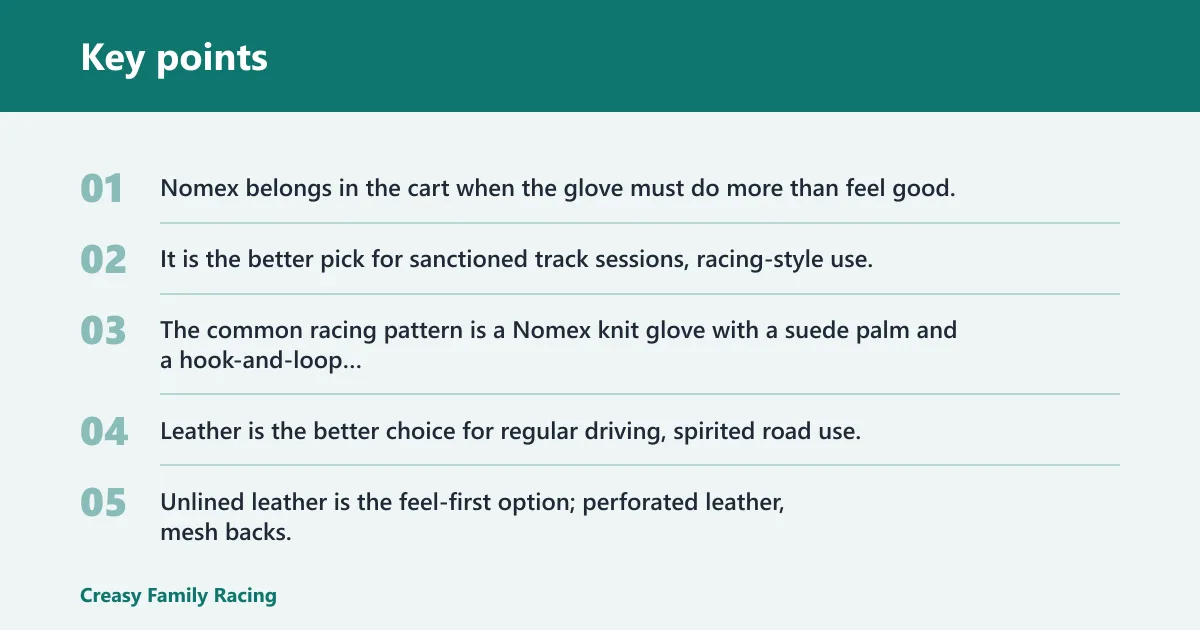
Nomex belongs in the cart when the glove must do more than feel good. It is the better pick for sanctioned track sessions, racing-style use, and any situation where the fire-protection requirement outweighs tactile comfort. The common racing pattern is a Nomex knit glove with a suede palm and a hook-and-loop strap.
Choose leather driving gloves if your priority is feel
Leather is the better choice for regular driving, spirited road use, and hot-weather comfort when the event does not require fire resistance. Unlined leather is the feel-first option; perforated leather, mesh backs, and hook-and-loop or snap closures help with comfort and quick entry. If you want the steering wheel to feel clean in your hands, this is usually the better path.
When neither is the right answer
If you need both high fire protection and the best possible wheel feel, the right answer is not a compromise street glove. It is the glove type your event requires, sized correctly and worn snugly. A loose glove defeats the point on both sides.
How should driving gloves fit?
Fit is the part most buyers get wrong. Measure palm circumference, check finger length accuracy, and aim for snug but not restrictive. A glove that is too loose reduces tactile feedback, while one that is too short or tight can pull at the fingertips and interfere with steering precision.
Measure the palm first
Use palm circumference as the starting point for sizing, then confirm finger length. The glove should sit close to the hand without compressing it. If the wrist closure is a snap or hook-and-loop strap, it should secure the glove without creating pressure points.
Unlined versus lined changes the fit
Unlined gloves usually feel truer to size and give better steering feel. Lined gloves can feel more comfortable at first, but the extra material changes how they wrap the hand. That matters most when the driver wants precise finger control at the wheel.
Frequently asked questions
Are Nomex driving gloves better than leather for track days?
Yes, when track rules or fire protection matter. Nomex is the better track-day choice if the organizer wants SFI-rated gear or if safety is the top priority. Leather is fine only when the event allows it and you care more about steering feel than fire resistance.
Do leather driving gloves grip better than Nomex gloves?
Usually, yes. Leather often gives stronger tactile feedback and palm grip, especially when it is unlined and sized snugly. Nomex can still work well, but it is usually chosen for protection first, not for the sharpest wheel feel.
Which driving gloves are cooler in hot weather, Nomex or leather?
Leather is usually cooler when it uses perforation, mesh panels, or a crochet knit back. Nomex can be acceptable, but airflow depends heavily on the glove’s construction. If heat is your main concern and fire protection is not required, leather is the safer buy.
Can Nomex gloves be used for regular driving or only racing?
They can be used for regular driving, but they are most sensible when safety requirements justify them. For daily use, many drivers will prefer leather because it is easier to live with and usually feels better on the wheel. Nomex makes the most sense when the event rules push you there.
Will leather driving gloves protect my steering wheel from sweat?
Yes, leather gloves help keep sweat and oils off the wheel. That is one of the basic benefits of driving gloves, and it matters on long drives or in warm weather. A snug fit is important, because a loose glove can move around and feel less secure.
What should I choose if I want the best steering feel and some fire resistance?
Start with the event rule. If fire resistance is required, choose Nomex. If it is optional, leather driving gloves are the better match for steering feel, especially in an unlined, snug fit. There is no leather substitute for genuine fire protection.
Are Nomex gloves softer or stiffer than leather gloves?
Nomex often feels softer at first touch, but not necessarily more precise. Leather usually feels more structured and direct at the wheel. Softness is not the deciding factor; fit and tactile feedback matter more than the surface feel in the hand.
What glove material is better for long sessions when my hands get sweaty?
For long road sessions, leather usually wins if it is well ventilated and correctly sized. Perforation, mesh backs, and snug fit matter more than material alone. If the session is a sanctioned event with fire requirements, Nomex is the correct choice even if leather feels cooler.