How Are Track Brake Pads Different From Street Pads?
Track brake pads handle repeated high heat and resist fade. Street pads are tuned for cold bite, low noise, and clean daily use; for mixed use, pick the pad type that matches the hardest stops you do most often. Choose wrong, and you can get weak cold braking on the street or faded, overheated brakes on track. This guide explains compound behavior, temperature range, noise, dust, rotor wear, and how to choose between them.
Brake pad decision matrix
Use this table to sort pad types by use case. The real question is simple: what temperature window is the pad built to live in, and what tradeoffs come with that choice?
| Pad type | Cold bite | Operating temperature | Dust and noise | Rotor wear | Track-day fit |
|---|---|---|---|---|---|
| Street ceramic | Strong cold-stop behavior | About 350–380°C before it gives up | Minimal dust, usually quiet | Usually gentler on rotors | Poor for track use |
| Sport / semi-metallic | Good bite, but can squeal cold | About 450–500°C | Moderate dust, more noise than ceramic | More rotor wear than ceramic | Works for light track duty or mixed use |
| Dual-duty | Acceptable on the street | About 650–700°C | Heavy dust, louder than street pads | More wear than street compounds | Good for occasional track days |
| Dedicated track | Poor cold bite | About 750–800°C and beyond | Severe dust, often noisy | Highest wear rate here | Best for repeated hard braking on track |
The pattern is direct. As temperature capacity goes up, cold manners, cleanliness, and rotor friendliness usually get worse.
What changes between street and track pads?
Street pads are generally built for the first stop of the day, not the tenth hard stop in a row. Track pads are built for repeated heat cycles, so they are commonly reported to stay consistent after long braking zones, late braking, and repeated deceleration at much higher temperatures.
Friction window
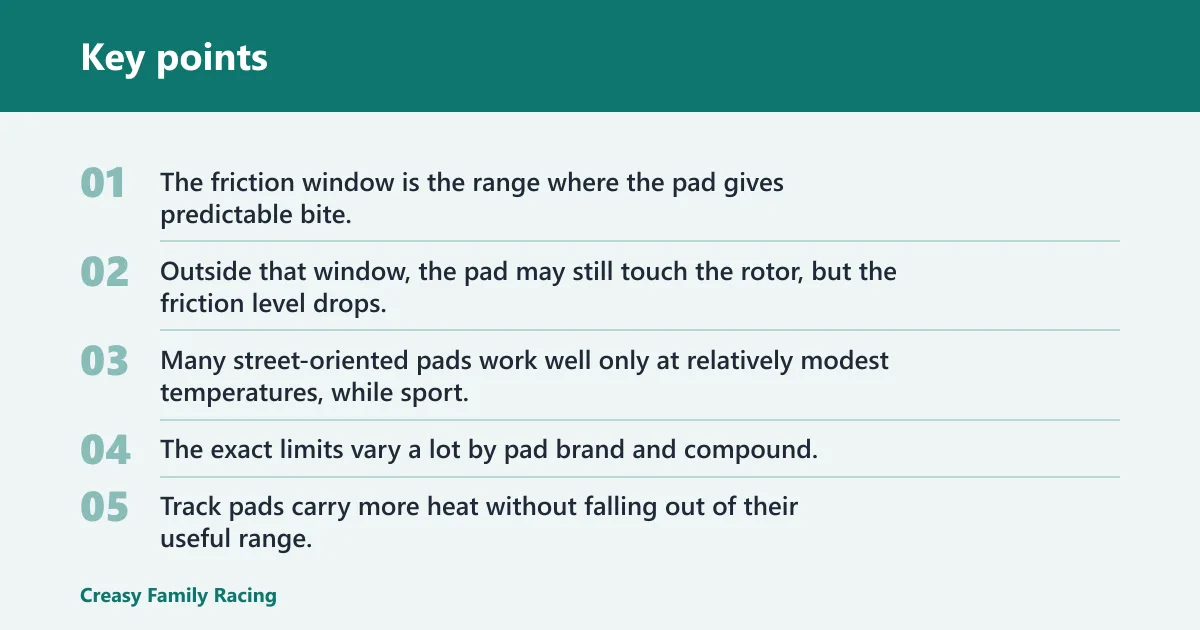
The friction window is the range where the pad gives predictable bite. Outside that window, the pad may still touch the rotor, but the friction level drops, the pedal feel changes, or the pad starts to shed material in a way that reduces braking force.
Many street-oriented pads work well only at relatively modest temperatures, while sport, dual-duty, and track-oriented pads are built to extend that window upward. The exact limits vary a lot by pad brand and compound.
Heat tolerance
Track pads carry more heat without falling out of their useful range. That matters because track braking builds heat fast, and the hottest 10 minutes of a session can decide whether a pad stays stable or starts fading.
Street pads can still work well on the road after a hard stop, but their lower heat ceiling makes them a poor match for repeated lap-after-lap braking. That is why a pad that feels fine on a back road can turn vague after only a few heavy stops on circuit.
Cold-stop behavior
Street pads are tuned for cold bite, quiet operation, and low dust. Track pads often feel dull when cold because the compound is built to wake up under heat, not to give instant bite in traffic or in the first stop of a commute.
That cold behavior is the tradeoff. If the pad is meant to survive very high temperatures, it usually gives up some first-stop response.
Wear tradeoffs
As heat capacity rises, dust, noise, and rotor wear often rise too. Ceramic compounds are usually street-oriented, with low dust and a lower heat ceiling. Semi-metallic compounds usually add bite and heat tolerance, but they often make more dust and can squeal cold. Some high-heat track-oriented compounds are aimed at repeated hard use, but they can be poor when cold and can wear rotors faster.
Say your car sees commuting all week and one open-track day every two months. A dual-duty pad may be the better compromise than a full track compound, because it keeps the street tolerable while still holding together under a short, hot event.
Why do street pads fade on track?
Street pads fade on track because their operating window is too low for repeated high-energy stops. Once the compound overheats, friction drops, pad material can gas off, and the driver feels less braking even though the pedal may still seem normal at first.
Pad fade
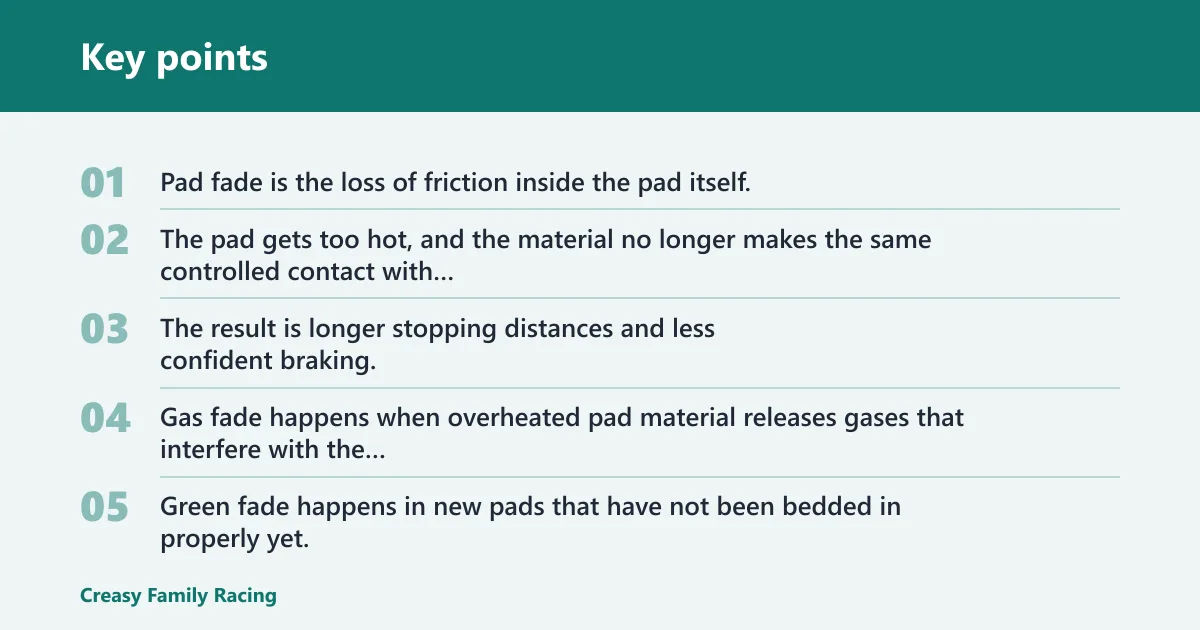
Pad fade is the loss of friction inside the pad itself. The pad gets too hot, and the material no longer makes the same controlled contact with the rotor. The result is longer stopping distances and less confident braking.
Gas or green fade
Gas fade happens when overheated pad material releases gases that interfere with the contact patch. Green fade happens in new pads that have not been bedded in properly yet. In both cases, the pad may feel okay for a moment and then lose bite under heat.
Fluid fade
Fluid fade is different. The pads may still be in range, but the brake fluid boils and compressible vapor enters the system. That produces a soft pedal, a longer pedal stroke, and a brake system that feels less firm even when the pad compound itself is still capable of working.
Picture a driver who runs a downhill section and then a hard braking zone into the next corner. If the pedal starts high and the car just stops less aggressively, that points more toward pad fade. If the pedal goes long and spongy, fluid is more likely to be the limiting factor.
How do you choose brake pads for track days?
A common rule of thumb is to choose pads based on the hardest about 10 minutes of driving, not the easiest 90 percent. If your event use is occasional and the car still sees normal street miles, a dual-duty pad can be the practical answer. If the car spends most of its life at the circuit, a dedicated track pad makes more sense. Autocross, HPDE, and wheel-to-wheel use can put different demands on the brakes, so the right choice depends on how hard and how long the braking actually gets.
Occasional event use
If you attend a track day once in a while, start by asking whether your current pad can survive the event without overheating. A true street ceramic pad is usually the wrong choice if the session includes repeated heavy braking and long hot laps.
A common first-timer mistake is assuming “streetable” means “track-ready.” It often means only that the pad can still be driven on public roads afterward, not that it will stay consistent through a full session.
Dual-duty pads
Dual-duty pads are the middle ground. They are often a compromise between street comfort and higher-heat use, and they hold on to more heat than a typical street pad. That makes them useful when you want to drive the car to the event, run a short session, and drive home without swapping compounds.
For many weekend drivers, this is the cleanest compromise. It is not the quietest choice, and it is not the lowest-wear choice, but it can fit both jobs better than a pure street pad or a full track compound.
Dedicated track pads
Dedicated track pads are the right answer when the event is serious enough to push a street compound past its limit. They are severe-dust, not suited to street use, so they are usually the wrong choice for a daily-driven car that spends most of its time in traffic or parking lots.
They do, however, resist fade under repeated hard stops far better than street compounds. That is the reason they exist.
Front and rear balance
Front pads usually do the most work, so front and rear choices do not always need to match exactly. Many drivers step up the front first, then choose a rear pad that keeps the car balanced without making the rear too aggressive or too weak.
If the rear compound is too street-oriented compared with the front, the car may feel inconsistent under heavy braking. If the rear is too aggressive, the car can become nervous at turn-in or during trail braking. Match the pair to the car’s brake bias and the session’s heat load.
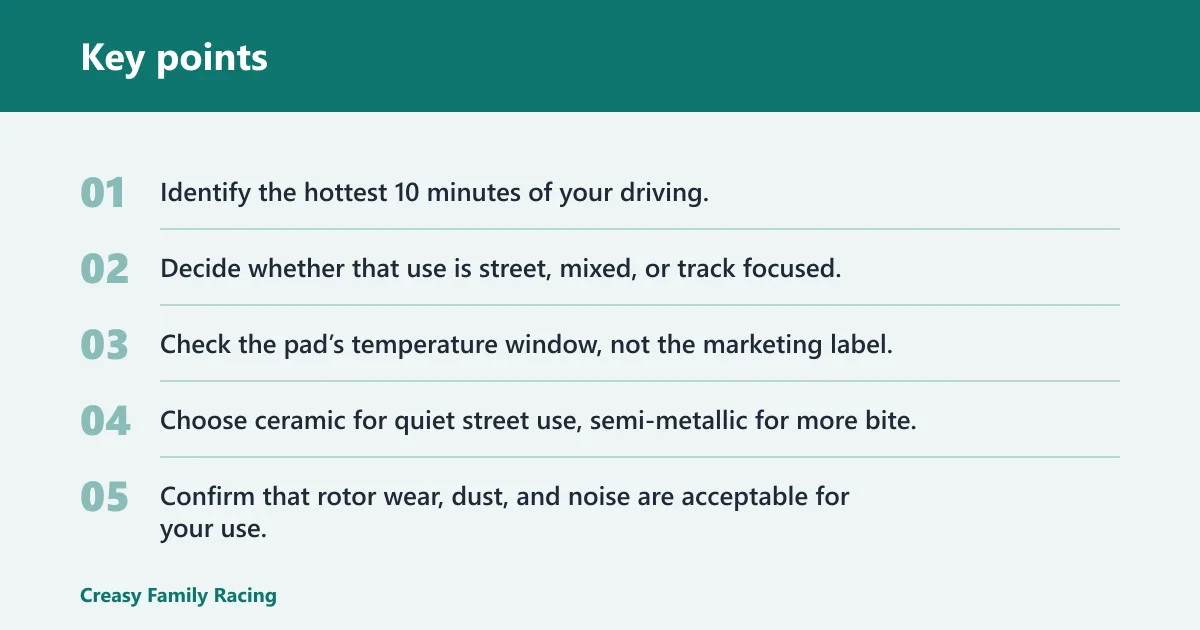
- Identify the hottest 10 minutes of your driving.
- Decide whether that use is street, mixed, or track focused.
- Check the pad’s temperature window, not the marketing label.
- Choose ceramic for quiet street use, semi-metallic for more bite, dual-duty for mixed use, or track compound for repeated heat.
- Confirm that rotor wear, dust, and noise are acceptable for your use.
Ceramic, semi-metallic, and track compounds
Compound choice matters because it changes how the pad behaves when cold, when hot, and when the rotor is being worked hard. The label on the box is less useful than the pad’s heat ceiling and its side effects.
Ceramic for street use
Comfort ceramic is listed as minimal dust and street-safe. It is a strong fit for daily driving where quiet operation matters and where brake temperatures stay well below track levels. It is usually the wrong pick for repeated lapping.
That lower heat ceiling is the price of clean street behavior. It is useful on the road, but it is not built for long sessions with repeated heavy braking.
Semi-metallic tradeoffs
Semi-metallic pads usually offer more bite and more heat tolerance than ceramic. They can also bring more dust and a little cold squeal, especially on cars that are driven gently most of the time.
They are a sensible middle ground when you want stronger braking response without moving all the way to a track-only compound. They are still not a default answer for track days unless their temperature window matches the event.
Track compounds and rotors
High-heat track-oriented compounds are made for heat. They can run hard when the brakes are being punished lap after lap, but they can be rougher on rotors, noisier on the street, and weak when cold.
Rotor compatibility matters because pad choice affects wear, noise, vibration, and the surface transfer layer. A pad that does not leave a stable transfer layer can feel grabby, dusty, or uneven, and that can make the brakes noisy or rough even if the pad has plenty of material left.
What to expect cold
Cold behavior is where many track compounds disappoint street drivers. The first stops can feel wooden, and the car may need a few firm applications before the pad begins to work in its intended range.
That is normal for a track compound. It is a warning, not a defect.
Bedding-in and rotor compatibility
Bedding-in matters because it sets the transfer layer and helps prevent glazing. The pad and rotor need a controlled heat cycle so the friction surface works as intended before full-load braking.
Gentle initial stops
Start with a series of gentle braking procedures to begin building the transfer layer without shocking the material.
Heat cycle transfer
The point of bedding is controlled heat, not max effort. The pad needs enough heat to move material onto the rotor face, but not so much that the surface overheats and turns glossy.
Cooling between stops
Cooling between stops keeps the pad from overheating before the surface layer is set. If the pad is driven too hard too soon, the face can glaze and the rotor transfer layer can become uneven.
Glazing prevention
Glazing reduces bite and makes the brakes feel inconsistent. It often shows up after heat that was too high, too soon, or too repeated without the right cooldown. That is one reason bedding is more than a formality.
How do you tell pad fade from fluid fade?
Pad fade usually shows up as weak braking with a pedal that still feels fairly firm. Fluid fade usually shows up as a soft pedal that travels farther before the brakes bite. The difference matters because one points to the pad compound and the other points to the hydraulic system.
| Symptom | Most likely cause | What it feels like | What to inspect next |
|---|---|---|---|
| Hard pedal, weak stopping | Pad fade or gas fade | Pedal stays firm, but the car will not slow as expected | Pad condition, bedding, rotor surface |
| Soft pedal, longer travel | Fluid fade | Pedal sinks farther and feels less solid | Brake fluid age, boiling point, system condition |
| Noise, dust, and uneven feel after heat | Compound mismatch or glazing | Brake response changes across stops | Pad temperature window, transfer layer |
If the pedal gets long, check fluid first. High-temp fluid matters when the car sees repeated track heat, because even a good pad cannot fix boiling brake fluid.
Frequently asked questions
Are all brake pads the same?
No. Pads use different compounds, and those compounds are built for different temperature windows. Street pads favor cold bite, low noise, and low dust, while track pads are built to stay consistent under repeated heat. The label matters less than the pad’s operating range.
How are track brake pads different from street pads?
Track pads are made for repeated high-temperature braking and better fade resistance. Street pads are tuned for quiet operation, low dust, and strong cold-stop performance. The tradeoff is clear: track pads usually work worse cold, while street pads give up earlier when heat rises.
Do track brake pads work on the street?
They can, but often poorly. Track pads may squeak, dust heavily, and feel weak when cold. If the car is driven daily, that noise and poor cold bite can be hard to live with, which is why many drivers reserve track pads for event weekends only.
What temperature window do track brake pads need?
Track pads are built to operate in a higher heat range than street pads, but the exact window varies by compound and brand. Below their intended range, many can feel dull or inconsistent, especially on the street. That is why they are matched to repeated hard braking instead of normal commuting.
How do I choose between ceramic, semi-metallic, and track compounds?
Choose ceramic for quiet street use and minimal dust. Choose semi-metallic if you want more bite and can accept more dust and some noise. Choose track compounds only if repeated heat is the real problem and you are willing to accept heavy dust, more rotor wear, and worse cold manners.