Why Do Brake Rotors Warp After a Track Day?
Most post-track-day brake “warp” is not a bent rotor; it is usually rotor thickness variation, pad deposits, or hub/runout error after repeated high heat. Ignore it and you will chase the wrong fix, waste pads and rotors, and keep the vibration coming back. This guide shows how to tell true rotor damage from lookalikes and what to inspect before replacing parts.
What people mean by warped rotors
When drivers say “warped rotors,” they usually mean a brake problem that causes pulsation, shake, or uneven braking feel. In practice, the usual culprits are uneven thickness, uneven friction material, or runout, not a rotor that has literally bent into a new shape.
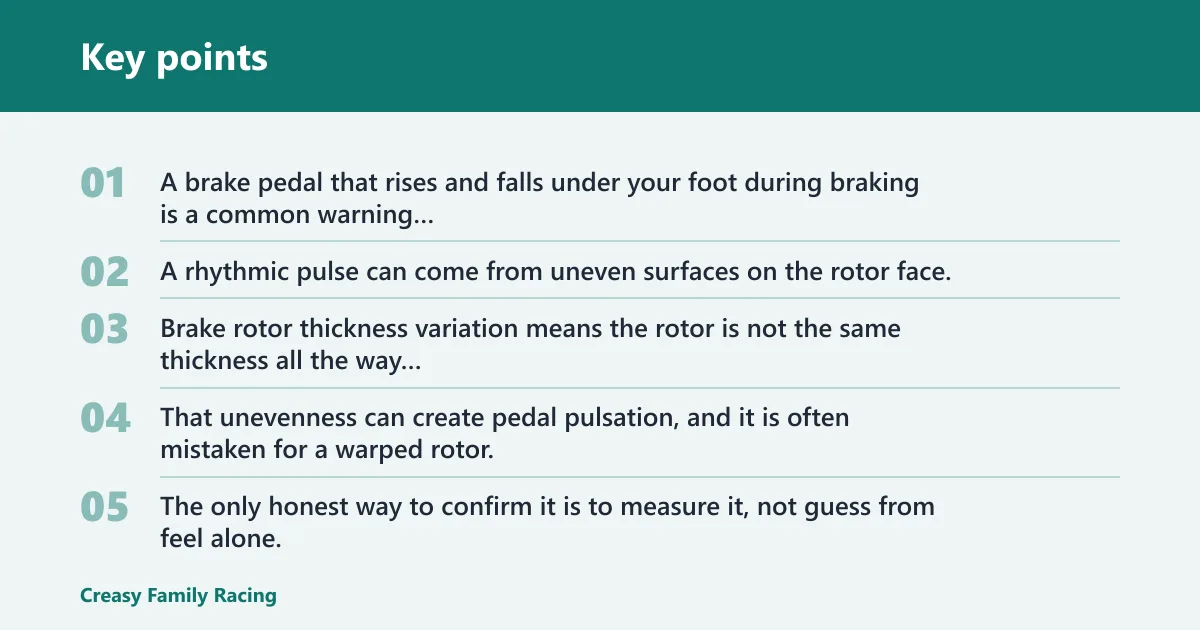
A brake pedal that rises and falls under your foot during braking is a common warning sign. A rhythmic pulse can come from uneven surfaces on the rotor face, and a vibration that starts when you press the pedal and disappears when you release it points to brake components rather than tire balance or suspension parts.
Thickness variation versus true rotor damage
Brake rotor thickness variation means the rotor is not the same thickness all the way around. That unevenness can create pedal pulsation, and it is often mistaken for a warped rotor. The only honest way to confirm it is to measure it, not guess from feel alone.
True heat damage can exist, but the most common post-track complaints trace to thickness variation, pad transfer, or runout. A rotor can be out of service without being physically bent. That matters, because the fix changes with the failure mode.
How track-day heat changes the diagnosis
Track-day braking loads the system differently from street use. Repeated hard stops, then heat soak in the paddock or in the pits, can leave hot rotors more likely to develop uneven pad deposits or thickness changes. Street driving rarely pushes the system into that same pattern.
That is why a brake that feels fine on the road can start pulsing after a session. Heat changes pad behavior, rotor surface condition, and the way the rotor seats on the hub. Those effects can be temporary, but they can also repeat if the root cause stays in place.
Why do brake rotors warp after a track day?
Most track-day “warping” complaints start after repeated hard stops because the brake system is hot, then held still while the pads clamp the rotor. Heat soak, stationary clamping, and uneven cooling can leave deposits or thickness changes that feel like warping even when the rotor has not bent.
Heat soak after repeated hard stops
Hard braking raises rotor temperature fast. After the session, heat soak keeps the rotor and pad interface hot even while the car sits. Hot rotors are more likely to develop uneven pad deposits or thickness changes, especially if the car is parked with the brakes clamped hard.
Say your car comes off track with a smooth pedal in the first cooldown lap, then starts pulsing after it sits in the paddock. That pattern fits heat-related pad transfer better than a rotor that suddenly changed shape in one stop.
Stationary clamping on a hot rotor
If the car stops and the pedal stays pressed, the pad can imprint material onto a hot rotor face. That localized deposit creates a thicker or more friction-heavy area, which can show up as pulsation later. This is one reason a post-session hot stop can leave a lasting complaint.
A common mistake is to come off a hot lap, stop with the brakes clamped at the pit lane, and then let the car sit with the pads pressing one spot on the rotors. If the pedal pulsation appears on the next drive, the rotor may be reacting to pad deposits, not a literal bend.
Why street and track symptoms differ
Street braking usually gives the brakes time to cool between events. Track use stacks heat cycles back-to-back, so small installation errors, pad chemistry issues, or slide-pin problems become more obvious. The same parts can feel acceptable on the street and poor after one hard day.
What causes rotor vibration?
Rotor vibration usually comes from one of three places: uneven pad material transfer, rotor runout tied to the hub or wheel seating, or clamping problems at the caliper. Track use amplifies all three. That is why diagnosis should start with the surface, the mounting, and the hardware.
Uneven pad material transfer
Pad transfer is a layer of friction material that deposits unevenly on the rotor face. After hard braking and heat soak, that layer can become patchy and mimic a warped rotor. Mild cases may respond to proper bedding or correction, but severe cases often keep returning.
Rotor runout from hub issues
Rotor runout is side-to-side wobble at the rotor face. It can cause pedal pulsation and is often linked to hub cleanliness, rust, and wheel torque. A dial indicator is the right tool for diagnosing it, because runout is a measurement problem, not a guess.
Wheel torque and seating problems
Uneven torque on wheel nuts or caliper bolts can lead to rotor distortion and pulsation. Lug nuts need to be tightened evenly and to the correct specification, using a star pattern and a torque wrench during assembly. Uneven clamping can distort how the rotor seats on the hub.
Caliper slide pins and clamping balance
Caliper slide pins must move freely. If they seize, the caliper can clamp unevenly and overheat one corner more than the others. That kind of drag can cook pads, create uneven deposits, and make a good rotor feel bad. Replacement and high-temp grease may be needed.
Brake rotor diagnosis checklist
Use symptoms to narrow the cause before replacing parts. Pedal pulsation, steering-wheel shake, one-wheel overheating, and ABS confusion point to different checks. The goal is to match the symptom to the most likely failure and confirm it with a quick inspection or measurement.
| Symptom | Likely cause | Quick home check | Next action |
|---|---|---|---|
| Pedal pulsation | Thickness variation, pad transfer, or runout | Brake from 40 to 60 mph and note whether the pulse grows with speed | Measure rotor runout and thickness variation; inspect pad imprinting |
| Steering-wheel shake | Front rotor issue | Feel whether the shake comes through the wheel during braking only | Check front rotors, hub surface, and wheel torque |
| One-wheel overheating | Seized slide pins or caliper drag | Compare wheel and rotor temperatures after a short drive without heavy braking | Inspect slide pins, pads, and caliper movement |
| Pad transfer | Hot stop or improper bedding | Look for blotchy rotor color or a repeated high-spot feel | Re-bed if mild; correct or replace if deposits are severe |
| Hub rust | Poor rotor seating | Remove the wheel and inspect the hub face for scale or debris | Clean the hub flat before reinstalling the rotor |
| Seized slide pins | Uneven clamping | Check whether the caliper slides by hand with the wheel off | Clean, lubricate, or replace the pins as needed |
| ABS confusion | ABS activation, not rotor damage | Watch for warning lights and note whether the pulsation happens during threshold braking | Differentiate ABS action from brake pulsation before replacing parts |
Pedal pulsation and steering-wheel shake
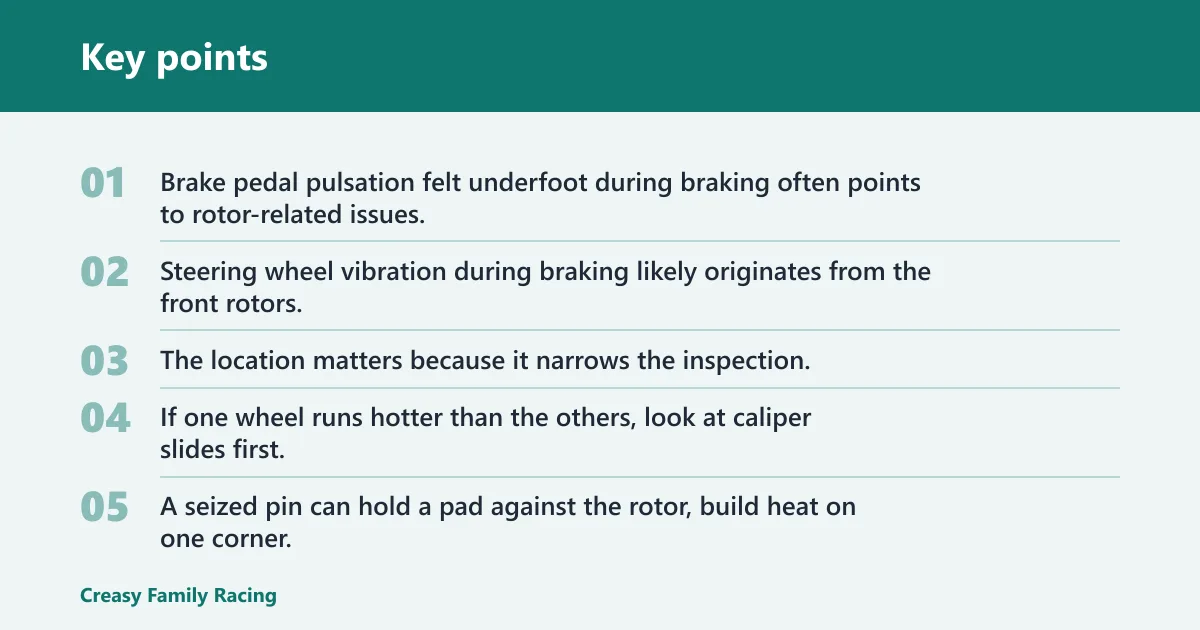
Brake pedal pulsation felt underfoot during braking often points to rotor-related issues. Steering wheel vibration during braking likely originates from the front rotors, while vehicle or seat vibrations are more likely from the rear rotors. The location matters because it narrows the inspection.
One-wheel overheating and slide pins
If one wheel runs hotter than the others, look at caliper slides first. A seized pin can hold a pad against the rotor, build heat on one corner, and create the kind of uneven wear that masquerades as rotor warp. That failure can also damage pads fast.
ABS confusion and warning lights
ABS engagement can feel like pulsation, but it is a safety feature, not rotor damage. Check warning lights and the braking context. If the pulse happens only during aggressive threshold braking on loose or uneven pavement, ABS may be doing its job instead of exposing a rotor fault.
How do you check for rotor runout?
Check rotor runout by cleaning the hub mating surface, reinstalling the rotor correctly, and measuring the rotor face with a dial indicator. Runout can be affected by rust, debris, and wheel torque, so the measurement should be taken on a clean, properly seated assembly.
Cleaning the hub mating surface
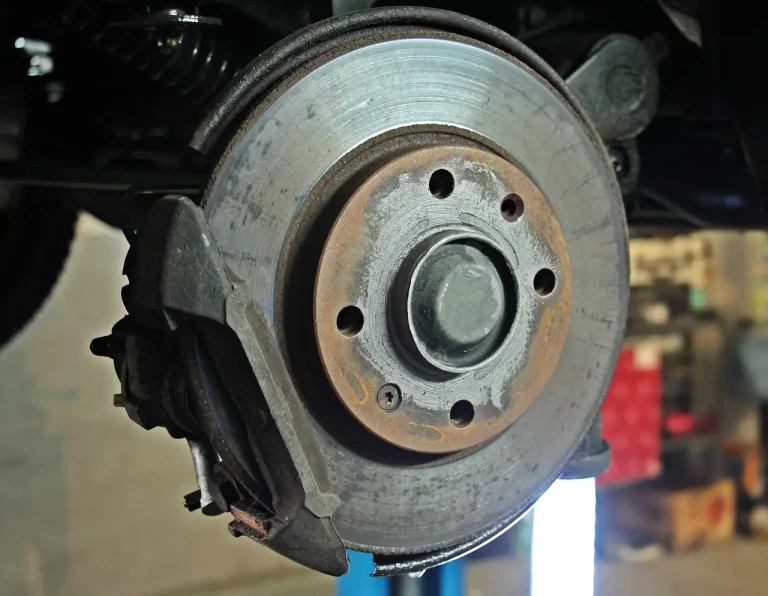
Rust and debris on the hub mating surface can throw the rotor off-center and affect runout. The hub face must be cleaned flat before installation. If the rotor sits on scale or grit, the rotor can appear bad even when the disc itself is serviceable.
Using a dial indicator correctly
A dial indicator gives a direct reading of side-to-side movement at the rotor face. That is the right way to confirm runout. Without a measurement, it is easy to confuse surface transfer, pad wear, and hub seating problems with actual rotor movement.
When wheel torque changes the reading
Wheel torque can change how the rotor sits on the hub, which can change the runout reading. Uneven torque on the wheel nuts can lead to rotor distortion and pulsation, so torque the wheels evenly in a star pattern with a torque wrench before taking any final measurement.
How do you fix warped rotors?
Fix the cause, not only the symptom. Mild pad transfer may respond to proper bedding or resurfacing, but track use often makes replacement the better long-term choice. If the rotor is within specification and the source is contamination or seating, correct that first.
When bedding can correct pad transfer
If the rotor face shows light, uneven friction deposits and thickness variation is not severe, a controlled bedding cycle may restore even transfer. That works best when the pads are still healthy and the rotor is not heat-checked, cracked, or near its service limit.
When resurfacing makes sense
Resurfacing rotors may work for mild warping, but it can be temporary. For a street car with light pulsation and enough rotor thickness left, it can be a valid short-term fix. For repeated track use, a thin or heat-stressed rotor may come back with the same complaint.
When replacement is the better choice
Replacement is often the better choice when the rotor has severe thickness variation, deep pad deposits, heat damage, or too little material left after machining. Track-day brakes see higher thermal load, so a rotor that is already marginal is more likely to repeat the problem.
Why do rotors keep warping?
Rotors keep “warping” when the real cause is still present. Seized slide pins, uneven lug torque, poor hub cleanup, and repeated heat cycles can all recreate the same vibration. If the fix stops at resurfacing or new rotors, the symptom usually returns.
Seized caliper slide pins
Slide pins that do not move freely keep the pads from retracting evenly. That creates drag, heat, and uneven wear. If the pins are the root problem, new rotors will only buy time until the caliper loads the next set the same way.
Uneven lug torque
Unevenly tightened lug nuts can distort rotor seating and create runout or thickness variation-like symptoms. The wheel must be tightened evenly and to spec. Use a star pattern, then verify with a torque wrench during assembly. Skipping that step can undo a fresh brake job.
Persistent heat and pad deposits
Track use can keep generating the same deposit pattern if pad choice, cooling, or driving style keeps the brakes too hot. Hot stops, a long idle with the pedal held down, or a caliper that drags will all set up the next vibration. The pad, rotor, and hardware need to be addressed together.
Suppose the steering wheel shakes only after a session, and the left-front wheel feels much hotter than the right-front. That pattern points away from a generic “warped rotor” story and toward a drag problem at that corner, such as a sticky slide pin or uneven pad transfer.
Frequently asked questions
What causes warped brake rotors?
The most common causes are uneven thickness, uneven friction material, and runout. On track cars, heat makes those problems more likely. Add in poor hub cleanup, uneven lug torque, or seized slide pins, and the brake system can feel “warped” very quickly.
How do brake rotors get warped?
They usually do not warp in the literal sense. What changes first is the rotor face condition or how the rotor sits on the hub. Heat, pad transfer, and clamping force create the vibration. A measurement, not a guess, tells you which one you have.
Is it possible to warp a rotor?
A rotor can be damaged by heat, and it can end up with runout or thickness variation that acts like a warped part. But most complaints after a track day are not from the disc physically bending. The more common issue is uneven surface condition or seating.
How do I check for warped brake rotors?
Start with the symptom, then inspect the hardware. Remove the wheel, clean the hub mating surface, check the slide pins, and measure rotor runout with a dial indicator. If the pedal pulse remains, measure thickness variation and inspect for pad deposits before buying parts.
Should I replace rotors or find the real cause first?
Find the real cause first unless the rotor is clearly damaged, too thin, or heavily heat-affected. New rotors can still pulse if the hub is rusty, the wheel torque is uneven, or the caliper drags. Replacement without diagnosis often repeats the same failure.