How Much Does a First Drag Strip Night Cost?
A first drag strip night for a beginner street car commonly costs about $100 to $250 in fees, fuel, food, and a small reserve; plan closer to $300 if you want room for wear items, a second pass, or a tech fix that has to be bought on site. This guide is priced against current public test-and-tune pages from drag strips, NHRA-style tech requirements, and current safety-gear retailer ranges, with the worksheet split for a stock street car versus a modified street car. If you need a quick primer first, see drag strip length, drag car cost, dragster cost, tech inspection basics, and helmet ratings. The goal is simple: avoid the most common first-night surprises before they turn into an early exit.
First-night budget at a glance
For a first street-car outing, the real question is not the cost of building the car. It is the cost of getting through one night without surprises. Public test-and-tune pages from active tracks commonly show racer entry or test-and-tune pricing in the rough $25 to $75 range, with some facilities adding a separate gate or spectator charge, while NHRA-style tech rules determine whether the car needs only a helmet or also gloves, a jacket, or more equipment. Retail helmet prices commonly run about $60 to $400+ depending on rating and shell type, with gloves and jackets adding more when required.
A practical first-night plan usually has three bands. Minimum viable keeps you on track with the required basics. Comfortable gives room for a second pass, a better meal, or a small wear item. Fail-safe holds cash for a tech rejection, extra fuel, or a replacement item before re-checking. The budget was calibrated for a stock commuter car that is street-legal and a lightly modified street car that still drives to the strip.
| Budget tier | What it covers | Typical first-night total |
|---|---|---|
| Minimum viable | Track fee, basic food, fuel top-off, and only the gear the track requires | $100 to $150 |
| Comfortable | Track fee, gear, fuel, tires wear, food, and a larger cash buffer | $175 to $250 |
| Fail-safe | Everything above, plus money set aside for tech rejection or a towing backup | $250 to $300 |
Use those numbers as decision budgets, not build budgets. A street-legal sedan or coupe that only needs a basic helmet and a few gallons of premium gas can stay near the low end. A more modified street car that needs additional safety gear, more fuel, and a bigger contingency reserve usually lands near the higher end. Heavier or faster cars can push the total higher because tech requirements, tire wear, and fuel use climb together.
What does a drag strip pass fee include?
A drag strip pass fee usually buys you lane access, timing, and the track’s basic safety process. On test-and-tune nights, the fee often covers your run through the staging lanes, a timing slip, and the pre-race briefing. Event pricing can be different, with separate registration or class fees added on top. That is why a public page may show a racer fee and still list a separate gate admission for everyone at the property.
Track pricing can also vary by local vs travel-night setup. A nearby local strip may offer a modest entry with multiple passes, while a traveling race weekend can add parking, crew, or class-based charges. The important distinction is simple: gate fee is not the same as racer tech or pass fee.
Test-and-tune vs event pricing
Test-and-tune is usually the beginner-friendly format. You pay to make passes, compare times, and sort out launch and shift points. A full event may charge for class entry, pit access, or a separate racer registration fee, so one night can cost more than the listed pass price.
If the track offers nightly admission, count that as the base gate or racer entry, then add any class or tech fee separately if the page lists one. If it uses per-pass pricing, count every run. Either way, do not fold spectator admission into the driver budget unless a companion is actually paying to enter.
Racer fee vs spectator admission
Do not mix up the driver’s cost with the passenger’s or spectator’s cost. A companion may pay a spectator fee while the driver pays the racer fee. That difference matters, because a first outing can look inexpensive until two admission lines and food are added.
For a beginner, the useful question is simple: what does the driver need to pay to make one legal pass, and what extra does a companion pay to enter the gate? Ask the track before you leave home.
Safety gear you may need to pass tech
Basic safety gear is priced at about $60 to $400+ for a helmet, with gloves often in the $20 to $80 range and a jacket commonly around $80 to $250, based on current retailer pricing and rating level. The exact requirement depends on the track and the car. A helmet is the most common purchase, and some tracks also require gloves or a jacket for certain cars or elapsed-time brackets. Track-mandated gear is not the same as optional gear.
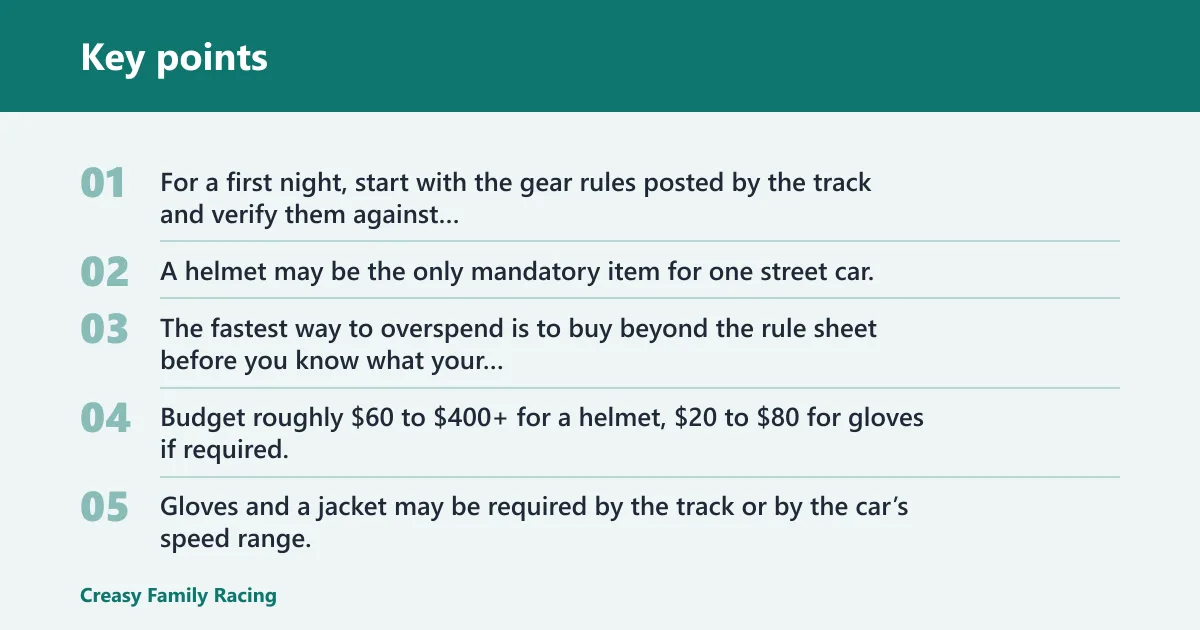
For a first night, start with the gear rules posted by the track and verify them against the vehicle’s setup. A helmet may be the only mandatory item for one street car, while another car may need a jacket or additional restraint equipment before tech will pass it. The fastest way to overspend is to buy beyond the rule sheet before you know what your car actually needs.
How much should I budget for helmet, gloves, and jacket?
Budget roughly $60 to $400+ for a helmet, $20 to $80 for gloves if required, and $80 to $250 for a jacket if the rulebook calls for one. The helmet is usually the main cost item. Gloves and a jacket may be required by the track or by the car’s speed range, but they are not universal requirements. The right budget depends on whether the rules list them as mandatory.
Buy to the rule, not to the rumor. A track may accept a current helmet rating and leave gloves optional, while another may want a jacket once the car crosses a certain performance threshold. Check the current tech sheet before spending.
What is mandatory and what is optional?
Mandatory items are the ones the track will check at tech. Optional items are comfort or convenience items that may still matter, such as extra gloves, a thin hoodie under a required jacket, or ear protection. Optional does not mean useless; it means the car may still pass without it.
If the car is borderline on safety requirements, keep the fail-safe reserve open. That reserve is what buys the item that lets the car pass tech on the second try.
How much fuel and tire wear should you budget?
Fuel and tires are easy to undercount. Fuel for a day of racing may cost around $25 to $100 for a basic street car and more for higher-output setups, while tire cost depends on whether the car is on a street tire, a drag radial, or a slick. A first night can use little fuel, but repeated passes and idling in the lanes add up fast.
A stock street car is usually cheaper to feed and easier on tires than a modified car. The more the car hooks and the harder it leaves the line, the more the tire bill matters. One night may not kill a tire, but it can add noticeable wear.
Pump premium vs race fuel
Most beginner street cars can run on premium pump gas for a test-and-tune night if the car is built for it. Race fuel costs more and is usually only worth planning for if the car needs it for tuning or detonation control. For a first outing, premium pump gas is the common budget choice.
Count a top-off before the track and enough cash for a little extra afterward. That usually covers idling, staging, and a few passes without forcing you to gamble on the fuel gauge.
Street tire, drag radial, or slick
A street tire is usually the cheapest first-night option, but it may spin more and wear less predictably on repeated launches. A drag radial costs more and can improve consistency. A slick is more specialized and tends to push the budget and prep level higher than a first-timer usually needs.
Wear rate depends on launch style, burnout length, and how many passes you make. A conservative first night may only round off the edges of a street tire, while an aggressive launch on a sticky setup can chew through tread far faster.
Drag strip budget worksheet
This worksheet turns the first night into a spending plan. Use the stock street car column if the car is mostly unmodified and only needs basic tech compliance. Use the modified street car column if the car has aftermarket parts, higher power, or a greater chance of needing extra equipment. Use the local-night assumption if the strip is close enough for a same-day trip. Use the travel-night assumption if the event requires a longer drive, a hotel, or a bigger fuel reserve.
| Item | Stock street car | Modified street car | Travel-night assumption | Local-night assumption |
|---|---|---|---|---|
| Track fee / pass fee | $25 to $50 | $40 to $75 | $50 to $100 | $25 to $60 |
| Tech-required gear | $60 to $150 | $150 to $400+ | $100 to $400+ | $60 to $250 |
| Fuel | $25 to $50 | $50 to $100 | $50 to $120 | $25 to $60 |
| Tires | $0 to $20 | $20 to $75 | $20 to $75 | $0 to $25 |
| Food and drink | $15 to $25 | $25 to $40 | $30 to $60 | $15 to $30 |
| Emergency cash | $20 to $50 | $50 to $100 | $75 to $150 | $20 to $75 |
| Total | $145 to $345 | $335 to $790+ | $325 to $885+ | $145 to $500 |
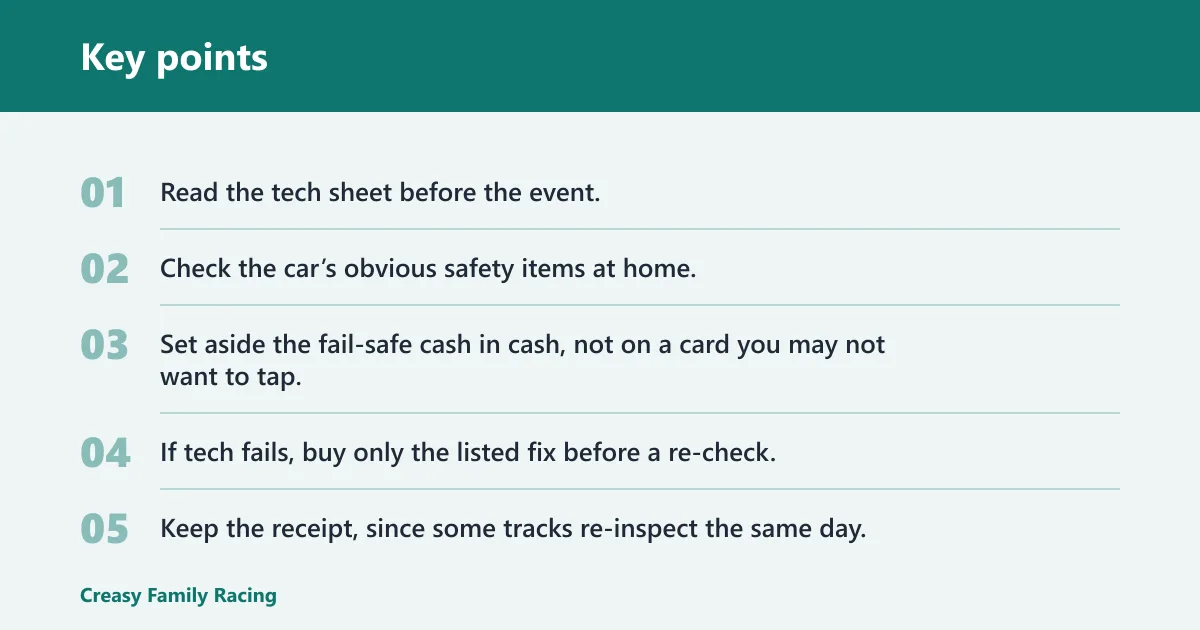
If tech fails, what to buy before re-checking: buy the item that fixes the rejection, not a larger upgrade. That may be a current-spec helmet, gloves, a jacket, a battery hold-down, a wheel-stud issue, or another rule-specific item listed by the track. In practice, the first purchase should match the exact tech sheet item that failed.
- Read the tech sheet before the event.
- Check the car’s obvious safety items at home.
- Set aside the fail-safe cash in cash, not on a card you may not want to tap.
- If tech fails, buy only the listed fix before a re-check.
- Keep the receipt, since some tracks re-inspect the same day.
First-night failure scenarios that happen often
Three common first-night tech problems show up repeatedly at the strip. A helmet may be outdated for the track’s current rule set even if it looks fine. A battery may lack a secure hold-down, which is a simple but very common fail. A car may have tire, wheel, or loose-component issues that are easy to spot once tech looks closely but expensive if they are not handled before the run.
Those failures are why the worksheet keeps a real reserve. The issue is often not a major repair. It is a missing item, a noncompliant piece of gear, or a small hardware fix that has to be purchased immediately if the car is going to make a pass that night.
What hidden costs catch beginners off guard?
Hidden costs are the ones that do not look like racing costs until the gate opens. Membership or license fees may apply at some tracks. Small tools, fluids, tape, zip ties, and tow money can matter more than expected when a simple issue stops the night.
A modified car usually carries more of those costs than a stock street car. That is because extra parts bring more checks, more wear, and a greater chance of a small failure that needs attention before the next pass.
Membership or license fees
Some tracks or classes require membership, a day license, or a separate registration. Those charges are easy to miss if you only look at the pass price. Ask whether the listed fee is for the driver, the car, or the event.
If a license is required for your class, budget it before the first outing. Do not assume the pass fee covers every layer of access.
Tools, fluids, and small repairs
Bring a basic tool kit and a small reserve for fluids or fasteners. A loose clamp, low tire pressure, or a minor fluid top-off can stop the night if you have nothing on hand. These costs are small, but they keep a first outing from ending early.
Suppose a battery tie-down does not meet tech on arrival. The fix may be a low-cost part, but the cost still matters because it can turn into a missed pass if you did not budget for it.
Towing and repair reserve
Set aside money for a tow or a return trip if the car will not pass tech or will not make it home. Even a street car can have an issue that is cheap to fix but expensive to move. A small towing reserve is better than being stranded.
This is the part of the budget beginners forget most often. The car may be street legal, but a broken belt, dead battery, or tire damage can still end the night in the pits.
What should you bring for food, water, and travel?
Food, water, and travel cost less than the car, but they still belong in the budget. Fuel to and from the track may be modest for a local event, yet a long drive can change the total quickly. Meals, drinks, and a little emergency cash should sit in the plan from the start.
For a first-timer, plan for one meal, bottled water, and a snack reserve. That keeps you from paying track-side prices for everything or leaving because the driver is tired, hungry, or out of cash.
Fuel to and from the track
Budget the round trip, not only the burn at the strip. A nearby track may only add a small fuel bill, but a longer drive can eat into the money you meant for passes. If the car needs premium pump gas, fill accordingly before the event.
A common first-timer mistake is spending the full entry budget and forgetting the drive home. Leave enough fuel to return without running the tank near empty.
Meals, drinks, and water
Plan on simple food and water, not a full evening out. A reasonable food budget keeps the night moving and avoids leaving the pits for something basic. Water matters because long waits in staging and hot weather can drain energy fast.
Bring snacks in the car or pit bag if the track allows it. That small step keeps food costs predictable.
Emergency cash
Carry cash for the unexpected: a replacement entry sticker, a late snack, a forgotten item, or a quick tool purchase. Card readers are common, but cash is still useful when time matters. For a first outing, a small reserve is enough unless the car is borderline on tech.
Say your sedan passes tech, but a helmet visor or gloves do not meet the posted rule. Without emergency cash, the night may end before the first run. With cash, the fix can happen on the spot if the track vendor has the item.
Frequently asked questions
How much does a first drag strip night cost?
For a beginner street car, a first drag strip night usually lands between $100 and $250 for fees, fuel, food, and a small reserve. If you want room for wear items, a second pass, or a tech fix, plan closer to $300. Modified cars can run higher, especially when the track requires extra gear or a larger travel buffer.
What is the entry fee for a drag strip test and tune night?
Track entry for test-and-tune nights commonly falls in the $25 to $75 range, with some tracks adding a separate gate or spectator fee. A few facilities also split racer admission from per-pass or class fees, so the total depends on how the event is structured rather than on one universal price.
What will fuel and tires add to my first drag strip night?
Fuel for a day of racing may cost around $25 to $100 for many beginner street cars, though higher-output setups can cost more. Tire wear ranges from light on a street tire to more noticeable on a drag radial or slick, especially with hard launches.
Do I need a roll bar or cage for my first pass?
Not always. A roll bar or cage is class- and performance-dependent, so a first pass in a street car may not need one. The track’s current safety sheet decides that call, not a general rule. Check the rulebook before driving out.
What hidden costs do beginners forget before going to the strip?
Membership or license fees, basic tools, fluids, food, travel fuel, and towing reserve are the usual misses. Another common one is the failure-case budget: money for the specific item tech rejects, such as a helmet, gloves, or a required safety part.
Sources
- NHRA rulebook and tech inspection guidance for helmet, jacket, glove, roll bar, and general safety requirements
- Current test-and-tune and racer admission pages from active drag strips for public entry pricing structure
- Current safety gear retailer listings for helmets, gloves, and jackets in current rating classes
- Drag strip event pages and track tech sheets describing gate admission, racer fee, and class registration distinctions