What Class Is My Miata in for Autocross?
A stock ND Miata often lands in SCCA Street Touring or Street Touring Roadster after simple bolt-ons, while stock NA/NB/NC cars usually start in Street or Street Touring depending on trim; one common modification can move you out of the expected class. Get it wrong, and you can face a bump, a protest, or an event-day scramble to re-enter. This guide maps Miata generations and common mods to the classes you are most likely to see before you register.
What class is my Miata in?
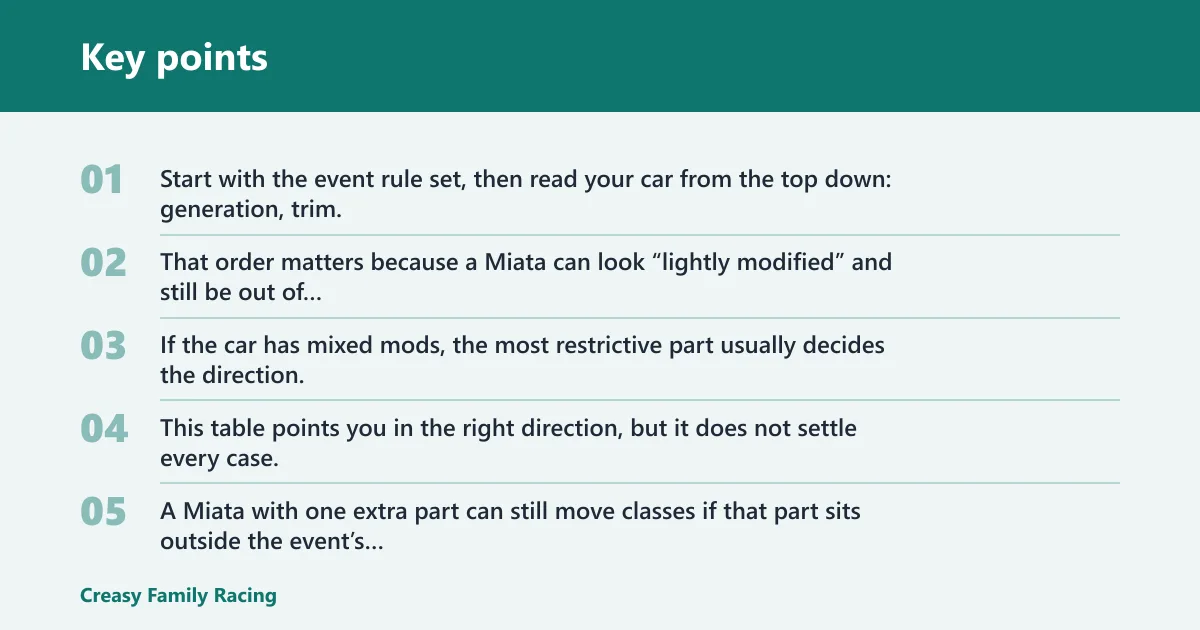
Start with the event rule set, then read your car from the top down: generation, trim, wheels and tires, suspension, then intake and exhaust. That order matters because a Miata can look “lightly modified” and still be out of Street if one part crosses the line. If the car has mixed mods, the most restrictive part usually decides the direction.
Miata autocross class table
| Generation | Trim | Wheel/tire changes | Suspension mods | Intake/exhaust changes | Likely SCCA Solo class direction | Verify before event |
|---|---|---|---|---|---|---|
| NA | Base or trim with factory equipment | Factory-size wheels and street tires | No suspension changes | Stock intake and exhaust | Street | Yes |
| NA | Factory LSD-equipped trim | Factory-size wheels and street tires | Stock springs, shocks, sway bars | Stock intake and exhaust | Street | Yes |
| NB | Base or limited-slip trim | Factory-size wheels and street tires | Stock or factory replacement dampers | Stock intake and exhaust | Street | Yes |
| NB | Any trim | Wider wheel, different offset, or competition tire | Aftermarket springs, coilovers, or alignment parts | Intake or exhaust change | Street Touring Roadster, then Street Prepared if the parts list crosses the Street Touring line | Yes |
| NC | Base or limited-slip trim | Factory-size wheels and street tires | Stock suspension | Stock intake and exhaust | Street | Yes |
| NC | Any trim | Wheel width or offset change, or aggressive tire fitment | Coilovers, sway bars, camber plates, non-stock arms | Intake or exhaust change | Street Touring Roadster or Street Prepared, depending on the exact parts | Yes |
| ND | Base, Club, or RF | Factory-size wheels and street tires | Stock springs, shocks, sway bars | Stock intake and exhaust | Street | Yes |
| ND | Any trim | Common autocross wheel/tire change | Lowering springs or coilovers | Intake or exhaust change | Street Touring Roadster for many bolt-on builds; Street Prepared when the setup goes beyond Street Touring rules | Yes |
This table points you in the right direction, but it does not settle every case. A Miata with one extra part can still move classes if that part sits outside the event’s rule set. When the setup is mixed, read the strictest item first.
Which Miata details change class?
Generation, trim, and factory equipment matter before any aftermarket part is added. On Miatas, the factory wheel and tire package, the presence of a limited-slip differential, and even trim-specific equipment can change which Street or Street Touring path you start in. That is why two cars with the same body shell can land in different places.
Factory wheel and tire differences by generation
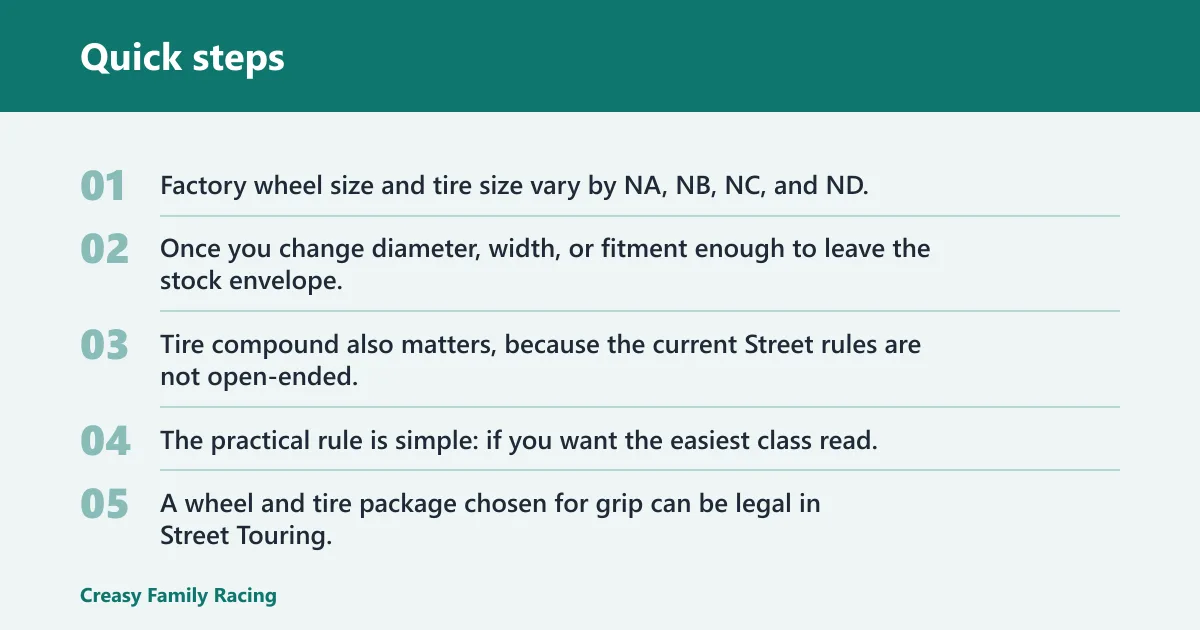
Factory wheel size and tire size vary by NA, NB, NC, and ND, and those factory sizes are the baseline for Street class checks. Once you change diameter, width, or fitment enough to leave the stock envelope, you need to check the wheel rule for the class you want. Tire compound also matters, because the current Street rules are not open-ended.
The practical rule is simple: if you want the easiest class read, keep the wheel package close to stock and stay on a normal street tire. A wheel and tire package chosen for grip can be legal in Street Touring, but the same package may knock the car out of Street.
Factory limited-slip differential differences by trim
Miata trim can matter because some trims include a factory limited-slip differential while others do not. That difference can affect class placement in some rulebooks and it also matters when you compare one car to another for parity. If the car is near-stock, write down the trim name and check whether the differential is part of that trim’s factory equipment.
Do not assume every Miata of one generation is classed the same way. A base car and a higher-trim car can follow different paths once you compare factory equipment against the event rules.
What mods move a Miata out of Street?
Street is the tightest of the four categories covered here. Wheel and tire changes, suspension parts, and some intake or exhaust changes can move a Miata out of Street quickly, even if the car still looks mild. Once you cross that line, Street Touring is the next place to check for lightly modified Miatas.
Wheel and tire changes that trigger a class change
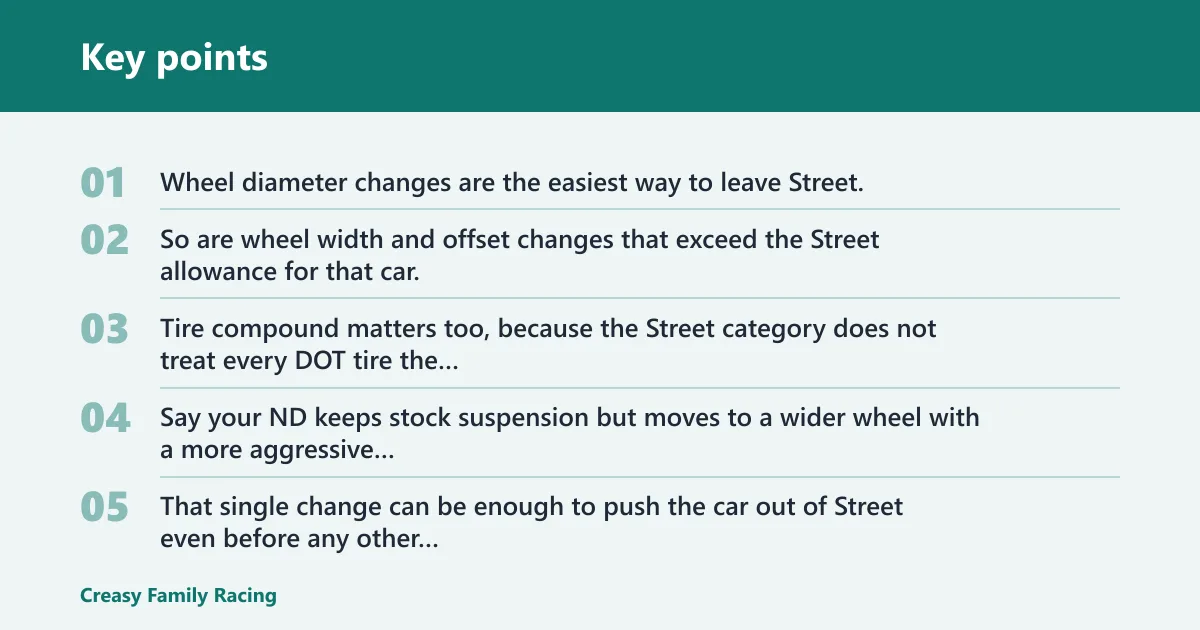
So are wheel width and offset changes that exceed the Street allowance for that car. Tire compound matters too, because the Street category does not treat every DOT tire the same way, and a grippier setup often belongs in a different class discussion.
Say your ND keeps stock suspension but moves to a wider wheel with a more aggressive offset to fit a larger front tire. That single change can be enough to push the car out of Street even before any other parts are considered.
Suspension changes that leave Street behind
Springs, shocks, coilovers, sway bars, camber plates, and adjustable arms all need a rule check. Some parts are Street-legal only in narrow factory-style forms, while others belong in Street Touring or beyond. Coilovers and alignment hardware are common fault lines because they often go beyond what Street allows.
A common first-timer mistake is mixing one allowed part with one disallowed part and assuming the whole package still counts as “mostly stock.” One set of coilovers plus camber plates can change the answer even if the car still uses stock wheels and tires.
Intake and exhaust changes that need rule checks
Intake and exhaust parts can be easy to overlook, but they still affect classing. A simple filter change may be fine in one category and out of bounds in another. A full intake system or a freer exhaust can push a Miata from Street into Street Touring, or from Street Touring toward a higher-prep class if other parts are already present.
Do not assume “bolt-on” means “Street-safe.” In autocross classing, the question is not whether the part was easy to install. The question is where the current rules place it.
Street Touring and the common Miata path
Many lightly modified Miatas end up in Street Touring Roadster, often shortened to STR. That is the common step-up when the car gets wheels, tires, springs, shocks, or basic bolt-ons that the Street class will not tolerate. For a modified Miata, STR is often the first place to check before you start reading higher-prep categories.
How to read the Street to Street Touring step-up
Think in layers. If the car is stock or nearly stock, Street is the first check. If the car has modest bolt-ons and still stays within the Street Touring rules for wheels, suspension, and power-adjacent parts, STR is the likely landing zone. If the setup includes more aggressive suspension geometry changes or parts beyond Street Touring allowances, move up again.
That step-up matters because a Miata that is only slightly modified can still be classed against a very different field once it leaves Street. The point is not to guess the “fastest” class. The point is to land in the correct one.
Where local rules still need a check
Local clubs sometimes split classes, combine classes, or allow a local-only index that does not match national SCCA Solo classing. That means a car can be legal in one club class and wrong in another. Read the local supplement first, then compare it to the current SCCA Solo Rules if you plan to use a national class label.
If the club says “street tire class” or “novice class,” ask what it maps to in the event’s rule sheet. Local labels are not always the same thing as SCCA class names.
Prepared and Modified boundaries
Prepared and Modified are the breakpoints for cars that go beyond the usual Street Touring path. If a Miata has major aero, deep suspension geometry changes, engine work, forced induction, or other non-street parts, it may leave Street Touring entirely. That is the boundary where the rules become much less forgiving.
When the car leaves Street Touring
Once the build starts to include parts that are not normal Street Touring fare, the car may move into Street Prepared or a Modified category. The exact line depends on the whole setup, not on one part alone. Wheels, tires, alignment hardware, power changes, and chassis modifications all matter together.
Picture an NC with coilovers, aggressive wheel fitment, and intake and exhaust changes already installed. If the build then adds more serious geometry or power changes, the car may no longer fit Street Touring at all.
What usually pushes a Miata into Prepared
Prepared is where the car starts to look like a serious autocross build instead of a lightly modified street car. The usual triggers are parts that go beyond Street Touring limits, especially in suspension and chassis setup. If your Miata has several non-stock systems working together, Prepared becomes a realistic possibility.
What usually pushes it into Modified
Modified is the farther boundary. Major engine changes, forced induction, extreme suspension changes, or other highly non-stock configurations can move a Miata there. If the car has gone well past bolt-ons and common autocross upgrades, do not try to squeeze it back into Street or Street Touring without checking the rule book line by line.
How to verify before registration
Check the current SCCA Solo Rules first, then check the local club supplement or event tech notes. Bring the exact mod list to registration if the class is not obvious. If there is any doubt, ask before you grid up. That is faster than fixing a class error after cars are already in line.
- Write down the Miata generation and trim.
- List every wheel, tire, suspension, intake, and exhaust part on the car.
- Match the wheel and tire setup against the current Street rules.
- If Street does not fit, check Street Touring Roadster next.
- If the car still does not fit, move to Prepared or Modified and verify again.
- Confirm the final answer with the event organizer or tech inspector before registration closes.
If the car has mixed parts, do not average them out. One disqualifying part is enough to change the class direction. If the organizer uses a local class sheet, follow that sheet for the event and keep a note of the national class for later comparison.
Frequently asked questions
What class is my Miata in for autocross?
A stock Miata usually starts in Street, while a lightly modified Miata often moves to Street Touring Roadster. The exact answer depends on generation, trim, wheel and tire setup, and suspension parts. If the car has mixed mods, use the most restrictive change first and verify against the event rules before you register.
How do I find my autocross class by car and mods?
Start with the car’s generation and trim, then list every modification in order: wheels and tires, suspension, intake, and exhaust. Compare that list with the current SCCA Solo Rules and the local supplement. If one part breaks Street, check Street Touring Roadster before looking at Prepared or Modified.
What mods move a Miata out of Street class in autocross?
Wheel diameter changes, wider wheels, offset changes, coilovers, camber plates, non-stock sway bars, and some intake or exhaust changes can move a Miata out of Street. The rule check is part-by-part, not “mostly stock” by feel. One disallowed part is enough to change class direction.
Do wheel and tire changes affect your autocross class?
Yes. Wheel diameter, width, offset, and tire compound all affect class placement. Staying near factory size makes Street easier to keep, while more aggressive fitment often points toward Street Touring Roadster or higher. Always verify the exact wheel and tire rule for your generation before the event.
Do coilovers or alignment parts change your autocross class?
Usually, yes. Coilovers, camber plates, and other alignment hardware are common reasons a Miata leaves Street. Some setups fit Street Touring Roadster, but that depends on the exact parts and how the rules treat them. Check the class rule before you install the parts, not after.
How do SCCA autocross classes differ from local classes?
SCCA Solo class names are national rule categories. Local clubs may use their own split classes, index systems, or novice groupings. A car can be legal in one local class and wrong in another, so read the event supplement first and treat the national class as a separate check.
Where can I find autocross class rules before an event?
Use the current SCCA Solo Rules and the local event supplement or tech notes. Those are the documents that decide classing, not forum guesses or old build threads. If the car is still unclear after that, send the mod list to the organizer before registration closes.