What RPM Should You Launch at on Street Tires?
Start around 2500-3000 rpm on street tires, then tune from the car’s behavior and the first 60 feet. No single rpm fits every manual car, because traction, gearing, torque curve, and track prep all change the result. Aim for a clean leave with no bog, no spin, and no hop.
Finding a workable launch point
Start with a baseline, not a guess
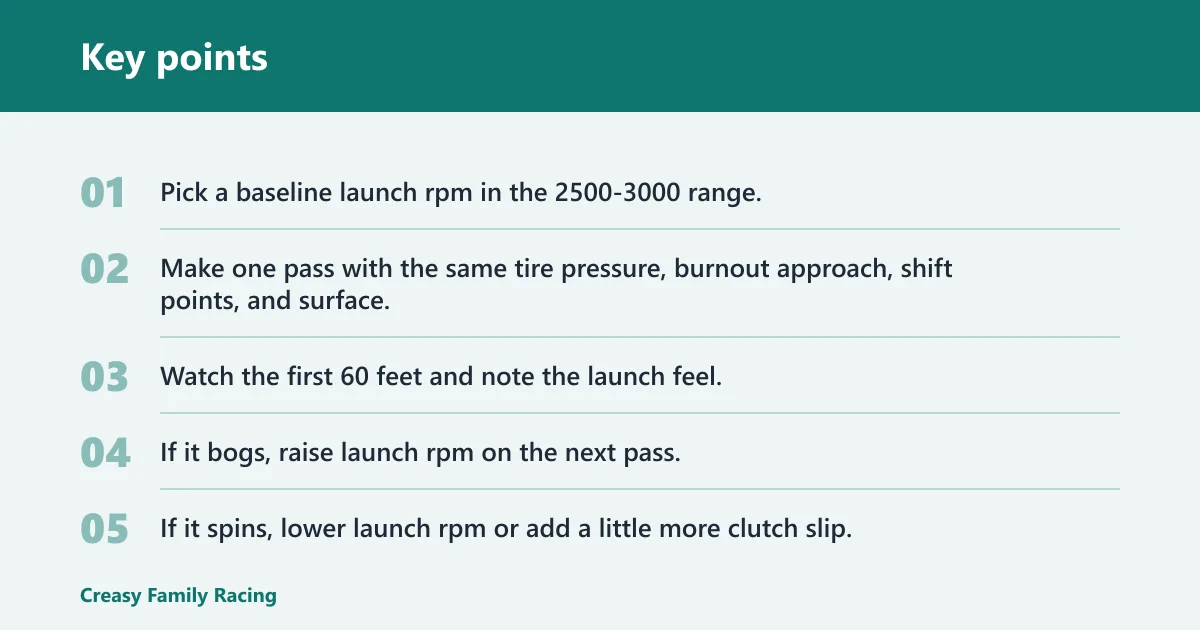
A practical baseline for many manual cars on street tires is about 2500-3000 rpm. One forum reply recommends revving and feathering between 2500 and 3000 rpm, then going to full throttle at 3500 rpm. Use that as a starting point, not the final setting.
Street tires give up grip faster than drag radials or slicks, so too much launch rpm can overwhelm them quickly. A front-drive car and a rear-drive car also react differently. Clutch choice, gear ratio, and axle load decide what the car will take on the hit.
Use the launch feel and the first 60 feet
The best launch rpm is the one that gives a clean hit and a repeatable 60-foot time. 60-foot time is commonly used as an early track metric for launch quality. Consistency matters more than one standout pass.
A common pattern is simple: if the engine falls on its face, the launch is too soft; if the tires flare, the launch is too aggressive; if the car shakes, the release is too abrupt or the driveline is getting shocked too hard.
Street-tire launch decision table
| Symptom at launch | Likely cause | Next adjustment |
|---|---|---|
| Bog | Engine rpm drops too low after the clutch comes in; one forum post says bogging can happen below 3000 rpm | Raise launch rpm in a small step, or slow the clutch release slightly so the engine stays in its power band |
| Spin | Too much torque reaches the street tire too soon | Lower launch rpm, add a little more clutch slip, or soften the throttle transition |
| Wheel hop | Too-fast clutch release or excessive torque too early | Release the clutch more progressively and back off the hit if the chassis starts oscillating |
That table is the useful part. Match the symptom to the cause, then change one variable at a time. On street tires, the wrong correction can make the next pass worse.
One-pass test sequence for manual cars
- Pick a baseline launch rpm in the 2500-3000 range.
- Make one pass with the same tire pressure, burnout approach, shift points, and surface.
- Watch the first 60 feet and note the launch feel.
- If it bogs, raise launch rpm on the next pass.
- If it spins, lower launch rpm or add a little more clutch slip.
- If it hops, slow the clutch release and back away from the hit.
- Stop changing once the car leaves cleanly and repeats.
Suppose a rear-drive car on ordinary street tires leaves cleanly at 2600 rpm, then noses over hard before the 60-foot clocks. That points to bog, not a traction problem. The next move is a small rpm increase, not a harder clutch dump.
Is it better to slip the clutch or dump it on street tires?
Slip the clutch. On street tires, clutch slip is the control that meters torque to the tires. It helps prevent both bogging and wheel spin. A hard dump loads the driveline all at once, which is exactly when street tires are most likely to complain.
How clutch slip works here
The clutch is the driver’s torque valve in a manual transmission. A controlled slip lets the engine stay in its usable range while the tire accepts load. That matters more on street tires because the tire has less grip margin than a drag radial or slick.
Too much slip is not free. It adds heat and wear, and if the release becomes a long slide instead of a quick, controlled transition, the clutch can take unnecessary abuse. The target is brief, controlled slip, not a dragged-out flare.
Why dumping the clutch is risky
A fast dump sends a shock through the driveline. On a sticky surface that can be useful; on street tires it often creates spin or hop. One forum reply warns that letting the clutch out too fast can cause wheel hop, and that hop can risk breaking axles.
That is why manual-car launch technique is different from an automatic brake-torque launch. The manual driver uses clutch engagement as the main control, not a stall-and-release routine.
How do you avoid wheel hop when launching hard?
Release the clutch more progressively and cut the shock to the driveline. Wheel hop usually shows up when too much torque arrives too quickly, especially if the clutch comes out abruptly. If hop starts on the hit, the next pass should be softer, not harder.
What wheel hop usually feels like
Wheel hop is a rapid oscillation of the tire and suspension. From the driver’s seat it feels like the car shakes or chatters instead of moving smoothly. That is a warning sign, not a launch strategy.
One forum post ties wheel hop to a too-fast clutch release and warns that it can break axles. If the car starts to hop, lift or abort the pass rather than trying to power through it.
What to change first
First, slow the clutch release. Second, reduce launch rpm if the car is still too aggressive. Third, check whether the surface is simply too poor for the current setup. Street tires on a marginal surface can hit hop sooner than the same car on a better-prepped lane.
A common first-timer mistake is assuming wheelspin from a muddy shoulder will disappear if you just launch at a higher rpm. That usually adds more shock, not more traction.
When should you go full throttle?
Full throttle timing matters in a manual launch. A common forum-style example says to rev and feather between 2500 and 3000 rpm, then go to full throttle at 3500 rpm. The point is to let the tire accept load before the engine sees the full hit.
Why throttle timing matters
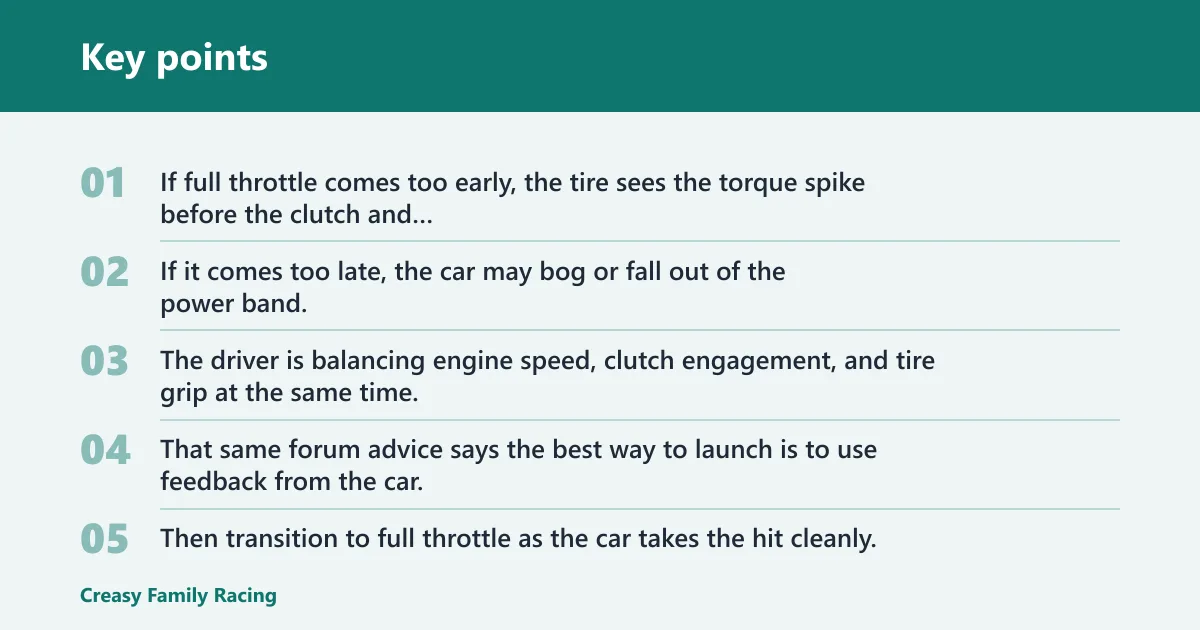
If full throttle comes too early, the tire sees the torque spike before the clutch and chassis are ready for it. If it comes too late, the car may bog or fall out of the power band. The driver is balancing engine speed, clutch engagement, and tire grip at the same time.
That same forum advice says the best way to launch is to use feedback from the car, that slipping the clutch is required, and that the clutch should be totally engaged by the time the engine is giving full power. Those are timing clues, not a fixed script.
How to transition without shocking the tires
Bring the rpm to the baseline first. Let the clutch begin to load the car. Then transition to full throttle as the car takes the hit cleanly. On street tires, a smoother feed is usually safer than a sudden stomp.
The car should not be off the clutch before 5000 rpm and should not be floored before 5000 rpm. That is one poster’s advice, not a universal rule, but it does show how much the timing debate varies. The useful part is the principle: match throttle timing to the tire’s ability to accept torque.
How do you find the best launch rpm in one session?
Test one variable at a time. Start in the 2500-3000 rpm range, then change only launch rpm, clutch release rate, or throttle transition on the next pass. That is the fastest way to find the best street-tire launch without turning the session into guesswork.
Bracket the baseline
Make two or three passes around your starting point. If 2600 rpm bogs, try a little more. If 2800 rpm spins, try a little less. Keep the rest of the launch the same. The answer is usually in the direction of the change, not in a dramatic jump.
Record what the car did
Write down the launch rpm, whether the clutch was slipped or released quickly, what the tires did, and the 60-foot time. A single pass can lie. Two or three consistent passes tell the truth.
Street surface, tire temperature, and lane prep all matter, so do not assume one number works everywhere. A better-prepped track surface may tolerate a little more rpm than a dusty one, but the same car still needs the same basic decision rule.
How much clutch slip is too much?
Too much clutch slip is any amount that turns a clean launch into a long, hot flare. You want enough slip to meter torque, but not so much that the clutch becomes the main source of speed loss. Repeatability matters more than one quick pass.
Signs the clutch is doing too much work
If the engine revs rise without the car moving forward the way it should, the clutch is slipping too much. If the launch feels soft but clean, the rpm may simply be too low. The difference matters.
One useful rule is to keep the clutch fully engaged by the time the engine is giving full power. That limits heat and helps protect the clutch from unnecessary abuse. It also keeps the car from dragging the engagement longer than needed.
When to reduce slip and raise rpm slightly
If the car leaves cleanly but the 60-foot time is soft, a small rpm increase can help more than extra clutch slip. If the car spins or hops, the opposite move is safer. The adjustment should follow the symptom, not a favorite number.
Say a light clutch on a manual car grabs hard at 2400 rpm and the car bogs. A small rise in launch rpm is the right next move. The fix is not to hold the clutch halfway out for a long stretch.
Frequently asked questions
What RPM should I launch at on street tires?
Street tires have less traction than drag radials or slicks, so the best number depends on torque, gearing, drivetrain layout, and how quickly you feed the clutch.
Why does my car bog when I launch?
Bog means the engine falls too low in rpm after the launch. Bogging can happen below 3000 rpm and links it to a torque spike around 3200 rpm. The fix is usually a small rpm increase or a slightly cleaner clutch release.
How do I get consistent 60-foot times on street tires?
Keep the launch repeatable. Change one variable at a time, use the same baseline rpm, and note whether the car bogged, spun, or hopped. Consistency in the first 60 feet matters more than chasing one high-rpm pass that only works once.
When should I go full throttle during the launch?
Full throttle should come after the car begins to take load, not before. The useful part is the sequence: let the clutch and tire accept the hit first.