Tire Pressure vs Temperature: How Much PSI Rises
A quick trackside estimate is 1 psi for every 10°F tire temperature rise, though real hot-pressure change can run a little higher or lower. Get that wrong and you can chase grip with bad pressures, overheat the tire, or miss a setup problem. This guide shows the conversion, then explains when moisture, session length, and circuit direction make the estimate fall apart.
| Decision factor | Tire pressure | temperature | Winner |
|---|---|---|---|
| Trackside use | Direct setup target and immediate check | Useful input for estimating change | Tire pressure |
| Speed of action | Measured and adjusted at pit exit | Must be converted before it helps | Tire pressure |
| Interpretation | Shows the result you must hit | Explains why the result moved | Tire pressure |
| Failure detection | Reveals corner-to-corner imbalance | Can hide the cause if read alone | Tire pressure |
| Cause analysis | Less useful by itself | Best for estimating heat-related rise | temperature |
How much does tire pressure rise on track?
A common trackside estimate is about 1 PSI for every 10°F of tire temperature rise. That is a quick rule, not an exact formula. For many HPDE sessions, it is close enough to predict whether a tire will land near its hot target or overshoot it.
The rule works best when you compare a cold starting point with a hot reading from the same session. Cold pressure should be measured after the tire has rested for at least 2 hours, while hot pressure should be measured in the first 2–3 minutes after pit entry.
Why that rule is only a starting point
The 1 PSI per 10°F shortcut assumes mostly dry gas behavior. Real track sessions do not always stay that clean. Moisture in the tire, heavy heat cycling, and long high-load runs can push the pressure rise beyond the estimate.
Use the rule to estimate, then confirm with a gauge at all four corners: LF, RF, LR, and RR.
Cold pressure vs hot pressure
Cold tire pressure is the baseline you set after the tires have rested for at least 2 hours. Hot tire pressure is the reading taken immediately after a session. Those are different numbers, and track-day setup works only if you keep the two separated.
Most street tires aim for 32–36 PSI hot on track. Performance compounds commonly target 28–32 PSI hot. Set cold pressure 4–6 PSI below your target hot pressure, then verify the result after a session.
How to set the cold baseline before session 1
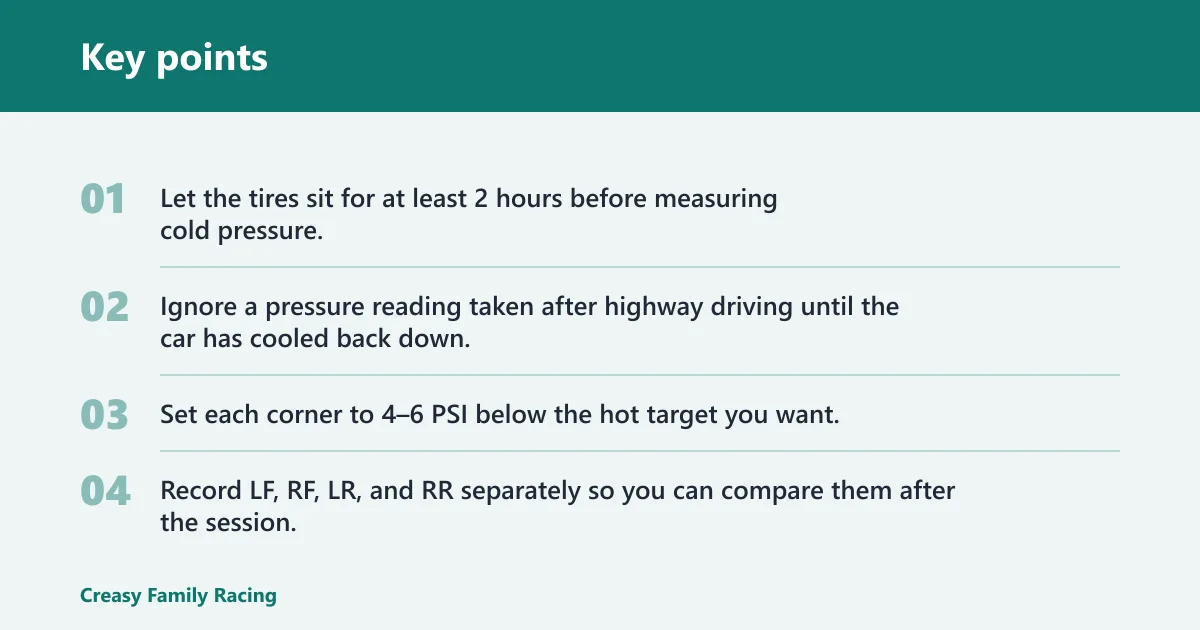
- Let the tires sit for at least 2 hours before measuring cold pressure.
- Ignore a pressure reading taken after highway driving until the car has cooled back down.
- Set each corner to 4–6 PSI below the hot target you want.
- Record LF, RF, LR, and RR separately so you can compare them after the session.
Highway driving before arrival can inflate the starting reading by 3–5 PSI. That means a “cold” number taken in the paddock after a freeway run may already be partway to hot. If you build the setup from that inflated baseline, the next session may start too low.
Typical hot ranges for street and performance tires
Many street tires sit in the 32–36 PSI hot band. Many performance-compound tires work in the 28–32 PSI band. Track-biased street tires often sit between those two, so one hot target does not fit every tire type.
Say your front street tires are at 28 PSI cold before session one. If the target hot range is 32–36 PSI, and the session adds about 6–10 PSI on a warm day, that cold start may be too low for the final target. The car may begin the session vague, then move into range only after several hard laps.
Trackside PSI rise estimator
This table turns temperature rise into an estimated pressure gain. It uses the common 1 PSI per 10°F rule as a trackside shortcut, then shows when that shortcut is likely to understate the real rise.
| Temperature increase | Estimated PSI gain | When the estimate may understate actual rise |
|---|---|---|
| 10°F | About 1 PSI | Moisture present, or the tire has already been heat-cycled hard |
| 20°F | About 2 PSI | Short sessions followed by repeated hot-cold swings can read higher than expected |
| 30°F | About 3 PSI | Heavy load on one side of the car, or moisture-driven vapor pressure begins to add to the rise |
| 40°F | About 4 PSI | Long, fast sessions or strong heat cycling can push beyond the dry-gas estimate |
| 50°F | About 5 PSI | Moisture and high internal heat can make the real gain exceed the simple rule |
How to use the table in the paddock
Start with the temperature rise you expect, then match it to the estimated PSI gain. If the car usually comes off track 6 PSI higher, a 30°F increase would point to roughly 3 PSI from dry-gas expansion and the rest from heat load, moisture, or session intensity.
A warm-day track session can produce a 6–10 PSI rise from cold. That range is why a quick estimate is useful, but not enough by itself. The gauge reading after the session decides whether the next adjustment should be one click, one psi, or no change at all.
Why pressure rises as tires heat up
Air and dry nitrogen expand in a similar way when temperature rises. That is why nitrogen does not stop pressure growth on track. The gas still heats, expands, and raises pressure.
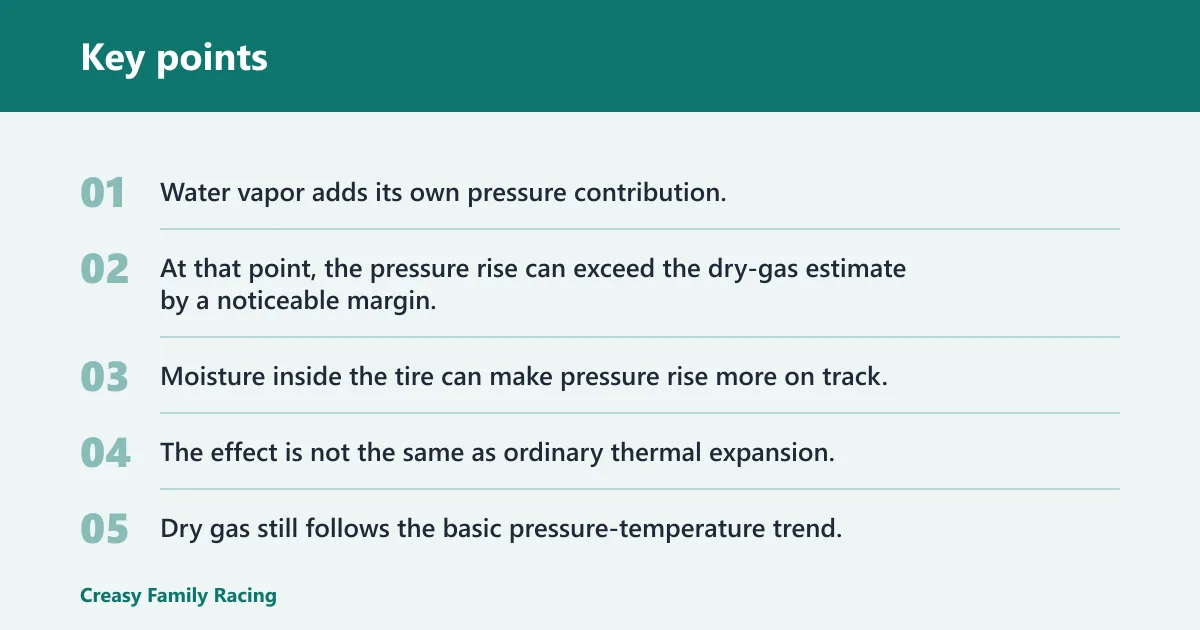
Moisture changes the picture. Water vapor adds its own pressure contribution, and that matters more once internal tire temperatures move above water’s boiling point. At that point, the pressure rise can exceed the dry-gas estimate by a noticeable margin.
Moisture and vapor pressure
Moisture inside the tire can make pressure rise more on track. The effect is not the same as ordinary thermal expansion. Dry gas still follows the basic pressure-temperature trend, while water vapor can add a separate spike as heat climbs.
That is why a tire that seems to rise too fast is not always overinflated. It may be running hot enough to vaporize trapped moisture, especially after repeated sessions or repeated bleed-and-refill cycles.
Should you bleed hot tires in the paddock?
Bleed hot tires only when the reading is clearly above the target hot range and the next session is short enough that a small pressure drop will not leave the tire too soft. If the tire is only a little high, leave it alone and check again after the next run.
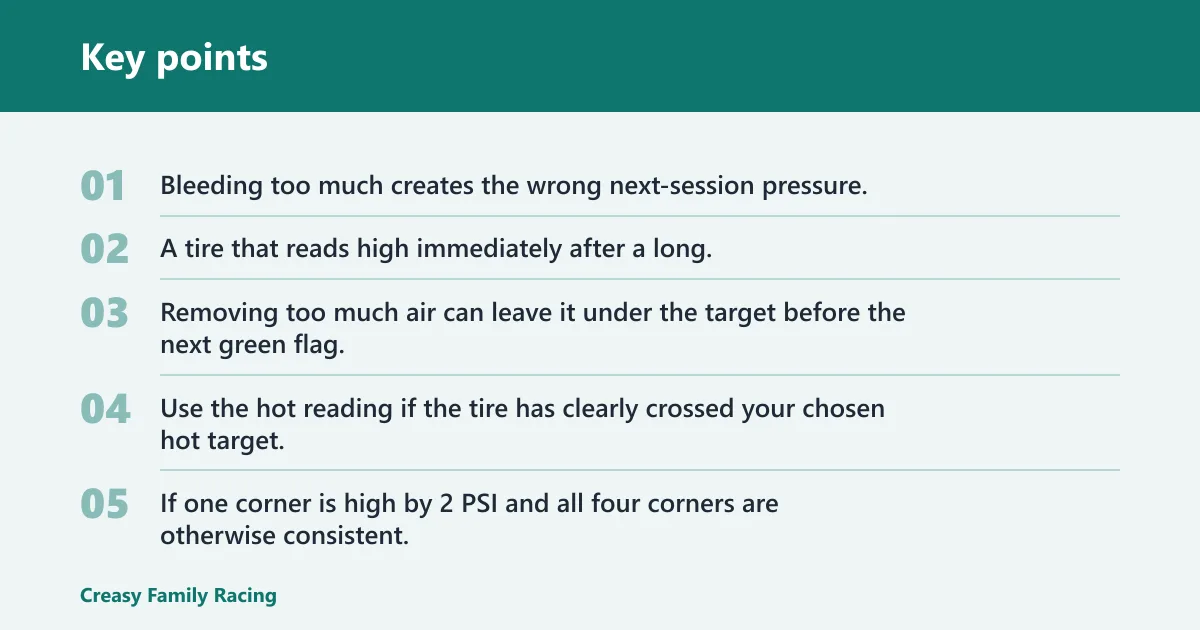
Bleeding too much creates the wrong next-session pressure. A tire that reads high immediately after a long, hard session may still settle into range once it cools. Removing too much air can leave it under the target before the next green flag.
When a hot bleed is the right call
Use the hot reading if the tire has clearly crossed your chosen hot target. That is the number that matters. If one corner is high by 2 PSI and all four corners are otherwise consistent, a small bleed is easier to justify than a large reset.
Check again on the next hot session. A single adjustment should not turn into a series of guesses.
When bleeding now creates the wrong next-session pressure
Do not bleed simply because the pressure looks high compared with the cold baseline. That comparison is not useful on track. Hot pressure is the number you manage, and the car may need that extra pressure to sit in the right band once the session begins.
Suppose a performance-compound tire is targeted at 30 PSI hot and comes in at 31 PSI. Bleeding it down to 29 PSI may sound neat in the paddock, but it can leave the next run below the working band once the tire cools and restarts the heat cycle.
Why left-side tires gain more on some tracks
Clockwise circuits typically make left-side tires read 1–2 PSI higher hot. Counterclockwise circuits reverse that bias. The side with the longer or harder-loaded load path usually shows the bigger gain.
That is why corner-by-corner readings matter. A single average pressure hides useful clues. LF, RF, LR, and RR can tell you whether the circuit direction, the setup, or the driving load is pushing one side harder.
Using corner-by-corner readings: LF, RF, LR, RR
Read all four corners immediately after the session. If LF and LR both climb more than RF and RR on a clockwise circuit, the direction effect is probably part of the answer. If one corner jumps well beyond the others, look at load transfer, alignment, or a tire that is running hotter than the rest.
Pressure gauge readings need to happen before the tires cool much. The first 2–3 minutes after pit entry matter because the numbers start dropping once the car sits still.
Why temperature, moisture, and session length change the estimate
Short sprint sessions usually show a cleaner pressure rise than long, high-load runs. Longer sessions keep the carcass hot for more time, which can lift pressure beyond the simple 1 PSI per 10°F estimate. Heavy heat cycling can do the same.
Moisture makes the estimate less reliable when the tire sees repeated hot-cold swings. It can also make a tire look like it gained pressure too fast when the real issue is overheating, not just extra air expansion.
Failure-case checklist for pressure rose too fast
- Cold starting pressure was too low for the tire type.
- The session was long enough to push the carcass well beyond the simple estimate.
- One side of the car carried more load because of circuit direction.
- Moisture inside the tire added vapor pressure at higher internal temperature.
- The tire was bled down too much after the last session and started the next one out of range.
Basic safety caution: do not use the hot reading as a reason to chase the lowest possible number. The goal is the right working pressure for the next session, not the smallest number in the paddock.
Choose Tire pressure if…
Choose Tire pressure if you need the number that tells you whether the car is ready for the next session. It is the actionable reading. It wins for setup decisions, corner-by-corner checks, and quick bleed-or-leave decisions in the paddock.
Choose temperature if…
Choose temperature if you are estimating how much the tire will move from cold to hot. It wins as the cause side of the comparison, especially when you want to predict a pressure gain before the car leaves pit lane.
Frequently asked questions
How much does tire pressure rise when tires heat up on track?
A common trackside estimate is about 1 PSI for every 10°F of tire temperature rise. Warm-day track use can produce a 6–10 PSI rise from cold, but moisture, session length, and heat cycling can push the result above or below that shortcut.
How many PSI does a tire gain from cold to hot on a track day?
For many HPDE sessions, expect about a 4–6 PSI gain from cold to hot, and warm-day use can sometimes end up in a higher range, around 6–10 PSI. The exact result depends on tire type, how hard the session runs, and whether the tire starts from a true cold baseline.
Should I bleed air out of hot tires in the paddock?
Bleed hot air only when the tire is clearly above its target hot range. If the pressure is only slightly high, bleeding can over-correct the next session once the tire cools and restarts its heat cycle. Small changes are safer than large guesses.
What hot tire pressure should I target after a session?
Most street tires aim for 32–36 PSI hot on track. Performance compounds commonly target 28–32 PSI hot. Track-biased street tires often sit between those ranges, so the tire type should set the target before you adjust anything else.
How soon after coming off track should I check tire pressure?
Check pressure in the first 2–3 minutes after pit entry. That window matters because the tire starts cooling quickly once the car stops. A delayed reading can be lower than the pressure you actually need to judge setup correctly.
Does nitrogen stop tire pressure from rising on track?
No. Air and dry nitrogen expand in a similar way as temperature rises, so nitrogen does not stop pressure growth on track. It may change the gas mixture, but it does not remove the basic heat-and-pressure relationship.
Can moisture inside the tire make pressure rise more on track?
Yes. Moisture can add vapor pressure on top of ordinary dry-gas expansion, and that effect becomes more important above 212°F inside the tire. If the pressure rises faster than the simple estimate, moisture is one of the first things to consider.
How much should I start below my target hot pressure?
Set cold pressure 4–6 PSI below your target hot pressure. That gives the tire room to rise into the working band once it reaches track temperature. Highway driving before arrival can distort the starting number by 3–5 PSI, so always confirm a true cold baseline.
Why do my left-side tires gain more pressure on a clockwise circuit?
Clockwise circuits typically load the left-side tires harder, so LF and LR can read 1–2 PSI higher hot. The direction bias is one of the easiest reasons for a side-to-side difference, especially when the rest of the car looks balanced.