DOT 3 vs DOT 4 vs DOT 5.1: Which Brake Fluid for Track Days?
Choose the lowest-cost brake fluid that meets your car’s OEM DOT spec and leaves enough wet boiling-point margin for track-day heat, not the highest DOT number. Choose wrong and you risk a long pedal, boiling fluid, and a session cut short. This guide compares DOT 3, DOT 4, and DOT 5.1 for street use and HPDE, then shows how to choose by spec and event intensity.
| Decision factor | DOT 3 | DOT 4 | DOT 5.1 | Winner |
|---|---|---|---|---|
| OEM-spec fit | Common in older US cars | Common OEM spec for modern cars | Sometimes allowed where higher heat margin is needed | DOT 4 |
| Track heat margin | Lowest margin of the three | Good baseline for many HPDE cars | Highest minimum dry and wet boiling points | DOT 5.1 |
| Cost efficiency for street plus HPDE | Lowest cost, but limited for track use | Usually the best balance | Best only when the extra margin is actually needed | DOT 4 |
| Compatibility with ABS/ESP systems | Compatible when the system calls for glycol fluid | Compatible with modern glycol-based systems | Compatible with modern systems when the manual allows it | DOT 4 |
Which brake fluid should you choose?
Check the reservoir cap or owner manual first, then match the fluid to the event’s heat load. For most street cars that see occasional HPDE, DOT 4 is often the default answer. DOT 5.1 earns its keep when repeated hard braking pushes fluid temperatures higher than a normal DOT 4 service margin can cover.
Brake fluid decision matrix
| Track intensity | OEM spec says DOT 3 | OEM spec says DOT 4 | OEM spec says DOT 5.1 | Minimum acceptable class | Flush cadence |
|---|---|---|---|---|---|
| Light HPDE, short sessions, stock brakes | DOT 4 | DOT 4 | DOT 5.1 only if the manual allows and the car runs hot | DOT 4 | Before the event; then about every 1-2 years for street use |
| Repeated hot sessions, fresh pads, decent cooling | DOT 4 | DOT 4 or DOT 5.1 | DOT 5.1 | DOT 4, with fresh fluid | Before each track weekend, and more often in humid climates |
| Heavy car or hard braking zones | DOT 5.1 if the system allows it | DOT 5.1 | DOT 5.1 | DOT 5.1 for margin | Before each event; bleed again if the pedal changes on track |
| Unknown service history | Flush to fresh DOT 4 first | Flush to fresh DOT 4 first | Flush to fresh DOT 5.1 only if the car calls for it | Fresh DOT 4 unless the OEM spec demands otherwise | Immediately before track use |
Why the matrix points to DOT 4 so often
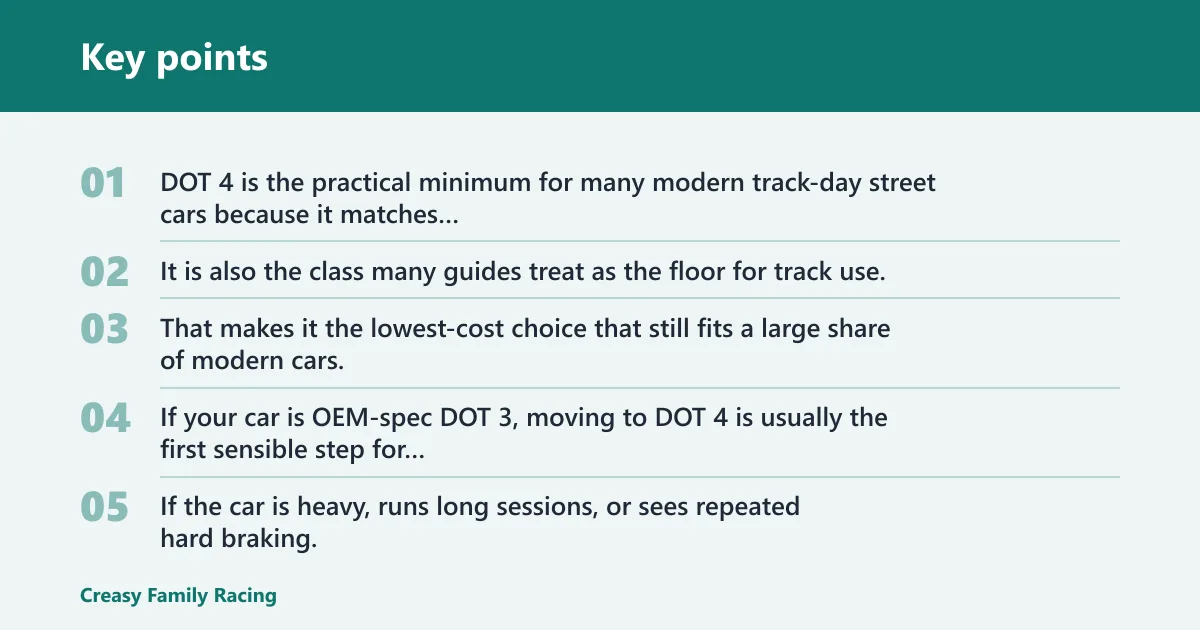
DOT 4 is the practical minimum for many modern track-day street cars because it matches common OEM specs and gives a better boiling-point buffer than DOT 3. It is also the class many guides treat as the floor for track use. That makes it the lowest-cost choice that still fits a large share of modern cars.
If your car is OEM-spec DOT 3, moving to DOT 4 is usually the first sensible step for HPDE. If the car is heavy, runs long sessions, or sees repeated hard braking, DOT 5.1 can buy more margin. The higher number is not the goal; usable margin is.
Why DOT 5.1 only wins in some cases
DOT 5.1 is glycol-based despite the name. It has a higher minimum dry boiling point and a higher minimum wet boiling point than DOT 4, plus lower cold viscosity, which helps modern ABS and ESP systems in cold conditions. That does not make it the right answer for every track-day car.
For a light car on short sessions, a fresh DOT 4 fluid often covers the heat load at lower cost. For a heavier car, a long session day, or a brake package that runs very hot, DOT 5.1 can be worth the extra headroom.
When DOT 3 is no longer enough
DOT 3 is still found in many older US cars, and it is chemically compatible with DOT 4 and DOT 5.1 glycol fluids. But its track margin is the lowest of the three. If the car sees repeated braking from speed, long downhill sections, or a full HPDE schedule, DOT 3 is the first class to leave the safety window too thin.
Picture a 3,300-pound sedan on street pads, running five 20-minute sessions in warm weather. If the pedal starts high and then gets longer by mid-session, that is the kind of heat load where DOT 3 becomes a weak link and DOT 4 or DOT 5.1 should be the baseline.
What wet boiling point means
Wet boiling point matters more on track because used glycol fluid absorbs moisture over time. The published wet number is measured at 3.7% water content, which makes it a better stand-in for in-service fluid than the fresh sealed-fluid dry number. On a track car, that is the number that tells you how much margin remains after time, heat, and humidity.
Dry versus wet numbers
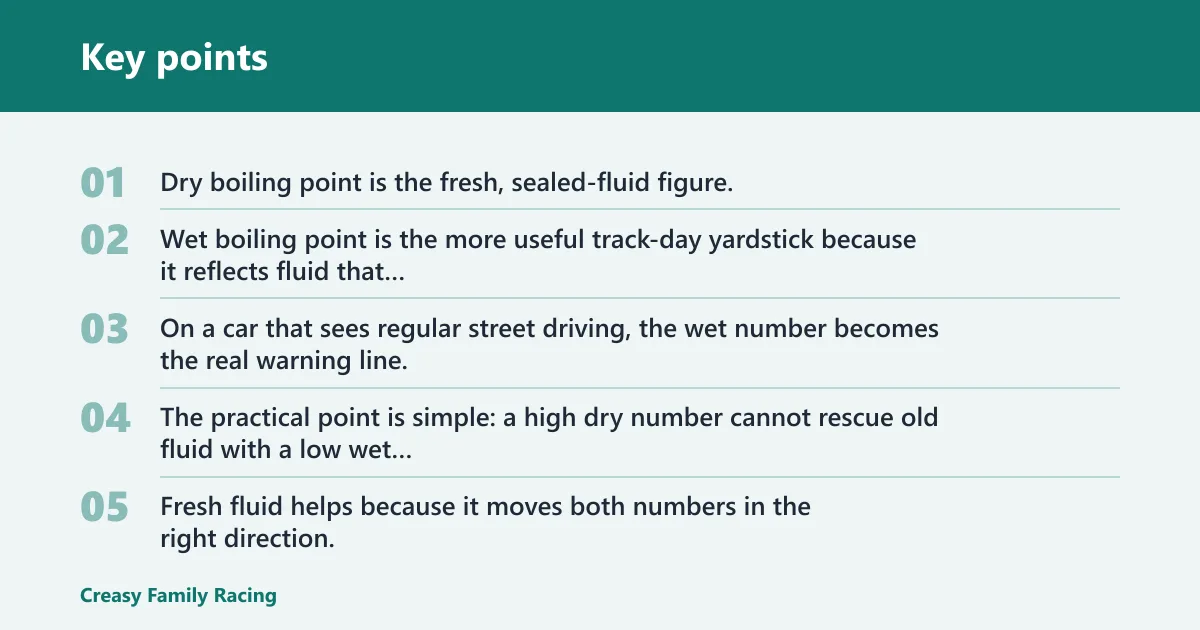
Dry boiling point is the fresh, sealed-fluid figure. It matters, but it is optimistic. Wet boiling point is the more useful track-day yardstick because it reflects fluid that has lived in a system and picked up water. On a car that sees regular street driving, the wet number becomes the real warning line.
The practical point is simple: a high dry number cannot rescue old fluid with a low wet margin. Fresh fluid helps because it moves both numbers in the right direction, and the wet figure is the one that tends to decide whether the pedal stays firm after repeated braking.
How moisture lowers margin
Glycol brake fluids absorb moisture from the air over time. That water lowers boiling resistance and increases the chance of brake fade or vapor lock when the calipers and fluid get hot. The failure can start as a long pedal, then a soft pedal, and in severe cases the pedal can sink toward the floor.
A common mistake is to choose DOT 5.1 for track use and overlook that an old, moisture-laden fluid can still fade under repeated braking. Fresh DOT 4 bottle stock beats old DOT 5.1 fluid that has been sitting in the car for too long.
Brake fluid compatibility rules
DOT 3, DOT 4, and DOT 5.1 are all glycol-based and chemically compatible with each other. DOT 5 is different: it is silicone-based, should not mix with glycol fluids, and is not the right choice for modern track-day ABS cars. If the car’s history is unknown, stay inside the glycol family unless the manual says otherwise.
Mixing DOT 3, DOT 4, and DOT 5.1
You can mix DOT 3, DOT 4, and DOT 5.1 in an emergency top-off because they are chemically compatible. That said, the mixture takes on the weakest link in the system. If old DOT 3 remains in the lines, topping off with DOT 5.1 does not magically turn the whole car into a high-margin track setup.
For unknown service history, a full flush is the clean answer before track use. A partial top-off is better than running the reservoir low, but it is not a substitute for fresh fluid.
Why DOT 5 silicone is different
DOT 5 silicone fluid is not compatible with glycol fluids. It also brings higher compressibility and aeration risk, which is why it is usually reserved for certain classic or military applications rather than modern ABS-equipped performance cars. It is marked do not use on track in one guide.
ABS and ESP systems need compatible fluid chemistry, and they can be sensitive to silicone contamination. That is enough reason to keep DOT 5 out of a modern street-and-track brake system unless the car was built for it.
Top-off rules for unknown service history
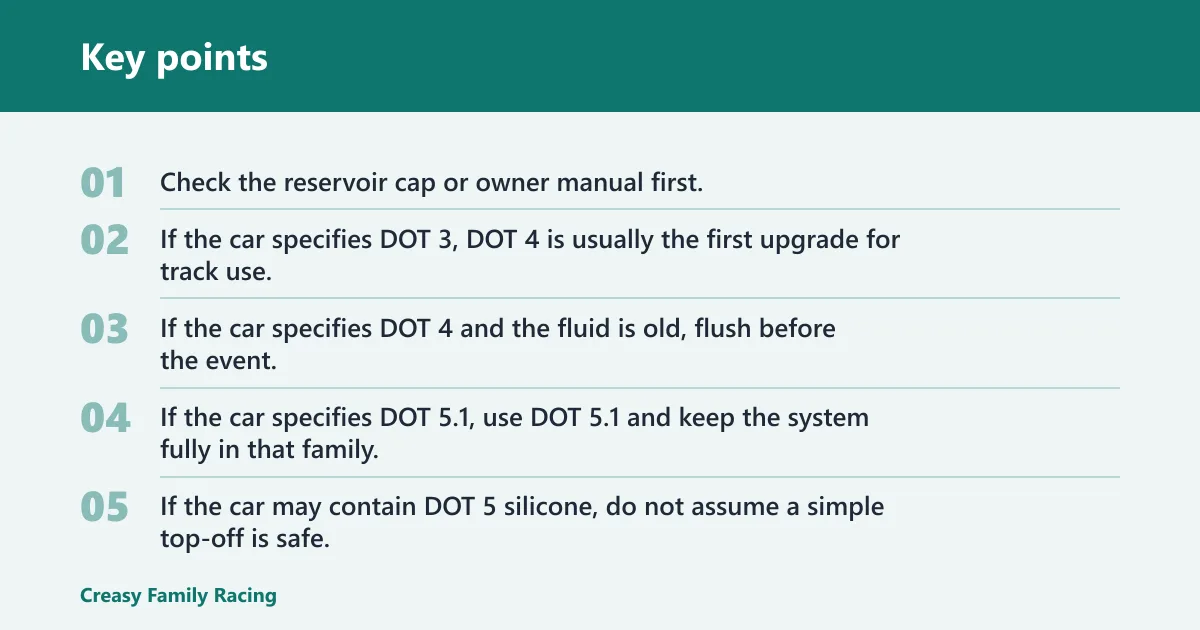
- Check the reservoir cap or owner manual first.
- If the car specifies DOT 3, DOT 4 is usually the first upgrade for track use.
- If the car specifies DOT 4 and the fluid is old, flush before the event.
- If the car specifies DOT 5.1, use DOT 5.1 and keep the system fully in that family.
- If the car may contain DOT 5 silicone, do not assume a simple top-off is safe; flush and verify the fluid type.
Boiling point table
The table below puts the minimum dry and wet boiling points side by side, along with the compatibility rule that matters most and the symptoms that mean you should stop driving. Use it as a quick screen before a session, not as a substitute for the manual.
| Fluid | Minimum dry boiling point | Minimum wet boiling point | Compatibility rule | Stop-driving symptoms |
|---|---|---|---|---|
| DOT 3 | 401 F (205 C) | 284 F (140 C) | Glycol-based; compatible with DOT 4 and DOT 5.1 | Long pedal, soft pedal, pedal-to-floor, changing pedal height |
| DOT 4 | 446 F (230 C) | 311 F (155 C) | Glycol-based; compatible with DOT 3 and DOT 5.1 | Long pedal, soft pedal, pedal-to-floor, changing pedal height |
| DOT 5.1 | 500 F (260 C) | 356 F (180 C) | Glycol-based despite the name; compatible with DOT 3 and DOT 4 | Long pedal, soft pedal, pedal-to-floor, changing pedal height |
| DOT 5 | Not a glycol grade | Not a glycol grade | Do not mix with glycol fluids | Not for track-day use in modern ABS cars |
Do you need DOT 5.1?
DOT 5.1 is not automatically better than a good DOT 4 for every driver. It is the right answer when the car’s OEM spec allows it and the event heat load is high enough that DOT 4’s wet margin looks thin. For mild HPDE, fresh DOT 4 often gives the best mix of cost and protection.
When DOT 4 is enough
DOT 4 is usually enough for light HPDE, street cars with modest brake heat, and many modern OEM systems. It is also the sensible upgrade from DOT 3 when the car’s manual allows glycol fluid and the goal is a better track buffer without moving to a higher-cost class.
Suppose a compact coupe runs a short novice day with good pads and stock cooling. If the pedal stays consistent and the fluid is fresh, DOT 4 is the minimum class that still makes sense for the job.
When DOT 5.1 earns its keep
DOT 5.1 earns its keep when repeated sessions, heavier curb weight, or long braking zones create a higher heat load. The lower cold viscosity also suits modern ABS and ESP systems. If the car is called out for DOT 5.1 in the manual, that spec should lead the choice.
When the OEM spec should win
The OEM spec wins whenever the reservoir cap or owner manual limits the system to a particular fluid class. That rule matters more than internet advice. If the manual says DOT 3 or DOT 4, stay within what the system calls for unless a qualified service source confirms a compatible upgrade path.
Verdict: which should you choose?
Choose DOT 3 if your car is an older US car that specifies DOT 3 and you are just staying within its OEM spec for street use, not chasing track-day heat margin.
Choose DOT 4 if you have a modern car that sees light HPDE or occasional track days, especially if the manual allows glycol fluid and you want the sensible upgrade from DOT 3 or the default answer for many street cars.
Choose DOT 5.1 if your car sees repeated hot sessions, long session days, heavy-car or hard-braking-zone use, or a brake package that runs very hot and the manual allows the higher-margin fluid.
Frequently asked questions
Which brake fluid is best for track days: DOT 3, DOT 4, or DOT 5.1?
DOT 4 is the best default for most track-day street cars because it balances cost, OEM fit, and usable wet boiling margin. DOT 5.1 is the better choice when the event is hotter, longer, or heavier than DOT 4 can comfortably cover. DOT 3 is usually the weakest option for track use.
Can I run DOT 4 instead of DOT 3 for a track day?
Usually yes, if the car’s manual or reservoir cap allows glycol brake fluid and does not forbid the move. DOT 3, DOT 4, and DOT 5.1 are chemically compatible with each other. For track use, DOT 4 gives a better margin than DOT 3 and is commonly recommended for modern cars.
Is DOT 5.1 better than DOT 4 for brakes on track?
Sometimes, but not always. DOT 5.1 has higher minimum dry and wet boiling points and lower cold viscosity, which can help on hard or repeated braking days. A fresh DOT 4 can still be the smarter choice when the car’s heat load is moderate and the OEM spec does not require DOT 5.1.
What boiling point do I need for track day brake fluid?
There is no single number that fits every track car. For street-driven HPDE cars, the wet boiling point matters more than the dry number because it reflects used fluid. DOT 4 is the minimum many guides use for track, and DOT 5.1 adds more margin for heavier or hotter sessions.
Can I mix DOT 3, DOT 4, and DOT 5.1 brake fluid?
Yes, those glycol-based fluids mix freely. That does not mean mixing is ideal, only that they are chemically compatible. If the car has unknown service history or old fluid, a full flush is better than relying on a top-off to create track-ready margin.
Do I need to flush brake fluid before every track day?
Not always, but you should flush before track use if the fluid is old, the car sees humid weather, or the service history is unknown. Many street cars are on a 1-2 year interval, but track use pushes that shorter. Fresh fluid lowers boil risk and helps preserve pedal feel.
Why is DOT 5 not used for track days?
DOT 5 is silicone-based, not glycol-based, so it should not mix with DOT 3, DOT 4, or DOT 5.1. It is not the right fluid for modern ABS cars because of compatibility and aeration concerns. Track-day brake systems are usually built around glycol fluid, not silicone.
How do dry and wet boiling points affect brake fade?
Dry boiling point tells you what fresh sealed fluid can handle, while wet boiling point tells you what used fluid can handle after moisture absorption. On track, brake fade and vapor lock happen when fluid boils and vapor compresses. The pedal then turns long, soft, or inconsistent.
What brake fluid does my car need from the reservoir cap or manual?
Use the fluid named on the reservoir cap or in the owner manual first. Most US cars use DOT 3 or DOT 4, and DOT 4 is the common modern choice. If the manual calls for DOT 5.1, use DOT 5.1. Do not assume a higher DOT number is automatically safer.
Will a higher DOT number always mean better track performance?
No. A higher DOT number only means the fluid meets a higher minimum class, not that it is the best choice for every car or event. A fresh DOT 4 often beats old DOT 5.1 in real track use. The right answer is the OEM spec plus enough wet boiling margin for the session load.