Reaction Time in Drag Racing for Beginners
Reaction time in drag racing is the starting-line timing number that shows how well your launch matched the tree; on a sportsman tree, about 0.500 is commonly treated as perfect, while on a pro tree, about 0.400 is commonly treated as perfect. Get it wrong and you can lose rounds with a quicker car, or chase reaction time so hard that your launch and ET fall apart. This guide explains how the tree works, what the time slip number means, how it differs from ET and 60-foot, and what to change next in an automatic or manual.
What reaction time means at the drag strip
It is a timing number, not the whole run
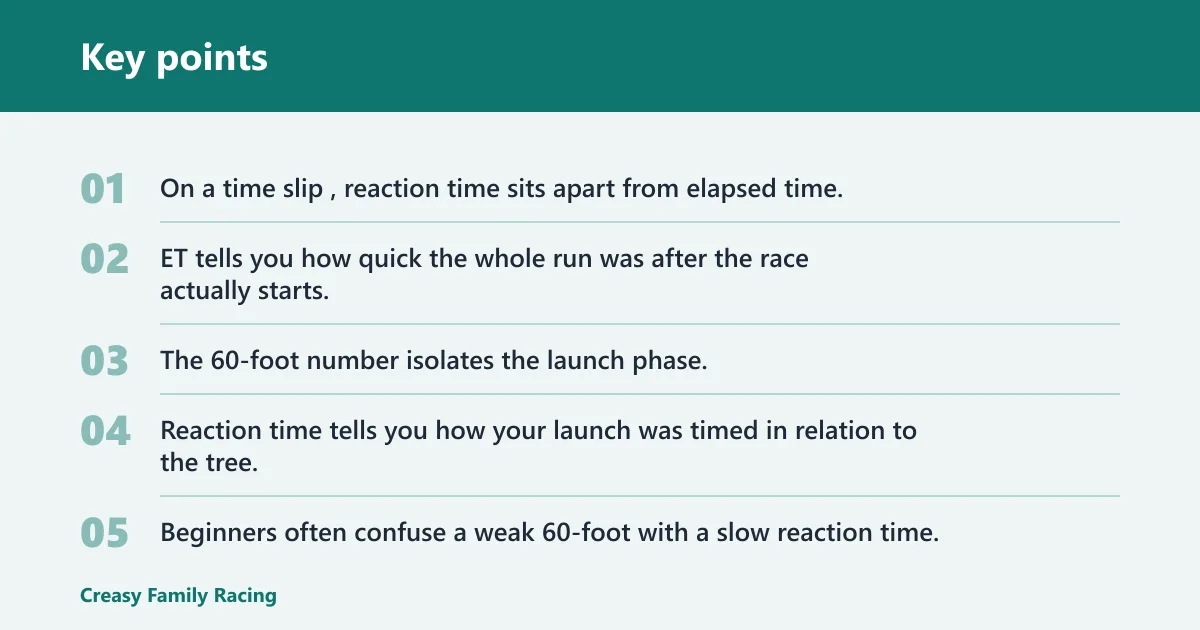
On a time slip, reaction time sits apart from elapsed time. It shows how your launch was timed in relation to the tree, measured in thousandths on the slip and often discussed in milliseconds when people compare human response.
That matters because two drivers can post the same ET and still have different results at the stripe if one gave away time on the starting line. It matters the other way too: a sharper light can still come with a worse pass if the launch, shift, or traction goes away.
ET and 60-foot answer different questions
ET tells you how quick the whole run was after the race actually starts. The 60-foot number isolates the launch phase. Reaction time tells you how your launch was timed in relation to the tree.
Beginners often confuse a weak 60-foot with a slow reaction time. They are different problems. A car can leave on time and still spin, bog, or short-shift its way to a poor 60-foot and slower ET.
Human reaction and drag-race reaction are related, not identical
Simple reaction time is the classic single-cue test: wait for green, then click. Choice reaction time adds a decision, such as different responses to different cues, and it usually runs slower because the brain has to identify the signal before acting.
Drag racing is closer to a timed launch than a pure lab reflex test. The cue is visual for most drivers, tied to the amber sequence on the tree, and the measured number also includes vehicle rollout. That means the slip does not report reflex speed alone.
How does the starting tree change your reaction time?
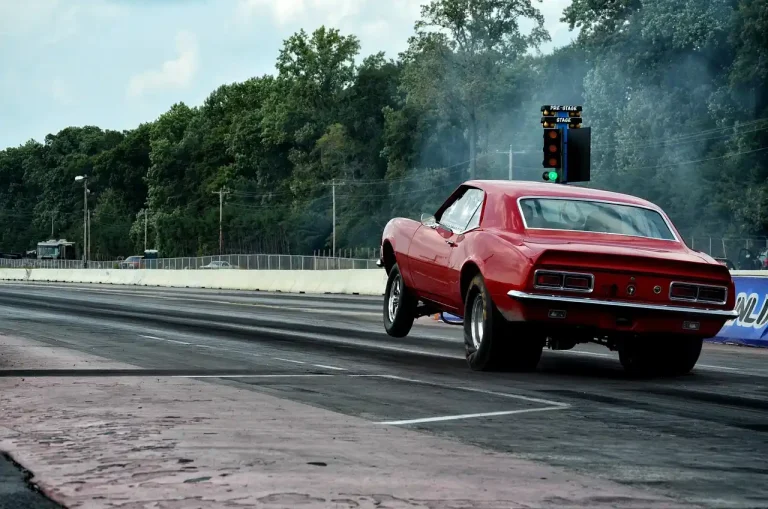
The starting tree changes both your launch rhythm and what counts as a strong light. On a sportsman tree, the ambers come down in sequence, so many beginners key off the last amber. On a pro tree, all ambers flash together, which cuts the timing window and changes what a good number looks like.
Sportsman tree timing
A sportsman tree drops the amber bulbs one after another before green. On that tree, a perfect reaction time is 0.500. Because the sequence gives you more visual information, many beginners find it easier to build a repeatable routine there than on a pro tree.
That does not mean you should “wait for green.” If you do, the slip will usually show a late light because the car still has to move enough to clear the staging beam.
Pro tree timing
A pro tree flashes all three ambers together, then goes green. On that tree, 0.400 is perfect. The launch is less about reading a descending pattern and more about matching one repeatable release to a much tighter cue.
Because the window is different, a number that looks decent on one tree can be weak on the other. Raw reaction time only makes sense when you know which tree was used.
Green, red, and what the slip records
A red light means the front tire cleared the staging beam before green. A “better” reaction time does not count if it crosses into red. For beginners, that is the clearest sign of guessing instead of timing.
Picture a driver who cuts 0.080, 0.030, then red on three sportsman-tree passes by launching earlier each time. The light improved, but the car did not become easier to race. The routine became less stable.
Why rollout and staging depth matter
Rollout in beginner terms
Rollout is the distance the front tire travels after launch before it fully clears the staging beam. The clock does not react to tire movement alone; it reacts when the beam is uncovered. That is why drag-strip reaction time includes car movement and staging position, not human response alone.
Shallow staging leaves more rollout. Deep staging leaves less. Less rollout can make the measured reaction time look quicker because the tire has less distance to travel before the clock sees the car leave.
Shallow staging vs deep staging
Shallow staging means barely turning on the stage bulb. You get more rollout, which can help ET because the car has a little more room before the timer sees it leave the beam. The tradeoff is that the measured reaction time number may look slower.
Deep staging means moving farther in until rollout shrinks. That can sharpen the reaction time number on the slip, but it often costs ET because you gave away that little bit of free movement before the clock starts counting the run.
Why deep staging can trade ET for the light
Say your car runs a steady ET and 60-foot shallow staged, but the light stays late. Deep staging may pull the reaction time closer to where you want it without changing your hand or foot timing much. The risk is that the ET slips because rollout got shorter.
That is why beginners should treat staging depth like a setup change, not a trick for one magic number. If reaction time improves while ET and 60-foot get worse, the whole pass did not improve.
Does a faster reaction time always mean a better run?
No. A faster reaction time can win the starting-line battle, but it does not guarantee a quicker or cleaner pass. You need to read reaction time with 60-foot and ET together, because a very sharp light can come with wheelspin, a bog, or a staging change that makes the car slower.
When the better light wins
In heads-up or bracket racing, a better light often decides who gets to the stripe first, especially when the cars run close. If two passes are otherwise similar, reaction time is race management in plain view.
When chasing the light slows the car
A common first-timer mistake is forcing the launch earlier and earlier until the slip shows a prettier reaction time but the 60-foot gets worse. That can happen when the driver rushes the clutch, flashes the converter at a different point, or stages deeper without checking ET.
Suppose your reaction time improves on three passes, but 60-foot gets slower on each one and ET follows it. That is not proof of better driving. It is proof that the pass after the beam broke got worse.
Read the three numbers together
Use this order. First, ask whether the reaction time is late, early, or red for that tree. Next, check whether the 60-foot improved, held steady, or fell off. Then read ET for the whole result.
If the light improves and the rest of the pass stays stable, keep the change. If the light improves but 60-foot and ET get worse, back up and fix the launch routine instead of chasing the slip’s first number.
What is a good reaction time for a beginner?
A good beginner reaction time is one that is repeatable on the tree you are actually racing, without hurting 60-foot or ET. On a sportsman tree, a beginner should value consistency and staying out of the red. On a pro tree, expectations shift because the cue arrives differently and the window is tighter.
Sportsman tree beginner targets
For a beginner, “good” means controlled, legal, and close enough to race with while the launch stays intact. A slightly later but repeatable light is more useful than one excellent number surrounded by red lights and erratic 60-foot times.
Pro tree context changes the answer
On a pro tree, raw comparison to sportsman-tree numbers is misleading because the perfect number changes from 0.500 to 0.400. A driver switching trees should expect the timing picture to change before the car itself changes.
Is 200 ms good in context?
A 200 ms simple visual test score can be quick in a browser-based reaction test, but it does not automatically translate into a strong drag-strip light.
At the strip, tree type, rollout, and staging depth matter more than the raw millisecond score by itself. A driver can have a fast lab-style response and still post mediocre lights if the staging routine changes every pass.
How do you test reaction time before going to the track?
Use at-home testing as limited practice for timing a visual cue, not as a substitute for track data. The best routine is five attempts, then review the average, median, best, and any false starts. That shows whether your timing is repeatable before you add rollout, staging depth, and vehicle movement.
Use a five-attempt routine
That format is useful because one quick click proves little. Five attempts show pattern.
- Pick one device. Use the same desktop, laptop, tablet, or phone for all five attempts in a session. Changing hardware mid-session adds noise that has nothing to do with your timing.
- Wait for green. Use a simple visual test that has you wait for green and click. That mirrors the basic cue structure of the tree better than random tapping drills.
- Run five attempts. Record all five, then note the average, the median, the best result, and whether any false starts occurred. A low best score with two false starts usually means timing by guess, not control.
- Repeat at one sitting. Do a second five-attempt set after a short pause and compare the medians, not just the single best result. Median helps reveal whether one outlier is hiding a sloppy session.
- Log the setup. Write down the device type, screen refresh rate if known, and whether you used a mouse or trackpad. That context matters because test pages warn that monitor, mouse or trackpad, and browser affect results.
Know the limits of browser testing
Device timing changes the result.
Those gaps are a warning, not a verdict on your talent. A 60 Hz display updates less often than a 144 Hz display, and mouse or trackpad latency can add more delay before the click registers. Browser timing adds another layer.
At-home testing can help build cue discipline. It cannot tell you whether a staging-depth change helped your race package.
Why does your reaction time change from run to run?
Reaction time changes from run to run because the starting conditions often change too. Tree type, staging depth, rollout, lane routine, clutch release or converter behavior, focus, fatigue, and guessing all move the number. The time slip only shows the outcome, so you need a consistent routine to find the real cause.
Tree and staging changes
Moving from sportsman to pro tree changes the visual rhythm right away. So does staging deeper on one pass and shallower on the next. If rollout changes, the measured reaction time changes even when the driver thinks the release timing felt identical.
Automatic vs manual cars do not leave the same way
Automatic cars usually put more emphasis on brake release, converter behavior, and how consistently the car is staged before the driver lets it go. Manual cars add clutch release timing and engine-speed control, which gives the driver another place to gain or lose consistency.
That is why beginner advice should split here. An automatic driver with wandering lights may need a tighter staging and brake-release routine. A manual driver with wandering lights may need to narrow clutch release variation before chasing the tree any harder.
Routine, guessing, and test-day variables
Focus and fatigue matter, but they are usually secondary after routine errors. Guessing the tree can produce one standout light, then a red, then a late light because the driver is no longer tied to a repeatable cue.
Say your first pass is shallow staged, the second is accidentally deeper, and the third adds a rushed pre-stage routine because the lane moves fast. That one-session mix can make reaction time look random when the real problem is that the process changed three times.
Reaction time decision table
| Scenario | Likely cause | What to change next | Does the change risk ET? |
|---|---|---|---|
| Late light on sportsman tree, 60-foot and ET steady | Launch cue is simply late for that amber sequence | Move the release point slightly earlier while keeping the same staging depth | Low risk if staging and launch stay the same |
| Better light after deep staging, ET slows | Reduced rollout improved measured reaction time but took away launch distance | Return to shallow staging and work on timing instead | Yes |
| Good reaction time, poor 60-foot | Launch problem after the beam, such as spin, bog, or clutch release issue | Leave reaction-time timing alone and fix traction or launch procedure | No, this usually protects ET |
| Poor reaction time, strong 60-foot and ET | Car leaves well, but driver is late to the cue | Adjust launch timing only, one small change at a time | Moderate risk if the driver starts guessing |
| Reaction time swings run to run with identical weather | Inconsistent staging depth or lane routine | Standardize pre-stage, stage, and release timing before touching launch rpm or tire pressure | Low risk |
| Switch from sportsman tree to pro tree and lights get worse | Driver is using the wrong visual rhythm for the tree type | Reset expectations and practice one release cue for pro tree only | Low risk |
| Automatic car shows random lights | Brake release or staging rollout changes more than the driver realizes | Set one staging routine and one brake-release rhythm, then compare slips | Low risk |
| Manual car shows random lights | Clutch release timing or launch rpm varies pass to pass | Hold launch rpm and clutch release method steady before moving the tree cue | Moderate risk if both are changed together |
| Reaction time improves, 60-foot gets slower | Driver is rushing the launch or changing release mechanics to chase the light | Back up to the previous launch routine and retune timing from there | Yes |
| Repeated red lights | Guessing the tree or moving the cue too early | Delay the release slightly and aim for legal consistency first | No, avoiding red protects the run |
| At-home test score looks quick, track lights stay mediocre | Browser test lacks rollout, vehicle movement, and staging variables | Use home testing for cue practice only; diagnose with time slips at the track | No |
| Time slip shows slower ET after chasing a lower light | Measured reaction improved, but the pass after launch got worse | Choose whether the race problem is start-line loss or car performance loss, then fix only that area | Yes |
How to improve reaction time without hurting ET
What automatic drivers should change first
Start with staging consistency, then brake-release timing. If the car is an automatic, beginners often gain more by staging the same way every pass than by trying to leave much earlier on the tree.
Check whether reaction time moved while 60-foot stayed steady. If yes, the timing change may be working. If reaction time improved but 60-foot spread out, the release routine probably changed too much.
What manual drivers should change first
Manual drivers should lock down launch rpm and clutch release before tuning the tree cue. If those two vary, reaction time and 60-foot will wander together, which makes the slip harder to read.
A small cue change is only useful when the mechanical side of the launch repeats. Otherwise you are changing driver timing and launch quality at the same time.
Use time slips to make one change at a time
- Choose one metric. Decide whether the first problem is reaction time, 60-foot, or overall consistency. If two numbers are bad at once, fix the one that changed most between otherwise similar passes.
- Hold staging constant. Keep staging depth the same for at least a few passes before judging the light. That removes rollout as a moving target.
- Adjust one cue. Move only the release timing, or only the clutch/brake routine, by a small amount. Do not change launch rpm, tire pressure, and staging depth in the same round of testing.
- Read the slip together. Compare reaction time, 60-foot, and ET as one set. Keep the change only if the light improves without damaging the rest of the pass.
- Stop chasing perfect. Once the light is legal and repeatable, put effort into launch consistency and ET. A nearly perfect reaction time with a weak 60-foot is still a soft package.
Frequently asked questions
What is a good reaction time for a beginner at the drag strip?
A good beginner light is repeatable for the tree being used and does not create red lights or slower 60-foot times. On a sportsman tree, staying legal and building consistency matters more than one standout number. On a pro tree, compare only to pro-tree expectations, not sportsman-tree slips.
Why does my reaction time change from run to run?
It usually changes because something in the routine changed: tree type, staging depth, rollout, brake or clutch timing, or simple guessing. Focus and fatigue can matter, but beginners should first check whether they staged the same way and used the same launch cue on every pass.
What is the difference between simple and choice reaction time?
Simple reaction time uses one cue and one response, such as waiting for green and clicking. Choice reaction time adds a decision between possible responses, so it usually runs slower. Drag racing includes visual timing plus vehicle rollout, which makes the time slip different from either pure lab measure.
Does a faster reaction time always mean a better drag race run?
No. A faster light helps only if the launch and the rest of the pass stay intact. If reaction time drops but 60-foot and ET get worse, the run did not improve. Read the slip as a package, because reaction time, launch quality, and ET answer different questions.
Is a reaction time of 200 ms good for drag racing?
For an at-home visual test, 200 ms can be quick. For drag racing, the answer depends on sportsman or pro tree, rollout, staging depth, and whether the time slip stays consistent and legal.