Launch Technique: How to Leave Hard Without Spinning
Leave hard without spinning by matching launch rpm and clutch or converter hit to tire grip: raise rpm only until 60-foot improves, then back off about 200-300 rpm if it spins, bogs, or wheel-hops. Get it wrong and you give away elapsed time, stress parts, and lose consistency for noise and smoke. This guide shows what spin, bog, and hop look and feel like in the first tire-loaded instant, then how to correct each with pressure, suspension, gearing, and driver inputs.
What you’ll need
- Notebook or phone notes app for pass-by-pass logging
- Accurate tire pressure gauge
- Air source or bleed tool
- Tachometer data, shift light recall, or datalogger if the car has one
- Time slip with 60-foot data
- Basic weather notes: air temperature, wind, and whether the surface feels cold, dusty, or well-rubbered
- A repeatable staging routine
What a hard, clean launch looks like
Read the first 30 feet
A good launch still uses some tire slip. The target is the shortest, most repeatable path to full drive without excess spin, bog, hop, clutch slip, or heavy traction-control intervention. The first 30 feet show the real hit, because power, gearing, or a strong back half can hide a poor launch later in the run.
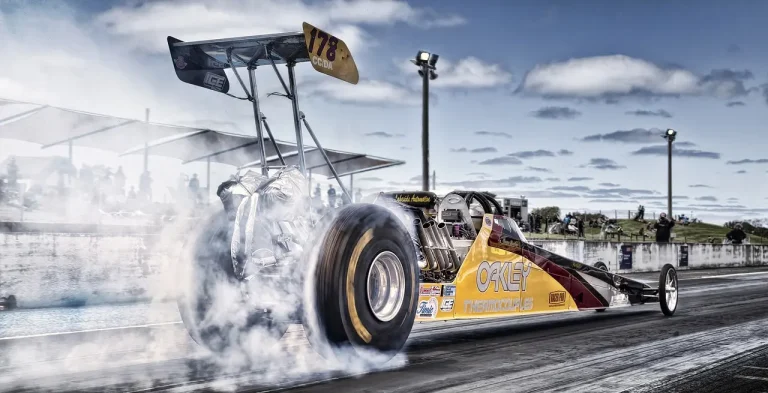
Controlled slip is brief and loaded. The engine does not flare wildly, the chassis moves forward in one motion, and the car does not shake. Spin looks different: engine speed jumps, acceleration falls over, and the drive tires skate instead of planting.
Separate spin, bog, hop, and slip
Bog means the engine drops below the useful part of its torque curve because launch rpm or converter load was too low for the gear, tire, and surface. Wheel hop is an oscillation: the tire grabs, unloads, then grabs again. It feels like fast hammering through the chassis and driveline, not a clean, loaded slip.
Clutch slip is its own issue. Engine rpm rises, vehicle speed does not follow, and the smell or delayed coupling points to friction material rather than tire loss.
Know what layout changes
Drivetrain layout changes what hooking feels like. Rear-wheel drive usually likes weight transfer to the rear axle, so a clean hit often feels planted if the surface has bite. Front-wheel drive gives up front axle load as the car tries to transfer weight rearward, so too sharp a hit often spins even when the tire looked decent in the lanes.
All-wheel drive can leave harder on average, but it is less forgiving when one end is off in pressure or grip. Manual and automatic cars also react differently. Manuals are highly sensitive to clutch release rate; automatics care more about converter flash, brake torque, and throttle timing.
How do I tell if the car is spinning, bogging, or hopping?
Watch and feel the first tire-loaded movement, then compare it with the 60-foot. Spin shows quick rpm flare and weak forward drive, bog shows a dead hit and delayed pull, and hop feels like repeated impacts. If the 60-foot gets worse after a harder hit, the symptom, not the effort, should choose the next change.
Signs of wheelspin at the hit
Spin usually shows up right as the clutch fully couples or the converter hits hard. The engine revs faster than the car accelerates, steering may go light, and the car drifts instead of driving straight and loaded. On street tires, even a short chirp can still mean a bad launch if the 60-foot slows.
Signs of bog from too little rpm or too much load
Bog feels flat at release, lazy for the first few car lengths, then normal only after the engine recovers. The nose may rise less than expected, the engine note drops, and the car feels heavy early. Too little launch rpm, too much clutch load too early, or an automatic leaving below the converter sweet spot can all cause it.
Signs of wheel hop versus normal slip
Hop is violent and rhythmic. Instead of a smooth tire haze or one loaded slip event, the chassis chatters and the driven end bounces in rapid cycles. Stop chasing it with more rpm. Hop breaks axles, differential parts, mounts, and shocks because torque is being applied and removed repeatedly.
Signs of clutch slip and inconsistent data
Clutch slip often looks like spin from the tach, but the feel is different. The engine climbs without the abrupt tire noise or side-step motion of spin, and coupling takes too long. Inconsistent 60-foot times, by contrast, often trace back to staging depth, changing lane prep, different burnout heat, or varying release timing rather than one single hardware issue.
Say your manual car leaves at 3,400 rpm on a drag radial and the engine flashes to 4,600 rpm while the car stays straight and quiet, then pulls harder only a car length out. That points more toward clutch slip than simple tire spin.
Launch diagnosis table
Use one symptom at a time
| Symptom | Likely cause | First adjustment | Second adjustment | What result confirms the fix |
|---|---|---|---|---|
| Spin at the hit | Launch rpm too high for grip, clutch release too abrupt, drive tire pressure too high, or poor surface prep | Lower launch rpm by 200-300 rpm and repeat with the same staging routine | Reduce drive tire pressure by 1-2 psi within safe tire and wheel limits, or slow clutch release slightly | 60-foot improves, engine flare is reduced, and the car drives forward cleanly without extra steering correction |
| Bog on release | Launch rpm too low, clutch loaded too early, converter not loaded enough, or tire pressure too low causing drag | Raise launch rpm by 200-300 rpm | Release the clutch more progressively through the first few feet, or add a little more brake torque on an automatic | Engine stays in the useful torque band and 60-foot drops without added spin |
| Wheel hop | Abrupt torque application, marginal damper or bushing control, tire pressure mismatch, or surface that grabs then releases | Reduce hit severity: lower launch rpm by 200-300 rpm or slow clutch release rate | Adjust tire pressure 1 psi at a time and inspect shocks, mounts, and suspension joints before making the hit harder again | Oscillation disappears and the car leaves in one smooth motion even if rpm stays the same |
| Clutch slip | Clutch cannot hold torque at the chosen rpm and release rate, or pedal free play and adjustment are wrong | Lower launch rpm by 200-300 rpm and shorten intentional slip time | Check clutch adjustment and hardware condition before adding more rpm or stickier tire | Engine rpm and vehicle acceleration track together instead of flaring independently |
| Inconsistent 60-foot times | Changing staging depth, lane differences, surface temperature swings, uneven burnout, or driver timing variation | Standardize staging depth, burnout, and launch rpm exactly for three passes | Log lane, surface feel, tire pressure, and traction-control setting; change only one variable next | 60-foot spread tightens pass to pass, even if ET changes later from weather or shifting |
What should I change first: tire pressure, rpm, or release?
Change the variable that matches the symptom, not the one that is easiest to reach. Spin usually points first to launch rpm, release rate, or traction-control intervention; bog points to more rpm or less clutch load; inconsistency points to routine and surface notes. Tire pressure matters, but it is not the default first move.
Use the shortest diagnosis path
- Log the baseline. Record launch rpm, drive tire pressure, front tire pressure, lane, surface condition, staging depth, traction-control setting, and 60-foot. One clean baseline pass matters more than three random changes.
- Match symptom to variable. If the car spins instantly, start with rpm or release rate. If it bogs, add 200-300 rpm. If it hops, soften the hit before touching power.
- Adjust tire pressure carefully. On many drag radials, racers work in small 1-2 psi changes because sidewall support and footprint both matter. Street tires usually dislike aggressive pressure drops; too low can distort the sidewall and make response slower or less stable.
- Change only one item. Keep burnout, staging depth, and shift points the same for the next pass. Otherwise the time slip cannot tell you whether rpm, pressure, or release fixed anything.
- Read the 60-foot first. A better ET later in the run does not prove the launch improved. If the 60-foot gets worse, the launch change missed even if the trap speed looks similar.
When tire pressure is the first move
Tire pressure moves to the front of the line when the symptom is mild spin with a repeatable hit, especially on a car already close on rpm. Lower pressure can enlarge the contact patch, but only within safe limits for the tire and wheel. Most racers adjust in 1-2 psi steps, then recheck hot pressure and sidewall behavior.
Suppose an AWD car on drag radials repeats the same slight front-end skate at 4,000 rpm in a well-prepped lane. A 1 psi drive-tire change is cleaner than a large rpm cut because the symptom is small and consistent, not violent.
When rpm or release is the first move
Launch rpm is usually the first move when the car either flashes into spin or falls on its face. Too high causes spin. Too low causes bog. Manual cars often need release-rate work before more rpm because the clutch controls how fast torque reaches the tire.
For automatics, brake torque and throttle timing are the comparable tools. If the converter leaves below the engine’s useful torque band, add load carefully. If the tire breaks loose right at release, reduce the hit first.
How do I leave harder without shocking the tires?
Leave harder by applying torque sooner, not all at once. The fastest hit is the hardest hit the surface will hold, delivered with repeatable rpm, staging depth, and release timing. Progressive clutch release, measured brake torque, and small rpm steps keep the tire loaded instead of shocking it into spin or hop.
Build a repeatable launch routine
- Pick one staging depth. Shallow stage for best rollout consistency or use the same deeper stage every pass if reaction and rollout strategy demand it. What matters here is repeating it, because staging depth changes effective rollout and can move 60-foot numbers around.
- Set the baseline rpm. Start conservatively on a new surface.
- Load the drivetrain smoothly. In a manual, bring the clutch to the friction point and release progressively over the first few feet instead of side-stepping it on low-grip tires. In an automatic, use consistent brake torque and throttle opening so converter flash is repeatable.
- Modulate the first hit. Hold the initial throttle and release timing constant for at least two comparable passes. A street tire usually wants a softer torque hit than a drag radial because the sidewall and compound recover differently.
- The next change should be just large enough to show up on the slip.
Manual cars without tire shock
Manual cars punish abruptness. A clutch dump can work on a sticky tire and excellent prep, but it is often too sharp for street tires or a cold lane. The release rate changes the torque hit as much as the selected rpm does.
Picture a rear-wheel-drive manual on 200-treadwear street tires in a cool evening lane. Launching at 4,000 rpm with a fast pedal release shocks the tire and spins. Holding the same lane, same pressure, and cutting launch rpm to 3,700 while slowing the release slightly is a cleaner test than dropping pressure and rpm together.
If that didn’t work
- Recheck the surface. Move from a dusty edge to a well-rubbered groove, or wait for a warmer lane if the track is cold. Surface mismatch can overpower a good technique change.
- Recheck the tire. If lower pressure made the car feel lazy or wobbly, go back up 1 psi. Too much sidewall movement can hurt as much as too little footprint.
- Inspect for hardware limits. Persistent hop, erratic clutch engagement, or changing bite pass to pass can point to shocks, bushings, mounts, clutch condition, or alignment rather than driver input alone.
How do track prep, tires, and drivetrain layout change the launch?
Track prep, tire type, and drivetrain layout change how much torque the tire can take at the hit, so the right launch on one surface can be wrong on the next. A prepped lane usually allows more rpm and quicker release, while an unprepped street surface demands softer torque delivery and tighter expectations.
Prepped lane versus unprepped surface
A well-prepped lane with rubber down and fresh compound usually gives a wider tuning window. The tire can take more hit, and repeatability improves. On an unprepped street or marginal test surface, dust, cold pavement, and uneven texture reduce bite and narrow that window fast.
Surface temperature matters. Cooler tracks generally need less launch aggression because compound works less effectively. Dirt, water box carryover, or a crosswind can also make one lane different enough to upset a previously good setup.
Street tire versus drag radial
Street tires usually want less abrupt torque application and less pressure reduction. Their sidewalls are stiffer, compounds vary more, and they rarely like the same launch violence as a drag radial. Drag radials can accept harder application on a prepared lane, but they still dislike being overpowered with rpm or poor shock control.
Lower pressure is not a free gain. On some combinations it helps the footprint. On others it adds sidewall distortion, slows response, or worsens stability at the hit.
FWD, RWD, and AWD differences
Front-wheel drive fights weight transfer. As the chassis tries to move weight rearward, the driven axle unloads, so FWD cars often respond better to a cleaner, less violent hit and careful front tire pressure tuning. Rear-wheel drive usually benefits from weight transfer, so the launch window can be broader if the rear suspension controls the hit well.
All-wheel drive spreads the work, but axle balance matters. Too much front or rear pressure mismatch, or a poor center-coupling strategy, can make one end break traction and drag the other into instability.
Manual versus automatic behavior
Manual launches revolve around clutch release rate, engine rpm, and how quickly the clutch is asked to carry full torque. Automatics replace that with converter multiplication, brake torque, and throttle timing. The first adjustment on a manual is often release rate or rpm; on an automatic, it is often brake-torque load or launch rpm against the converter.
Air density changes power, too. Temperature, humidity, wind, and elevation alter how hard the engine hits the tire. More power on a cool, dense evening can mean the same launch rpm that worked earlier now spins.
Should you use traction control or launch control?
Use traction control or launch control selectively, not blindly. On poor surfaces, factory or aftermarket systems can save a pass by trimming initial spin. On a good surface, intrusive intervention often slows the 60-foot and ET. Electronics should support a sound launch setup, not hide a mismatch in rpm, tire pressure, or release.
When electronic aids help
Factory systems can be useful on cold pavement, street tires, or mixed-grip surfaces where a small amount of intervention is better than a blown launch. Some aftermarket systems let the car leave with controlled slip targets or rpm management, which can improve repeatability.
When intervention slows the car
If the system closes throttle, cuts spark heavily, or drags torque out too long, the car may feel safe but slow. A strong clue is a clean, drama-free launch paired with a lazy 60-foot. That often means the electronics prevented spin, but also removed too much acceleration.
Use electronics without masking problems
Try the least intrusive setting that still keeps the tire under control. Then compare 60-foot times, not just how tidy the launch looked. If turning traction control on fixes a spin that reappears the instant it is off, the car still needs mechanical or technique work.
Prevention: keep a fixed launch log. Recording lane, ambient conditions, rpm, tire pressure, and aid setting makes it easier to spot when a changing surface, not a sudden driver error, caused the problem.
Common mistakes
What goes wrong and how to avoid it
- Changing three things at once. If you alter rpm, tire pressure, and release rate on one pass, the slip cannot tell you what worked.
- Treating hop like spin. More rpm or a harder clutch hit often worsens hop and raises breakage risk.
- Dropping pressure too far. Lower pressure can help, but too low can distort the sidewall and make the launch slower or less stable.
- Using one launch rpm everywhere. The right rpm depends on torque curve, gearing, tire, prep, and weather.
- Letting traction control hide the tune-up. If intervention is doing all the work, the car is not actually sorted.
- Ignoring staging depth. Moving around in the beams changes rollout and can create false launch trends.
- Reading ET before 60-foot. The back half can disguise a weak launch; the first increment is the cleanest diagnosis tool.
Frequently asked questions
How do I leave hard without spinning the tires?
Start from a repeatable baseline, then raise launch rpm only while the 60-foot improves. If the car spins, bogs, or hops, back off 200-300 rpm and keep staging depth, burnout, and release timing the same. On manual cars, soften the clutch hit before chasing more rpm.
What rpm should I launch at to hook better?
There is no universal rpm because the right number depends on torque curve, gearing, drivetrain layout, tire type, and surface bite. Use 200-300 rpm steps between comparable passes. Too high usually shows up as spin; too low shows up as bog and delayed acceleration.
Should I slip the clutch or dump it on launch?
On most street tires and many average-prep surfaces, a progressive release works better than a dump because it controls the torque hit. A clutch dump can work on strong prep and a tire that can take it, but it is a poor default for repeatable launches.
How do I tell if my car is bogging or spinning on launch?
Spin raises engine rpm faster than vehicle speed and often feels loose or noisy at the driven tires. Bog does the opposite: rpm falls or hangs low, the car feels flat, and acceleration arrives late. The time slip confirms it when a softer-feeling hit produces a worse 60-foot.
What tire pressure helps prevent wheelspin at the strip?
The useful pressure depends on tire construction and wheel size, so use the tire maker’s track guidance as the safe starting point, then move in 1-2 psi steps. Drag radials usually tolerate finer tuning for footprint and sidewall behavior; street tires often dislike aggressive pressure drops.
Should I use traction control when launching hard?
Use it when the surface is poor enough that slight intervention beats blowing the hit, then compare 60-foot numbers. If the car leaves neatly but slows down, the setting is probably too intrusive. The goal is selective help, not a permanent patch for a bad launch setup.