When Should You Stop Chasing Launch RPM and Fix the Car Instead?
Stop chasing launch rpm when changes of about 200–300 rpm no longer move the 60-foot the same way, or when the car’s launch varies by more than about 0.05 second from run to run under similar track conditions. At that point, rpm is usually the wrong knob. The real fault is often traction, tire behavior, suspension control, or drivetrain coupling. This guide shows the signs that point there, and the checks that usually find the issue fastest.
When launch rpm stops being the right lever
Stop treating launch rpm as the main fix when repeated changes no longer improve the 60-foot, or when the car behaves differently from one pass to the next on the same lane, same tire pressure, and similar surface condition. At that point, the problem is usually traction, tire, suspension, or drivetrain behavior, not the release rpm itself.
Use the 60-foot time as the main checkpoint. A best pass can hide a weak pattern. If a small rpm change helps one run but the next run swings back the other way, the launch tune has stopped being a clean lever.
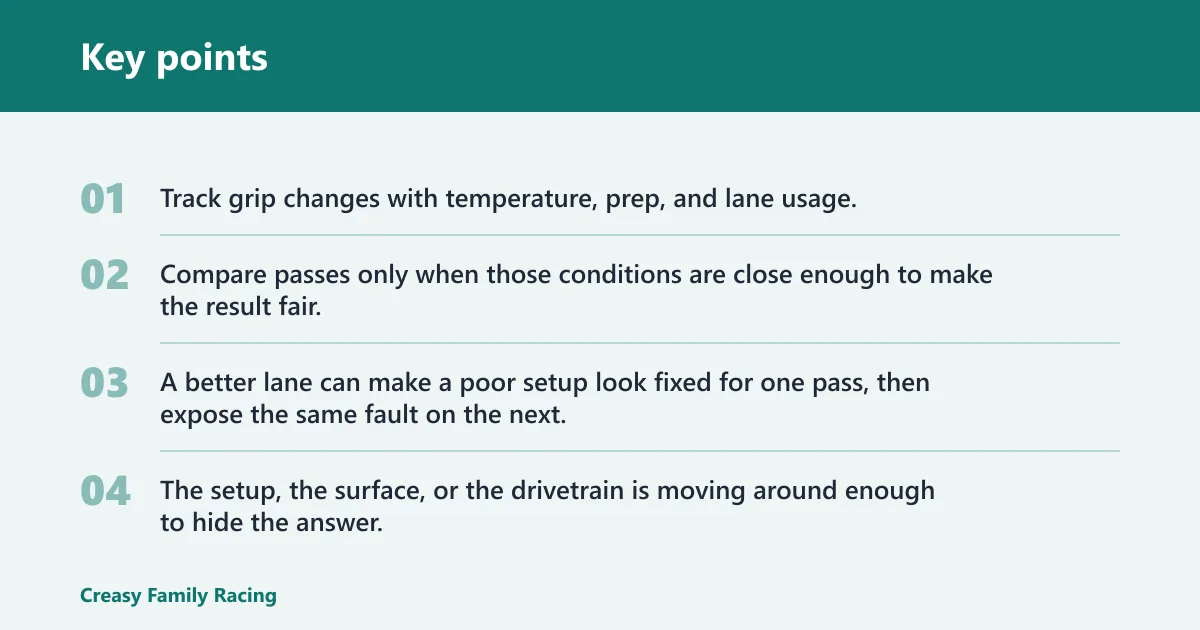
Track grip changes with temperature, prep, and lane usage. Compare passes only when those conditions are close enough to make the result fair. A better lane can make a poor setup look fixed for one pass, then expose the same fault on the next.
Stop chasing rpm decision tree
| Observed symptom | What it usually points to | Next check |
|---|---|---|
| Immediate tire spin at launch | Traction limit, pressure too high, too much torque too early | Tire pressure, tire compound, surface prep, throttle or clutch release |
| Engine falls on its face or bogs | Launch rpm too low, clutch or converter behavior, power coming in late | Boost rise, converter flash, clutch timing, torque curve, gear choice |
| Rapid hop through the hit | Wheel hop, bushing or control arm issue, shock control problem | Suspension, mounts, bushings, axle and differential play |
| Different 60-foot on nearly every pass | Inconsistent driver input or a mechanical part that is changing behavior | Data log, launch rpm trace, throttle timing, clutch or converter consistency |
| Change in rpm makes no repeatable difference | Launch rpm is no longer the limiting factor | Inspect traction, suspension, tires, and drivetrain in that order |
Say your car picks up at 4,200 rpm on one run and drops 0.08 second in the 60-foot on the next run at the same pressure and lane. That is not a clean rpm problem anymore. The setup, the surface, or the drivetrain is moving around enough to hide the answer.
Why does it still bog?
A bog means the engine or powertrain cannot carry the car through the hit, even if the launch rpm looks higher on paper. The cause is often power delivery that comes in too late, or a clutch or converter that changes how quickly load reaches the tires. Raising rpm without fixing that mismatch usually just moves the bog around.
Power delivery shape matters
Naturally aspirated engines usually respond more linearly. Turbo combinations can lag, then hit hard when boost builds. Supercharged and nitrous setups often bring torque in sooner, which can overwhelm the tire if the launch rpm is too aggressive. The point is not only engine speed. It is when the torque arrives.
If the car bogs right after release, watch the data for a slow rise in rpm, throttle, or boost. If the engine recovers late but the car still leaves softly, the issue may be converter stall, clutch release speed, or a gear ratio that does not keep the engine in its useful range.
Clutch and converter clues
Manual cars can bog from a clutch release that is too fast or too gentle for the torque curve and tire. Automatic cars can bog from a converter that flashes lower than expected, couples too hard, or is mismatched to the engine’s torque. In both cases, launch rpm changes only mask the real behavior.
- Check the launch trace. Look at rpm, throttle position, and boost from release to 60 feet. A flat or delayed rise points away from simple rpm tuning and toward power delivery or drivetrain behavior.
- Compare similar passes. Use runs with the same tire pressure, lane, and weather window. If the bog appears only when conditions change, track grip may be hiding the actual launch window.
- Inspect coupling parts. For a manual, look for clutch slip or inconsistent release timing. For an automatic, check converter flash and any signs of shudder or lazy coupling. Those faults can make every rpm change feel random.
Suppose a turbo car leaves at 4,500 rpm, then falls flat for the first 30 feet while boost climbs slowly. Raising launch rpm to 4,800 may help one pass and hurt the next. If the turbo is not reaching target boost early enough, the better fix is usually in boost control, converter choice, or the launch strategy, not more rpm.
Why does it still spin?
If the car still spins after you lower launch rpm, the limit is often traction, not engine speed. Tire pressure, compound, sidewall stiffness, surface prep, and torque delivery can all overpower the tire even at a modest launch rpm. At that point, reducing rpm may help only a little, or not at all.
Traction comes first
Surface grip changes with prep, temperature, and lane. A lane with more compound can accept a higher launch rpm, while a cold or dirty surface can turn the same setup loose. That is why the same car may want different launch rpm from pass to pass, even when nothing else changes.
Start with tire pressure before larger changes. A few psi can matter a great deal, especially with a narrow tire or a stiff sidewall. The right pressure window depends on the tire type and size, so use the tire maker’s range as the starting point and work in small steps.
When lower rpm is the wrong answer
Lower rpm is the right move when spin starts immediately and the car is otherwise stable. It is the wrong answer when the tire breaks loose because the suspension unloads, the axle hops, or the car hits the tire too hard in one sharp pulse. In those cases, the rpm is not the real cause.
A common first-timer mistake is dropping launch rpm several hundred rpm after one spin pass, then changing tire pressure too, then making a clutch change. That hides which change mattered. Adjust one variable, then judge it on the 60-foot and the launch trace.
Track prep and tire setup
- Track prep changes the effective bite, so the same rpm may be too much on one lane and too little on another.
- Tire compound affects how quickly the tire can absorb torque without slipping.
- Tread type and sidewall stiffness change how much the tire wrinkles, distorts, and loads the chassis.
- Pressure window matters because too much pressure reduces contact patch and too little can make the tire unstable.
What parts should you inspect first?
Start with wheel hop, then suspension, then drivetrain. That order catches the highest-probability faults first and avoids wasting passes on rpm changes that cannot fix a broken or mismatched part. If the car hops, shudders, slips, or shows damage risk, stop chasing launch rpm until the hardware is checked.
Wheel hop and suspension checks
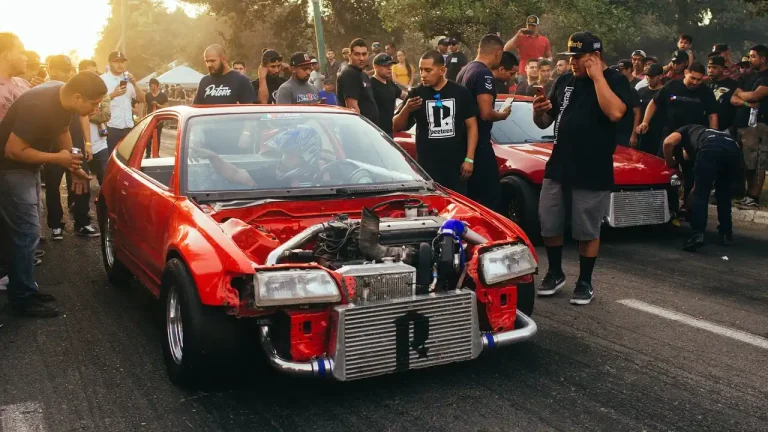
Wheel hop is rapid tire-and-suspension oscillation. It is usually a sign of a chassis or bushing issue, not a launch rpm problem. Because hop can damage parts, it deserves an immediate setup check. More rpm often makes it worse, not better.
- Inspect bushings and joints. Check control arm bushings, shocks or struts, spring mounts, and any looseness in the rear or front locating parts, depending on the drivetrain layout. Movement here can unload the tire, then snap it back into hop.
- Review shock control. Look for settings or wear that let the tire bounce instead of plant. If the car hits hard and rebounds, the shock may be too loose in extension or compression for the tire and spring rate.
- Check wheel and axle play. Loose hardware, worn bearings, or differential issues can add movement that turns into hop under load. Fixing the launch rpm will not cure that.
Drivetrain checks
Transmission, clutch, converter, differential, and axles can all make launches inconsistent when worn or mismatched. Failure signs include slip, shudder, delayed coupling, or breakage risk. If the car feels fine at low load but acts different on the hit, the drivetrain deserves a close look.
Manual cars should be checked for clutch slip and release inconsistency. Automatic cars need attention on converter flash, stall behavior, and any shudder under load. Rear gear ratio and axle condition matter too, because a weak or mismatched combination can blur every launch change you make.
How do I know if the problem is my launch technique or the car setup?
Technique is more likely when the data changes with the driver’s inputs and the hardware looks steady. Setup is more likely when the same inputs produce different results, or when the car shows hop, slip, shudder, or a repeatable 60-foot problem even with careful launches. Good data separates the two.
Look for a pattern across several passes, not a single best run. If a launch rpm change helps only when the clutch comes out faster, or only when throttle timing is delayed, then the issue may be technique interacting with the setup. If the car is inconsistent even with the same release point, the hardware is the first suspect.
Log the right channels
Data logging should include rpm, boost, throttle position, clutch timing, and wheel speed. Those channels show whether the driver input is clean and whether the car is actually putting power to the track. Without them, every launch guess looks the same.
- Record every launch channel. Capture rpm, throttle, boost, clutch release timing, and wheel speed from the hit through the 60-foot mark. That gives a direct view of what changed.
- Match the test conditions. Keep tire pressure, lane, and launch rpm the same while you compare runs. If the 60-foot still swings, the car is telling you the issue is not simple driver variation.
- Change one variable. Move launch rpm in 200 rpm steps, then judge the trend across at least two or three similar passes. If the trend disappears, stop and inspect the car instead of adding more rpm.
Picture a car that leaves at the same pedal position every time, yet the wheel speed spikes on one pass and falls flat on the next. That points away from pure technique. It points to traction loss, clutch or converter inconsistency, or a suspension issue that changes how the tire is loaded.
Stop chasing rpm checklist
Use this checklist when launch changes stop paying off. Each question tests one symptom, and the inspection order starts with the most likely cause first.
| Yes/no question | Symptom it tests | Recommended inspection order |
|---|---|---|
| Did a 200–300 rpm change leave the 60-foot unchanged? | Launch rpm is no longer the main lever | Compare data first, then inspect traction and tire pressure |
| Does the car vary by more than 0.05 second in the 60-foot on similar runs? | Inconsistency from setup or hardware | Driver inputs, then tire, then suspension, then drivetrain |
| Does the tire spin immediately even at lower rpm? | Traction limit or pressure problem | Tire pressure, track prep, tire condition, then power delivery |
| Does the car bog even after a higher launch rpm? | Late power delivery or coupling issue | Boost rise or converter flash, then clutch timing, then gear choice |
| Is there hop, shudder, or a harsh oscillation? | Wheel hop or suspension control problem | Shocks or struts, springs, bushings, control arms, then mounts |
| Do launches change with the same driver input? | Hardware inconsistency | Drivetrain wear, tire condition, suspension movement, then data review |
Use the answers to decide whether launch rpm still deserves attention. If two or more checklist rows point to traction, suspension, or drivetrain, the article advises stopping rpm-only changes and moving to inspection.
Frequently asked questions
When should I stop adjusting launch rpm and look for a mechanical problem?
That pattern usually means the limit is traction, suspension, tires, or drivetrain behavior, not launch rpm.
Why does my car still bog even when I raise the launch rpm?
A higher launch rpm cannot fix late torque delivery, an overly tight converter, a slipping clutch, or a gear setup that drops the engine out of its useful range. Check boost rise, clutch timing, converter flash, and the launch trace before pushing rpm higher again.
Why does my car still spin even when I lower the launch rpm?
If spin continues after lowering rpm, the tire may still be overmatched by track prep, pressure, compound, or a harsh torque hit. Wheel hop and suspension unload can also cause spin at modest rpm. In that case, pressure, chassis control, and surface grip matter more than more rpm change.
What parts should I inspect first if launch rpm changes do nothing?
Start with tire pressure and tire condition, then move to wheel hop and suspension parts such as shocks, springs, bushings, and control arms. After that, check clutch, converter, differential, and axles for slip, shudder, or wear. That order catches the most common faults first.
Can bad shocks, tires, or suspension make launch rpm useless?
Yes. Bad shocks can let the tire bounce, worn bushings can change load transfer, and the wrong tire or pressure window can erase the effect of rpm changes. When the chassis cannot plant the tire consistently, launch rpm becomes a poor tuning lever.
How do I tell if wheel hop means I need a setup change instead of more rpm?
Wheel hop is the clue. It is rapid tire-and-suspension oscillation, and it usually means the chassis is unloading and reloading the tire. More rpm often makes the hop worse. Check shocks, bushings, control arms, mounts, and any play in the drivetrain before touching launch rpm again.
What data should I log before chasing launch rpm again?
Log rpm, boost, throttle position, clutch timing, wheel speed, tire pressure, lane, and the 60-foot time. Those data points show whether the launch changed because of driver input, traction, or hardware. Without them, rpm tuning becomes guesswork.