Best Autocross Classes for Cars with Factory Performance Packages
A factory performance package keeps a car in Street class only if it is a documented OEM option or trim and every added part still fits Street rules; if you cannot prove that chain, assume it is out. Mistakes here can put you in the wrong class, trigger protests, and cost points or trophies. This guide lays out the checks, the documents to verify, and the rule traps that decide Street legality.
This guide is part of our Autocross classes explained series.
What counts as a factory performance package?
A true factory performance package is built into the car’s delivery spec, or listed as an OEM-approved option group tied to the VIN. That matters because SCCA classing follows what the car was sold with, not what the badge says on the trunk.
Dealer-installed accessories and port-installed add-ons are different. They may be installed before delivery, but if they are not part of the factory build record, they can act like aftermarket parts for classing.
OEM-installed vs dealer-installed equipment
The cleanest case is an option package shown on the build sheet and window sticker, with a matching option code or package code. That is the paper trail you want for Street eligibility.
A dealer-installed spoiler, wheel set, lowering spring kit, or brake upgrade needs separate scrutiny. If it is not in the OEM build record, do not assume Street legality.
Why the exact build matters more than the badge
Two cars with the same model name can class differently because one has the package and one does not. The package may change wheel size, brake hardware, suspension parts, differential type, or tire fitment.
That is why the exact VIN, trim, and package code matter more than marketing language. SCCA Solo rules start with the delivered configuration.
Which Street classes fit package cars?
For factory-package cars, the first comparison is almost always against the SCCA Street class subclasses, not a vague “Street” label. The classes people most often compare here are DS, GS, FS, and BS, since those are common homes for package cars that stay close to OEM spec.
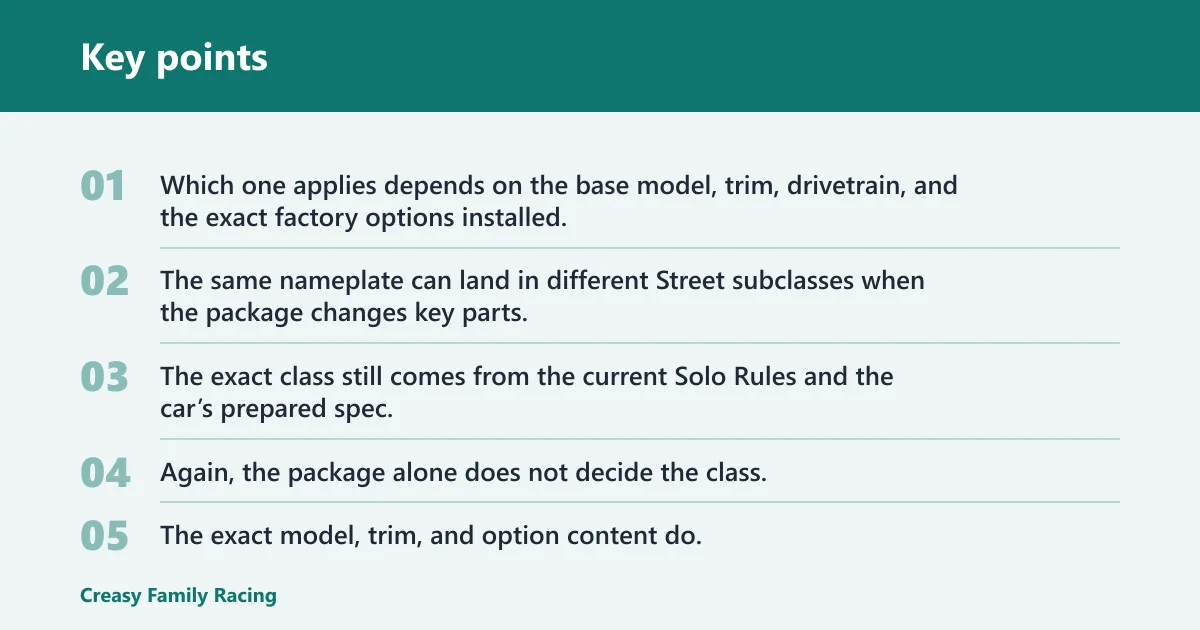
Which one applies depends on the base model, trim, drivetrain, and the exact factory options installed. The same nameplate can land in different Street subclasses when the package changes key parts.
DS and GS examples
DS and GS often capture lighter, smaller, or more modestly powered factory package cars, especially when the package adds wheels, brakes, or a mild suspension tune without pushing the car into a higher-prep category.
If the package keeps factory wheel and tire sizes within Street limits and does not add non-OEM suspension parts, DS or GS may remain the likely starting point. The exact class still comes from the current Solo Rules and the car’s prepared spec.
FS and BS examples
FS and BS are common comparison classes for more aggressive factory performance packages, especially on larger coupes and sedans that receive substantial brake, wheel, or chassis changes from the factory.
Again, the package alone does not decide the class. The exact model, trim, and option content do.
Why identical models can split by trim or package
A base car and a performance-package version can look similar from ten feet away and still class differently. A package can change tire size, wheel width, differential type, or brake hardware enough to move the car into a different Street subclass.
That is why you should never class by name only. Class by documentation.
Does your package keep the car in Street?
Sometimes yes, sometimes no. A package car may remain in Street only if the parts are OEM-delivered, documented, and the car still fits Street allowances for wheels, tires, brakes, suspension, aero, and drivetrain parts.
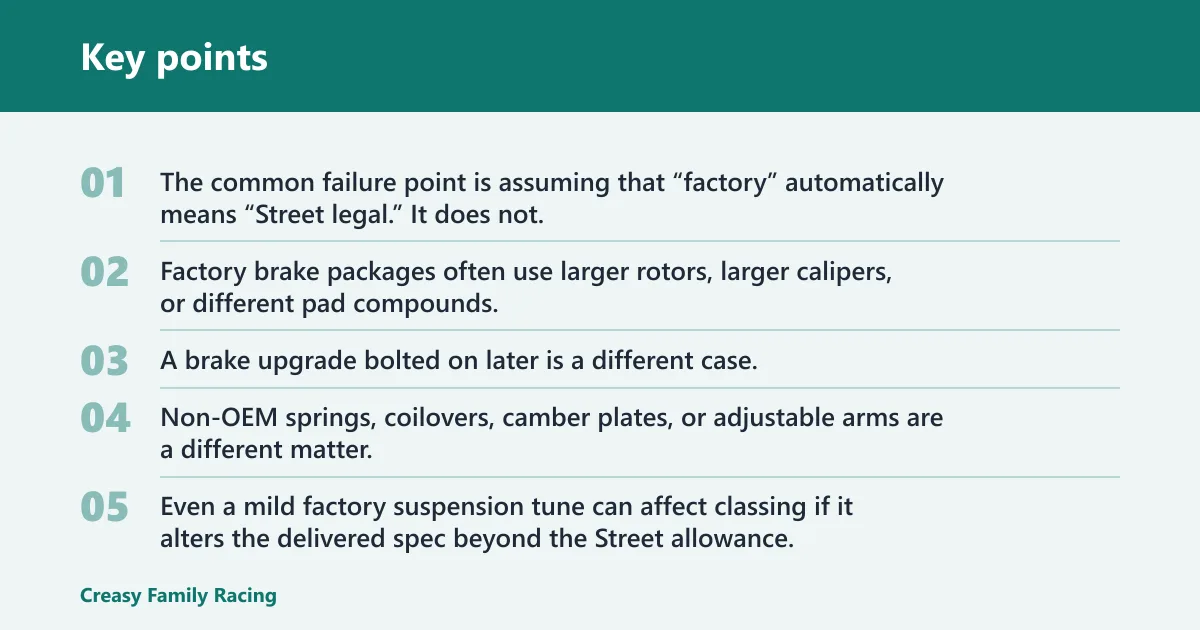
The common failure point is assuming that “factory” automatically means “Street legal.” It does not. The package must fit the rulebook too.
Brakes and rotor size
Factory brake packages often use larger rotors, larger calipers, or different pad compounds. Those parts can be legal if they are part of the OEM package and the class allows that configuration.
What matters is whether the brake package is part of the delivered trim and whether the package remains within the Street rules for that car. A brake upgrade bolted on later is a different case.
Suspension and ride-height changes
Factory shocks, springs, bushings, and ride height changes can keep a car in Street if they are part of the stock package. Non-OEM springs, coilovers, camber plates, or adjustable arms are a different matter.
Even a mild factory suspension tune can affect classing if it alters the delivered spec beyond the Street allowance. Read the package code and the rule text before assuming it is legal.
Wheels, offset, and tire size
Factory wheel size is one of the first things to verify. Street class cares about wheel diameter, width, offset, and whether the tire still fits the body without rubbing or fender changes.
Street legality also depends on the applicable SCCA Solo Rules and the car’s wheel and tire fitment. In common autocross use, drivers often talk about a 200-treadwear-style benchmark, but SCCA classing depends on the current Street tire rule and the car’s exact wheel and tire fitment.
OEM limited-slip differential and factory aero
An OEM limited-slip differential is often part of a performance package. That can be a legal factory upgrade, but only if the model and class rules allow that delivered setup.
Factory aero parts follow the same logic. A wing, splitter, or lip may be legal if it is part of the OEM package and remains within the Street rules for that class. Wider tires outside the package spec are a common line-crossing point.
Factory class verification checklist
Use this before an event, before buying parts, and before assuming the car belongs in Street. The goal is simple: prove the exact delivered configuration, then compare it to the current SCCA Solo Rules.
| Document or check | What to confirm | Why it matters |
|---|---|---|
| VIN | Matches the exact car you plan to run | Ties the car to a specific build record |
| Build sheet | Lists the performance package, trim, and option code | Shows whether the package was factory-delivered |
| Window sticker | Shows the package name and installed options | Confirms the car’s original equipment |
| OEM option code | Matches the package code used by the manufacturer | Verifies that the package is not a dealer add-on |
| Wheel specs | Diameter, width, and offset | Street legality depends on exact fitment |
| Tire specs | Size and type on the car now | Tires are a common class-changing item |
| Brake package details | Rotor size, caliper design, and package source | Factory brake packages can alter class eligibility |
| Suspension type | Stock shocks, springs, and any factory tuning | Confirms whether the car remains in Street |
| Differential type | Open diff or OEM limited-slip differential | Some packages change drivetrain classing |
| Final decision | Yes or no for Street legality | Keeps the entry honest before the event |
Match the VIN. Pull the VIN from the car and match it to the paperwork. If the paperwork does not match the car, stop and resolve it before classing.
Verify the build sheet. Look for the exact package name and the OEM option code. If the car has no build sheet, use the window sticker and manufacturer records when available.
Compare wheel and tire specs. Confirm diameter, width, offset, and tire size against the delivered package. A wheel that fits the fender differently from stock can create a class problem.
Check brakes and suspension. Confirm rotor size, caliper type, shock and spring content, and whether those parts came with the package. If they are not OEM-delivered, treat them as suspect until the rules say otherwise.
Check the differential. Confirm whether the car has an OEM limited-slip differential or an open differential. Package cars often differ here, and the drivetrain spec can change the class result.
Record a yes or no. Mark the car as Street legal only if the documents and the rulebook both support it. If either one fails, move to the safer class or ask for a ruling before you grid up.
Final Street legality decision: Yes if the package is documented by VIN, build sheet, window sticker, or OEM code, and every wheel, tire, brake, suspension, aero, and differential detail still fits the Street rules. No if the package is undocumented, dealer-installed without proof, or includes non-OEM parts that cross the line.
What parts push a car out of Street?
Aftermarket wheels and tires are often the first problem, especially when width, diameter, or compound no longer match Street limits. Non-OEM suspension parts, such as lowering springs or coilovers, are another common move out of Street.
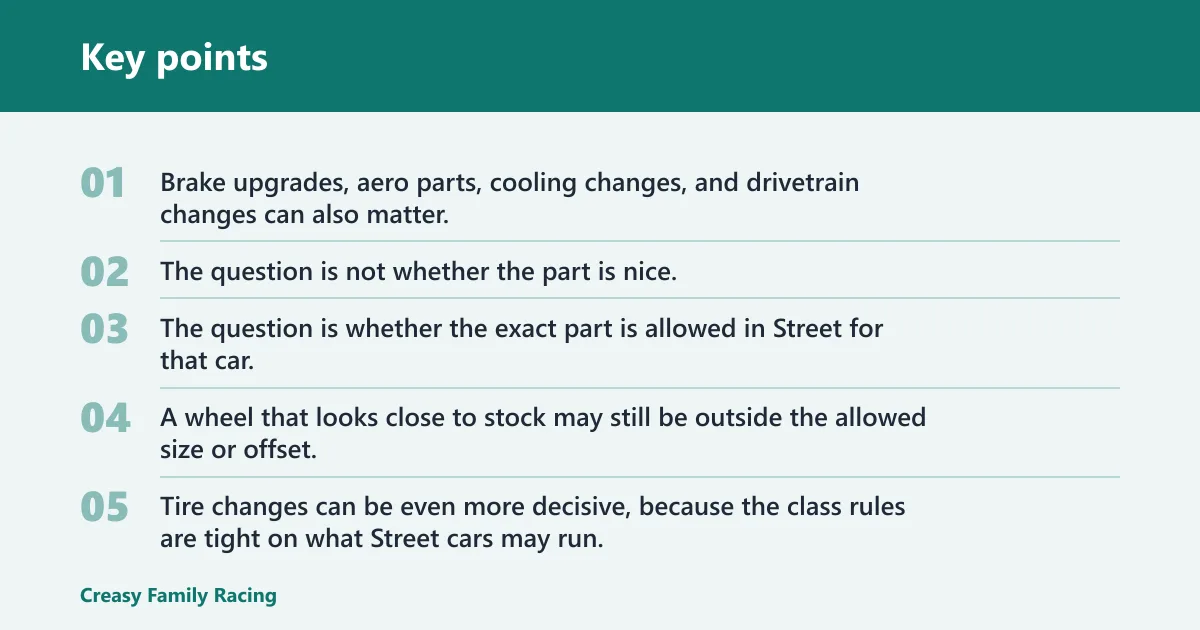
Brake upgrades, aero parts, cooling changes, and drivetrain changes can also matter. The question is not whether the part is nice. The question is whether the exact part is allowed in Street for that car.
Aftermarket wheels and tires
A wheel that looks close to stock may still be outside the allowed size or offset. Tire changes can be even more decisive, because the class rules are tight on what Street cars may run.
Suppose a package car came from the factory on 19×8 wheels with a specific tire size, but the owner fits 19×9 aftermarket wheels and a wider tire. That is no longer a safe Street assumption.
Non-OEM suspension, brakes, and aero
Non-OEM springs, dampers, control arms, brake calipers, and aero pieces are the classic border breakers. A factory package is only helpful if it stayed factory.
A common first-timer mistake is assuming a dealer-installed splitter or lowering spring counts as OEM because it was fitted before delivery. Unless the paperwork proves it, do not count on that.
Cooling and drivetrain changes
Intercoolers, radiators, oil coolers, intake duct changes, and differential swaps can all affect classing. Some package cars include factory cooling or drivetrain changes, but the exact delivered spec still controls the result.
If the part was added later, it usually needs extra scrutiny. When in doubt, treat it as a class-changing modification until the rulebook says otherwise.
Dealer-installed package or true factory option?
This is where many classing mistakes start. A dealer-installed or port-installed package can look factory-clean and still fail the Street test if it is not part of the original OEM build.
When the paperwork is thin, the safest move is to assume the car is not confirmed for Street until you prove otherwise.
Port-installed accessories
Port-installed equipment may arrive on the car before retail delivery, but that does not automatically make it a factory package for classing. Documentation has to show how the OEM lists that equipment.
If the package was added after the factory build, it may not count the same way as a VIN-linked option code.
Missing paperwork or incomplete records
Missing paperwork is a warning sign, not a small inconvenience. Without a build sheet, window sticker, or option code, you are guessing.
That guess can put you in the wrong class and create protest risk. Use the rulebook, the manufacturer’s records, and event staff guidance before you enter.
How to document the car before your event
Bring the VIN, build sheet, window sticker, and any manufacturer documentation that names the package. Keep wheel, tire, brake, suspension, and differential details in one place so you can answer class questions quickly.
If the car has a dealer-installed package, write down exactly what was installed and by whom. Then compare that list against the Street rules before you choose a class.
Where Street ends and Street Touring begins
Street ends when the package goes beyond the OEM-delivered, Street-allowed setup. Street Touring begins when the car needs more preparation than Street allows, such as non-OEM wheels and tires, more open suspension changes, or other mods that exceed Street rules.
For borderline cars, the safer class is the one that matches the parts on the car today, not the one you hope it belongs in.
Common border cases
Common border cases include a performance package with undocumented wheels, a dealer-installed suspension kit, or a model that exists in both base and package trims. Those are the cars that need the closest paperwork review.
If the package is real but the parts do not match the record, Street is not a safe assumption.
How to choose the safer class
If the paperwork is incomplete, pick the class that clearly fits the car’s current state or ask for a ruling before the event. That is better than finding out after trophies are posted.
For a package car that sits near the line between Street and Street Touring, the rulebook wins. Event organizers can help, but the current Solo Rules remain the source of truth.
Frequently asked questions
What autocross class is a car with a factory performance package in?
Usually one of the Street subclasses, often DS, GS, FS, or BS, depending on the exact model, trim, and package content. The answer is not the badge name alone. It is the documented OEM configuration plus the current SCCA Solo Rules.
Does a factory performance package keep a car in Street class?
Often yes, if the package is factory-delivered, documented, and still fits Street rules for wheels, tires, brakes, suspension, aero, and drivetrain parts. If the package is missing paperwork or includes non-OEM changes, do not assume Street legality.
Which factory performance packages are allowed in SCCA Street class?
The allowed packages are the ones the current rules permit for that exact car and class. The key filters are OEM delivery, option-code proof, and part-by-part fit with Street allowances. A package name by itself is not enough.
Do factory performance brakes, suspension, or wheels change autocross class?
They can. Factory brakes, suspension, and wheels are often legal when they are part of the delivered package, but they still have to fit the class rules. Once those parts are changed outside the OEM record, classing can move out of Street.
What happens if my performance-package car has optional factory parts?
Optional factory parts are fine only if you can prove they were part of the OEM build and still fit Street. Missing records, mixed trim content, or dealer-installed substitutions make the car harder to defend in Street and may push it elsewhere.
What autocross class should I pick if my car has a dealer-installed performance package?
Do not assume Street. Start with the paperwork: if the package is not on the VIN-linked build record or window sticker, treat it as a modification until proven otherwise. When the record is incomplete, choose the class that clearly matches the car’s current parts.