Autocross Classes Explained
Find your autocross class by starting with your car’s exact base model in the SCCA Solo rules, then checking every modification against the allowed-prep list; one illegal Street-class part can move you into Street Touring, Street Prepared, or higher. Get it wrong, and a daily driver can be legal yet badly outclassed before first run. Here you’ll learn how to read national and local class lists, spot common class-changing mods, and judge parts by competitiveness before you buy or register.
How autocross classing actually works
SCCA Solo rules are the national base for classing, but your event may also use a local class list or operations document that adds novice, indexed, or extra local categories. Your car still has an underlying rules class, and that base class matters more than the run group name printed on the event page.
Start with the national rules, then read the local event structure
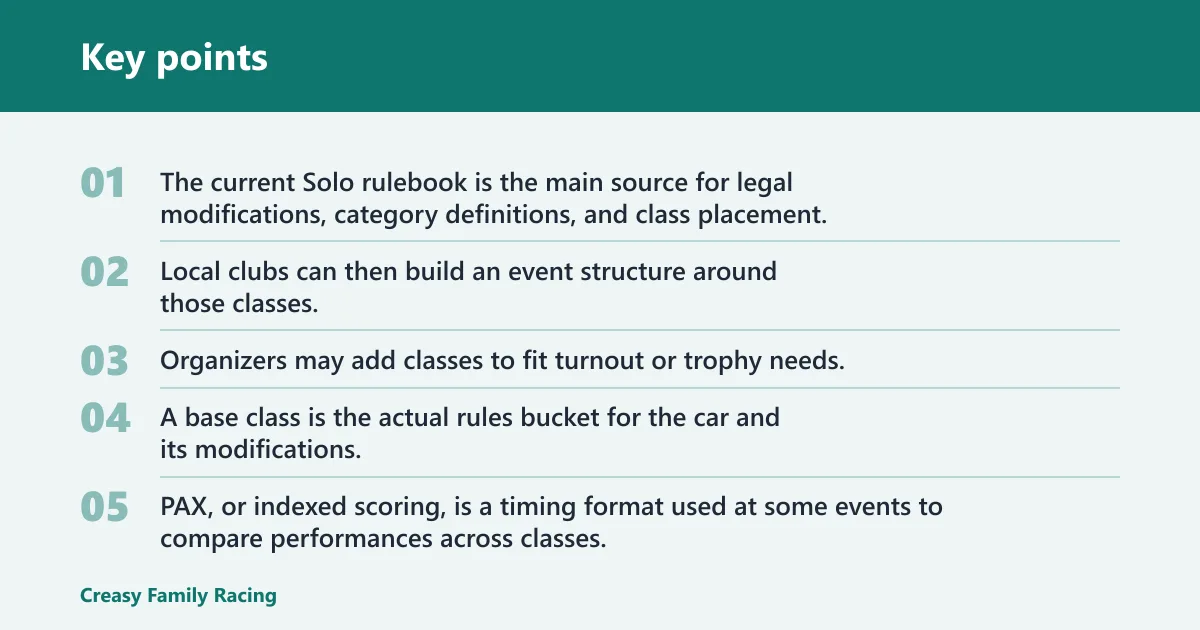
The current Solo rulebook is the main source for legal modifications, category definitions, and class placement. That is where a car’s base class is assigned, and where the prep limits for each category are written.
Local clubs can then build an event structure around those classes. Organizers may add classes to fit turnout or trophy needs. That is why an event may show novice, ladies, CAM-style catch-alls, or a local Street Touring Over class without changing what the car actually is under the national rules.
Base class, category, and indexed scoring are different things
A base class is the actual rules bucket for the car and its modifications. A category is the larger family that bucket belongs to, such as Street, Street Touring, Street Prepared, Street Modified, Prepared, or Modified.
Indexed competition is separate again. PAX, or indexed scoring, is a timing format used at some events to compare performances across classes. It does not replace classing. A car can be classed in Street Touring and also appear in indexed results the same day.
Why modification limits matter more than category names
For a new driver, the smart way to think about classing is not “What list am I on?” but “What did this part change, and what prep level does that allow?” Category names sound simple. The actual class jump usually comes from the rule allowance tied to that specific change.
That is where beginners lose ground. A part can add grip, sharpen response, or add power, then place the car against wider tires, lighter builds, and much deeper setups than it faced before.
Say your car starts in a Street class on 200-treadwear tires with factory springs and a mild alignment. Add coilovers because they look like an easy grip upgrade, and the car may move to a category where much more suspension freedom is legal. The part helps, but the class move may cost more than it gives back.
Miata autocross classing basics
If you drive a Miata, the first step is matching the generation and your current mods to the class rules before you register. The supporting guide breaks down where stock NA, NB, NC, and ND cars usually land, which common bolt-ons shift you into Street Touring or beyond, and which changes can surprise you on event day. That matters because the wrong class can mean an unexpected bump, a protest, or having to re-enter at the last minute.
Use this Miata class guide to check your car against the most likely categories and verify the details that change the answer, from trim level to suspension and wheel setup.
What class is my car in for autocross?
Find the exact model and trim in the current SCCA Solo rules first, then verify every installed part against that category’s allowances. After that, read the event’s local class list for novice or indexed groups, but do not confuse those local run groups with the car’s actual rules class.
Exact model and trim come first
Do not class the car by badge alone. The right answer can depend on the exact base model, performance package, trim level, transmission, or factory-installed option set recognized by the current rules.
That matters before any modification is considered. If the base placement is wrong, every later decision starts from the wrong line.
Then compare the installed parts to the allowed-prep
After the base class is identified, the next question is whether the car still fits the allowed changes for that category. Most mistakes happen here, especially with wheels, tires, springs, coilovers, camber parts, intakes, and body pieces.
A common first-timer mistake is assuming a part sold for street use must stay in a street-oriented class. Autocross does not work that way. The rules care about the exact change the part makes, not whether the car is registered and driven to the site.
Local novice and indexed groups do not replace the rules class
Many events let beginners enter novice for trophies or for easier result comparison. The car still has an underlying class because the rules still need to know what modifications are legal.
The same goes for indexed groups. A registration page may let a driver select an indexed option, but that is a scoring format, not a way around class legality.
Which changes move a car out of Street class?
Street is the closest category to showroom-stock competition, so the parts that move a car out of it are usually the ones that alter tire type, suspension architecture, wheel dimensions beyond the category allowance, induction hardware, or bodywork. Small changes can stay legal; the wrong common bolt-on can force a bigger jump than expected.
Street class basics that shape the answer
Street class is divided into 9 classes, from SS to HS. Street-class cars must run on DOT legal street tires with treadwear of 200 or higher.
That tire rule is a practical dividing line. If a car is on the usual 200TW autocross street tire, it can still fit Street or Street Touring. Once tire type changes upward into race-tire territory, Street is off the table.
Changes that often stay in Street
Street does not mean untouched. Tire replacement within the category’s street-tire rule often stays legal. Alignment changes may also stay legal when they use the car’s factory adjustment range rather than added aftermarket correction hardware.
Shocks can be a trap because some shock changes fit Street while full spring-and-damper systems do not. Read the rule for the exact component and mounting change, because the legal answer comes from that wording, not from how the manufacturer labels the kit.
Changes that usually bump the car out
Coilovers are a common bump point because they typically change more than a simple damper. Springs, ride height, and mounting details are the reason to stop and verify before buying. The same caution applies to camber plates, control arms, and other parts that create extra adjustment outside factory means.
Engine and induction parts can change the answer fast. Intake parts, intercooler changes on turbo cars, header changes, and many body or aero parts often move the car beyond Street even when they look modest on a street build sheet.
Suppose a front-wheel-drive hatch starts in Street with factory 17-inch wheels and 200TW tires. Add a cat-back exhaust alone and the answer may be simple; add camber plates and coilovers at the same time, and classing usually becomes a category move question, not a fine-print Street question.
Autocross classes decision matrix
Common beginner changes mapped to class risk
| Mod type | Likely legal class range | Likely bump risk | Check first |
|---|---|---|---|
| 200+ treadwear DOT street tires in stock size range | Street through Street Touring | Low | Confirm the exact tire still meets the 200+ treadwear rule and does not create a wheel-fitment issue. |
| DOT legal race tires | Street Prepared or Street Modified | High | Street and Street Touring require 200+ treadwear street tires, so race tires usually end that path immediately. |
| Purpose-built slicks | Prepared or Modified | Very high | Prepared cars run on purpose-built racing slicks; Modified also lives in the slick-tire world. |
| Wheel width or diameter change | Street Touring or Street Prepared, depending on the exact setup | Medium to high | Do not assume wheels are harmless. Diameter, width, offset, and category-specific limits all matter. |
| Aftermarket shocks only | Often Street, sometimes higher if bundled with other hardware | Low to medium | Verify whether the part is only a damper replacement or part of a coilover-style conversion. |
| Coilovers | Often Street Touring or higher | High | Check spring location, ride-height adjustment, and whether top mounts or helper parts add extra non-Street changes. |
| Camber plates, arms, or non-factory alignment hardware | Often Street Touring or higher | High | Factory adjustment is different from added adjustment hardware. Read the exact suspension allowance first. |
| Sway bar change | Street or Street Touring, depending on which bar and what mounts change | Low to medium | Check whether only the bar changes or if links, mounts, or relocation parts create a different answer. |
| Lowering springs | Usually Street Touring or higher | Medium to high | Street-class legality usually gets narrow once springs, perch height, or ride height are changed. |
| Intake or induction hardware | Often Street Touring or Street Prepared | Medium to high | On turbo cars, intake path details matter. On any car, “bolt-on” does not mean Street-legal. |
| Cat-back exhaust | Often Street or Street Touring, depending on exact category limits | Low to medium | Read the exhaust section for your category, not forum summaries. |
| Header, manifold, or major exhaust routing change | Street Prepared or higher | High | These parts often go well beyond Street and can also change where Street Touring ends. |
| Front splitter, wing, or replacement body panel | Street Modified or higher, sometimes Prepared depending on the build | Very high | Replacement body panels are specifically associated with Street Modified allowances. |
| Engine swap or turbo/supercharger change | Street Modified | Very high | Street Modified allows engine swaps, forced induction, and replacement body panels. |
What is the difference between Street and Street Touring?
Street keeps a car much closer to its showroom configuration and runs on 200+ treadwear DOT street tires, while Street Touring is the usual next stop for bolt-on street-car builds that still stay on 200+ treadwear DOT street tires. Street Touring opens the door to more parts, but that does not always make it the more competitive choice.
Street is the tighter box
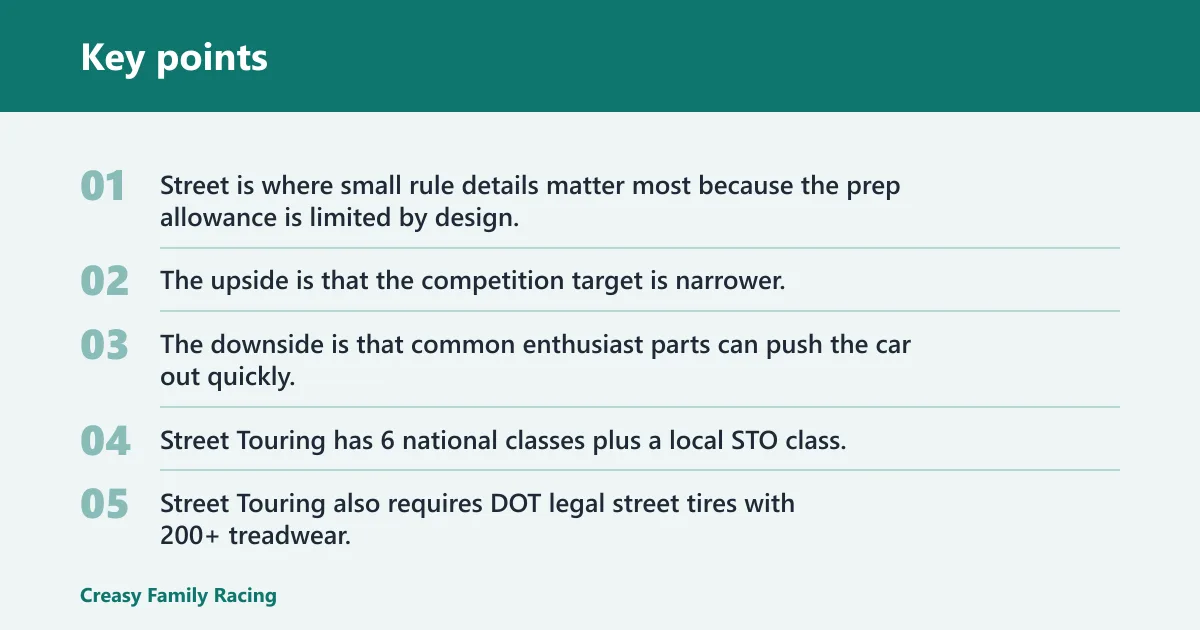
Street is where small rule details matter most because the prep allowance is limited by design. The upside is that the competition target is narrower. The downside is that common enthusiast parts can push the car out quickly.
For many new drivers, Street is the cleanest place to learn because the car can stay close to factory form and the tire rule remains simple.
Street Touring is the common bolt-on destination
Street Touring has 6 national classes plus a local STO class. Street Touring also requires DOT legal street tires with 200+ treadwear.
In plain English, Street Touring is where many daily-driven autocross cars land after springs, wheel changes, intake changes, or alignment hardware enter the picture. It still looks and feels like a street-car category, but the prep room is wider and the average build quality is often much higher.
Why Street Touring can be legal but still a poor competitive move
Legality answers only half the question. Competitiveness is the other half.
Say your rear-drive coupe is legal in Street with good 200TW tires and a basic alignment. If coilovers and wider wheels move it into Street Touring, the car may now face entries built around every legal tire-width, shock setting, and alignment advantage available in that category. The mod package helps, but the comparison set gets harder.
Where Street Prepared and Street Modified change the game
Street Prepared and Street Modified raise both the prep ceiling and the competition ceiling. Street Prepared opens larger wheel, suspension, and induction freedom while using DOT legal race tires; Street Modified goes further with swaps, boost changes, and body panels. For most street-car owners, these categories are major commitment points.
Street Prepared opens race-tire pace without leaving street-car roots
Street Prepared includes 7 classes: SSP, ASP, BSP, CSP, DSP, ESP, and FSP. Street Prepared allows wheel size and width, induction, and suspension changes. Street Prepared cars use DOT legal race tires.
That combination matters. A car can still look recognizable and remain based on a production street car, yet the tire and prep level change the class pace immediately.
If a part list includes wider wheels, broader suspension work, and intake or induction changes, Street Prepared is often the first category where those changes start to fit together. It is also where a beginner can find that the tire bill and setup demands changed more than expected.
Street Modified is where big rework becomes normal
Street Modified has 3 classes: SSM, SM, and SMF. Street Modified allows engine swaps, forced induction, and replacement body panels.
This is the point where the rules stop treating the car as a mildly altered street machine and start allowing deep hot-rodding. A swapped engine, major turbo change, or composite replacement panel may all be legal here even though they are far beyond Street or Street Touring expectations.
Street Modified also uses DOT legal race tires, which means the car may still appear road-going from a registration standpoint while competing in a category with much more serious prep than most beginners expect.
Prepared and Modified are a different destination
Prepared is not intended for street-driven cars and includes CP to FP plus XP. Prepared cars run on purpose-built racing slicks.
Modified includes 7 classes from AM to FM and KM. Modified cars are typically brought to events on trailers.
Those categories matter here for one reason: they show where unchecked modification paths can lead. If the plan includes major aero, extensive chassis work, or purpose-built race-car thinking, classing is no longer about a tidy street-car build.
Do wheel, tire, and coilover changes affect class?
Yes. Tire construction, treadwear category, wheel dimensions, and suspension hardware are some of the most common class-changing modifications in autocross. A street tire may keep the car in Street or Street Touring, while race tires, larger wheel changes, or coilovers often trigger a move into more open categories.
Tires: the first big split
Street and Street Touring both use DOT legal street tires with 200 or higher treadwear. That shared tire rule is why many daily-driven cars move from one to the other before ever looking at Street Prepared.
Street Prepared and Street Modified move to DOT legal race tires. Prepared and Modified run on slicks. Those tire groups are an easy way to sanity-check whether the current class guess even makes sense.
Wheels: harmless-looking, often decisive
Wheel changes catch beginners because they look cosmetic. In classing terms, width, diameter, and offset can matter as much as any flashy power part.
Do not assume an 18×9 wheel is class-neutral because it clears brakes and fits under the fender. If the category limit is narrower, that wheel may change the class before the car even leaves the driveway.
Coilovers, springs, bars, and camber hardware
Coilovers usually deserve a full rules check before purchase. They often affect more than damping and can change ride-height adjustment, spring type, or top-mount configuration.
Alignment is similar. Factory adjustment is one thing; added camber plates, eccentric hardware, or replacement arms are another. Sway bars and shocks can be legal in categories where springs or top mounts are not, so the exact part list matters.
How do local classes and PAX change what you see at an event?
Local clubs can add classes, combine small fields, or offer novice and indexed groups without changing the car’s underlying national class. PAX is one of those event formats: it compares results across classes by index, but it does not decide what modifications your car is allowed to run.
Local add-on classes are common
A region may add novice for beginners, an indexed class for mixed competition, or a local Street Touring Over group when national buckets do not fit turnout neatly. That local flexibility helps events run well, but it also means one club’s class list may not match another’s.
Street Touring is a good example. Nationally, there are 6 Street Touring classes, yet many regions also add local STO. That extra local line can be useful at registration, but it does not erase the need to class the car correctly under the main rules.
PAX is a scoring method, not a shortcut
Indexed competition lets different classes compare times on a common results sheet. It is popular for trophies, fun-runs, or regions with small entries.
What it does not do is make legality less important. A wrongly classed car is still wrongly classed even if the event posts indexed results beside raw class times.
How to class your car before you buy parts
Use a parts-first decision process
- Identify the exact car. Open the current Solo rulebook and find the precise model, trim, and factory package that matches the car. Do this before thinking about mods, because the correct starting class can change with factory equipment.
- List every installed part. Write down wheels, tire model and size, springs, shocks, top mounts, sway bars, alignment hardware, intake parts, exhaust parts, aero pieces, and engine changes. Include previous-owner parts, because undocumented changes are a common source of wrong classing.
- Check category legality. Compare each part against the allowed changes for the base class first. When one part fails Street, stop and check the build against Street Touring; if it fails there, continue upward instead of guessing.
- Confirm tire category. Make sure the tire type matches the category path. Street and Street Touring require 200+ treadwear DOT street tires, Street Prepared and Street Modified use DOT legal race tires, and Prepared and Modified use slicks.
- Read local supplements. Check the region class list, event registration page, and any local supplemental rules or operations documents. This is where novice, indexed, combined, or local extra classes usually appear.
- Decide before buying. If a planned part bumps the car, compare the gain from that part with the strength of the category it creates. The smarter beginner move is often to stay in a tighter class and spend the budget on tires, maintenance, and seat time.
Where to verify the answer before an event
The best places to confirm classing are the current SCCA Solo rules, the local region class list, the event registration page, and any local supplemental rules or operations document. Use all four when the car has more than one modification or when the event advertises extra local classes.
Frequently asked questions
How do autocross classes work?
Autocross classes work by placing a specific car and its current modifications into a rules bucket with defined prep limits. The national SCCA Solo rules set the base class, then local events may add novice or indexed groups around it. The key is matching each installed part to the category that allows it.
What mods move a car out of Street class in autocross?
The usual bump points are race tires, nontrivial wheel changes, coilovers, lowering springs, added camber hardware, induction parts, and body or aero changes. Some shocks, alignments, and tire swaps can remain legal in Street, but common enthusiast parts often push the car into Street Touring or higher.
Do coilovers or alignment parts change your autocross class?
Often, yes. Coilovers commonly change more than damping, which is why they frequently move a car beyond Street. Alignment done with factory adjustment is different from alignment created by camber plates, arms, or other hardware; once extra adjustment parts are added, classing often changes with them.
How do SCCA autocross classes differ from local classes?
National SCCA classes determine the car’s real rules placement and legal modifications. Local classes are event tools that clubs use for turnout, trophies, and administration, and organizers can add classes to suit their requirements. That is why a local STO, novice, or indexed group may appear without changing the underlying class.
Where can I find autocross class rules before an event?
Check the current SCCA Solo rulebook first, then read the region’s class list, the event registration page, and any local supplemental rules or operations manual. That combination covers base class placement, legal modifications, and any local novice, indexed, or add-on classes the event uses.