How to Find Beginner-Friendly Track Days Near You
Find beginner-friendly track days near you by choosing events with novice or novice-only run groups, mandatory classroom sessions, and point-by-point passing rules; if an organizer cannot explain those three items, skip it. A bad screen can put you in a fast run group, waste your entry fee, or leave you unprepared for track etiquette. This guide shows how to read calendars, run-group rules, and organizer policies before you register.
How to judge a first track day
HPDE means a non-competitive, educational track event, usually split into novice, intermediate, and advanced run groups. The best first event gives beginners instructor support, clear classroom time, and restricted passing so you can learn lines, flags, and pit procedures without being dropped into open lapping too early.
What beginner-friendly looks like
- Novice or first-timer run group named on the event page.
- Instructor in the car for the novice group.
- Passing limited to point-by zones, usually on straights.
- Solo sign-off required before you move up.
- Clear helmet rule and tech inspection checklist.
What to read before you register
Open the event page, then read the run-group description, the novice rules, and the tech section in that order. If the page buries passing rules or leaves the novice group vague, treat that as a warning. A beginner-safe event explains who can pass, where passing happens, and when an instructor can approve solo driving.
What you’ll need
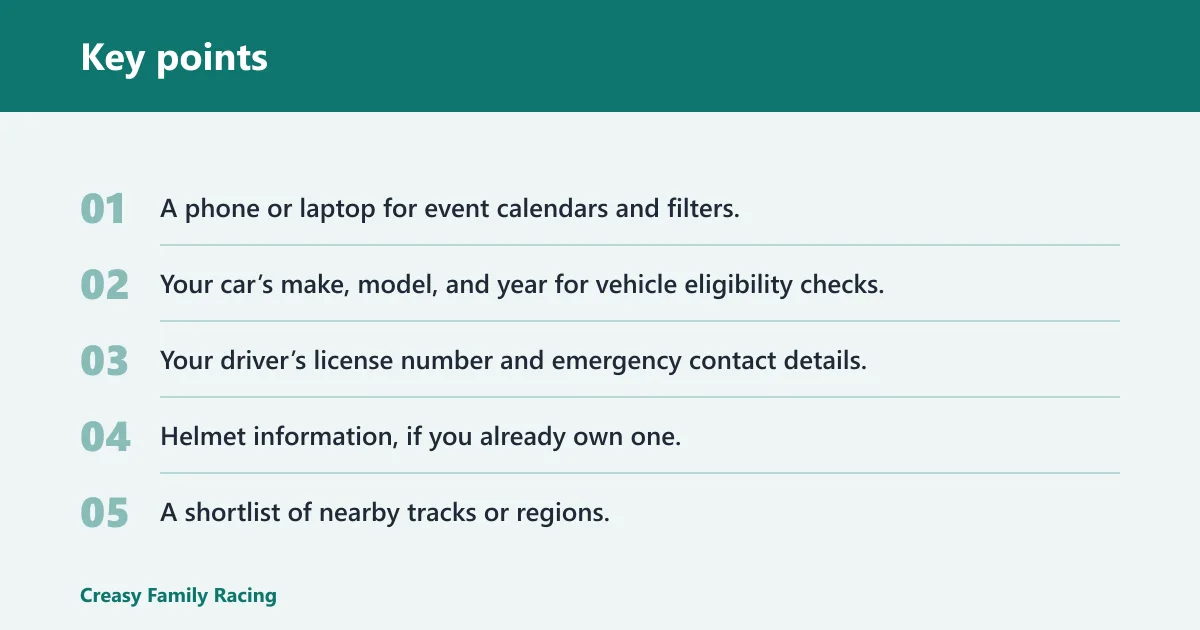
- A phone or laptop for event calendars and filters.
- Your car’s make, model, and year for vehicle eligibility checks.
- Your driver’s license number and emergency contact details.
- Helmet information, if you already own one.
- A shortlist of nearby tracks or regions.
- A notes app or checklist for comparing rules, costs, and membership requirements.
Track-day search tools to use first
MotorsportReg is one of the fastest ways to search organizer listings by location, date, and event type. Trackday.directory is a mapped directory that covers events across 39 states, lists 128 upcoming events on its homepage, and offers distance filters from 50 to 300 miles. Track Shaker says its locator covers 100 road courses in the United States and its events page shows over 1500 track days and HPDE events.
Track Shaker also recommends MotorsportReg or ClubRegistration for finding track day events near you. Use those tools together: one for organizer listings, one for distance and venue filtering, and local club calendars for region-specific events.
- Search your state or metro area in MotorsportReg and sort by date.
- Check trackday.directory with a 50 to 300 mile radius to catch nearby options you may miss.
- Open local club calendars by region, state, and vehicle type.
- Read the novice rules before you compare prices.
- Keep only events that name a beginner group, instructor policy, and passing rule.
Say your home base is in central Ohio and the closest listing is a generic open-lapping day at a nearby road course. That may look convenient, but a slightly farther event with a named novice group, in-car instruction, and point-by-point passing is the better first choice.
How do I find beginner-friendly track days near me?
Start with MotorsportReg, trackday.directory, and the regional calendars for NASA, SCCA, PCA, and BMW CCA. Then filter by distance, state, date, and vehicle type. The closest listing is not always the right one; the right one has a novice group, instructor support, and a rulebook you can understand before you pay.
Where to look first
NASA regional chapters run HPDE events with numbered run groups and beginner instruction. SCCA Track Night in America is a beginner-focused evening format with novice, intermediate, and advanced groups. PCA Driver Education and BMW CCA chapter events are common club-based options, and both may accept non-members depending on the region and event page.
Use the calendar filters in this order: region, then date, then vehicle type, then run group. That order helps you avoid a common mistake: finding a close event that does not accept your car, your experience level, or your registration status.
How do I screen the run groups?
Read the run-group section before you look at entry price. A true beginner event names the novice group, explains whether an instructor rides with you, and says exactly when passing is allowed. If the event offers only open-track sessions or very limited instruction, it is not a good first pick.
What novice policies should say
Look for words like “novice,” “first-timer,” “beginner,” or “green.” Then verify the next step: in-car instruction, classroom sessions, and a solo sign-off threshold that is spelled out in the event rules. Some organizers require you to stay in the novice group until an instructor approves a move-up; others use session attendance or demonstrated control.
For passing, the safest beginner format is point-by-point only, with passing zones listed by the organizer. If the page says “passing anywhere” or leaves the rule vague, skip it for a first event.
Suppose an event lists “Novice 1” but then allows open passing after the first session. That is not the same as a structured novice group. The better choice is the event that keeps passing restricted until the organizer gives clear approval.
Do I need club membership for my first track day?
Sometimes yes, sometimes no. NASA, PCA, and BMW CCA often use club membership models, but membership requirements vary by region and event. SCCA Track Night in America is often used as a lower-cost entry point, and some events do not require club membership at all. Always check the specific event page before you assume anything.
How membership changes the total cost
Membership can turn a cheap-looking entry fee into a higher total once you add dues, tech inspection, and helmet rental if needed. If you are comparing two events, include the membership line item only if the organizer requires it for registration.
A good comparison is simple: event fee, membership fee if required, tech inspection cost if charged by a shop, and helmet rental if you do not own a compliant helmet. That total matters more than the headline entry price.
Track day matrix
This matrix is a quick filter, not a final booking tool. Use it to compare novice support, passing rules, and likely total cost before you register.
| Organizer | Distance from home | Novice group name | Instructor required | Passing rules | Membership required | Typical entry price | Helmet rented on-site |
|---|---|---|---|---|---|---|---|
| NASA regional chapter | Filter by region and track | Novice / numbered beginner group | Usually yes | Usually restricted, often point-by | Vary by region and event | Full-day HPDE events are commonly $250-450 | Varies by event |
| SCCA Track Night in America | Filter by venue or host | Novice | Usually no full-time in-car instructor, but format is beginner-focused | Structured and controlled by session rules | No club membership for many events | Track Night in America typically runs around $150-250 | Varies by venue |
| PCA Driver Education | Filter by region | Novice / green | Usually yes for beginners | Restricted in novice groups | Varies by region | Varies by region and event | Varies by event |
| BMW CCA HPDE | Filter by chapter region | Novice / beginner group | Usually yes | Restricted in beginner groups | Usually chapter membership model | Varies by chapter and event | Varies by event |
| Trackday.directory listing | 50 to 300 miles radius filter | Depends on organizer | Depends on organizer | Depends on organizer | Depends on organizer | Varies by organizer | Check the event page |
How to use the matrix
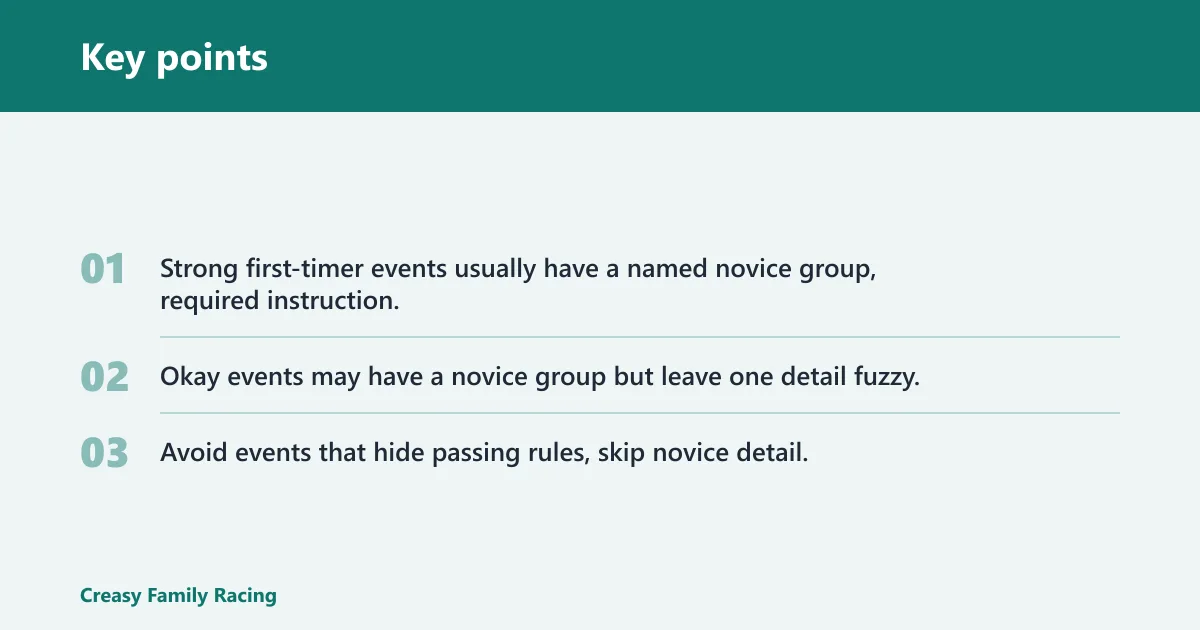
Strong first-timer events usually have a named novice group, required instruction, restricted passing, and a clear solo sign-off rule. Okay events may have a novice group but leave one detail fuzzy. Avoid events that hide passing rules, skip novice detail, or expect you to self-manage from session one.
What should I avoid when choosing a first track day?
Avoid open-passing events, vague novice policies, and listings that do not say whether your car is eligible. Also avoid events that hide helmet rules, tack on unexpected membership costs, or mention tech inspection without listing what the car must pass. A beginner-friendly listing makes those details easy to find.
Common beginner mistakes
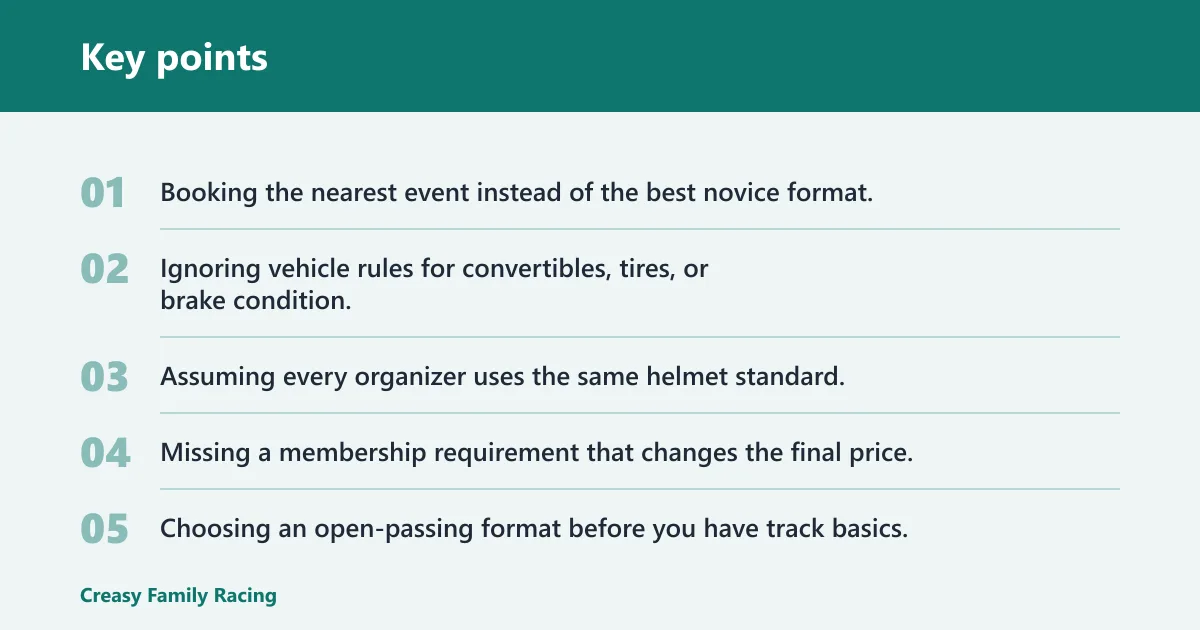
- Booking the nearest event instead of the best novice format.
- Ignoring vehicle rules for convertibles, tires, or brake condition.
- Assuming every organizer uses the same helmet standard.
- Missing a membership requirement that changes the final price.
- Choosing an open-passing format before you have track basics.
Track-day tech checks usually focus on brake pad wear, fluid leaks, wheel condition, tire condition, and secure battery mounting. If an organizer or tech sheet uses a stricter cutoff, follow that sheet. A common first-timer failure is arriving with tires that look fine from five feet away but show cracks, cords, or uneven wear up close.
Another common miss is the helmet rule. Many organizers list a specific current Snell rating on the event page, and some do not allow a generic substitute. Read the rule line by line, because helmet acceptance can differ between organizers and even between chapters of the same club.
If that didn’t work, try this next
- Open the event page and find the novice section first.
- Check whether the organizer requires in-car instruction for novices.
- Confirm the passing rule: point-by, restricted zones, or open passing.
- Read the membership line and add it to the total if required.
- Review the tech sheet for tire, brake, and helmet requirements.
How much does a beginner track day usually cost?
Beginner pricing varies by organizer and region, but a useful starting range comes from the event format. CarSandbox says Track Night in America typically runs around $150-250, while full-day HPDE events are commonly $250-450. Those numbers do not include membership, tech inspection, or helmet rental when those items are charged separately.
Hidden costs to check before you pay
- Club membership, if the organizer requires it.
- Pre-event tech inspection, if your organizer or track requires a shop stamp.
- Helmet rental, if you do not own a compliant helmet.
- Track insurance, if the organizer or a third party offers it.
Use the entry fee as only part of the total. A cheaper event can end up costing more if it requires membership and a separate helmet rental, while a slightly pricier event can be the better value if it includes novice coaching and clearer rules.
Frequently asked questions
Which track day organizers are best for beginners?
Some common beginner-facing names to compare include NASA, SCCA Track Night in America, PCA Driver Education, and BMW CCA. NASA is one of the largest HPDE organizers in the country, and SCCA Track Night in America is often the easiest lower-cost entry point. The best one is the one with clear novice rules and a close venue.
What counts as a beginner-friendly HPDE event?
A beginner-friendly HPDE event typically gives you a novice group, in-car instruction, classroom time, and restricted passing. It should also explain when you can be signed off to drive solo. If those details are missing or vague, treat the event as a poor first choice.
How can I tell if an event has novice run groups?
Look for “novice,” “first-timer,” “green,” or a numbered beginner group in the schedule. Then confirm that the group has its own rules for passing and instruction. If the event only lists open sessions or does not separate experience levels, it is not a true beginner setup.