What tire pressure gauge is best for track day use?
For track day use, the best tire pressure gauge is a calibrated digital or high-quality analog gauge with 0.1 psi resolution, a bleed valve, and a rubber hose or swivel chuck for fast, repeatable adjustments. Bad readings can leave you chasing grip, overheating tires, and burning time in the paddock. This guide covers the features that matter, the gauges worth comparing, and how to choose one for repeatable pressure checks.
Top gauges and what makes them work
The top pick for most track-day drivers is a digital gauge with fine resolution, a bleed valve, and a hose or swivel chuck. That mix gives you fast reads, simple pressure trimming, and better access around hot brakes and tight wheel designs.
Among the commonly compared options, one comparison against calibrated laboratory equipment put the JACO ElitePro Digital near the top overall. It claims ±0.5% accuracy, shows 0.1 PSI resolution, and lists a 5–100 PSI range, which fits passenger-car and performance use without forcing you into a narrow specialty range.
Best overall: JACO ElitePro Digital
This is the strongest all-around choice when you want one tool for reading, bleeding, and rechecking pressure quickly. The combination of 0.1 PSI resolution and a 5–100 PSI range makes it easier to dial in hot pressures session after session.
Best digital: a backlit digital gauge with hose and bleed valve
Choose this if you want the clearest readout in the paddock and the easiest pressure number to see at a glance. A good digital gauge helps in low light, but it should have a solid housing and a battery system that is easy to service.
Best analog/dial: a quality dial gauge with bleed valve
A dial gauge is the better fit if you want battery-free operation and a face that is easy to read quickly. Bob Vila describes analog gauges as having a clocklike face with a needle, which helps when you are checking several tires in sequence and do not want a dead battery to stop the process.
Best budget: a basic pencil gauge
Pencil gauges remain the low-cost option, and they are compact enough to live in a glovebox or small tool roll. They work for simple checks, but they are usually harder to read in low light and less convenient for exact track-day adjustments.
Quick picks
- Best overall: JACO ElitePro Digital, for high-resolution reads and track-friendly adjustment speed.
- Best digital: A backlit digital gauge with a bleed valve and a hose or swivel chuck.
- Best analog/dial: A dial gauge with a bleed valve and durable body.
- Best budget: A pencil gauge if you mainly need a compact backup tool.
Which gauge type is best for track use?
For track use, digital and high-quality analog/dial gauges are the strongest choices because they are easier to read accurately and usually easier to work with in the paddock. Pencil gauges are compact and inexpensive, but they are the weakest option for repeated hot-lap pressure changes and quick exact adjustments.
Digital tire pressure gauges
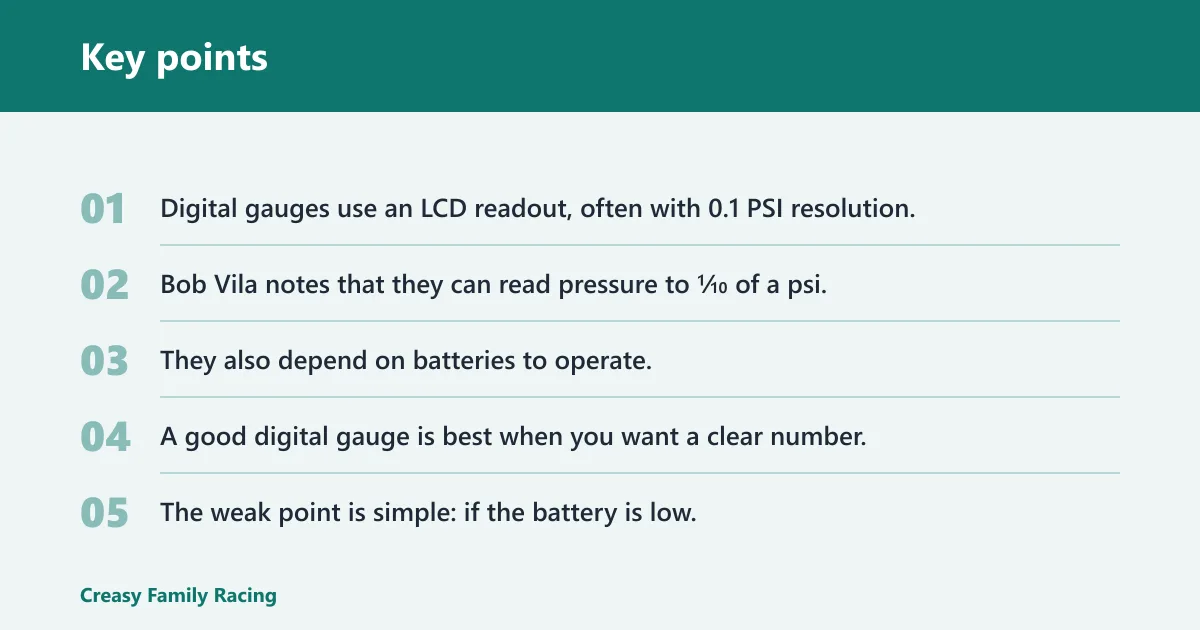
Digital gauges use an LCD readout, often with 0.1 PSI resolution. The same source notes that they can read pressure to ⅒ of a psi, which is useful when you are trying to trim pressure in small steps after a session. They also depend on batteries to operate, so the battery system matters as much as the display.
A good digital gauge is best when you want a clear number, especially in early morning or night sessions. The weak point is simple: if the battery is low, Bob Vila notes that it can cause faulty readings.
Analog/dial tire pressure gauges
Dial gauges avoid batteries and usually have a needle on a clocklike face. Many include a bleed valve, which makes them especially practical for track use because you can release captured air without removing the gauge.
They are often easier to use than pencil gauges and can be a smart choice if you want a straightforward tool that can stay ready in the paddock bag. The tradeoff is that the reading is not as instantly numeric as a digital display, so you need to read the needle carefully.
Pencil/stick tire pressure gauges
Pencil gauges are the smallest and cheapest category. Their metal tube and sliding indicator are simple, but the format is harder to read in low light and less convenient for exact setup work between sessions.
They are fine as a backup or basic street tool. For track-day-only use, they sit at the bottom of the list because they slow you down when you need fast, repeatable pressure changes.
Track gauge scorecard
This scorecard ranks the common gauge types and features by what matters in the paddock, not by price alone. It also shows the spec target that makes sense for track-day use.
| Criterion | Best track-day target | Digital gauge | Analog/dial gauge | Pencil/stick gauge |
|---|---|---|---|---|
| Accuracy | ANSI B40.7 Grade 2A, ±0.5% | Strong when the claim is backed by a reference standard | Good on quality models, but varies more by build | Usually weakest for fine adjustment |
| Repeatability | Read the same tire within 0.1 PSI on repeated checks | Very strong | Strong | Fair to weak |
| Valve access | Swivel chuck or flexible hose | Strong when equipped with a hose | Strong when equipped with a hose | Poor to fair |
| Low-light readability | Backlit LCD or glow-in-the-dark dial | Strong | Fair to strong | Weak |
| Drop tolerance | Housing that tolerates transport and minor impacts | Varies; electronics can be more sensitive | Usually better than digital if built well | Moderate, but simple construction is not the same as precision |
| Adjustment speed | Bleed valve plus easy-to-seat chuck | Very strong | Very strong | Weak |
What features matter most in the paddock?
The most useful track-day features are the ones that speed up reading, bleeding, and rechecking pressure. A perfect display means little if the chuck is awkward on a performance wheel or the gauge is hard to read under a canopy at dusk.
Bleed valve
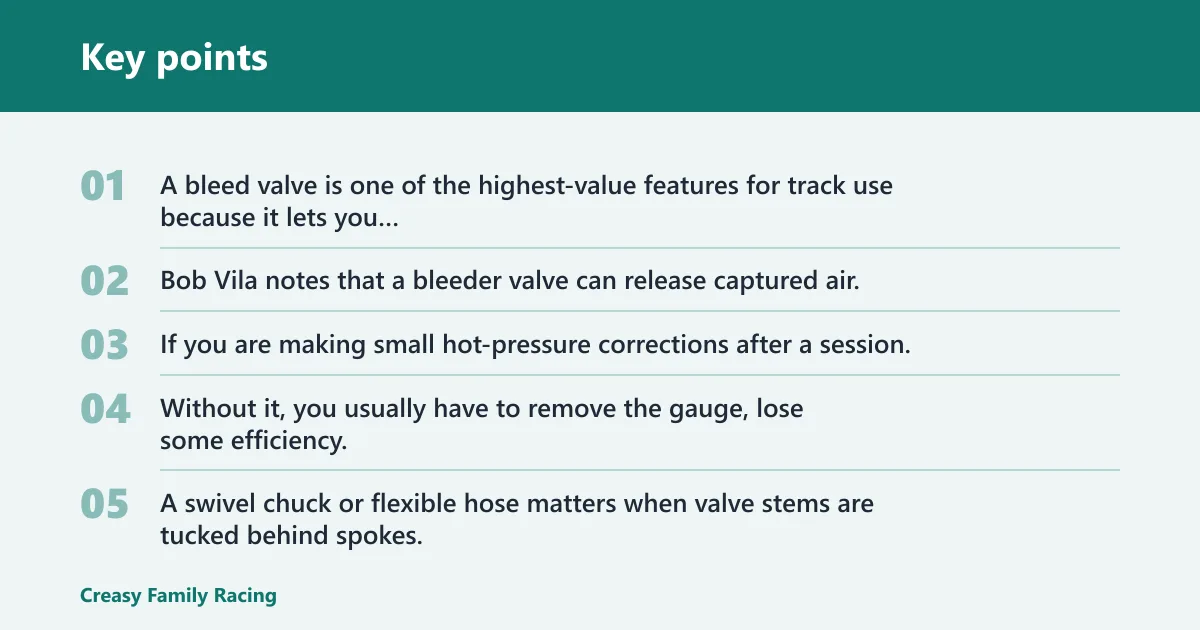
A bleed valve is one of the highest-value features for track use because it lets you trim pressure without removing the gauge. The same source notes that a bleeder valve can release captured air, which makes fine adjustment faster and reduces the chance of overshooting your target.
If you are making small hot-pressure corrections after a session, a bleed valve is close to essential. Without it, you usually have to remove the gauge, lose some efficiency, and recheck more often.
Swivel chuck or flexible hose
A swivel chuck or flexible hose matters when valve stems are tucked behind spokes, close to brakes, or awkward to reach on performance wheels. The Joes Racing gauge includes a 17-inch hose, which shows how track-oriented hose length can improve access.
That extra reach helps more than many buyers expect. It keeps your hand clear of hot calipers and makes it easier to seat the chuck without wrestling the wheel.
Backlit display or glow-in-the-dark dial
Backlit LCDs and glow-in-the-dark dials are useful when you are checking pressures before sunrise or after dark. The same source notes that digital gauges can read to ⅒ of a psi, and that precision is easier to use when you can actually see the display clearly.
If your track schedule includes early arrivals or late-day runs, low-light readability is not a luxury. It is a practical time saver.
Battery system and auto-off
Digital gauges depend on batteries to operate, and low batteries can cause faulty readings. For that reason, a replaceable AAA or coin cell is preferable because it is easier to service before an event than a sealed pack that fails unexpectedly.
Auto-off helps extend battery life, which matters when the gauge sits in a gear bag between events. A dead battery can make a digital gauge unusable at the exact moment you need it.
How do you choose the right range and calibration?
The right gauge should cover the pressures you actually use, support a believable accuracy claim, and hold up to transport. Track-day work also benefits from a simple verification step before you leave for the circuit.
Pressure range for passenger cars and performance use
Look for a range that covers both lower starting pressures and higher road-going pressures. A roughly 5–100 PSI range is a practical example because it covers a wide spread without forcing a tool that is too specialized for many passenger cars or performance-use situations.
Range matters because you may want the same gauge for a street car, an autocross setup, or a track car with different baseline pressures. A narrow gauge can be awkward if you move between vehicles.
ANSI B40.7 Grade 2A and accuracy claims
ANSI B40.7 Grade 2A is a reference standard for high-accuracy gauges, and it is commonly used as a benchmark when comparing serious tools. A claim like that matters more than vague marketing language.
Project Farm compared 23 gauges against calibrated laboratory equipment, which gives that comparison extra context. If a gauge claims precision but does not name a standard or a credible verification method, treat the claim cautiously.
A practical pre-track verification check
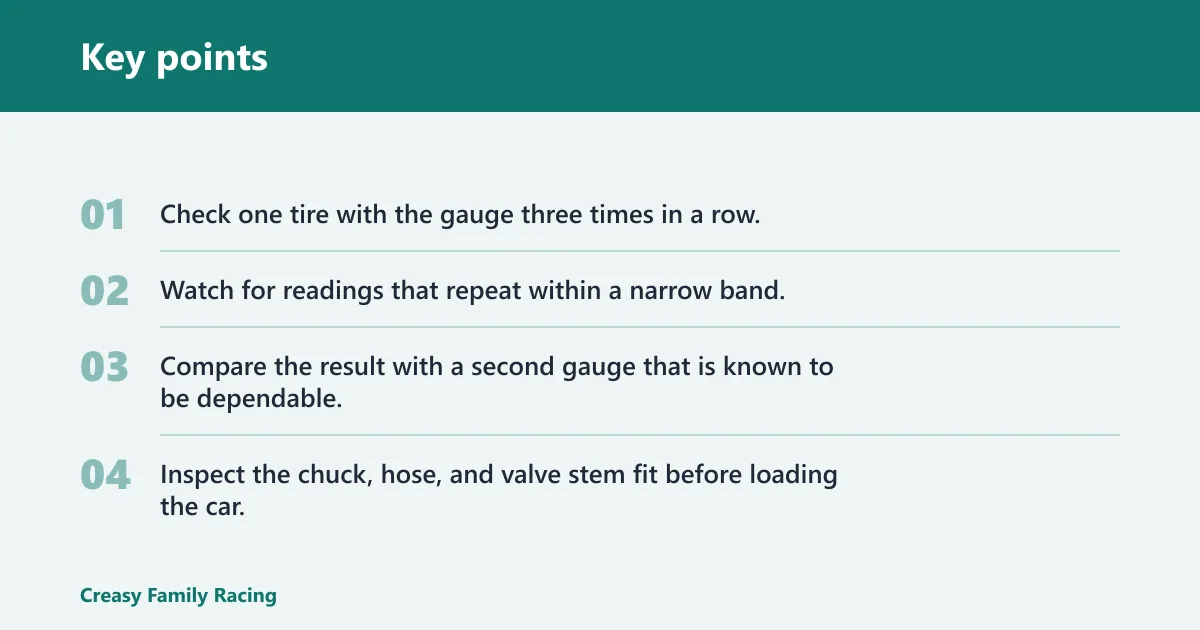
Before a track event, compare the gauge against a known reference or repeat readings on the same tire several times. The goal is not laboratory certification; the goal is to see whether the tool is consistent enough to trust in the paddock.
- Check one tire with the gauge three times in a row.
- Watch for readings that repeat within a narrow band.
- Compare the result with a second gauge that is known to be dependable.
- Inspect the chuck, hose, and valve stem fit before loading the car.
Say your front left tire is warm after a session and the gauge reads differently each time you attach it. That is a warning sign, even if the display looks precise. Consistent repeat readings matter more than a flashy screen.
Suppose your car has aggressive brake ducting and a deep wheel barrel, so the valve stem is hard to reach with a straight chuck. In that case, a hose or swivel chuck is worth more than a slightly nicer display because it saves time and reduces fumbling around hot hardware.
Can a tire pressure gauge lose calibration if it gets dropped?
Yes. Calibration durability matters because impact sensitivity can change a gauge’s accuracy after a drop, especially with digital tools that combine electronics and pressure sensors. A gauge should survive transport, but it should not be treated as calibration-proof.
That is why drop tolerance belongs in the buying decision. A track tool lives in a bag, gets moved from pit to pit, and can hit the floor of a trailer or paddock cart. If a gauge takes a hard impact, recheck it before trusting it again.
Frequently asked questions
What tire pressure gauge is most accurate for track days?
A high-quality digital gauge or a high-quality analog gauge with a credible accuracy claim is the best choice. For track work, look for a reference such as ANSI B40.7 Grade 2A with ±0.5% accuracy, then verify the gauge against a known reference before an event.
Is a digital tire pressure gauge better than an analog gauge for track use?
Digital gauges are easier to read and often easier to use when you want 0.1 PSI resolution, especially in low light. Analog gauges avoid batteries and can be very reliable, so the better choice depends on whether you value display clarity or battery-free simplicity more.
Do I need a gauge with a bleed valve for track day tire pressures?
Yes, if you plan to fine-tune pressures between sessions. A bleed valve lets you release captured air without removing the gauge, which speeds up small corrections and reduces the chance of overshooting your target pressure.
What PSI range should a track day tire pressure gauge cover?
A 5–100 PSI range is a practical target for most passenger-car and performance use. That span gives you room for both lower starting pressures and higher street pressures without forcing you to buy a narrow specialty tool.
Are pencil tire gauges good enough for track days?
They are usable, but they are the least suitable option for exact track adjustments. Pencil gauges are compact and inexpensive, yet they are harder to read in low light and less convenient when you need repeated, precise pressure changes in the paddock.