What Are 200TW Tires and Are They Good for Track Days?
200TW tires are U.S.-rated street tires with a treadwear rating near 200. They can be a solid track-day choice for drivers who want more grip and heat tolerance than a normal summer tire. Choose the wrong one and you can spend more, overheat the tire sooner, or give up wet-road manners you still need on the street. This guide explains what 200TW means, who benefits, and how to compare them with summer and race tires.
What 200TW means
TW stands for treadwear in the UTQG labeling system. A 200-rated tire is expected to wear about twice as long as a 100-rated reference tire, while a 400-rated tire is expected to wear about twice as long as a 200-rated tire. That makes 200TW a category label, not a direct promise of grip or lifespan.
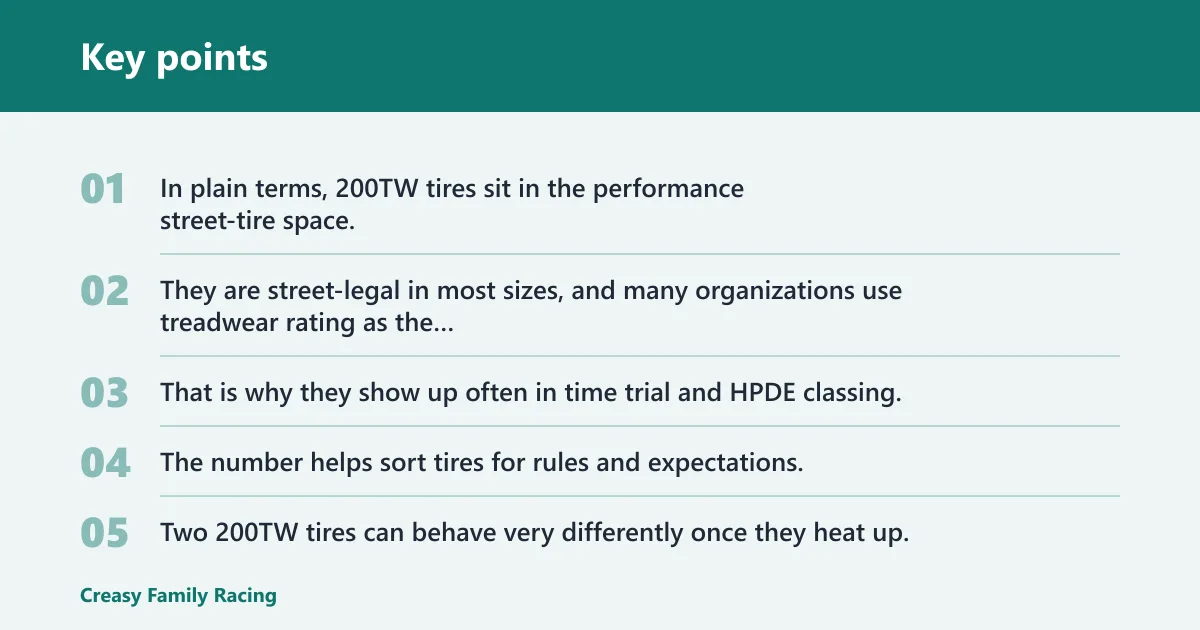
In plain terms, 200TW tires sit in the performance street-tire space. They are street-legal in most sizes, and many organizations use treadwear rating as the dividing line between street tire and race tire classes. That is why they show up often in time trial and HPDE classing.
The number helps sort tires for rules and expectations. It does not tell you everything. Two 200TW tires can behave very differently once they heat up, and that difference matters more than the sidewall number on a track day.
Are 200TW tires good for track days?
Yes, 200TW tires are a strong fit for drivers doing regular open-lapping days and wanting one tire that can handle street use and occasional track work. They make the most sense once you are doing enough track days to justify a dedicated set. For a first track day, a quality summer tire in the 300-400 range is often the smarter choice.
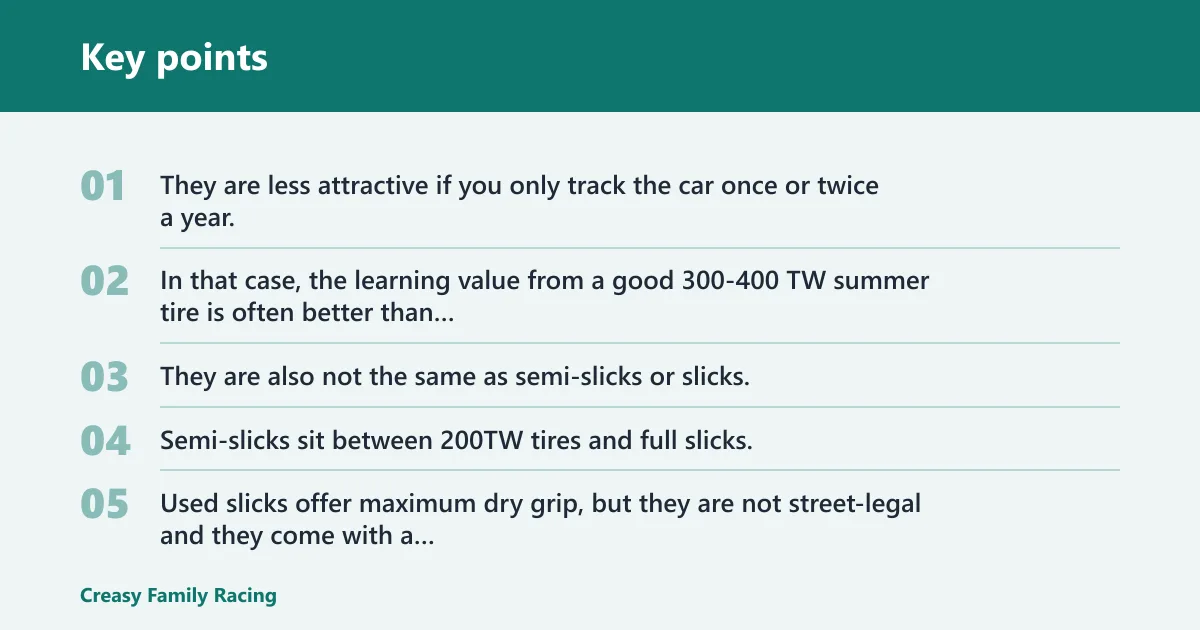
They are less attractive if you only track the car once or twice a year, if rain use matters a lot, or if the car is still stock and the driver is learning line, braking, and vision. In that case, the learning value from a good 300-400 TW summer tire is often better than chasing more grip too early.
They are also not the same as semi-slicks or slicks. Semi-slicks sit between 200TW tires and full slicks, with more dry grip than 200TW tires and a longer usable life than slicks. Used slicks offer maximum dry grip, but they are not street-legal and they come with a higher risk of hidden damage.
Who benefits most
Drivers who do monthly or near-monthly track days, run longer sessions, or want a tire that still works for driving to and from events usually benefit most. Heavy front-engine cars often fit that profile too, because they can overwork ordinary street tires quickly.
Drivers who already know their alignment, pressure targets, and session pace can also use 200TW tires well. The tire rewards a car that is set up to keep the contact patch working evenly across the tread.
When a summer tire is the smarter choice
A 300-400 TW summer tire is the practical beginner choice when the car spends most of its time on the street and only sees a few track sessions. It usually rides better, tolerates cold weather a little more calmly, and gives more wet-road confidence than a track-biased 200TW tire.
If the goal is learning braking points, corner entry, and basic heat management, a good summer tire often gives enough grip without forcing immediate pressure or alignment changes.
When semi-slicks or slicks make more sense
Semi-slicks make sense when track use is common and you want more dry grip than a street-biased 200TW tire can offer. Slicks make sense only when the car is essentially track-only and the driver can manage warm-up, pressure, and inspection carefully.
For most beginners, slicks are too much tire. They need more heat, give less forgiveness in poor conditions, and are a poor match for mixed street use.
How 200TW tires behave on track
200TW tires are heat-sensitive. Grip, braking performance, and steering response change as the tire warms, and a tire that feels sharp for the first lap may feel greasy after several hot laps if it is overloaded or under-pressured. That is why session length matters more than the number on the sidewall.
A tire can feel excellent in the middle of its operating window and then fall off quickly once the tread surface gets too hot. Some 200TW tires stay consistent for a full track session; others are more autocross-oriented and can lose pace after only a few hard laps.
Heat cycling and falloff
Heat cycling means the tire repeatedly gets hot and cools down. Over time, that can change feel and reduce peak grip. The effect is tire-specific, which is why two tires with the same 200TW label can behave very differently across a season.
Autocross-focused 200TW tires usually warm quickly and give strong short-run grip. Endurance-oriented 200TW tires usually tolerate longer sessions better, even if their first-lap bite is not as aggressive.
Signs the tire is too hot
Look for a greasy steering feel, vague turn-in, and the car sliding a little more even though pace has not increased. Excess shoulder wear, chunking, or a surface that looks torn can also point to too much heat or too much slip angle.
Say your front-heavy sedan runs about 225/45R17 200TW tires and the steering gets mushy by about lap four. That usually points to pressure, alignment, or heat management before it points to a need for a softer tire.
200TW tire decision matrix
This matrix treats the tire choice as a decision tool. Weight, session length, weather, and event frequency matter more than the label alone.
| Driver type | Car weight | Session length | Weather | Event frequency | Best tire class | Why | Watch-outs |
|---|---|---|---|---|---|---|---|
| First-time track-day driver | Any | Short to medium | Mixed | 1-2 events per year | 300-400 TW summer tire | More forgiving, better cold and wet manners, lower cost of mistakes. | Less track grip than a dedicated tire; may still overheat if driven very hard. |
| Regular HPDE driver | Light to medium | 20-minute sessions | Mostly dry | Several events per season | 200TW street-legal performance tire | Good balance of grip, durability, and street use. | Needs pressure checks, camber, and attention to heat build-up. |
| Heavy front-engine car | Heavy | Long sessions | Hot and dry | Frequent track use | 200TW street-legal performance tire or semi-slick | More heat tolerance and shoulder support than a normal summer tire. | Shoulder wear can be fast if camber is weak or pressures are off. |
| Autocross-focused driver | Light to medium | Very short runs | Dry | Frequent events | 200TW street-legal performance tire | Quick warm-up and strong short-run grip. | May fall off in long lapping sessions and can feel abrupt at the limit. |
| Track-regular with a spare set | Any | Long sessions | Dry only | Many events per year | Semi-slick | Better dry grip than 200TW with more consistency than a pure race setup for many use cases. | Less street-friendly, more sensitive to setup, and poorer in wet or cold use. |
| Track-only build | Any | Long | Dry | Very frequent | Slick | Maximum dry grip for a dedicated track car. | Not street-legal and hidden damage is harder to spot on used tires. |
Tread depth, pressure, and alignment
Starting tread depth matters because it affects wet performance, wear reserve, and hydroplaning resistance. Different 200TW models start with different tread depths, so one tire may be much better in standing water than another even if both carry the same label.
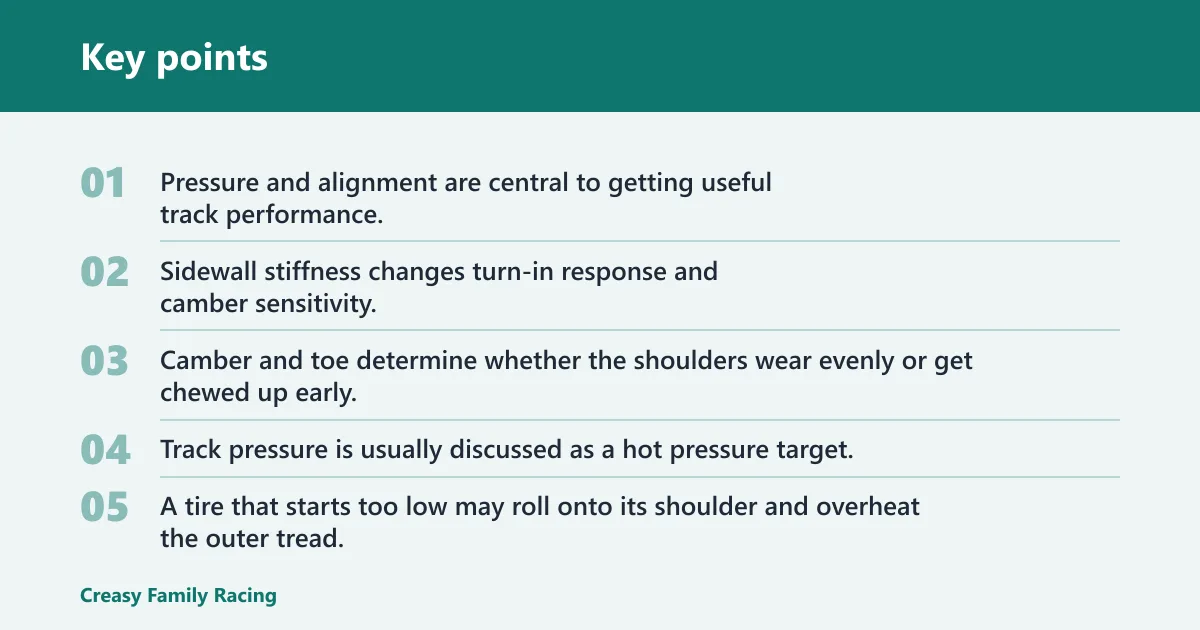
Pressure and alignment are central to getting useful track performance. Sidewall stiffness changes turn-in response and camber sensitivity, while pressure changes the contact patch and how the tire supports the car at speed. Camber and toe determine whether the shoulders wear evenly or get chewed up early.
Pressure targets
Track pressure is usually discussed as a hot pressure target, because the cold-to-hot change can be significant. A tire that starts too low may roll onto its shoulder and overheat the outer tread. A tire that starts too high may lose grip and feel nervous over bumps.
A common first step is to set a safe cold pressure, run a session, then adjust toward a hot target based on the car and tire. The exact number depends on the model, wheel size, and load, so the tire maker’s guidance matters.
Suppose a front-wheel-drive hatchback on 200TW tires comes off track with hot fronts several psi higher than the rears and the outer shoulders are wearing fast. That usually calls for more negative camber, a pressure check, or both.
Alignment
More negative camber usually helps keep the outside shoulder alive in corners, especially on heavy front-engine cars. Toe settings matter too. Too much toe can scrub speed and wear the tire faster than necessary.
If you want track tires to last, alignment is not optional. It is part of the tire setup.
What do 200TW tires compare with?
The tradeoff is usually more road noise, less comfort, shorter life, and weaker wet and cold behavior.
Compared with semi-slicks, 200TW tires are more street-friendly and easier to live with, but they generally give up dry grip and high-heat consistency. Compared with slicks, they are far more practical for mixed use, but they are also less aggressive at the limit.
Street tire versus 200TW
The practical difference is often heat management. A good summer tire can be the better teacher for a beginner because it is less likely to punish a bad setup right away. A 200TW tire becomes more useful when you have enough pace and track frequency to use the extra grip.
Semi-slick versus 200TW
Semi-slicks are the step up when you want more grip than a 200TW street tire can provide and you can accept more compromise. They tend to suit drivers chasing lap time more than daily comfort.
Slick versus 200TW
Slicks bring maximum dry grip, but they are track tools. Used slicks also come with a higher risk of hidden damage, so inspection matters more than the savings suggest.
Can you daily drive 200TW tires?
Yes, you can daily drive many 200TW tires, and that is one reason they are popular. They are street-legal in most sizes, and they are often chosen by drivers who want both street driving and occasional track days. The compromise shows up in ride comfort, noise, and wet or cold behavior.
They usually are less pleasant than a normal street summer tire in rain or cool weather. They can also wear faster if the car spends a lot of time commuting in heat and stop-and-go traffic. Winter use is a poor match for most 200TW tires.
Rain and hydroplaning
Do 200TW tires work in the rain? Yes, but not as well as a typical street-focused summer tire, and starting tread depth matters a lot. A deeper tread pattern usually helps move water and resist hydroplaning, while a worn 200TW tire can become much less forgiving in standing water.
In light rain, many 200TW tires are manageable. In heavy rain, the driver should slow down and expect less margin than with an ordinary road tire.
Noise and comfort
Many 200TW tires ride firmer and make more noise because they are built with track use in mind. That is part of the tradeoff. The same features that help turn-in and heat tolerance often make the tire more noticeable on rough pavement.
How long do 200TW tires last on track?
There is no single lifespan figure for 200TW tires. Lifespan depends on car weight, alignment, pressure, track surface, session length, and how hard the driver pushes the tire. A light car with good camber can get much more use from a set than a heavy car with poor setup.
The practical answer is that they last longer when track sessions are controlled and shorter when the car is heavy, hot, and out of alignment. That is why the same tire can be a smart buy for one driver and a poor buy for another.
A good way to judge value is not just mileage but session count. If a tire stays consistent across the kind of sessions you actually run, it is doing its job.
Frequently asked questions
What are 200tw tires?
200TW tires are tires with a UTQG treadwear rating around 200. They are street-legal in most sizes and are commonly used as performance summer tires for track days, time trial, and HPDE classing. The number is a classing and wear benchmark, not a direct grip rating.
Are 200 treadwear tires good for track days?
Yes, they can be very good for track days, especially if you do open-lapping events often enough to justify a dedicated set. They are usually a stronger fit than a normal summer tire once you are ready to manage pressure, camber, and heat across full sessions.
What is the best cheap 200tw track tire?
The best cheap choice depends on fitment, event type, and how the car is used. A cheaper 200TW tire may still work well for short sessions or autocross, but model differences matter a lot. For a first track day, a 300-400 TW summer tire can be the better value.
How do I know if a 200tw tire is right for my car?
Start with your track frequency, vehicle weight, and weather exposure. If you run events often, have decent alignment, and want one tire for street and track, 200TW may fit. If you only track occasionally or need strong rain manners, a good summer tire may be wiser.