How Many Times Should You Walk an Autocross Course?
Walk an autocross course once to scout it, then keep walking until you can say the course out loud and spot brake points, offsets, slaloms, and hazards without hesitation. Skip that, and you waste runs guessing at cones, turn-in points, and surface changes. This guide gives a simple rule for how many walks to do, plus a quick way to know when you are ready. For related basics, see autocross cone meanings, novice checklist, course memorization, and novice coaching.
How many walks are enough?
Most new drivers should start with one scouting lap, then add passes until they can rehearse the course out loud and identify the key hazards without hesitation. Experienced drivers often need fewer walks on a short, simple course. Longer or more complex layouts usually need more passes, and club-specific flow can vary by organizer.
What a course walk should do
A course walk should turn a cone layout into a mental map. Traffic cones mark the course, and different groupings can mean gates, slaloms, sweepers, or transitions. You are not admiring the lot. You are learning sequence, line choice, and where a mistake could trigger an off-course call or a cone penalty. Common autocross rules award two seconds per cone, though event supplements can vary, so verify the posted event rules when in doubt.
What to look for on each pass
On the first pass, find start, finish, direction changes, and any tight cone clusters that may hide the real line. On later passes, connect each section to the next decision point. The useful questions are simple: where do you brake, where do you turn in, and where do you commit early?
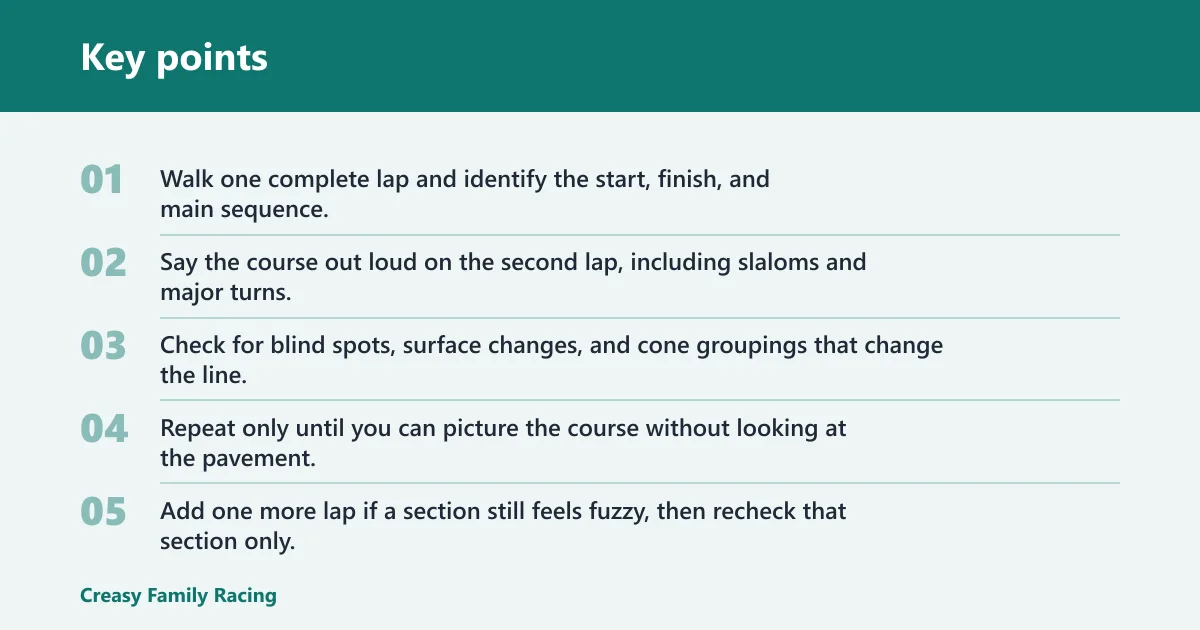
- Walk one complete lap and identify the start, finish, and main sequence.
- Say the course out loud on the second lap, including slaloms and major turns.
- Check for blind spots, surface changes, and cone groupings that change the line.
- Repeat only until you can picture the course without looking at the pavement.
- Add one more lap if a section still feels fuzzy, then recheck that section only.
How should you pace the first pass?
The first pass should be a scout lap, not a memory test. Move at a steady walk and look for the course’s shape: where it starts, where it opens up, where it tightens, and where cone clusters mark gates or offsets. That first lap should answer “what is this layout?” before it tries to answer “how fast can it be driven?”
Beginner, intermediate, and experienced drivers
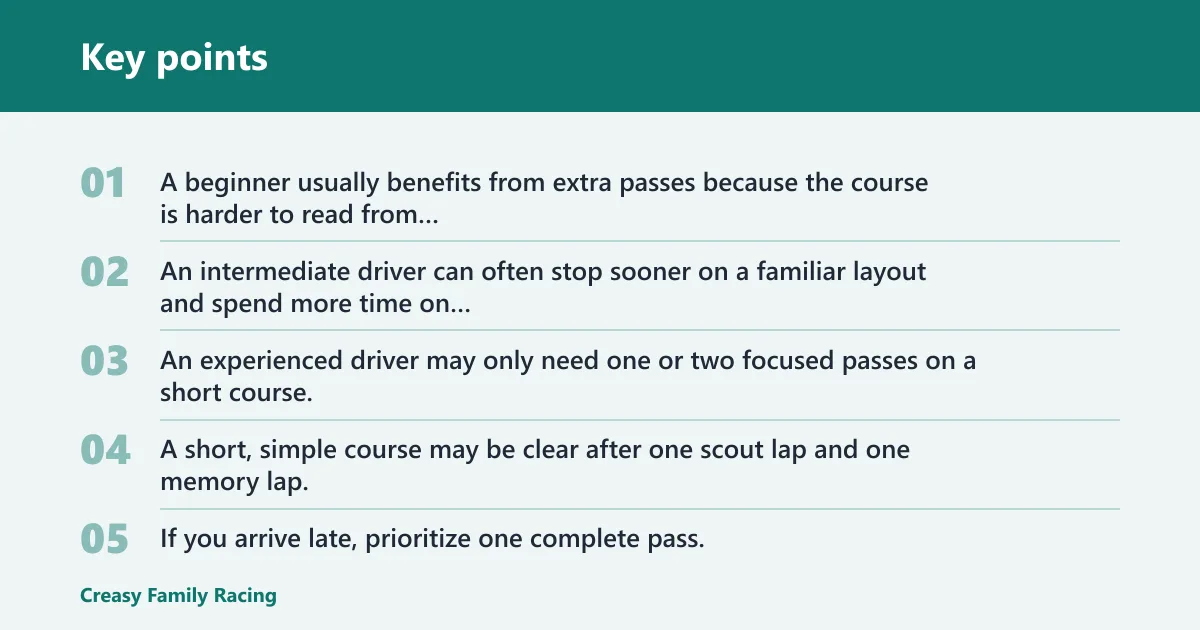
A beginner usually benefits from extra passes because the course is harder to read from the sidelines. An intermediate driver can often stop sooner on a familiar layout and spend more time on the sections that still feel uncertain. An experienced driver may only need one or two focused passes on a short course.
Short, simple, and late-arrival scenarios
A short, simple course may be clear after one scout lap and one memory lap. A tight, twisty layout often needs more. If you arrive late, prioritize one complete pass, then do a fast hazard check for blind entries, slaloms, offsets, and any surface change that could affect braking or turn-in.
| Driver or course situation | Recommended walk count | What to look for on each pass |
|---|---|---|
| Beginner | 2 to 4 walks | Walk 1: learn the sequence. Walk 2: say it out loud. Later walks: confirm braking points, cone groups, and any blind spots. |
| Intermediate | 1 to 3 walks | Walk 1: scout the full layout. Walk 2: tighten the line in your head. Extra passes only for sections that still feel unclear. |
| Experienced | 1 to 2 walks | Walk 1: verify changes from the last run group or practice session. Walk 2: confirm the few corners that matter most. |
| Short, simple course | 1 to 2 walks | Find the main rhythm, the obvious hazards, and the few places where the line changes quickly. |
| Long, twisty course | 3 or more walks | Break the course into sections, then link each section to the next decision point so the sequence holds together. |
| Late-arrival scenario | 1 walk plus a hazard check | Do one full pass, then inspect the sections that can cost the most time or create a missed gate. |
Should beginners walk the course more than once?
Yes. Beginners usually need more than one walk because they are learning both the course and the language of cone layouts at the same time. One lap often gives the shape of the course, but the second and third laps are where the sequence starts to stick and the line begins to make sense.
Use the second lap to build memory
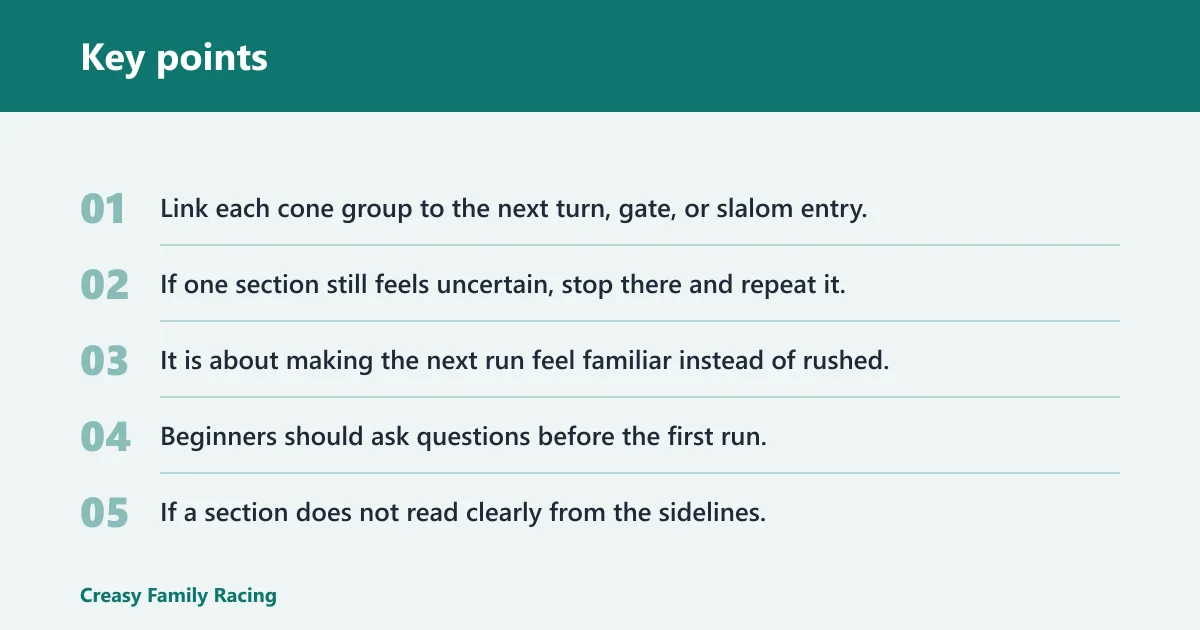
Say the course out loud as you walk. Link each cone group to the next turn, gate, or slalom entry. If one section still feels uncertain, stop there and repeat it. A second lap is not about covering distance. It is about making the next run feel familiar instead of rushed.
Ask questions early
Beginners should ask questions before the first run, not after a cone penalty or a missed gate. If a section does not read clearly from the sidelines, ask an experienced club member to explain which cones define the path and where the car should be placed on entry and exit. That advice is especially useful at organizer-led novice programs, which are common at many SCCA and local-region events, though the exact format varies by club and venue. See also the SCCA’s general guidance on event participation and autocross setup at https://www.scca.com/pages/autocross.
Should I walk the autocross course with a novice coach?
Yes, if the club offers one-on-one guidance. A novice coach can explain what different cone layouts mean, point out the line through each section, and help you read the course faster than you can alone. That is useful when the layout is new or when the event uses tight and twisty sections.
What a novice coach can clarify
The coach can point to the first braking area, explain where a slalom begins and ends, and show how one cone group leads into the next. That support matters because autocross runs are usually short, so the course has to live in your memory quickly. Depending on organizer and course length, a run may be well under a minute or extend longer on a more complex layout.
What to ask before your first run
Ask which sections are easy to miss, where the line opens up, and whether any cones create a trap for late turn-in. If the club runs multiple run groups, ask which one gives you the best chance to walk again before you strap in. Club schedules vary, so rely on the posted event order rather than a fixed timing assumption.
Can you walk the course too many times?
Yes. Extra passes can turn useful detail into mental clutter, and too much second-guessing can make a driver less certain, not more certain. Once you can recite the course and identify the main hazards without hesitation, more walking usually adds little unless the layout is long, twisty, or changed late.
When to stop walking
Stop when you can rehearse the sequence cleanly and point to the important cone groups without pausing. That is the practical finish line. More laps after that may create false confidence, because the course feels familiar but the details are no sharper than they were two walks earlier.
Common mistakes
A common first-timer mistake is standing at the start line still unsure of the first three turns. Another is walking the course so many times that every section starts to blur together. A third is treating the sidelines as enough. They are not. The layout has to be mapped in your head.
Suppose a 45-second course has one slalom, one offset, and a blind left-hander. A beginner may need three walks to hold the order in memory. A seasoned driver may only need one scout lap and one focused lap on the blind section if the rest is already familiar.
How long should a course walk take at an autocross?
There is no fixed clock for every event. Course walk timing depends on event size, course length, and how long before morning runs you arrive. The usual approach is to arrive early enough that you can walk before the schedule tightens, then use the pre-run timing window for one last check if needed.
Course walk timing and event flow
Many clubs begin with registration, tech, and course walking before runs begin, but the day’s timeline is organizer-dependent. The SCCA recommends reviewing event materials and walking the course during the available pre-run time so drivers can learn the layout before their first timed attempt. Since runs are short, the walking window is where you solve the course problem before the clock starts working against you. See SCCA timing and event format guidance at https://www.scca.com/pages/autocross.
How to use the walk window well
Use the first part of the window for understanding the whole layout, and the last part for verifying the sections that matter most. If the club allows it, a map or notes can speed up that last check. If not, your verbal rehearsal has to do the job.
How do you remember an autocross course before your run?
Remember the course by turning it into a spoken sequence, then linking that sequence to a few fixed landmarks. Say the course out loud, identify the high-risk corners, and confirm where braking and turn-in happen. If you can say the next three elements without looking, you are usually ready to grid.
- Rehearse the course from start to finish in order.
- Mark the key hazards: slaloms, offsets, blind entries, and cone clusters.
- Attach each hazard to one action, such as brake, turn in, or stay patient.
- Do one final lap of memory right before grid if the schedule allows it.
Traffic cones, a short timed run, and a quick event pace leave little room for guesswork. Runs are commonly short, and many autocross layouts fit into roughly a minute or less, though actual course length varies by organizer. Hitting a cone typically adds two seconds to your time under standard autocross rules, so a clear mental map matters more than extra walking once the course is already in your head.
Frequently asked questions
How many times should you walk an autocross course?
Start with one full scouting lap, then keep walking until you can recite the sequence and spot the major hazards without hesitation. For many beginners that means two to four walks. For an experienced driver on a short course, one or two focused passes may be enough.
Is two course walks enough for autocross?
Two walks can be enough on a short, simple layout, especially if the driver already knows how to read cone groups quickly. If the course is long, twisty, or new to you, use the second walk as a checkpoint and keep going until the sequence feels automatic.
How do experienced autocross drivers decide how many walks to do?
Experienced drivers often use the course itself to decide. If the layout is short and familiar, one walk may be enough. If the course has tight transitions, blind entries, or a late change, they add another pass only where the line still feels unclear.