First Drag Strip Guide for Street Car Beginners
Treat your first drag strip visit like a systems check: bring a safe street car, make one easy pass, and read the time slip before you change anything. Ignore that approach and you can fail tech, overheat the car, or hide real problems behind a bad launch and rushed choices. This guide covers pre-track checks, track flow, your first pass, and what to change next.
Why your first night should be a systems check
The right goal for pass one
Your first visit is not the night to prove the car or your nerve. The useful goal is simpler: get through tech, reach the line calmly, make one straight pass, and collect a clean time slip that shows whether the car needs more traction, more repeatability, or more cooling margin.
That changes how you prep. You stop chasing a hero launch and start checking what actually matters: leaks, brakes, battery hold-down, seatbelts, tire condition, cabin loose items, engine temperature, and whether the car behaves the same from burnout box to finish line.
Why test-and-tune beats race night for beginners
Most tracks have street nights or test-and-tune nights for newcomers, and the number of practice passes often depends on turnout, schedule, and track operations. That format matters because it gives you more than one shot without class pressure, dial-ins, or a race-night clock pushing every decision.
A beginner-friendly open track format also lets you change one thing between passes. You can lower tire pressure slightly, alter launch rpm, or change a shift point and see the result on the next slip instead of guessing from one rushed run.
What success looks like on a first visit
Success on night one is boring in the best way. The car passes tech. You do not miss your staging-lane call. You avoid the water if you are on normal street tires. You stage without rushing. You stay in your lane. Then you read the slip and decide whether any change is worth making.
Drag strips are commonly one-eighth or one-quarter mile long. That distance changes the feel of the run. An eighth-mile pass usually ends sooner, with fewer shifts and less time for nerves to build. A quarter-mile pass gives launch mistakes more time to show up and asks more from cooling, braking, and patience after the finish.
What your first-night budget should cover
A first drag strip night usually costs more than the pass price alone, because you also need to account for fuel, food, a small cash buffer, and any last-minute safety or tech items. The supporting guide breaks down a realistic beginner budget for a street car, showing where the money goes and when a simple outing can move from roughly $100–$250 to closer to $300.
That matters because it helps you plan before you arrive, avoid scrambling at the track, and decide whether your car is ready for a basic test-and-tune night. See the full drag strip night cost breakdown for the line-by-line estimate and the hidden expenses beginners often miss.
What do you need for your first drag strip night?
Bring the items commonly needed to get through the gate and tech: a driver license, entry money, long pants, closed-toe shoes, and a helmet if local rules or your expected speed require one. Pack a tire gauge, basic hand tools, and a way to lock down or remove loose items before tech checks the car.
Driver gear and paperwork to bring
Start with the plain essentials: your driver license, cash or card for entry, and whatever track form the gate staff hands you. If the track uses waivers or wristbands, take care of that before unloading floor mats or changing tire pressure so you are not rushed when lanes start moving.
Bring a tire-pressure gauge because tire pressure is one of the few first-night changes you can make quickly and reverse just as easily. A small air source or access to air helps, but the gauge matters more. A flashlight, basic socket set, and a rag are enough for most beginner nights.
What should you wear to a drag strip as a first-time racer?
Wear jeans or work pants, a T-shirt or other top that fully covers your torso, and closed-toe shoes like sneakers. Empty your pockets and remove loose items from the cabin. Tracks often enforce these clothing rules at tech or in the staging lanes because they cut distractions and keep you within local helmet or ET rules.
Do not treat clothing as an afterthought. A jacket on the passenger seat, a phone in the cupholder, or a loose tool in the trunk can become a tech issue or a distraction under braking.
Do you need a helmet at the drag strip?
Helmet rules vary by track and often depend on ET, speed, vehicle type, or a combination of those factors. Some tracks require a helmet for street cars, and tracks following NHRA-style rules may require a specific Snell-rated helmet rather than a generic DOT-marked one, while others do not until the car reaches a local threshold. Check the track’s posted rules before leaving home, not at the front of the tech line.
Local tracks often base safety rules on NHRA-style standards while still setting their own details. That means a car that is legal at one test-and-tune may need different gear at another. If you expect the car to run quicker or faster than a basic commuter, bringing a helmet is usually the safer bet.
What to pack for tire pressure and quick checks
- Tire-pressure gauge.
- Basic hand tools for battery terminals, hose clamps, and minor trim removal.
- Paper towels or a rag for quick fluid checks.
- Painter’s tape or masking tape if the track wants numbers on the windows.
- Water for you, and time to let the car cool between passes.
Turn off air-conditioning before the burnout bay if lane waits are long, since heat soak builds faster when the car sits in staging lanes with the AC running.
What a drag strip actually is
A drag strip is a straight, measured course built for two cars to launch side by side and run to a set distance, usually 1/4 mile or 1/8 mile. That simple setup changes everything about how you prepare: you are not managing corners, traffic, or lap strategy, but a short, timed sprint where the start and the finish matter most. The drag strip basics article breaks down the staging lanes, starting line, time slip, and the sequence of a pass so you know what is happening before your car ever moves.
Can a stock street car pass tech inspection?
A stock street car may pass tech if it is roadworthy, free of fluid leaks, and within the track’s local rules, but approval is not automatic. Tech is a quick safety screen, not praise for the build, so small faults like a loose battery or bad seatbelt can end the night.
What tech inspectors usually check first
A roadworthy car that does not drip fluids is enough to start, but tech usually goes a bit farther. Expect a quick look for leaks, brake condition, battery security, seatbelt condition, tires, and anything loose inside the cabin or trunk.
Inspectors may also check throttle return, helmet compliance if required, and whether aftermarket parts create their own safety issue. The point is to catch simple failures before the car reaches the line.
Common street-car failures that send you home
Common beginner issues can include an unsecured battery, visible fluid seepage, worn tires, loose floor mats, and loose items in the trunk. A check-engine light by itself may not end the night, but a visible leak often will.
A common first-timer mistake is lowering rear tire pressure in the parking area, then forgetting to recheck a tire that was already borderline low on the drive in. The car reaches tech with one rear tire visibly softer than the other, and the night starts with a correction instead of a run.
When local rules add helmet or ET-based requirements
Local rules are where stock and modified cars separate. The same beginner guide that says even a relatively highly modified late model car can usually pass tech easily still assumes the car meets the track’s own safety requirements for speed, ET, and equipment.
That is why it helps to know what the car roughly runs before arrival, even if only from prior owner claims or similar builds. A mildly modified car may need the same basic tech items as a stock one but trigger helmet or clothing rules sooner.
How arrival flow works at the track
From gate to parking to tech line
The basic flow is usually gate, pit or parking area, tech line, then staging lanes when called. Do your loose-item cleanup and tire-pressure check in the parking area, not while the tech line creeps forward.
If the strip runs both street cars and purpose-built cars on the same night, ask where your lane or tech line starts. Small delays stack up fast once cars begin cycling to the starting line.
How staging lanes are organized
Staging lanes are the waiting area before you make a pass. Lane assignments can vary by vehicle type, class, or whoever the officials want paired next. Listen for announcements and watch the lane workers instead of assuming the car ahead of you belongs in the same queue.
Being ready means more than idling forward. Windows up or down according to local procedure, helmet on if required, belts fastened, loose items gone, and tire pressures already set.
How to avoid missing your lane call
Missed calls happen because beginners focus on the wrong thing. They watch another pair leave, or they dig through the trunk for a gauge after their lane starts rolling. Keep the car close enough to move promptly and watch coolant temperature while waiting.
Picture an automatic street car on a warm evening, idling for a long stretch with the AC on. Coolant temperature creeps upward, then the lane finally moves. Turning the AC off before the burnout bay and watching the temp gauge can help manage that before you reach the line.
Street car decision table
| Setup | Street tire | Drag radial | Faster or modified street car |
|---|---|---|---|
| Expected prep level | Basic. Check leaks, brakes, battery, seatbelts, rear tire pressure, and remove loose items. | Moderate. Same checks, plus set rear pressure carefully and plan a repeatable burnout routine. | Higher. Same checks, plus confirm local helmet and ET rules, cooling margin in lanes, and any aftermarket part that could draw tech attention. |
| Burnout choice | Usually go around the water and skip the dramatic burnout. Keep the tires dry and clean. | Usually benefits from a proper burnout in or just after the water as local procedure allows. | Depends on tire. Street tire: avoid water. Drag radial: burnout usually helps. Match the routine to the actual tire, not the car’s power. |
| Likely track requirements | Roadworthy condition, no fluid drips, secure battery, seatbelts, clothing rules, helmet only if local rules require it. | Same basic tech items, with more attention on helmet and performance-based rules if the car is quicker. | Same basic tech items, but expect local helmet, ET, speed, and equipment rules to matter more. |
| Top three mistakes to avoid | Driving through the water box, doing a smoky burnout on normal street tires, chasing reaction time instead of traction. | Weak or inconsistent burnout, forgetting pressure changes between passes, turning traction aids off without a plan. | Overheating in staging lanes, missing lane calls while making adjustments, adding power before solving traction or shifting issues shown on the slip. |
Should you do a burnout with street tires?
Usually no. On normal street tires, the smarter first-night move is to drive around the water, keep the tread dry, and make a clean launch attempt. Street tires usually do not gain from a full burnout the way a drag radial does, and water trapped in the tread can hurt traction.
What the water box
The water box, or burnout box, exists so cars on drag tires can clean and warm them before staging. That does not make it mandatory for every setup. If your car is on regular street tires, water contamination can reduce grip and irritate racers waiting behind you.
Why street tires usually go around the water
Street tires work for first-time passes, but they offer less traction than drag radials or slicks. The practical beginner rule is simple: if the car is on normal street tires and traction is limited, skip the smoky show and keep the tires dry and clean instead.
Beginners are often told to start with sticky tires for traction, and Mickey Thompson ET Street Radials are commonly recommended as street-friendly drag tires. That does not mean you need them for pass one. It means you should know what problem they solve before buying them.
When drag radials need a different approach
Drag radials are stickier than street tires and can be driven to the track, but they usually respond better to a proper burnout. If the car already wears them, ask a lane worker what the track wants and copy a simple routine rather than improvising.
Suppose your car is on drag radials, leaves cleanly once, then spins hard on the next pass after a short idle-through. Change one thing: do the burnout correctly on the next attempt. If the 60-foot improves while trap speed stays similar, the issue was traction prep, not power.
How do you stage your car for the first time?
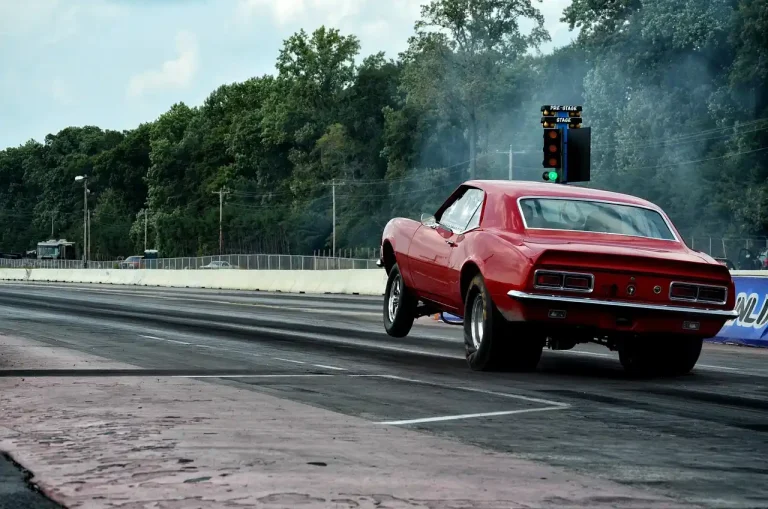
Stage the car in two calm steps: roll forward until the pre-stage light comes on, inch ahead until the staged light comes on, then stop and breathe. Watch the tree, leave cleanly, and ignore the other lane. For a first solo learning pass, reaction time is secondary to a straight, repeatable launch.
How pre-stage and stage beams work
The Christmas tree is the starting-light system at the line. The first light pair tells you the front tires have reached the pre-stage beam. Roll a little farther and the staged lights come on, showing the car is set for the start.
The tree gives you position first, then the launch signal. The first set of beams does not start the MPH timers; trap speed is measured in timing traps near the end of the track, which matters later when you read the slip and try to separate launch problems from power or shift problems.
What the Christmas tree is actually telling you
Before your pass, watch the tree and other racers. That advice sounds basic, but it shortens the learning curve. You will see how quickly cars roll from pre-stage to stage, when the ambers drop, and how little drama is needed for a clean launch.
On a learning pass, reaction time is a timing reference, not the main score. It does not change the car’s elapsed time on a solo pass. A bad light can still come with a useful ET and 60-foot.
A calm first-pass staging routine
- Approach the line slowly and straight.
- Roll into pre-stage and pause.
- Inch into stage and stop.
- Settle your breathing and look at the tree.
- Leave smoothly when the sequence reaches your launch point.
- Keep the car straight before thinking about full throttle.
What should you do on the pass and after the finish?
Make the pass as cleanly as possible: launch without panic, shift smoothly, stay in your lane, and ignore the other car. If the run feels wrong, lift early and keep it straight. After the finish, brake in a straight line, take the correct turnout, and collect the slip.
Launch, shift, and lane-discipline basics
The launch still matters on both strip lengths, but the distance changes what you feel. On an eighth-mile strip, you may make fewer shifts and reach the shutdown area sooner. On a quarter-mile strip, trap speed and braking demand more attention, and over-revving one gear has more time to spoil the slip.
If the car spins, do not add steering input to chase grip. If the engine is near the limiter, short-shift rather than forcing a missed shift. Staying in your lane matters more than finishing one car length ahead.
What to do if the run feels wrong
If anything feels off, lift smoothly and keep the wheel straight. A pass that ends early still teaches you something. A pass carried through wheelspin, a bad shift, or a warning light usually teaches the wrong lesson.
Say your car dead-hooks for a moment, then flashes traction control, cuts power, and noses over. Finish the pass cleanly if it is safe, then decide whether local rules allow changing that setting. Do not lower tire pressure, disable aids, and alter launch rpm all at once.
Braking, turnoff roads, and where to get the time slip
After the finish line, lift smoothly and brake in a straight line. Watch for turnout signs and use the correct exit road. Many first-timers stay on the brakes too long because the run felt fast; others miss the turnoff by staring at the other lane.
Take the time slip from the booth or official where the track directs you. Keep it flat, readable, and matched to that one pass. If you make a change next run, write it down immediately so the slip stays useful.
What time slip numbers matter for beginners?
For a first-timer, the most useful numbers are 60-foot, overall ET, and trap speed. Reaction time matters far less on a learning pass. A weak 60-foot points to launch or traction, inconsistent ET points to driver repeatability, and trap speed usually says more about power than the launch.
Reaction time versus elapsed time
Beginners often stare at reaction time because it is printed first. On a test pass, that is the wrong priority. Reaction time tells you when the car moved relative to the green, but it does not improve the mechanical quality of the run or the car’s actual elapsed time downtrack.
Why 60-foot is the first traction clue
The 60-foot number is your first serious clue about how the car left the line. If the car spun, bogged, or hit traction control, the 60-foot usually shows it before anything else on the slip does.
Look next at the 330-foot, the 1/8-mile ET and MPH, and the 1000-foot if the track prints it. On a quarter-mile strip, compare those to the 1/4-mile ET and MPH. If the early numbers are poor but trap speed is normal, the problem is likely in the launch, not the engine.
How ET and trap speed point to the next change
Use one-change logic. If 60-foot is weak and the rest of the slip looks ordinary, adjust traction or launch technique first. If ET is erratic across passes, work on staging routine and shift consistency. If trap speed stays low even with a decent launch, then a power or shift issue deserves attention.
That is how the first night guides an actual upgrade. A car on street tires with repeatable trap speed but poor 60-foot may justify a drag radial. A car with strong 60-foot but inconsistent ET may need the driver to calm the launch and shifts before buying parts.
Frequently asked questions
What do I need for my first drag strip night?
Bring a driver license, entry money, long pants, closed-toe shoes, and a helmet if local rules call for one. Add a tire-pressure gauge, basic hand tools, and a way to secure loose items. The goal is to clear tech, make one clean pass, and learn from the slip.
Can a stock street car pass drag strip tech inspection?
Many can, provided the car is roadworthy, does not drip fluids, has good brakes, secure battery mounting, working seatbelts, and acceptable tires. Passing is never automatic, though. Local rules, visible leaks, loose cabin items, or missing gear can still stop a stock car at tech.
Should I do a burnout with street tires at the drag strip?
Usually no. On standard street tires, going around the water and keeping the tread dry is often the better move. Full burnouts are more useful for drag radials and slick-style tires. For a first pass, a clean launch on dry tires beats a smoky burnout that adds water.
What should I do if I get nervous on my first pass?
Slow the routine down. Roll into pre-stage, then stage, stop, breathe once, and focus only on leaving straight. Ignore the other lane and treat the run like a systems check. If the car spins or the shift goes wrong, lift smoothly and keep the car straight.