Helmet Ratings Explained for Track Days and Autocross
For many U.S. track days, a Snell SA2020 helmet is commonly considered a safe choice, and some organizers may also accept SA2025. For autocross alone, some rulebooks accept more than SA, including certain motorcycle standards, while other clubs want SA labels only. Buy the wrong sticker or an aging helmet, and you can fail tech, miss runs, or replace the helmet sooner than you expected.
This guide uses a simple decision tree: start with the event, then confirm the certification family the organizer accepts, then confirm the certification year and label condition, then choose full-face or open-face based on risk and future plans. That order matters because street-legal and motorsport-legal are different questions, and autocross, HPDE, drag strip, and future racing plans do not follow the same acceptance rules.
What helmet rating do you need for your event?
Start with the organizer’s written helmet rule, not the product title on a retailer page. SCCA Solo, non-SCCA autocross clubs, HPDE groups, drag-strip operators, and racing schools can all allow different certification families and different year windows. The fastest way to avoid overbuying or getting turned away is to match the sticker to the exact event type first.
SCCA Solo versus other autocross clubs
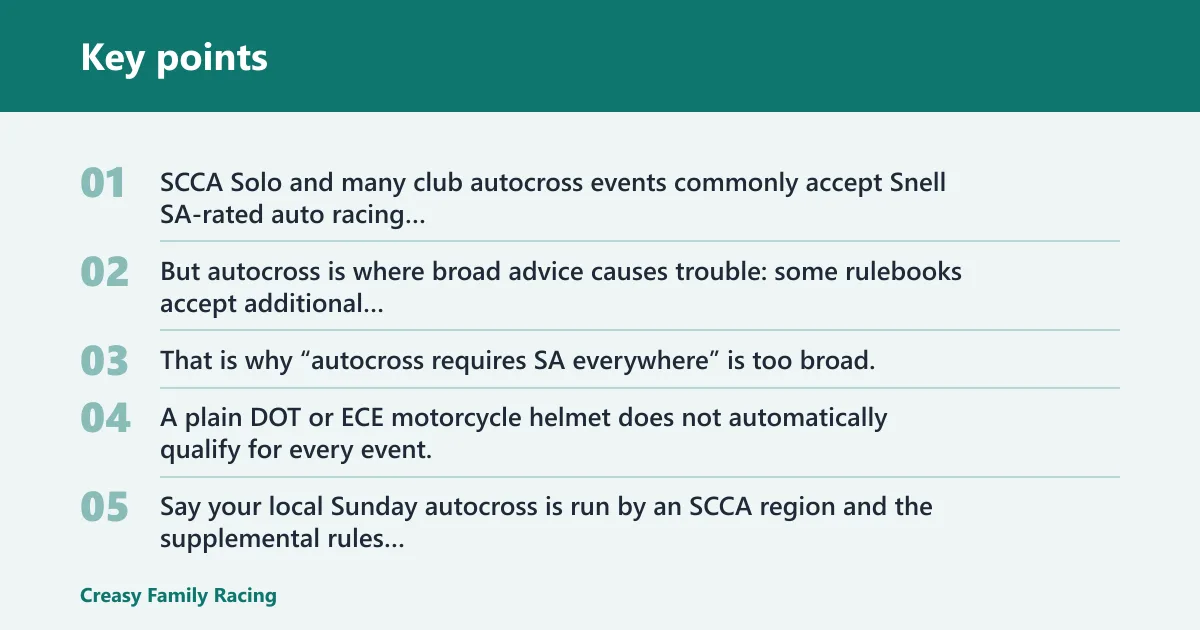
SCCA Solo and many club autocross events commonly accept Snell SA-rated auto racing helmets, and Snell SA is still the cleanest low-drama choice for car events. But autocross is where broad advice causes trouble: some rulebooks accept additional standards, including certain motorcycle certifications, while another local club may write a narrower helmet rule for the same parking-lot sport.
That is why “autocross requires SA everywhere” is too broad, and “my motorcycle helmet is fine for any autocross” is also too broad. A plain DOT or ECE motorcycle helmet does not automatically qualify for every event. The event rulebook and tech staff decide.
Say your local Sunday autocross is run by an SCCA region and the supplemental rules mirror the current Solo helmet list. Another local club across town may post “Snell SA only” in its event notes. Same driving format, different answer at tech.
HPDE and open-track day organizers
HPDE and open-track day groups tend to be stricter because speeds, runoff demands, and car-to-barrier risk differ from autocross. For most U.S. track days, Snell SA2020 is the cleanest answer, and some organizers may also accept SA2025, because SA is the auto-racing standard and tech inspectors widely recognize it.
That does not mean every organizer writes the same rule. Some allow additional standards. Some permit M-rated helmets in limited cases. Some require full-face regardless of certification if the car is open-top. A road-legal motorcycle standard, including ECE 22.06, is not automatically track-day legal just because it is newer than ECE 22.05.
Drag strip nights and sanctioning-body rulebooks
Drag-strip rules are their own branch. A local test-and-tune night may be looser at the gate, while an NHRA-governed event or a track following NHRA-based helmet language may require specific Snell ratings depending on the car and class details.
That means “legal at autocross” does not carry over to the drag strip. Check the track’s posted rulebook before you buy for street-car test nights, especially if the car has quicker elapsed times, added power, or safety equipment that moves it into a stricter ruleset.
If you expect to move into time trials or racing schools
If the plan is autocross now and HPDE, time trials, or racing school next season, buying SA once is usually the smarter path. Snell SA helmets are built for auto-racing use, and SA helmets are designed for car-racing environments with fire-resistant lining materials and impact-testing criteria that differ from M-rated motorcycle helmets.
That longer-view buying logic usually matters more than saving a little at checkout. An accepted autocross motorcycle helmet can still become the wrong helmet for the next step.
Helmet acceptance matrix
How to read the matrix
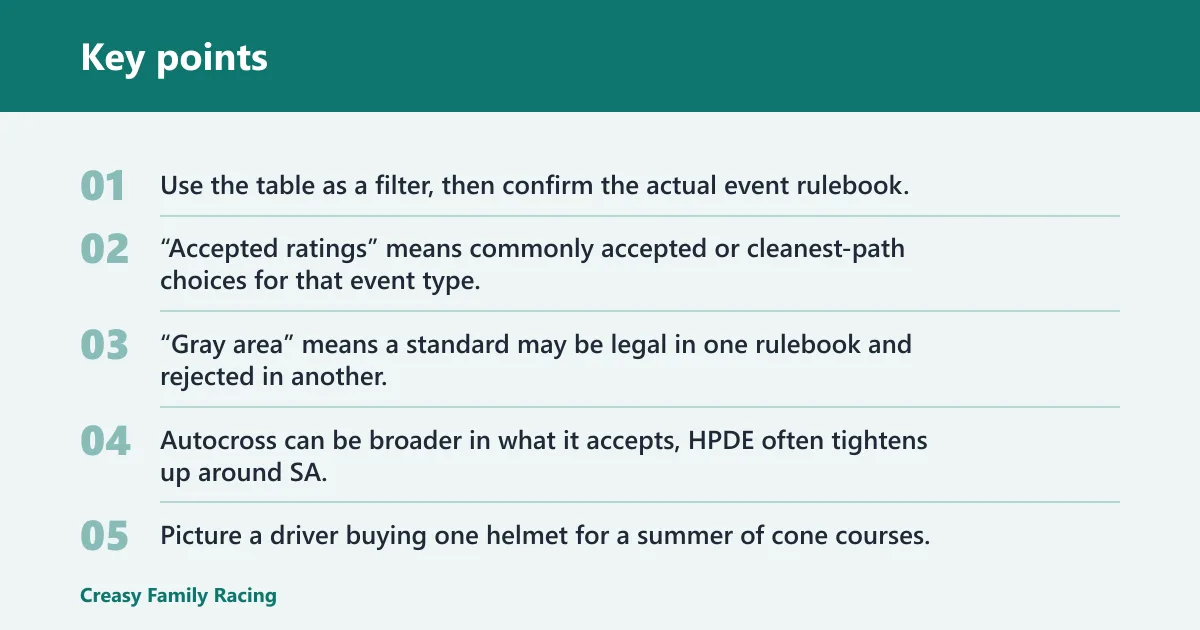
Use the table as a filter, then confirm the actual event rulebook. “Accepted ratings” means commonly accepted or cleanest-path choices for that event type. “Gray area” means a standard may be legal in one rulebook and rejected in another, or an older label may be near the end of its accepted life.
| Event type | Accepted ratings | Expired or gray-area ratings | Quick check step |
|---|---|---|---|
| SCCA Solo autocross | Check the current Solo helmet list; Snell SA is a safe choice, and some seasons also accept selected M, ECE, or other listed standards | DOT-only; any helmet not on the current accepted list; older Snell years near phase-out | Read the current season helmet appendix, then match the exact sticker inside the helmet |
| Non-SCCA autocross club | Varies by club; many accept Snell SA, some also allow selected M or ECE standards | Anything the club did not list; assumptions based on another club’s rules | Check the event page or supps, then email the organizer if the rule text is short or vague |
| HPDE or track day | Snell SA2020 and Snell SA2025 are both valid for 2026 events; some groups accept other standards, but SA is the least ambiguous buy | DOT-only; ECE-only unless specifically listed; M-rated helmets where the organizer prefers or requires SA | Read the organizer’s helmet rule and any open-top or full-face requirement before registration |
| Drag strip | Track and sanctioning-body dependent; many rulesets point to Snell helmet standards for quicker or more serious cars | Assuming a local test-and-tune rule applies to every NHRA-based event; DOT-only where Snell is required | Use the track’s posted rulebook, not autocross or HPDE advice |
| Future time trials or wheel-to-wheel | Snell SA2020 or SA2025 as the practical buy-once route for 2026 shopping | M-rated helmets bought only for autocross; older SA labels with little useful service life left | Buy the helmet that fits the strictest near-future event, not only this month’s entry list |
Autocross, HPDE, drag strip, and future racing use
The main pattern is simple. Autocross can be broader in what it accepts, HPDE often tightens up around SA, drag-strip rules split by sanctioning body and vehicle performance, and future racing plans push strongly toward SA from the start.
Picture a driver buying one helmet for a summer of cone courses, then adding two HPDE dates in the fall. If the first purchase was made only to satisfy a permissive autocross rule, that helmet can become dead money once the event type changes.
What is the difference between Snell SA and Snell M?
Snell SA and Snell M are not interchangeable labels. SA is the auto-racing standard, while M is the motorcycle standard. For car events, SA matters because SA helmets use fire-resistant lining materials and are tested to auto-racing criteria that differ from M-rated motorcycle helmets.
What SA adds for car-racing use
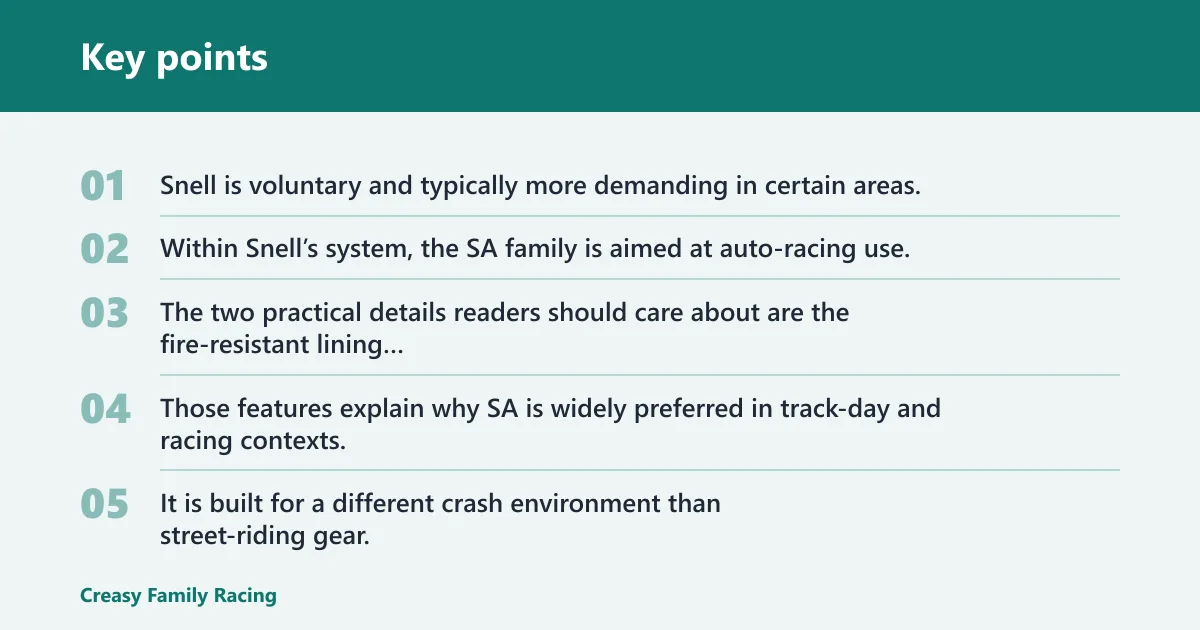
Snell is voluntary and typically more demanding in certain areas. Within Snell’s system, the SA family is aimed at auto-racing use. The two practical details readers should care about are the fire-resistant lining materials and the extra impact-testing criteria meant for car-racing environments.
Those features explain why SA is widely preferred in track-day and racing contexts. It is built for a different crash environment than street-riding gear.
What M covers and where it falls short for many car events
Snell M helmets are designed for motorcycle use. That does not make them worthless. It does mean the label is solving a different problem, and many car-event tech sheets either prefer SA or require it outright.
This is also where readers get burned by shorthand. “It’s Snell rated” is incomplete. The family letter matters as much as the year.
Why “Snell” by itself is not enough
A seller can truthfully say a helmet is “Snell” while the inside label reads M instead of SA. If the organizer wants SA, the shell graphics and listing headline do not help. Tech inspection looks for the actual certification sticker.
Is a DOT or ECE motorcycle helmet legal?
Sometimes, but not by default. DOT is the U.S. legal baseline for motorcycle helmets, and ECE 22.06 is a current motorcycle safety standard newer than ECE 22.05. Either may be road-legal, yet neither is automatically accepted for autocross, HPDE, or track days unless the organizer’s helmet rule says so.
DOT FMVSS 218: what it does and does not tell you
DOT is the U.S. legal baseline for motorcycle helmets. DOT uses a self-certification process, which means the manufacturer labels the helmet as compliant. A motorcycle DOT sticker is not proof the helmet truly meets the standard, and DOT alone is often not enough for motorsport tech inspection.
That gap matters because street legality and event legality are separate checks. A helmet can be sold legally for motorcycle road use and still fail a car-event tech line.
ECE 22.06 versus ECE 22.05
ECE 22.06 is the newer regime compared with ECE 22.05. That makes it relevant when a rulebook specifically lists accepted ECE standards. It does not turn every ECE 22.06 helmet into a universal track-day pass.
For some autocross rulesets, ECE can matter. For HPDE, the answer is more often “read the organizer’s exact helmet section.”
Why a motorcycle standard can pass one event and fail another
Autocross clubs often have more variation than readers expect. One may track SCCA’s accepted list. Another may simplify its policy to SA only. HPDE organizers are often narrower still.
A common first-timer mistake is reading a forum post that says “ECE is fine for autocross,” then showing up to a private club event whose tech sheet says “Snell SA required.” The helmet may be legal on the road and accepted at one cone course, yet still fail that event.
Why DOT-only is still a common tech-fail scenario
DOT-only fails because many motorsport tech inspectors are not judging whether the helmet is legal for street riding. They are checking whether the helmet matches the event rule. If the rule requires SA or a named list of accepted standards, a plain DOT sticker is the wrong answer.
Can you use SA2020, SA2025, or older helmets in 2026?
Often yes, but the exact answer depends on the organizer’s rulebook. For most buyers, the decision is about price, remaining service window, and near-future event plans. Older labels need more caution because acceptance windows vary by organizer, and a used helmet with an older sticker can age out quickly even if it still looks clean.
Current shopping logic: SA2025 versus discounted SA2020
Snell SA2025 is a current auto-racing standard, and full-face and open-face models are available. Snell SA2020 is the prior standard and is still commonly accepted for 2026 club events. If prices are close, SA2025 may give a longer runway. If an SA2020 deal is strong and the helmet is new, it can still be a sensible buy for club events in 2026.
How accepted-year windows usually work
Many event rules accept the current Snell SA cycle and the prior one, but that is a pattern, not a universal law. Some rulebooks list exact accepted standards. Others use a rolling window. The only safe move is to read the current season rulebook for the organizer you actually plan to run with.
Used-helmet risk with SA2010 and older labels
SA2010 is where buyers need to slow down. Competitor guidance often notes late-stage acceptance windows for SA2010 in some series, but older-standard shopping still belongs in the “verify the exact rulebook” category rather than the “blanket safe” category.
Even if a used SA2010 helmet is technically accepted for one remaining season, the value can be poor if the label is near the end of its event life or the seller cannot document condition. Older than that, the odds of useful acceptance narrow fast.
Why the season rulebook matters more than forum advice
Forum answers age badly because helmet lists change by season. Organizer supplemental rules can also narrow an otherwise broad sanctioning-body rule. A screenshot from last year, or a comment that starts with “they let me run it once,” is weaker than the current helmet section on the event page.
How do you verify the sticker before you buy?
Check the actual certification label inside the helmet before money changes hands. The shell graphics, online title, and seller description are secondary. The important details are the certification family, the certification year, and whether the interior label appears original, readable, and attached where the manufacturer placed it.
Where the certification label is usually located
Helmet tech inspection usually relies on the sticker or sewn-in interior label, often under the liner or inside the helmet. Organizers want the exact standard year and family, not a promise in the listing text. If the seller cannot show that label clearly, treat the helmet as unverified.
What to check in a listing photo or in person
- Find the inside certification sticker or interior label.
- Read the full family and year, such as SA2020, SA2025, or M2020.
- Check that the label is readable and not partly peeled, cut, or painted over.
- Compare the seller’s description to the actual label, not the shell decals.
- Inspect the liner for tampering, missing sections, or odd glue marks around the label area.
- Walk away if crash history, storage history, or ownership history is unknown and the price assumes a clean helmet.
Red flags that should end the deal
Missing label. Damaged or unreadable sticker. Altered liner. Suspicious replacement decals. Shell damage. Unknown crash history. Any one of those can turn a bargain into a helmet that fails tech or should not be worn at all.
Suppose a used helmet is advertised as “Snell race legal” and the listing shows only exterior photos. When the seller finally sends an inside shot, the liner edge looks lifted and the certification decal is wrinkled and half-covered. That is a walk-away case, even if the price is tempting.
When tech discretion enters the picture
Helmet tech inspection is event-specific. Even a legitimate label may not settle the matter if the shell is visibly damaged or the organizer has a stricter supplemental rule. The final call is made at tech or grid by the event staff.
Should you choose full-face or open-face?
Full-face is the safer default because it adds chin-bar protection and usually lines up better with future track use. Open-face helmets often pass autocross tech when the certification and event rules match, but they leave the chin and jaw more exposed. The right choice depends on risk tolerance, comfort, and where the driving plan is headed.
Why full-face is the safer default
The practical advantage is simple: more coverage in front of the face. That matters in any car event, and it matters even more if track days, time trials, or open-top cars are in the plan. Full-face also makes it easier to buy once for a wider range of future events.
When open-face is commonly allowed
Open-face helmets can be legal in autocross if the event accepts the certification on that helmet. Snell SA open-face models exist, including SA2025 and SA2020 examples in the market. That gives drivers a legal option when cooling and visibility matter more than maximum facial coverage.
Still, legal does not mean equally protective. Open-face is cooler in summer and easier for some drivers with glasses, but it offers less chin protection than full-face.
Heat, visibility, glasses, and communication trade-offs
Open-face usually feels less enclosed. Full-face usually feels more secure and better aligned with stricter events. For glasses, intercoms, or track-day add-ons, fit varies by model, so check the manufacturer’s listing for your model and test the fit before the event if possible.
If HANS or another head-and-neck restraint is in your future
If you expect to move toward time trials, racing school, or wheel-to-wheel, think beyond this month’s autocross. Head-and-neck restraint compatibility varies by model, and future event requirements tend to move in the same direction as SA helmets and full-face coverage. Buying with that path in mind reduces the chance of replacing everything at once later.
Why helmets fail tech even when the seller said they were legal
Expired or unsupported certification year
The sticker can be real and still be too old for that season’s rulebook.
Wrong certification family for the organizer
“Snell” is not enough. SA and M are different. DOT is different again. ECE 22.06 may be accepted in one event and irrelevant in another. The family must match the organizer’s rule language.
Unverifiable label condition or shell damage
A real standard is only part of tech. If the interior label is missing or damaged, or if the shell shows damage and the helmet’s history is unclear, tech staff can reject it.
Organizer discretion and local supplemental rules
Some clubs copy a national rulebook. Others add local restrictions. Grid workers and tech inspectors still make the final call on the day, especially if the helmet condition is questionable.
Frequently asked questions
What helmet rating do I need for track days and autocross?
For most U.S. track days, Snell SA2020 is the cleanest answer, and some organizers may also accept SA2025. For autocross, the accepted list depends on the organizer: some clubs accept SA plus selected motorcycle or ECE standards, while others narrow the rule. Match the exact sticker to the exact event.
Is a motorcycle DOT helmet legal for autocross?
Sometimes no, sometimes maybe, and never by assumption. DOT is the U.S. legal baseline for motorcycle helmets, but DOT-only often fails motorsport tech. Some autocross rulebooks accept broader standards; others do not. Read the club’s current helmet rule before showing up with a street bike helmet.
What is the difference between Snell SA and Snell M ratings?
Snell SA is the auto-racing standard. Snell M is the motorcycle standard. SA helmets use fire-resistant lining materials and are tested to auto-racing criteria that differ from M-rated motorcycle helmets. For car events, that difference is why SA is widely preferred and often required.
Can I use SA2020 or do I need SA2025 for 2026 events?
Often yes, but the exact answer depends on the organizer’s rulebook. SA2025 may make more sense if the price gap is small because it can give a longer useful window. SA2020 can still be a good value if the helmet is new, legitimate, and accepted by the organizer you actually run with.
How do I check the helmet sticker before buying a used helmet?
Ask for a clear photo of the inside certification label under the liner or on the interior tag. Confirm the family and year, then inspect label condition, liner condition, and shell condition. Walk away from helmets with missing labels, altered liner areas, unreadable decals, or unknown crash history.
Do open-face helmets pass autocross tech?
Often yes, if the helmet’s certification matches the event rule and the helmet is in acceptable condition. Snell SA open-face helmets are common in autocross. They are cooler and less enclosed, but they provide less chin and jaw protection than a full-face helmet, which remains the safer default.