Track Brake Pads: How to Choose the Right Compound
Choose track brake pads by matching compound temperature range to your longest session: Novices on 200-treadwear tires often fit mid-temp pads, while heavier cars, added aero, slicks, or advanced pace may call for high-temp compounds above roughly 1,200°F. Get it wrong and you buy fade, longer stops, cracked rotors, noisy street manners, or both. This guide maps compound choice to session heat, tire grip, vehicle mass, brake limits, and the street compromises worth accepting.
Start with heat load, not the box label. A pad has to match stopping power, fade resistance, and pedal feel, and brake pads should be chosen for the vehicle’s real use. That means session length, cooldown laps, ambient temperature, braking frequency, tire grip, weight, and how much rotor and caliper capacity the car actually has.
Catalog terms do not answer the question. “Street performance,” “dual-duty,” and “track-capable” can cover pads with very different friction curves, hot consistency, dust, noise, and wear, and rotor-and-pad kits are often grouped under broad labels that hide those differences.
Start with heat load, not pad labels
Why duty cycle decides the compound window
The same car can need two different pad types depending on the event. A common short novice session with early braking and a full cooldown lap asks far less of the pad than a longer open-lapping session with traffic, repeated threshold stops, and a short pit-in.
Track-day duty cycle is the heat story: how long the session runs, how often the brakes see near-maximum pressure, how much time they get to cool, and whether the car sits after a hot stop and heat-soaks the caliper and pad backing plate.
Performance driving calls for pads that stay consistent at higher temperatures. That consistency matters before outright fade. Many pads feel acceptable for three laps, then lengthen pedal travel or lose bite after repeated heavy stops.
How car weight, speed, and tire grip raise pad temperature
Heavier cars ask the pad to turn more speed into heat every time you brake. So do tracks with long straights ending in slow corners. Tire grip matters just as much. A sticky 200-treadwear tire, or anything beyond it, lets the car decelerate harder and keeps brake temperatures up even if lap times stay modest.
Say your 3,900-pound sedan runs a novice event on a warm day with 200-treadwear tires and short cooldowns. A pad sold as a “performance street” option may feel fine on the first session, then smear material unevenly by the third when the fronts stay hot after every stop.
Why brake system size and cooling change the answer
A light car with large rotors, good vane design, and direct airflow can survive on a milder compound than a heavy car with small rotors and poor ducting. Brake system capacity is not only caliper size. Rotor mass, pad area, airflow, and fluid volume all set how much heat the system can absorb before the pad leaves its working range.
That is why two cars on the same tire and same track can want different compounds. Pad choice is a brake-system decision, based on rotor mass, airflow, front-to-rear balance, and duty cycle, not a jump from one brand tier to the next.
How do you choose the right compound for your car?
Choose the compound by estimating your true heat load first, then back into the street compromise. Session length, tire grip, car mass, ambient temperature, braking frequency, and brake cooling decide the needed fade margin. Cold bite, dust, rotor wear, and noise should be accepted only after that track requirement is met.
Estimate your real track-day duty cycle
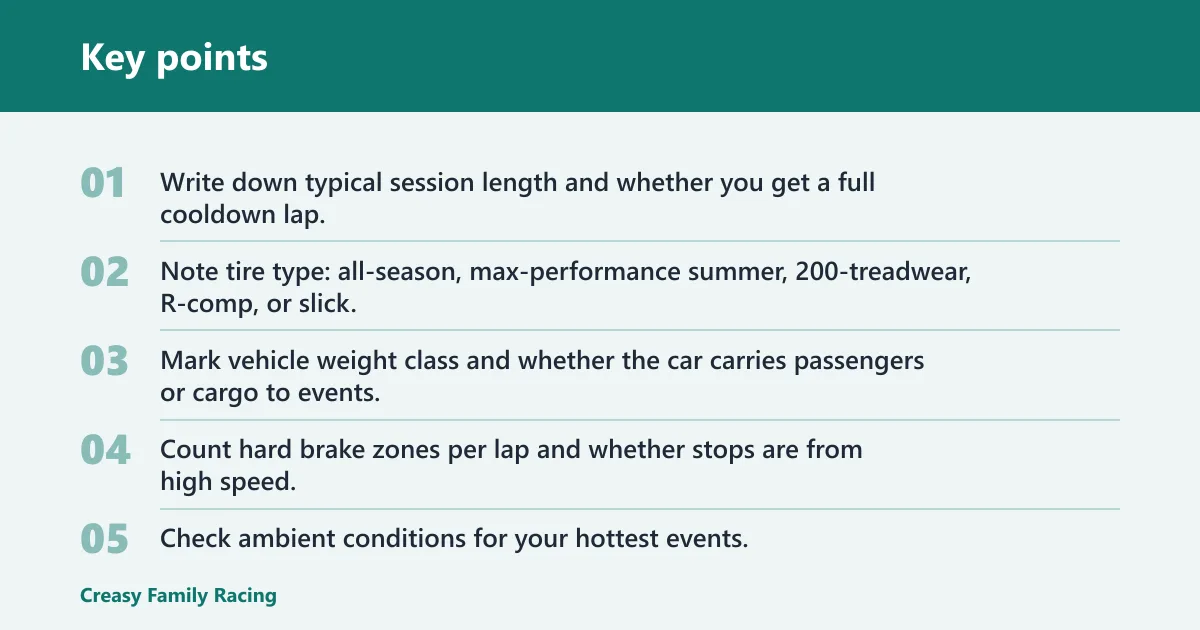
Use the hardest event you actually attend, not the easiest one on your calendar. If one track has two heavy brake zones from triple-digit speeds, size the compound for that track. If summer events run thirty-minute sessions, do not buy for the cool spring twenty-minute day.
- Write down typical session length and whether you get a full cooldown lap.
- Note tire type: all-season, max-performance summer, 200-treadwear, R-comp, or slick.
- Mark vehicle weight class and whether the car carries passengers or cargo to events.
- Count hard brake zones per lap and whether stops are from high speed.
- Check ambient conditions for your hottest events.
- Inspect rotor size, airflow, and whether fluid has shown any boiling symptoms.
If three or more of those factors are severe, it may be wise to move up a compound family rather than hoping a street pad will survive on technique alone.
Match compound behavior to street tolerance
Brake pad friction compound should be judged on usable traits: effective temperature range, cold bite, hot friction stability, modulation, fade resistance, noise, dust, and rotor wear. Peak bite alone is a trap. Brake pad quality affects braking power, distance, modulation, and wet performance, so a pad that feels strong on the first stop may still be the wrong choice if the curve falls off when hot.
Cold behavior matters for a street car. The first stop on a 40°F morning, a wet downhill exit from a parking garage, or the first brake application after highway cruising will expose a track pad with weak low-temperature friction. Some compounds need heat before they bite hard, squeal at low speed, and grind through rotors faster. If the car spends most of its life commuting, that penalty has to be worth the extra fade margin.
Set a safe margin for fade resistance
Most manufacturers list operating ranges, but the numbers are not directly comparable across brands. The safer method is to leave margin above your current use. If a mild pad already smells hot, leaves the pedal longer by the end of a session, or deposits uneven material on the rotor, move up one step in heat capacity before the next event.
A common first-timer mistake is choosing the quietest street pad that still mentions “track-capable,” then blaming fluid when the pad itself goes greasy. Fluid can fail too, but pad fade and fluid fade often arrive together when the compound is undersized.
What pad material actually works on track?
Semi-metallic compounds are usually better suited to repeated high heat than street-oriented ceramics, while NAO pads are generally the weakest choice for sustained lapping. But material family is only the starting point. Formulation, friction curve, and intended temperature range matter more than the single word on the carton.
Semi-metallic: higher heat tolerance with NVH tradeoffs
Semi-metallic pads remain a common answer when repeated high-temperature stops matter most. They tend to hold friction deeper into a session and can offer stronger bite once warm. That makes them attractive for frequent track use, heavier cars, and cars on sticky tires.
The tradeoff is street civility. Semi-metallic pads are inherently noisier than other materials, and noise complaints are a leading brake repair comeback issue. They also tend to dust more, can wear rotors faster, and may feel rougher at parking-lot speeds.
A typical semi-metallic compound may contain only eight or nine ingredients. That does not make it simple in behavior, but it helps explain why broad labels alone tell very little about feel or temperature ceiling.
Ceramic: street manners first, track limits sooner
Ceramic linings are used on many late-model vehicles for good reason. Ceramic compounds can use 18 to 20 ingredients, ceramic linings are significantly quieter than semi-metallics, and ceramics provide a consistent pedal feel hot or cold. Ceramic materials can improve brake pad life as well.
Those are street strengths. For track work, many ceramic compounds hit their limit sooner under repeated heavy braking, especially in heavier cars or on high-grip tires. Low dust and quiet operation do not mean they can absorb endless heat. Some “ceramic performance” pads do fine in short novice sessions, but repeated hard stops often expose their ceiling.
NAO and hybrid compounds: where they fit and where they do not
Organic or NAO pads are usually poor choices for sustained track heat. They may offer decent initial bite and low noise on the street, but they generally lack the thermal stability needed for repeated high-energy stops.
Hybrid compounds sit between categories and can work very well, but the same rule applies: ignore the label and read the intended use, operating window, and user feedback from cars with similar weight, tire, and event length.
Why friction feel matters as much as peak bite
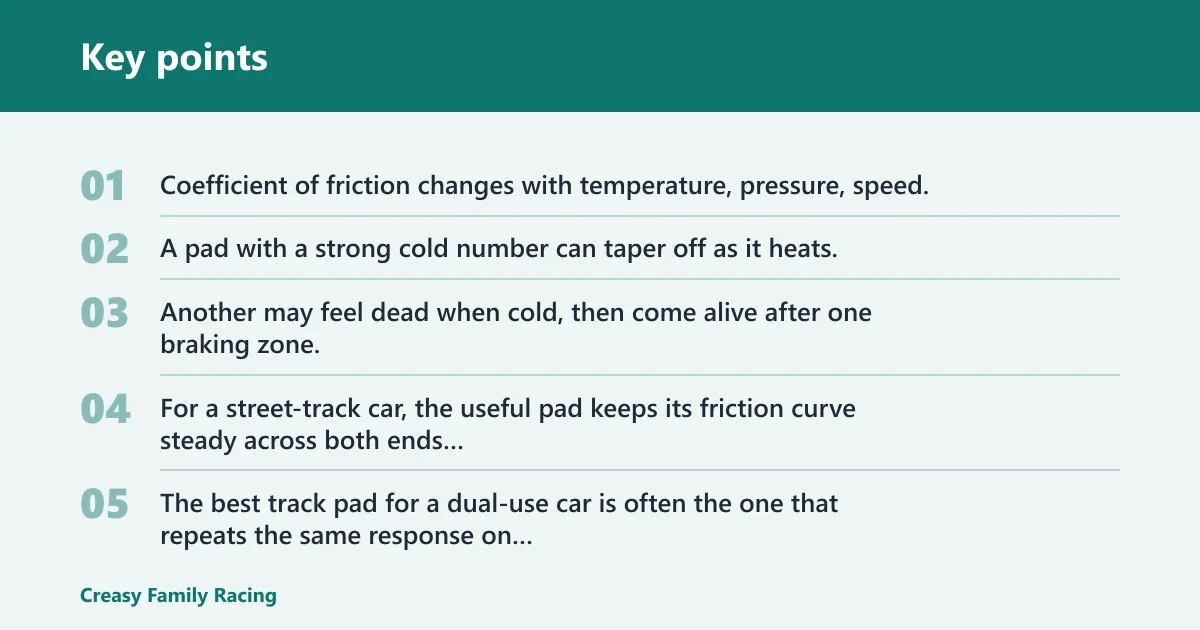
Coefficient of friction is a curve, not a single number
Coefficient of friction changes with temperature, pressure, speed, and transfer layer condition. A pad with a strong cold number can taper off as it heats. Another may feel dead when cold, then come alive after one braking zone. For a street-track car, the useful pad keeps its friction curve steady across both ends of that range.
Consistency, modulation, and pedal feel through a session
The best track pad for a dual-use car is often the one that repeats the same response on lap two, lap seven, and the drive home. Consistency lets you brake at the same marker and release the pedal with confidence. Modulation matters because too much grab can upset turn-in, while a flat, numb pedal makes threshold braking harder to judge.
Mavic says carbon and aluminum rims do not brake the same way. The same principle applies here: two pads can stop the car, yet deliver very different feel, release, and repeatability.
How fade starts before total brake failure
Fade rarely arrives as one dramatic moment. It often begins as a small rise in pedal effort, then a longer stop for the same pressure, then a need to brake earlier every lap. If you keep pushing, the surface can glaze, the transfer layer can smear, and the rotor can pick up uneven deposits that later feel like warped rotors.
Can performance street pads handle track days?
Yes, sometimes. A performance street pad can work for occasional novice events if the car is light to moderate in weight, uses street tires or mild 200-treadwear tires, runs shorter sessions, and has healthy fluid and rotors. The margin disappears quickly with heavy cars, sticky tires, heat, or advanced pace.
When they are acceptable for novice use
If the event is an introduction day with conservative pace, twenty-minute sessions, and a full cooldown lap, a good performance street pad may be enough. The key is managing expectations. It is a learning setup, not a blank check for repeated threshold braking.
Suppose a 3,100-pound coupe runs street tires at a cool-weather novice event with four hard brake zones per lap. Fresh high-boiling-point fluid, clean rotors, and a mid-temp street-performance pad may survive the day. Change only one variable to 200-treadwear tires, and the same pad can become the weak link.
The limits with heavier cars and stickier tires
Once weight climbs, pace rises, or grip increases, street pads often fail in predictable ways: greasy pedal feel, smoking corners, tapered wear, crumbling edges, and transfer patches on the rotor face. Aggressive tires push a mild pad past its window because the chassis can ask for more deceleration, more often, with less tire slip to bleed heat elsewhere.
Red flags that say you need a true track compound
- Brake effort rises each lap for the same corner and marker.
- The pad smells hot or smokes after a normal cooldown lap.
- Rotor faces show patchy dark deposits or new glazing after one event.
- Front pad thickness drops fast across a single day.
- Pedal feel is fine on the street but falls off only after repeated hard stops.
Should you change front or rear compound first?
Usually the front axle needs the bigger move because most track cars load the front brakes harder. But front and rear compounds must stay in balance. Changing one end too far can alter ABS behavior, entry stability, rear lock tendency, and pedal feel, turning a fade fix into a handling problem.
How front-to-rear balance affects ABS and stability
More aggressive front pads can shorten stopping distances and add confidence if the rear remains supportive. Go too front-heavy and the car may dive harder, engage front ABS early, and feel longer-pedaled because the rear contributes less. Go too rear-aggressive and the car can feel nervous on trail braking or trigger rear lock on corner entry.
When staggered compounds make sense
Staggered compounds can work when the front axle clearly overheats first and the rear still operates in range. That is common on nose-heavy street cars where the rear brakes are smaller and less stressed. The step should be moderate, not dramatic, and ideally within one maker’s stated compatibility guidance if available.
Mistakes that create rear instability or long pedal feel
Do not mix compounds casually because one set was on sale. Different compressibility, friction rise, and release characteristics can change pedal feel even before peak decel changes. If ABS cuts in earlier, the rear becomes twitchy on entry, or the car needs more pedal stroke after the swap, balance may have moved the wrong way.
Pad use decision table
| Use case | Recommended compound type | Cold bite | Fade resistance | Dust/noise | Rotor wear | Avoid if |
|---|---|---|---|---|---|---|
| Occasional novice track day | Mid-temp performance street or mild dual-duty hybrid | Good on the street | Adequate for short sessions and full cooldown laps | Low to moderate | Low to moderate | Avoid if the car is heavy, runs sticky 200-treadwear tires, or shows fade before session end |
| Frequent open lapping | Track-focused semi-metallic or high-temp hybrid | Fair to good once warm | High for repeated hard stops | Moderate to high | Moderate | Avoid if daily street comfort matters more than lap consistency |
| Heavy car on endurance sessions | High-temp track compound with strong thermal margin | Often weak when cold | Very high | High | Moderate to high | Avoid if the car spends most days commuting in traffic or sees cold, wet first-stop use |
| Street car with aggressive tires | Upper-mid to high-temp dual-duty compound, usually semi-metallic leaning | Acceptable to strong | High if rotor and fluid are up to it | Moderate to high | Moderate | Avoid if you want low dust and near-OEM quiet above all else |
| Dual-use daily driver | Mild dual-duty hybrid or conservative track-day compound | Good in traffic | Moderate; depends heavily on session length and cooldown | Moderate | Low to moderate | Avoid if sessions are long, ambient heat is high, or braking zones are severe |
Track brake pads checklist
- Too street-biased: fade starts before the checkered flag, rotor faces glaze, or pad material smears after one hard day.
- Too track-biased: weak first stop on cold mornings, persistent squeal at low speed, heavy black dust, and fast rotor wear during normal commuting.
- Too mixed front to rear: new ABS behavior, entry instability, or a changed pedal character immediately after the swap.
What else can make the right pad feel wrong?
The right compound can still perform badly if rotors are thin, glazed, cracked, grooved, or covered in uneven deposits, or if fluid is old and boiling early. Poor bedding can do the same. Before blaming the pad, inspect the whole system in order: fluid, rotors, pad install, bedding, then wear patterns.
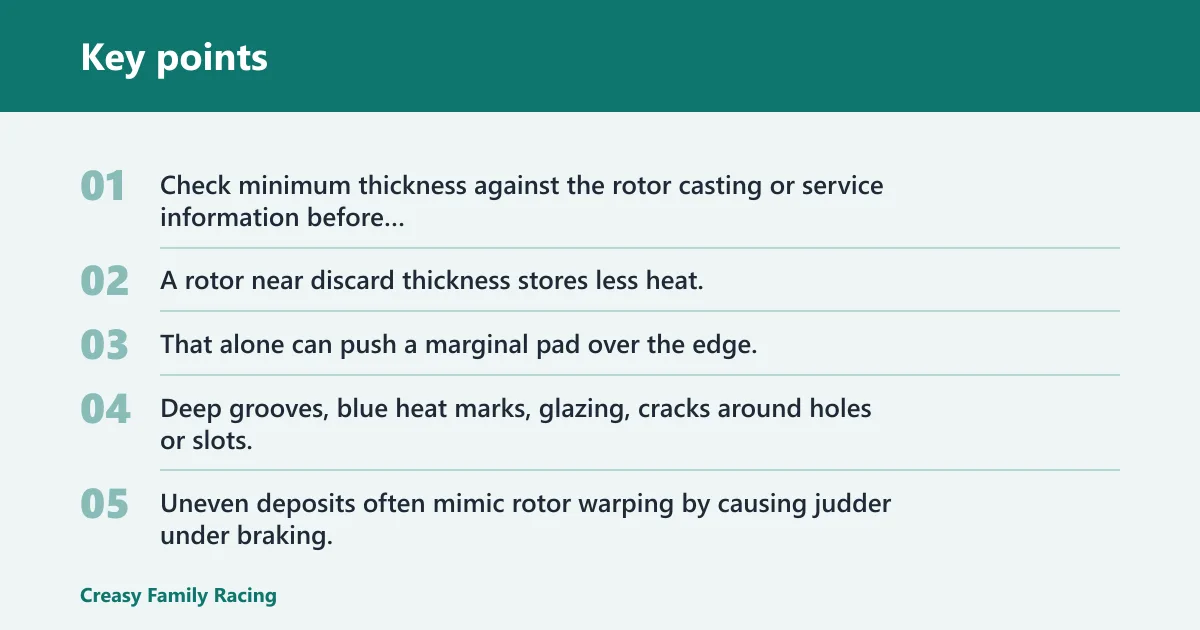
Rotor thickness, glazing, grooving, and uneven deposits
Check minimum thickness against the rotor casting or service information before installing new pads. A rotor near discard thickness stores less heat. That alone can push a marginal pad over the edge.
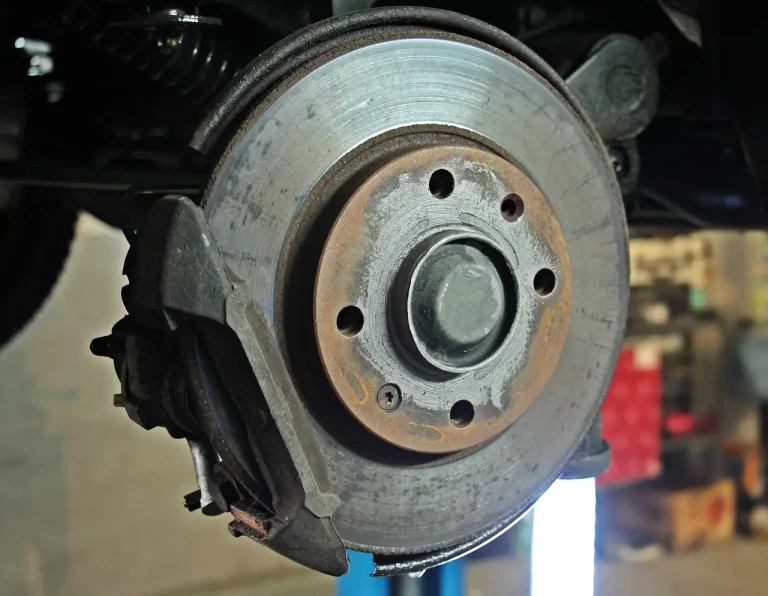
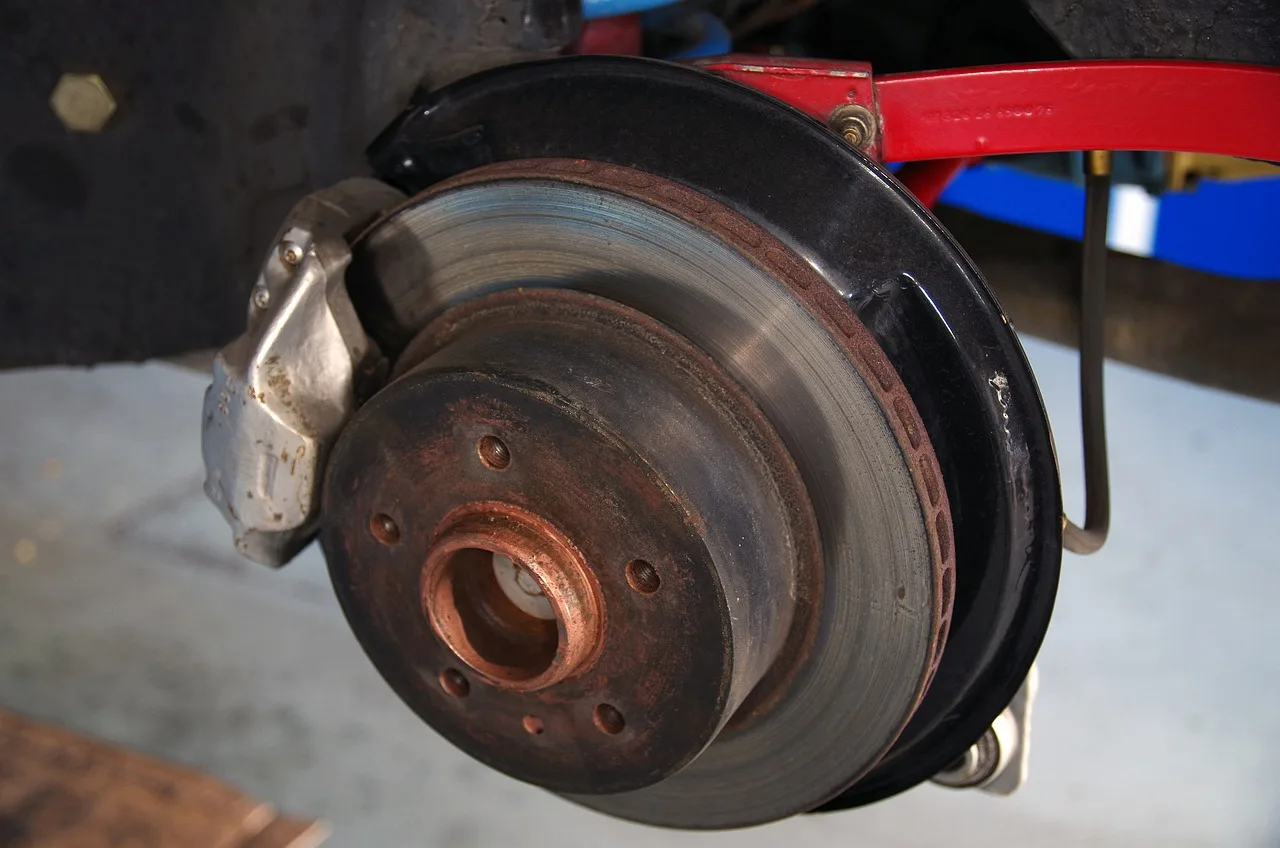
Surface condition matters too. Light, even wear can be fine. Deep grooves, blue heat marks, glazing, cracks around holes or slots, and patchy transfer material are not. Uneven deposits often mimic rotor warping by causing judder under braking. New pads on a dirty transfer layer may never bed correctly.
If taper wear appears across the pad, inspect hardware, guide pins, caliper stiffness, and hub runout. Taper can overheat one end of the pad and ruin a good compound choice.
Brake fluid boiling point, age, and heat tolerance
Fluid fade can feel like pad fade, but the symptoms differ. When fluid boils, the pedal often goes longer or softer because vapor compresses. When the pad overheats, pedal travel may stay similar while deceleration drops for the same force. Both issues can happen in one session.
Track prep should include fresh fluid with a boiling point suited to repeated heat. Wet boiling point matters, not only dry boiling point, because street cars absorb moisture over time. Old fluid reduces the margin you thought the new pad would have.
Poor bedding, bad transfer layers, and false pad diagnoses
Bedding lays down an even transfer layer so the pad sees a stable friction surface. A common process is several moderate stops, then a smaller number of harder stops, followed by cooldown driving without holding the car on the pedal at a complete stop. Always follow the pad maker’s instructions when they differ.
Skip bedding, park hot with the pedal clamped, or jump straight into maximum braking on green pads, and you can create deposits, judder, glazing, and misleading complaints about bite or noise. Some pads never recover fully once the surface is damaged.
How do you know a compound is too mild or too aggressive?
A pad is too mild when it loses bite, smears deposits, or wears too fast during your normal sessions. It is too aggressive when street cold stops feel dull, noise becomes constant, dust is excessive, or rotors wear faster than your use justifies. The right answer sits where your real event load and street tolerance overlap.
Signs of a street-biased pad at the track
Watch for fading bite, increasing stopping distances, smoking after cooldown, glazing, pad edge crumbling, and fresh judder from uneven transfer. Heat checking on rotors, while not always fatal by itself, is another cue that the system is being pushed hard and needs more margin.
Signs of a track-biased pad on the street
If low-speed squeal becomes constant, first-stop bite is poor in cool weather, dust coats the wheels quickly, and rotor faces wear rapidly in ordinary commuting, the compound may be beyond what a dual-use car needs. Ceramic linings are significantly quieter than semi-metallics, so a move away from ceramics often raises NVH even when braking power stays acceptable.
Wear rate, taper, and replacement thresholds
Inspect pad thickness before and after every event. A common rule of thumb is to replace track-used pads before friction material gets close to 3 mm, and to stop using any pad that shows cracks, crumbling, or severe taper. Uneven wear across inner and outer pads points to hardware or cooling issues, not only compound mismatch.
Post-event checks should happen in the same order every time: pad thickness, inner-versus-outer wear, rotor face condition, fluid look and pedal feel, then any new noise or vibration. That routine catches real causes before they become expensive ones.
Frequently asked questions
What pad compound is best for occasional track days?
For occasional novice events, a mid-temp performance street pad or mild dual-duty hybrid is often the best fit if the car is not especially heavy and tires are not very sticky. The limit appears when sessions get longer, speeds rise, or the car starts showing fade, glazing, or fast wear.
How much cold bite do track brake pads need for street driving?
A street-driven car needs predictable first-stop response in cool and wet conditions, even if peak bite comes later when hot. If the pedal feels numb for the first few stops, that compound is asking too much from daily use. Cold confidence matters more than ultimate hot friction on public roads.
What tradeoffs come with semi-metallic versus ceramic brake pads?
Semi-metallic pads usually tolerate heat better and suit repeated hard stops, but they tend to be noisier, dustier, and harder on rotors. Ceramic pads are quieter, cleaner, and stable in ordinary use, and many late-model cars use them, yet repeated track heat often exposes their street-oriented limits sooner.
How do rotor condition and brake fluid affect pad choice for track days?
Thin, glazed, grooved, or deposit-covered rotors can make a good pad act bad, and old fluid can mimic pad fade by boiling and lengthening the pedal. Choose pads only after confirming rotor thickness, surface condition, and fresh high-heat fluid. Otherwise the new compound gets blamed for other failures.
Can I run performance street pads instead of true track pads?
Yes, within limits. They can work for short novice sessions on lighter cars with modest tires and healthy brake prep. They become a poor choice for heavy cars, long sessions, hot weather, and sticky tires because heat rises faster than their friction curve and wear rate can tolerate.
What makes some brake pads noisier or dustier than others?
Abrasive content, operating range, chamfers and shims, transfer-layer behavior, and street use outside the pad’s intended temperature window all affect NVH and dust. Semi-metallic pads are inherently noisier than other materials, while quieter ceramic formulations usually aim for cleaner street manners before extreme track heat capacity.