How Do You Recover From a Bad Launch?
Recover by separating the launch from the run that follows. If the tires spin, ease the throttle in and keep the wheel straight. If it bogs, stay in it and let the car pull back into the powerband. A bad correction can cost ET, trap speed, or both, and it can turn a recoverable pass into a strike. This guide covers spin, bog, and hop triage, plus the steering, throttle, and lift decisions that protect speed and safety after the launch.
What counts as a bad launch?
A bad launch is any first-60-foot problem that pushes the car out of its intended powerband, hurts straight-line control, or forces a driver to adjust the plan too early. Spin, bog, wheel hop, a missed shift, and a slow reaction can all count, but they do not all call for the same response.
Spin, bog, and wheel hop
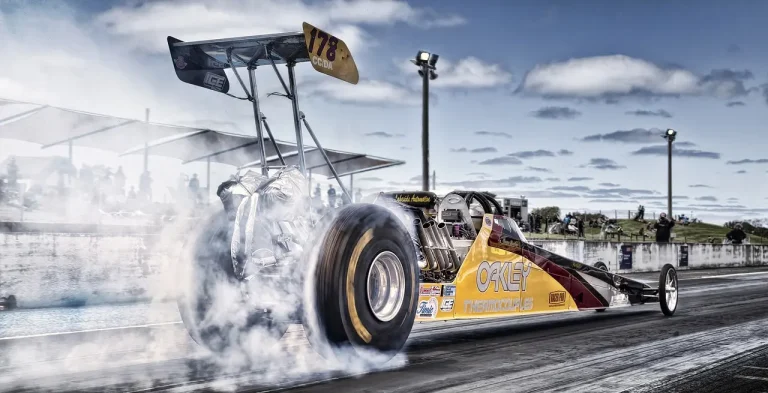
Spin is tire slip at launch or on the hit, often seen as a lazy 60-foot and a flare in rpm without matching acceleration. Bog is the opposite: engine speed falls below the powerband, the car noses over, and recovery depends on gearing and how fast rpm climbs back. Wheel hop is the violent oscillation that can break parts, so it gets the lowest tolerance.
A missed shift is different because the launch may be fine and the pass falls apart later. A slow reaction hurts ET slip at the tree, but it does not change the car’s mechanical run the way wheel hop or a big bog can.
Why the first 60 feet matter most
The first 60 feet is a common way to judge launch quality. It is the main launch metric because changes there ripple through the rest of the pass, and a poor number often means the car will chase lost time unless the rest of the run is unusually strong.
Use the 60-foot time to sort the type of loss, then compare the rest of the slip. If the 60-foot is off but trap speed stays close to normal, the pass may still be worth studying rather than discarding.
Can you still save the pass?
Yes, a bad launch does not always ruin the full pass. Once the car is straight and the tires are hooked again, the best move is usually to finish the run cleanly, keep shift timing consistent, and avoid adding a second problem that costs more ET or trap speed than the launch already did.
What a lost 60-foot does to ET
A poor 60-foot usually shows up as more elapsed time by the finish line, because the car spent the opening part of the run slower than planned. That lost ground is hard to erase, especially in short races, but the driver can still stop the gap from widening with clean inputs.
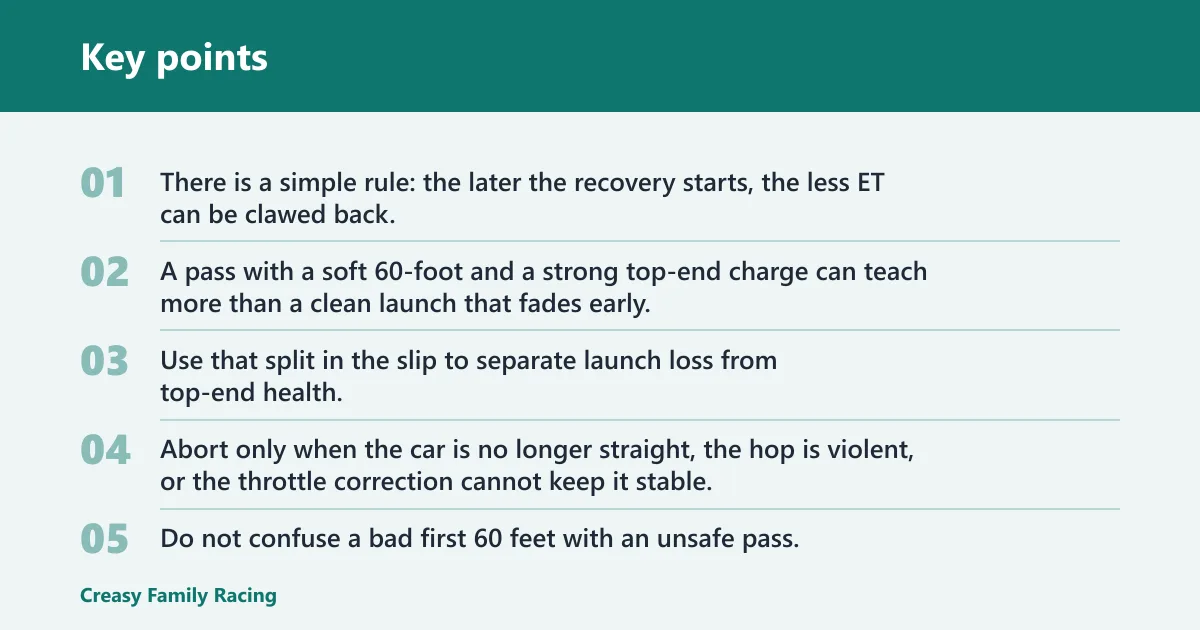
There is a simple rule: the later the recovery starts, the less ET can be clawed back. A bad launch on a no-prep lane may leave little room to recover, while a prepped surface can give enough bite for the rest of the pass to stay competitive.
Why trap speed can still improve
Trap speed can still look decent even when ET is compromised, because the car may recover midtrack and pull well from the half-track to the stripe. That matters. A pass with a soft 60-foot and a strong top-end charge can teach more than a clean launch that fades early.
Use that split in the slip to separate launch loss from top-end health. If trap speed stays near expected while ET falls, the launch or early shift timing likely caused the damage, not the whole tune-up.
When the run is too far gone
Abort only when the car is no longer straight, the hop is violent, or the throttle correction cannot keep it stable. If the car is pointed, the tires are under control, and the engine is still in a safe range, staying in it is usually better than lifting on instinct.
Do not confuse a bad first 60 feet with an unsafe pass. One is a performance problem. The other is a control problem.
Launch recovery matrix
The best response depends on the problem and the drivetrain. Spin, bog, and wheel hop do not call for the same fix, and manual, automatic, turbo, and AWD cars give the driver different tools. Use the matrix below as a quick triage guide.
| Setup | Spin | Bog | Wheel hop |
|---|---|---|---|
| Manual | Pedal in smoothly, keep the wheel straight, and do not lift fully unless the car is skating sideways. Expect some ET loss, but trap speed can stay close if the tires recover cleanly. | Stay in it, let rpm climb back into the powerband, and avoid a quick clutch re-dump. ET can be salvaged better than with a lift, but drivetrain stress rises if the clutch is abused. | Lift and reset. Wheel hop in a manual can quickly damage axles, hubs, and clutch parts, so a saved pass may not be worth the risk of breaking a part. |
| Automatic | Ease off throttle just enough to stop flare, then roll back in. Do not snap the pedal closed; that can shock the converter and waste more time. | Keep the throttle where the transmission can recover, then let the converter and shift schedule pull the car back. ET loss is often smaller than in a manual if the unit is already in the gear you need. | Abort if hop starts. An automatic may absorb some shock, but repeated oscillation still pounds the drivetrain and can turn a recoverable pass into parts failure. |
| Turbo | Modulate gently. A sudden lift can drop boost, and a sudden stab can worsen slip. The goal is to keep the engine loaded enough to stay in the boost window. | Stay in the throttle if boost is still building. If the car falls out of the boost window, the rest of the pass may recover ET poorly even if the tires hook again. | Abort if the hop is sharp. Turbo cars often carry more torque hit as boost comes in, which can make hop more violent and harder on the shafts. |
| AWD | Small throttle trims can help, but do not over-correct. AWD can mask a poor hit better than a two-wheel-drive car, so a mild spin may still lead to a good run. | Stay in it unless the car falls far out of the torque range. AWD can recover from a soft launch well if the surface has bite. | Back out if hop starts. AWD can load all four corners at once, so the stress rises quickly and the pass can go from salvageable to unsafe in a moment. |
What should you do after wheel spin?
After wheel spin, the goal is to stop the tires from flaring while keeping the car pointed straight and loaded enough to recover. A small, smooth pedal correction is usually better than a hard lift or a big stab, because abrupt inputs can make the tire slip worse and add time.
Pedal input without upsetting balance
Feed throttle back in with a light, steady motion. If the tires are spinning but the car is still moving straight, a brief correction of about a few tenths of a second is often enough to help the tire bite again without upsetting weight transfer.
- Hold the wheel straight. Straight steering keeps the front end calm and gives the rear tires the best chance to hook again. Turning to “help it” usually makes the slip worse.
- Trim throttle smoothly. Back out just enough to stop the flare, then roll back in. The goal is to end the slip, not to kill momentum.
- Return to the plan. Once the tire hooks, shift on the normal schedule and keep the pass on course. Chasing the lost 60-foot with extra aggression often costs more than it gains.
Suppose a 10.50-second car spins hard for the first 20 feet on a warm prepped lane, then hooks at the 60-foot cone. A smooth pedal correction and normal shift timing can still leave a respectable ET, while a full lift would usually give up more time than the spin already did.
What to avoid on a slick lane
Do not jab the throttle, saw at the wheel, or lift and reapply with big swings. On a slick lane, those inputs can turn manageable spin into a wider slide, especially if the track is cold, dusty, or has poor lane choice. If traction control is active, check whether it is cutting power so hard that the car cannot recover cleanly.
What should you do after a bog?
After a bog, stay in the run and let the engine climb back into its powerband unless the car is clearly loaded up or falling on its face. A bog often costs less time when you keep the throttle steady than when you lift, stab, and force another stumble.
Getting back into the powerband
The fix is usually to keep load on the engine and let rpm recover. If the launch was too soft, a clean shift schedule matters more than chasing rpm with a big pedal move. If the engine is already below the useful range, a short delay in recovery is still better than a panic lift.
- Keep throttle steady. Let the engine climb instead of snapping the pedal closed. That helps the car move back through the powerband without adding another stumble.
- Shift on time. Do not short-shift to “save” a bog unless the powerband calls for it. A shift that is too early can bury the car deeper below peak pull.
- Watch the next gear. If the next gear drops the engine back into the useful range, stay consistent. The rest of the pass may still be strong enough to protect trap speed.
That usually adds another stumble, raises drivetrain shock, and costs more ET than the original bog.
Manual versus automatic recovery
Manual cars can recover from a bog if the clutch and rpm come back together quickly, but they are the most sensitive to bad clutch timing. Automatics often recover better because the converter can keep the engine in a more usable range, though too much throttle lift can still upset the unit and cost speed.
DCT cars sit between those two. They shift fast and can mask some launch mistakes, but they still need clean throttle and straight-line control after the hit.
How do drivetrain and surface change the fix?
Transmission type and track surface decide how much recovery is possible after the hit. A manual gives the driver more direct control, an automatic gives more torque management, a DCT shifts quickly, and AWD can recover a soft start better if the surface has enough grip. Track prep changes all of that.
Manual, automatic, DCT, and AWD responses
Manual cars need the most careful shift timing after a bad launch, because clutch work and rpm recovery are tied together. Automatics can keep pulling through a mistake if the converter stays coupled. DCTs reward steady inputs and clean shift points. AWD cars can save a weak launch better than most two-wheel-drive cars, but a violent hop can be worse because all four corners are loaded.
Turbo versus naturally aspirated behavior
Turbo cars care about boost recovery. A brief lift can dump the turbine speed and cost more ET than a small pedal trim would have. Naturally aspirated cars usually respond more directly to throttle changes, so they are easier to correct after spin but less forgiving when the engine falls below the powerband.
Prepped track versus no-prep surface grip
On a prepped track, a light spin may clean up fast enough to save the pass. On no-prep or a cold lane, the same correction can fail because the surface cannot take the load. Tire pressure, lane choice, and temperature all change the result, so the same driver input can work one round and fail the next.
Use the time slip or a data log to see where the pass fell apart. If the 60-foot is weak, the middle of the run is normal, and trap speed stays close, the launch was the main issue. If the whole pass is soft, the correction may have cost more than the hit.
Frequently asked questions
How do you recover after a bad launch in drag racing?
Separate the problem first. Spin usually wants a gentle pedal correction, bog wants steady throttle and normal shift timing, and wheel hop wants an immediate lift. If the car is straight and stable, keep driving the pass. The goal is to save ET without creating a second mistake.
Can you still run a good ET after spinning at the launch?
Yes, especially if the spin is brief and the car hooks again before the 60-foot clocks. A strong middle and top end can still produce a decent ET slip. The best chance comes from smooth throttle correction and clean shifts, not from a hard lift.
What should you do if the car bogs or spins off the line?
If it bogs, stay in it and let rpm recover into the powerband. If it spins, ease the throttle until the tire stops flaring, then roll back in. Do not use the same fix for both. Bog and spin call for opposite responses.
Should you lift after a bad launch or stay in it?
Stay in it if the car is straight, the tires are under control, and the engine is still in a safe range. Lift if the car is sliding, hopping hard, or moving unpredictably. The safest pass is the one that stays pointed straight and does not break parts.
How do you keep from wasting the rest of the run after a poor 60-foot?
Keep the shift pattern steady and avoid chasing the launch with extra aggressive inputs. The 60-foot tells you how much time was lost, but the rest of the run still matters. Clean shifts and stable throttle can protect trap speed and keep the ET from getting worse.
Does a bad launch mean the pass is ruined?
No. A bad launch can hurt the slip, but it does not automatically ruin the run. The pass is only lost when the driver piles on a second mistake or the car becomes unsafe to continue. A clean recovery can still leave useful data and a respectable number.