
Driving Gloves as a Gift: How to Choose the Right Pair
Choose driving gloves by the recipient’s climate, grip preference, and hand size: unlined leather for mild weather, perforated or suede-backed pairs for heat, and a snug fit with no palm bunching. A poor match can mean weak steering feel, uncomfortable seams, and a gift that sits unused. This guide covers glove types, sizing, materials, and driving conditions so you can choose with less guesswork.
This guide is part of our Driving gloves for track days and autocross series.
What makes driving gloves a good gift?
Driving gloves feel thoughtful when they match how the recipient drives. The best pair fits the steering wheel surface, the season, and how long the wheel stays in hand. That makes gift buying simpler, because you are matching use, fit, and comfort.
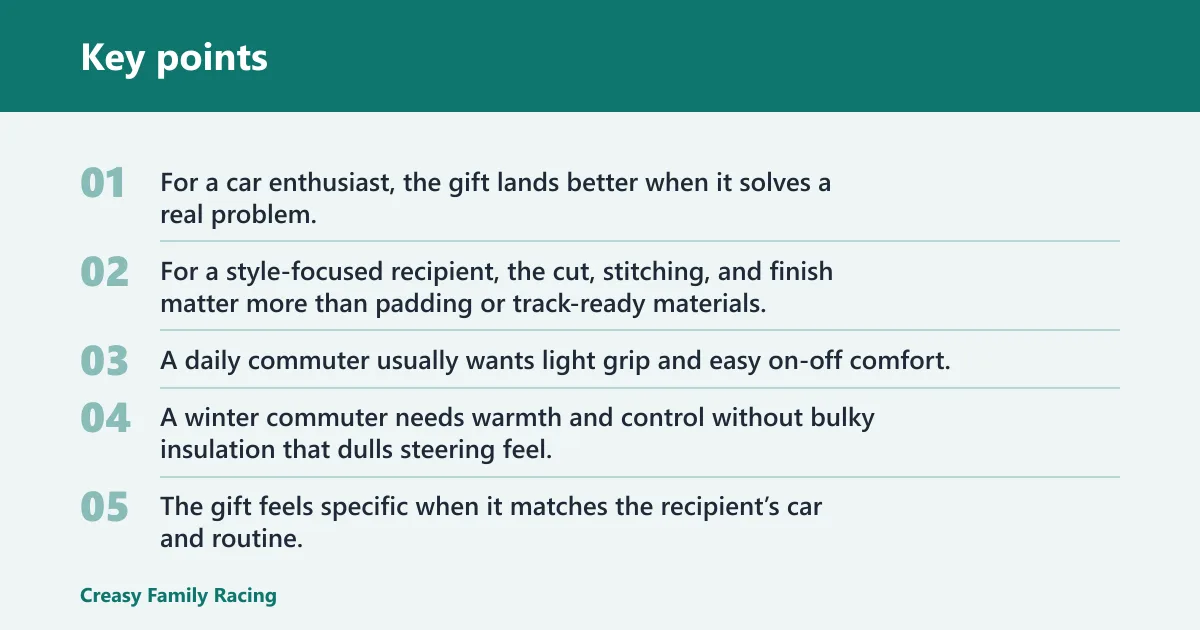
For a car enthusiast, the gift lands better when it solves a real problem. That might be sweaty hands on a long drive, a cold steering wheel in winter, or extra grip on a slick leather wheel. For a style-focused recipient, the cut, stitching, and finish matter more than padding or track-ready materials.
Why the right pair depends on driving style
A daily commuter usually wants light grip and easy on-off comfort. A track driver or autocross driver often wants thin palms, close finger fit, and seams that avoid pressure points during repeated steering input. A winter commuter needs warmth and control without bulky insulation that dulls steering feel.
That is why one “best” glove does not exist. The right gift depends on where it will be used, how long each drive lasts, and whether the recipient values tactile feel, warmth, or appearance most.
When driving gloves feel thoughtful instead of generic
The gift feels specific when it matches the recipient’s car and routine. Alcantara-wrapped wheels need different attention than smooth leather wheels. Warm-climate drivers often care more about ventilation and sweat control, while cold-weather drivers often care more about insulation and dexterity.
Small details matter too. A pair with the right palm width, finger length, and seam construction feels intentional. A pair chosen only by color usually does not.
Gift risks to avoid before you buy
The biggest risk is guessing size. The second is buying a glove style that fights the recipient’s use case. Thick gloves on a track wheel, or stiff fashion gloves for a winter commuter, often end up returned.
Check the seller’s exchange policy before you buy. If the recipient’s hand size is unknown, choose a retailer that makes returns simple and keep the packaging intact until the fit is confirmed.
Driving gloves gift matrix
This matrix turns use case, material, fit, and budget into a quicker gift decision. It also helps you estimate return risk before you buy, which matters when you cannot measure the recipient’s hands in person.
| Recipient type | Driving environment | Glove material | Fit cues | Estimated budget band | Return-risk level |
|---|---|---|---|---|---|
| Track driver | Track days, autocross, spirited weekend use | Thin leather or Nomex | Snug palm, minimal finger excess, close seam placement | Mid-range to premium | Medium |
| Daily commuter | Street use, mixed weather, short drives | Leather or breathable synthetic | Easy wrist entry, no palm bunching, moderate flexibility | Entry-level to mid-range | Medium |
| Winter driver | Cold starts, unheated cabin, early-morning commuting | Leather with light lining or insulated synthetic | Enough room for dexterity, but not loose at the fingertips | Mid-range | Medium |
| Style-focused enthusiast | Weekend drives, cars-and-coffee, display use | Smooth leather | Tailored look, neat seams, clean wrist finish | Mid-range to premium | High |
| Sweaty-hands driver | Hot weather, long drives, humid climates | Perforated leather or breathable synthetic | Ventilation at fingers or backhand, firm palm hold | Entry-level to mid-range | Medium |
| Alcantara-wheel owner | Street or performance use with suede-like wheel wrap | Thin leather or soft synthetic with gentle grip | Low-abrasion palm, no coarse seams, tight fit | Mid-range | Low to medium |
| Long-session driver | Road trips, endurance track sessions, repeated steering corrections | Leather with articulated panels or Nomex for competition use | Finger articulation, no pressure ridges, secure wrist | Mid-range to premium | Medium |
How should you size driving gloves as a gift?
Measure hand circumference, compare it to the manufacturer’s chart, and favor a close fit over a loose one. Driving gloves should sit snug but not restrictive. If you are between sizes, many buyers choose the larger size for comfort, but that depends on the brand’s cut and break-in behavior.
Measuring hand circumference the right way
- Wrap the tape. Use a soft tape measure around the widest part of the dominant hand, usually across the knuckles and around the palm, excluding the thumb. Keep the tape flat and snug, not compressed.
- Note finger length too. Circumference alone does not catch long fingers or short fingers. If you can, compare the measured hand shape with product photos or sizing notes that mention long-finger or slim-cut patterns.
- Record the brand chart. Match the measurement to that brand’s chart rather than a generic glove chart. Sizing varies enough that one maker’s medium can feel like another maker’s small or large.
Using the manufacturer size
Manufacturer charts are the most practical sizing tool because each cut is different. Some gloves are built narrow through the fingers, while others allow more palm room. If the product page gives palm width guidance or hand circumference ranges, use that first.
A common first-timer mistake is sizing only for length. A glove can reach the fingertips and still still feel wrong if the palm is too wide. That extra room shifts the material in the hand and dulls steering feel.
Fit cues that matter more than guesswork
Look for a glove that feels snug across the palm, with no folded material under the heel of the hand. Fingers should reach close to the end without forcing the tips or pressing the seams into the knuckles. The wrist should close cleanly without needing to over-stretch the opening.
Stiff leather often eases slightly with wear, while softer synthetic gloves may change less. That means a glove that is already loose usually does not get better with break-in. A close fit is safer for control and less likely to shift during steering input.
What to expect during break-in
Leather often softens after a short break-in period. That can improve comfort, especially around the knuckles and palm creases. Still, the glove should feel usable from the start; it should not rely on stretching to become functional.
A hand circumference of about 9 inches can fall between sizes on a brand chart. A snug size may feel ideal if the glove is thin leather for street use, while a slightly roomier option may be safer if the glove is lined for winter. The intended use changes the right answer.
Which material should you choose?
Leather is the safest general gift choice when you want feel, grip, and durability in one package. Synthetic gloves can be lighter, more breathable, and lower in cost. Nomex belongs in track-focused use where heat resistance and motorsport standards matter more than style or warmth.
Leather for feel and durability
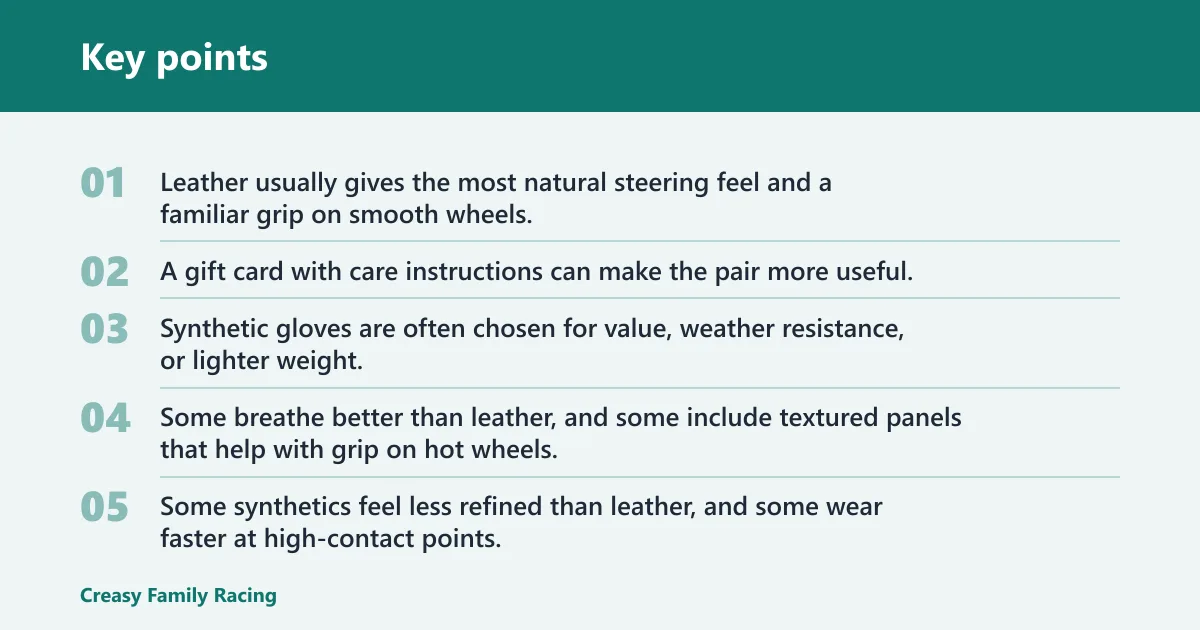
Leather usually gives the most natural steering feel and a familiar grip on smooth wheels. It also wears well if cared for properly. That makes it a strong choice for a gift when you do not know the recipient’s exact priorities, especially for street use or mild weather.
Care is straightforward but not optional. Leather needs cleaning and conditioning appropriate to the finish, and it should be kept away from harsh cleaners that dry the material. A gift card with care instructions can make the pair more useful.
Synthetic options for grip and lower cost
Synthetic gloves are often chosen for value, weather resistance, or lighter weight. Some breathe better than leather, and some include textured panels that help with grip on hot wheels. They can be a good option for daily drivers and sweaty-hands drivers.
The tradeoff is feel. Some synthetics feel less refined than leather, and some wear faster at high-contact points. If the recipient wants precise steering feedback, check whether the palm material is thin enough for that use.
Nomex for track-focused use
Nomex is often the more specialized choice for motorsport settings where fire-resistant gear matters. It suits track days, autocross, and other motorsport settings where fire-resistant gear is part of the use case. For a casual street driver, Nomex is usually more glove than needed.
It can be a thoughtful gift only when the recipient already uses performance gear. Otherwise, the fit, stiffness, and price may feel excessive for ordinary commuting.
Care needs and wear differences
Leather usually offers the best balance of longevity and steering feel, but it asks for more care. Synthetic gloves may be easier to maintain and can dry faster after sweaty use. Nomex is selected for function first, not for easy cleaning or broad everyday comfort.
Choose the material that matches how often the gloves will be worn. A weekend car pair can prioritize feel and finish. A daily-use pair should prioritize comfort, ventilation, and easy maintenance.
What works with different steering wheels?
Wheel surface changes the answer. Alcantara needs a gentler touch than smooth leather, and a leather wheel can tolerate a wider range of glove materials. The right pair gives grip without making the wheel feel abrasive or slippery.
Alcantara wheel compatibility
For Alcantara, choose a thin, soft glove that will not scratch or drag at the surface. Coarse seams, stiff palm panels, and rough exterior textures can wear the wheel faster than smooth materials. That is why low-abrasion construction matters more here than decorative detail.
Goal number one is preserving the wheel finish. A glove that feels aggressive in the hand can be a poor match for Alcantara even if it feels excellent on a leather wheel.
Leather wheel compatibility
Smooth leather wheels are more forgiving. Most leather and many synthetic gloves work well, provided the palm is not so thick that it dulls the wheel feel. If the recipient likes precise steering input, thinner gloves usually suit them better than padded ones.
Grip still matters. A glove that slides on a polished leather wheel can feel insecure, especially in hot weather or with sweaty hands. Texture, fit, and material all matter together.
Grip, abrasion, and tactile feel
There is a tradeoff between grip and wheel wear. More grip can help control, but rougher surfaces can abrade delicate wheel materials. Tactile feel usually improves as glove thickness decreases, though warmth and padding may fall with it.
For a gift, that means matching the glove to the wheel surface first, then to the season. If the wheel is Alcantara, protect the wheel. If the wheel is smooth leather, prioritize control and comfort.
Which details affect comfort and control?
Construction details change how the glove feels after ten minutes and after an hour. Seam placement, finger articulation, padding, and ventilation decide whether the glove disappears in use or keeps reminding the driver it is there.
Outseam versus in-seam construction
Outseam gloves place seams outside the hand-contact area, which can help improve comfort and reduce pressure during longer drives. In-seam gloves can feel cleaner and slimmer, but the seam ridges may be more noticeable on bare skin. For gifts, outseam construction is often easier to wear right away.
Finger articulation and palm shape
Articulated fingers follow the hand’s bend more naturally. That helps during repeated steering corrections and reduces bunching at the joints. A glove with a well-shaped palm also stays flatter on the wheel, which improves feel and reduces hot spots.
For a long-session driver, that matters more than a flashy finish. For a casual recipient, it still improves comfort enough to make the glove feel less fussy.
Padding versus steering feel
Padding can help in cold weather or on long drives, but it can also reduce precision. Too much bulk in the palm or across the fingers makes small steering inputs feel less direct. Thin gloves generally transmit wheel texture better.
If the gift is for track use, lean toward less padding. If it is for winter commuting, a little extra structure may be worth the tradeoff.
Ventilation for warm conditions
Perforations, open knuckle zones, or lighter backhand panels help with sweat management. That matters in hot weather, humid climates, and cars with strong cabin heat. Better airflow keeps the glove from feeling sticky and can reduce the urge to remove it mid-drive.
For sweaty-hands drivers, ventilation can matter as much as material choice. A breathable glove with a close palm fit usually beats a heavier pair with more insulation.
How much should you spend?

Spend based on use, not on price alone. Entry-level pairs are fine for light street use and style-first gifts. Mid-range gloves usually offer the best balance of fit, finish, and longevity. Premium pairs make sense when the recipient is picky about steering feel or uses them often.
Entry-level price band
Entry-level gloves are the place to start for a budget-conscious gift or a casual driver. They can be a smart value if the recipient wants basic grip and a cleaner look more than specialized features. Expect simpler materials and less refined seam work.
Mid-range price band
Mid-range pairs often give the best value versus longevity. They are more likely to have better leather, cleaner stitching, and more thoughtful shaping than very cheap options. For most gift buyers, this is the safest budget band because it covers a broad set of use cases without pushing into specialty pricing.
Premium price band
Premium gloves make the most sense for a recipient who cares about fit, materials, or a particular driving discipline. They may offer better leather selection, finer construction, or track-oriented materials like Nomex. The higher price should buy better fit consistency and more durable wear, not only a fancier look.
Value versus longevity
Value is not the same as the lowest price. A cheaper pair that stretches badly or fits the wheel poorly becomes an expensive mistake. Longevity comes from material quality, construction, and getting the fit right the first time.
- Check the use case first. Decide whether the recipient drives daily, on weekends, in winter, or at the track. That choice narrows the material and construction options before you look at color or trim.
- Measure or estimate size. Use a tape measure if you can, then compare the result to the brand’s chart. If sizing is uncertain, favor a retailer with a clear exchange policy.
- Match the wheel surface. Choose softer, low-abrasion gloves for Alcantara and thin, grippy gloves for smooth leather wheels. This reduces wear and improves control.
- Set the budget band. Choose entry-level for light use, mid-range for the best balance, and premium for frequent use or specialized needs. This keeps the gift aligned with longevity expectations.
- Confirm return flexibility. Keep the packaging clean and check whether the seller allows size exchanges. That matters most when you do not know the exact hand shape in advance.
Picture a recipient who drives a daily commuter with a leather wheel and tends to get sweaty palms in summer. A thin perforated leather glove with a snug palm and close finger fit is a better gift than a thick lined pair, because it preserves steering feel and cuts down on slipping.
Say the recipient has an Alcantara wheel and only wants gloves for weekend drives. A soft, low-bulk leather pair with smooth seams is the safer gift than a padded fashion glove, because the wheel surface is the part most likely to suffer damage.
Frequently asked questions
How do I choose driving gloves as a gift?
Start with the recipient’s driving environment: street, winter commuting, track use, or hot-weather driving. Then match the material to that use, check the wheel surface, and use the manufacturer’s size chart if you can estimate hand size. The right gift balances fit, grip, and the amount of steering feel the driver wants.
What size driving gloves should I buy as a gift?
Measure hand circumference around the widest part of the hand and compare it to the brand’s chart. If you cannot measure, buy from a seller with a clear exchange policy and avoid oversized gloves. A snug fit is usually better than a loose one because loose gloves shift and reduce steering precision.
Should driving gloves be leather or Nomex for a gift?
Choose leather for most gifts because it offers broad usefulness, good steering feel, and a familiar look. Choose Nomex only if the recipient already uses track gear or needs a motorsport-focused glove. For everyday driving, Nomex usually adds cost and stiffness without adding much benefit.
Are fingerless driving gloves a good gift?
Sometimes, but only for a style-first recipient or very warm-weather use. Fingerless gloves reduce coverage and can leave seams or edges exposed where the hands contact the wheel. If the recipient drives long distances, in winter, or on a delicate wheel surface, full-finger gloves are usually the safer choice.
What driving gloves work with an Alcantara steering wheel?
Choose soft, thin gloves with smooth seams and low-abrasion palm material. Avoid coarse textures, bulky padding, and rough stitching that can wear the wheel surface. The goal is gentle grip and clean contact, not maximum texture or heavy reinforcement.
How do I know if driving gloves will fit safely and comfortably?
The glove should feel snug across the palm, close at the fingertips, and secure at the wrist without cutting off movement. If the fingers bunch or the palm folds when the hand closes, the fit is off. A proper fit keeps control high and avoids pressure points during longer drives.