Does Car Insurance Cover Track Days?
No, a normal car insurance policy usually does not cover track days, HPDE sessions, or other closed-course driving unless the insurer explicitly adds that use. If you assume it does, you can face a denied claim, large repair bills, or a total loss with no payout. This guide explains the road-use split, the common exclusions, and the checks that tell you when you need track day cover.
Does car insurance cover track days?
Usually, no. Standard auto insurance is written for normal road use, and many policies exclude HPDE events and other closed-course driving. If the event is outside the policy wording, a claim can be denied even when the car was insured for street use that same morning.
HPDE matters because it is education-focused, not racing, but the coverage question still turns on event type and policy language. A street policy may still apply on the way to the circuit, then stop once the car enters the track environment.
Where road use ends and track use begins
The split is simple: public-road driving and closed-course driving are treated as different risks. The normal commute, errands, and highway travel are the kinds of use most personal-auto policies are built around. A timed session, parade lap, or instructional run on a circuit is a different exposure.
That difference matters because the insurer is not judging only the car. It is judging where the car is used, how it is driven, and whether the activity fits the policy terms. If the policy excludes track use, the claim gap appears before the first lap.
Why HPDE is not the same as racing
HPDE stands for high-performance driver’s education. It is training-oriented, but it still takes place on a closed course. That is why many insurers treat it separately from normal road driving and separately from competitive sessions with timing or race rules. (Wikipedia)
Do not blur those categories. An education session may be eligible for specialist cover, while a timed or competitive session may fall outside it. The event format can change the answer even when the venue is the same.
Where standard cover stops
Most standard auto insurance policies exclude HPDE events. That exclusion is usually written into the policy itself, not left to interpretation. Physical damage claims are the first place owners find the problem, but liability terms can differ too.
Specialist track-day insurers such as RLI separate street use from event use for this reason. Their HPDE wording is a good model of how the market handles the split: one policy for public roads, a different policy for a specific closed-course event.
Policy wording that creates the gap
Look for wording that excludes driving on a race track, competitive event, speed contest, or closed-course use. The exact phrase changes by insurer, but the result is similar. If the event falls inside an exclusion, the policy may respond to the road trip there and then stop at registration.
That is why “I have full coverage” is not enough. Full coverage on public roads does not mean the same thing on course. Read the exclusions before you pay the event entry fee.
Why physical damage claims often fail on track
On-track losses often involve the car itself: body damage, suspension damage, a bent wheel, or a spun engine after a missed shift. Standard auto insurance often excludes that kind of use entirely. When the exclusion applies, the claim fails even if the damage happened during a beginner-friendly session.
Track organizers also often reserve the right to pass along damage, cleanup, or recovery costs. That exposure can sit outside your own repair bill and become a separate charge from the circuit or operator.
How liability terms can differ from road driving
Liability on a closed course is not automatic. Some track day policies protect physical damage only, not liability. That means a policy can help repair your car while leaving injury or property claims outside its scope unless the wording says otherwise.
Check the liability section before you register. If the policy does include liability, the limits matter as much as the existence of the coverage.
What track day insurance usually covers
track day insurance is usually separate from normal auto insurance. It is often written as single-event coverage and is aimed at physical damage to your personal car. RLI says it offers single-event coverage for HPDE events, covers damage to your personal car on track, and applies while the car is on track and in the paddock.
That means event-specific protection, not a replacement for street insurance. It may stop at property damage. Some policies include no liability protection at all.
Single-event policies and why they matter
A single-event policy fits a one-day HPDE or a short weekend session. That can make sense if you do not plan to drive on track often, or if you want coverage only for a specific car and date. It can also keep the cost tied to one exposure instead of a year-round policy.
Single-event cover does not mean broad cover. It means the policy is tied to one event, one set of terms, and usually one kind of use.
What physical damage coverage usually means
Physical damage coverage is meant to pay for damage to the car itself. It does not automatically pay liability claims, and it may exclude some components or scenarios. That is where the fine print matters most, because the part that fails is not always the part the policy covers.
Track-day insurers and event specialists commonly draw hard lines around wear items, mechanical failure, and race-related loss. That includes losses tied to brake heat on track, overheated fluids, or failures that happen after sustained high-load use.
Does track day insurance include liability?
Sometimes, but not always. The same source says its coverage protects physical damage only, not liability. That means you should never assume the policy will cover injury to a passenger, damage to another car, or property claims unless the wording says so clearly.
Ask for the liability wording in writing before you register. The limit, the named insured, and any event-specific conditions all matter.
How much is track day insurance?
Track day insurance pricing is not standardized. The premium usually depends on the car’s value, the deductible, the track day format, the event length, the vehicle’s modifications, the driver’s experience, and whether the policy covers only physical damage or adds extra protections. A more expensive car and a lower deductible usually increase the price.
Insurers also look at event risk. A single-day HPDE, a weekend event, a timed session, and a higher-speed track all can price differently. The best way to compare quotes is to compare the same event, the same agreed value, and the same deductible.
What changes the price most
Car value is one of the biggest drivers because the insurer’s potential payout is larger on a higher-value vehicle. Deductible choice also matters: a lower deductible usually costs more, while a higher deductible usually costs less. Vehicle eligibility, driver limits, and whether the policy applies in the paddock can also affect the quote.
Modifications can matter too. A vehicle with track-focused changes may be priced differently, or it may be excluded altogether if the insurer considers it non-eligible.
Track day decision table
Use this checklist before you sign up. It separates event type, policy type, likely coverage status, common exclusions, and the questions that should be answered by the insurer and the circuit before you pay.
| Event type | Policy type | Likely coverage status | Common exclusions | Questions to ask before registering | Register / do not register yet |
|---|---|---|---|---|---|
| Street driving only | Standard auto insurance policy | Usually covered on public roads only | Closed-course use, HPDE, racing, speed contests | Does the policy exclude any track or course use at all? | Register if the trip is street-only and the policy wording is clear. |
| HPDE event | Standard auto insurance policy | Often excluded for track use | Physical damage on track, liability for course incidents | Does the policy exclude HPDE by name or by event type? | Do not register yet until you confirm whether the policy excludes HPDE. |
| HPDE event | Track day insurance | Often covers physical damage to the personal car | Liability may be excluded; engine, transmission, wheels, tyres; fire; recovery costs | Is liability included? Are paddock, recovery, and closure charges covered? | Register if the policy matches the event and the exclusions are acceptable. |
| Timed or competitive session | Track day insurance | May be ineligible | Competition use, racing, timing, instruction rules, secondary drivers | Is this event eligible, or is it excluded by format? | Do not register yet until the insurer confirms eligibility in writing. |
| Paddock or loading area | Track day insurance | May be covered by some policies | Parking damage, loading damage, unlisted exposure | Does coverage apply in the paddock and during loading or unloading? | Register if paddock and loading/unloading exposure are clearly covered. |
| Instructor driving your car | Track day insurance | May be allowed only if named or approved | Unlisted drivers, non-approved instruction, event rule violations | Is the instructor covered as a driver under the policy and event rules? | Do not register yet unless the policy allows instructor driving. |
| Passenger riding along | Track day insurance | May be limited or excluded | Passenger injury, seat-instructor limitations, waiver conflicts | Are passengers allowed, and does coverage change when one is in the car? | Register only if passenger rules and coverage are both clear. |
| Loading and unloading the car | Track day insurance | May be covered by some policies | Ramp damage, trailer damage, parking-lot damage, unlisted exposure | Does coverage begin before the car reaches the track and end after loading? | Do not register yet until loading and unloading are covered clearly. |
| Modified or non-eligible vehicle | Track day insurance | May be excluded | Heavy modifications, non-eligible model, motorcycle use | Is the vehicle eligible as modified, and does the policy exclude certain builds? | Do not register yet until the insurer confirms vehicle eligibility. |
What should you check before registering?
Check the event type first, then the policy wording. If the event is HPDE, confirm that the insurer treats it as eligible use and that the policy is written for that kind of event. Then check the deductible, exclusions, paddock language, and any circuit charges that could fall on you.
That order matters. Buying cover before reading the event rules can leave you with a policy that looks useful but does not fit the actual session.
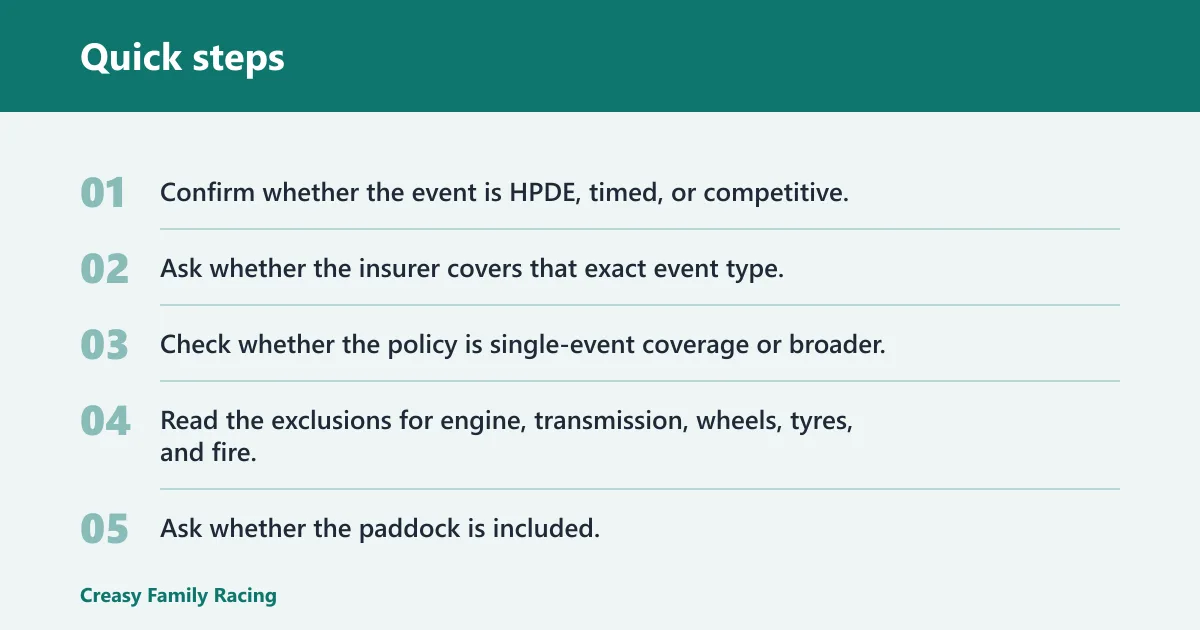
- Confirm whether the event is HPDE, timed, or competitive.
- Ask whether the insurer covers that exact event type.
- Check whether the policy is single-event coverage or broader.
- Read the exclusions for engine, transmission, wheels, tyres, and fire.
- Ask whether the paddock is included.
- Ask about recovery costs and circuit operator charges.
- Check the deductible and decide whether the price matches your risk tolerance.
- Confirm whether instructors, passengers, or secondary drivers are covered.
- Verify vehicle eligibility, including any motorcycle restriction.
- Read the event disclaimer or waiver before you sign.
Deductibles and cost trade-offs
The deductible is the part you pay before the policy responds. A higher deductible usually lowers the premium, while a lower deductible usually raises it. The right choice depends on how much loss you can absorb if the car is damaged in one session.
Do not choose the deductible from the premium alone. A cheap policy with a deductible that is too high for your budget may not help in a real loss.
Paddock, recovery, and operator charge questions
The same source says its coverage applies in the paddock, but not every policy does. Ask where the protection starts and stops: in the garage, in the loading lane, in the paddock, or only once the car is on track. That boundary matters for door dings, loading incidents, and low-speed mishaps.
Track organizers may also assign towing, cleanup, barrier, or surface-repair costs to the driver after an incident. Ask the circuit who pays for recovery, spill cleanup, and any damage assessment before the event starts.
Vehicle eligibility and who can drive
Eligible vehicles can vary by insurer. The same source says its policy does not offer motorcycle coverage, so do not assume a policy written for cars also fits a bike. Ask whether your car is eligible, whether modifications change that answer, and whether the person driving it must be named on the policy.
A common mistake is to assume a policy covers a loaner hatchback at a track day without checking whether the person behind the wheel is actually listed and approved. If an instructor or secondary driver will take the wheel, confirm that the policy allows it before the event starts.
What happens if you crash with no special cover?
If you crash on track without special cover, you may be paying for repairs yourself. That can mean bodywork, suspension, glass, tires, alignment, or a total loss if the damage is severe. If the policy excludes track use, the claim can be denied even when the car was insured for the drive to the venue.
Waiver language does not change that result. A waiver can limit claims against organizers, but it does not replace insurance or erase your own repair exposure.
What a waiver can and cannot do
Event waivers often limit what you can claim against the organizer and may shift more responsibility to the driver. They do not create insurance coverage and do not guarantee payment for your car. If the waiver also mentions towing, cleanup, or surface repair, treat those as real possible costs.
Read the waiver with the same care you give the policy. If the circuit shifts cleanup, barrier, or recovery costs to the driver, that should be clear before you sign.
Why instructor driving and passenger rules matter
If an instructor drives your car, ask whether that person is covered under the policy and event rules. The same is true for passengers. Some policies limit who may drive, how the car may be used, and whether laps with an instructor change the eligibility of the claim.
Suppose your car is a 2019 hot hatch with fresh brake pads and a standard street policy. If an instructor takes one lap and the car slides off into a tire barrier, the claim question is not only about damage. It is also about who was driving, what event was running, and whether the policy allows that use.
Can insurance companies track your vehicle?
Sometimes, but that is separate from track-day claim coverage. Many insurers use telematics, app-based driving data, or vehicle GPS features for pricing, safety, or claims review on ordinary road policies. That does not mean the insurer automatically “tracks” your car for a HPDE claim or provides track-day protection because the car is connected.
In other words, vehicle tracking and track-day coverage are different issues. A connected-car feature may show mileage, braking, location, or driving behavior on a street policy, but it does not turn a normal auto policy into closed-course coverage. Check the policy wording for track use first.
Frequently asked questions
Does my car insurance cover track days?
Usually no. Most standard auto insurance policies exclude HPDE and other closed-course driving, so the claim may be denied if the damage happens on track. Check the exact wording before you register, because road use and course use are often treated differently.
Can I use regular auto insurance at an HPDE event?
Usually not for the event itself. The same source says most standard auto insurance policies exclude HPDE events, and that is the practical rule to follow. Your street policy may still apply on public roads, but it usually ends once the car is being used on the course.
What does track day insurance actually cover?
Track day insurance usually covers physical damage to your personal car. The same source says its single-event coverage applies to HPDE events and covers the car on track and in the paddock. It does not automatically mean liability, so read the policy for what is excluded.
Can I buy track day insurance for a single event?
Yes. The same source says it offers single-event coverage for HPDE events. That structure makes sense if you want protection for one weekend or one session rather than a year-round policy. Confirm that the event type and vehicle are eligible before you buy.
How do deductibles work on track day insurance?
The deductible is the amount you pay before the policy responds. A higher deductible usually means a lower premium, while a lower deductible usually means a higher premium. Choose the level you can absorb if the car is damaged and the policy is triggered. (Healthcare)