What Do They Check in a Track Day Tech Inspection?
Track day tech inspection is usually a pass/fail check of a car’s safety items, fluid leaks, brakes, wheel condition, battery tie-down, throttle return, and loose hardware. Any major leak, bad tire, weak brakes, or unsecured battery is usually an immediate fail. Missed items can cost you the entry fee and your first session. This guide lists what inspectors check, what fails on sight, and what to fix before you leave home.
How tech inspections separate safety and rules
Track day tech inspection checks whether the car is safe to go on track and, at some events, whether it meets class or event rules. Safety tech and rules tech are separate jobs. A car can be mechanically fine and still fail for the wrong helmet, wrong tire, or missing paperwork.
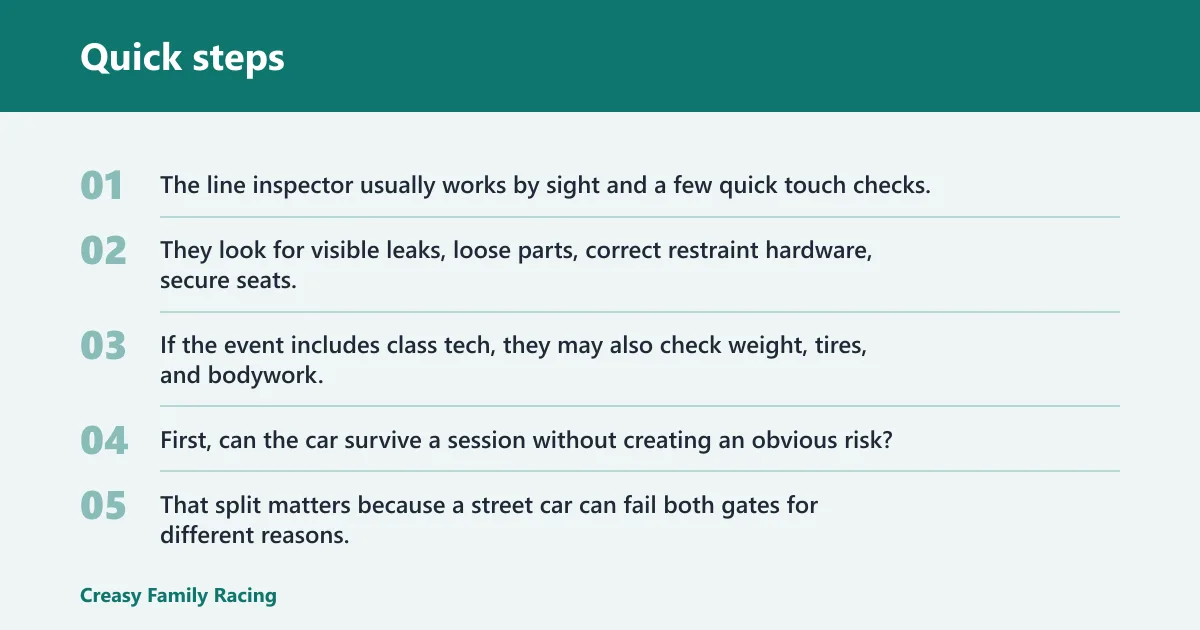
The line inspector usually works by sight and a few quick touch checks. They look for visible leaks, loose parts, correct restraint hardware, secure seats, and gear that matches the organizer’s date and rating rules. If the event includes class tech, they may also check weight, tires, and bodywork.
Think of it as two gates. First, can the car survive a session without creating an obvious risk? Second, does it fit the event rules? That split matters because a street car can fail both gates for different reasons.
Track tech matrix
| Inspection item | What the inspector checks | Common fail conditions | Fix on-site or return later? |
|---|---|---|---|
| Helmet | Current accepted rating, intact shell, usable strap and liner | No accepted sticker, expired by organizer rule, cracked shell | Return later if the rating is wrong or expired |
| Harness or belts | 5-, 6-, or 7-point layout, secure mounting, correct belt routing | Loose anchors, twisted webbing, incorrect mounting, worn labels | Usually return later if mounting or date is wrong |
| Seat | Solid mounting, no rocking, belts route through the correct openings | Wobble, poor bracket fit, wrong belt path, damaged shell | Return later if the seat or mounts need hardware changes |
| Window net | Present where required, latches correctly, webbing condition | Missing net, broken latch, frayed or sun-rotted webbing | Usually return later unless a spare net is already installed |
| Fire bottle or suppression system | Secure mount, charged status, in-date tag or bottle date | Loose mount, low charge, expired date, damaged plumbing | Return later if it needs service or recertification |
| Roll cage or roll bar | Correct tube size for the car’s weight, sound welds, no cracks, padding on reachable tubes | Visible cracks, poor welds, no padding on contact points | Return later for structural defects |
| Fuel system | Lines secured, no seepage, venting matches event rules | Leaks, loose hose routing, damaged venting, unsecured cell | On-site only for a minor clamp issue if the leak is fully fixed |
| Brakes | Pad thickness, rotor condition, fluid age or condition, pedal firmness | Thin pads, cracked rotors, dark or old fluid, soft pedal | Return later if pads, fluid, or parts need service |
| Tires and wheels | Legal type and size, tread and sidewall condition, lug tightness | Sidewall damage, cord exposure, wrong size, loose lugs | Loose lugs may be corrected on-site; damaged tires need return later |
| Battery and loose items | Battery hold-down, terminals, cargo area, cabin, trunk, and floorboard items | Unsecured battery, tools rolling around, loose floor mats, stray hardware | Usually fixable on-site if you can remove or secure the item |
| Throttle return | Pedal returns freely and snaps back without sticking | Binding cable, stuck pedal, slow return, interference from floor mat | Fix on-site if the cause is obvious and safe to correct |
| Paperwork | Registration, waiver, required forms, class or car-group paperwork | Missing signature, wrong class form, no waiver, no license if required | Usually fixable on-site only if the organizer allows it |
Say your street car arrives with new brake pads, but the fluid has turned dark and the pedal feels soft after a few pumps. The inspector may pass the car on parts condition alone and still fail it because the pedal response shows the system is not ready for track use.
Suppose the car has a clean exterior and no leaks, but one rear tire has a visible sidewall cut near the bead. That can stop the inspection on sight even if the tread is deep, because sidewall damage is a direct failure point.
What items will fail track day tech inspection?
Hard failures are commonly the items that stop a car before it reaches grid. Missing helmet acceptance, visible leaks, unsecured batteries, bald or damaged tires, and brake problems are the most common. A car can also fail for paperwork, belt dates, or class-rule violations even if the mechanical condition looks good.
The usual sight failures are obvious once you know what the inspector is watching. Frayed netting, loose belt anchors, missing seat bolts, cracked windshield glass in the driver’s line of sight, and dangling wiring all stand out quickly. The exact line depends on the event, but these are common stop signs.
Some failures are immediate because they point to a car that could shed parts, lose control, or create a fire risk. Others are date or rules problems that have nothing to do with how clean the car looks. That is why the event sheet matters as much as the car.
What gets checked visually at the line
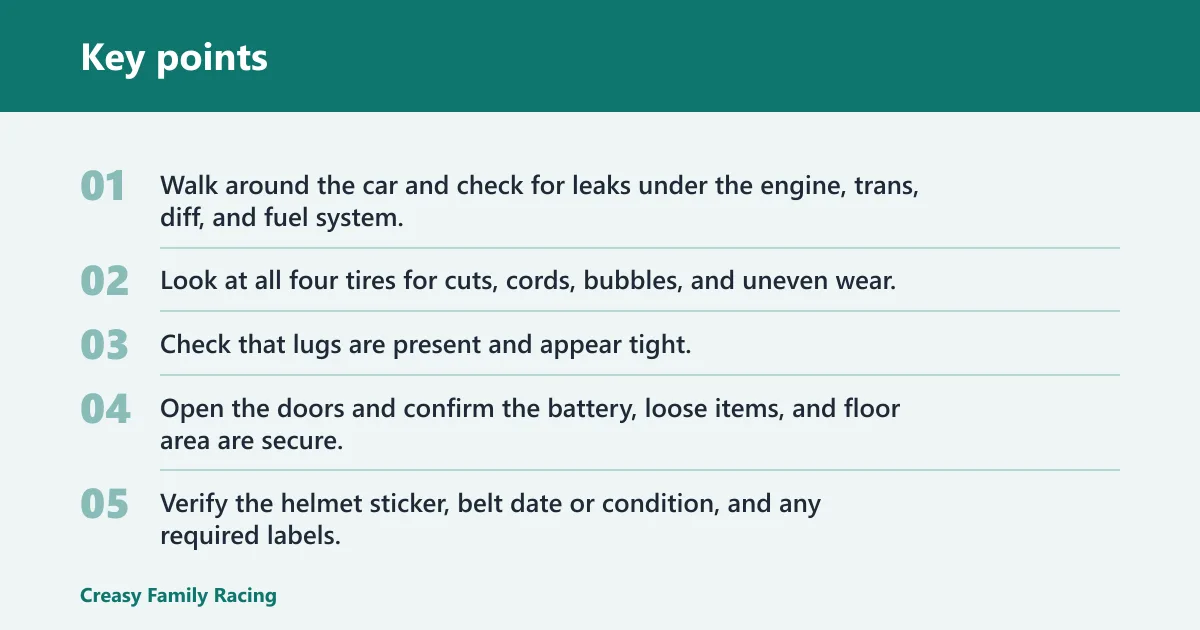
- Walk around the car and check for leaks under the engine, trans, diff, and fuel system.
- Look at all four tires for cuts, cords, bubbles, and uneven wear.
- Check that lugs are present and appear tight.
- Open the doors and confirm the battery, loose items, and floor area are secure.
- Verify the helmet sticker, belt date or condition, and any required labels.
- Test the window net latch, seat stability, and throttle return.
How strict is track day tech inspection for a street car?
A street car is often allowed, but it is not automatically safe or legal for track use. The stricter the event, the more the inspector will care about basic safety hardware, paperwork, and visible wear. Many street cars fail on simple issues such as old brake fluid, loose cargo, or an out-of-date helmet.
The common mistake is assuming a car that passes state inspection will pass track tech. That is not the same standard. Track tech usually cares less about emissions and more about whether the car can survive repeated high-load corners, heavy braking, and a quick emergency response.
Check the organizer’s rules before you show up. Some events are lenient with a stock interior. Others still want a net, fixed-back seat, or certain tire standards for faster groups.
Which helmet and paperwork do you need?
The helmet must carry a current Snell SA sticker or another rating the organizer accepts, and the helmet rules can change by event. Most organizers accept a Snell rating about a decade old. Snell recommends replacing a helmet after five years of use, so age matters even when the shell still looks fine.
Paperwork is usually a second gate. Bring registration, your waiver if it must be signed ahead of time, and any class or car-group form the organizer asks for. If the event requires a license or membership card, missing it can stop you before the car is even checked.
Belt and helmet date/rating checks
A driver restraint system is commonly a 5-, 6-, or 7-point belt setup, but it must be mounted correctly and the webbing date or expiration can matter. SFI Specification 16.1 limits restraint webbing life to two years. If the belts are frayed, twisted, or mounted at the wrong angle, that is a common fail.
The helmet check is faster but just as strict. Inspectors look for the sticker, obvious damage, and organizer acceptance. A helmet that is technically fine for one event may still fail at another if the rulebook is stricter.
Registration and class rules
Some events use tech to enforce more than safety. Rules tech can include weight, tires, and bodywork. A minimum weight example cited by some rule sets is 2,400 lbs, which shows why a car can be safe and still be wrong for its class.
That means the answer to paperwork is not always “bring a waiver.” Sometimes the inspector is also checking whether your car belongs in the group you signed up for.
What items fail the car itself?
Brake issues, tire damage, lighting damage, and loose interior items are common street-car problems. The inspector wants a car that can stop, turn, and stay intact for a session. If the problem is visible or obvious during a quick pedal or wheel check, it can fail immediately.
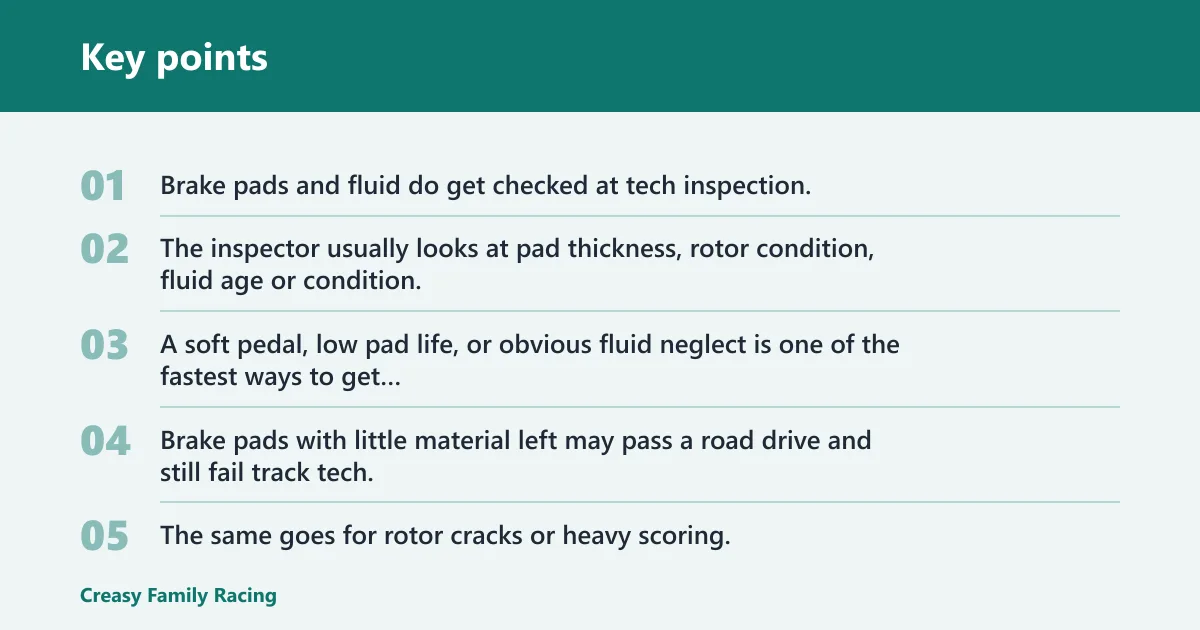
Brake pads and fluid do get checked at tech inspection. The inspector usually looks at pad thickness, rotor condition, fluid age or condition, and pedal feel. A soft pedal, low pad life, or obvious fluid neglect is one of the fastest ways to get sent home.
Brakes, fluid age, and pedal feel
Brake pads with little material left may pass a road drive and still fail track tech. The same goes for rotor cracks or heavy scoring. Fluid that is old enough to be dark or unknown in age is a common issue because brake heat rises fast on track.
The pedal check is simple. If the pedal sinks, feels spongy, or changes height when pumped, the inspector may call it unsafe. Even a street car with good pads can fail here.
Tires, wheels, lugs, and visible damage
Tires and wheels are checked for the correct type and size, sidewall damage, and loose lugs. Wrong size can be a rules problem. Damaged rubber is a safety problem. Loose lugs are often treated as an immediate stop because the wheel cannot be trusted.
Cracked wheels, bent rims, exposed cords, or tire bubbles are common sight failures. If the car uses spacers or wheel studs, those parts can draw extra attention when they look improvised or poorly fitted.
Windshield, lights, loose items, and battery hold-down
Can cracked windshield or lights fail track tech inspection? Yes, depending on the event rules and the location of the damage. A crack in the driver’s line of sight is more likely to draw a fail than a small chip at the edge, but rulebooks vary. Damaged lights can also fail if they are loose, sharp, or unsafe.
Loose items are a major street-car failure point. Floor mats, tools, spare parts, bottles, and anything in the trunk or cabin should be removed or secured. Battery tie-down matters too, because an unsecured battery can shift and short against metal.
How are belts, seats, nets, and fire gear checked?
These items are checked for fit, mounting, and condition. The inspector wants each piece to hold the driver in place and stay attached during a hard stop or impact. A loose mount or worn webbing can fail even if the rest of the car is clean.
A seat must be securely mounted, and the belts must route through the seat the way the system was designed to work. A fixed-back bucket seat that rocks, flexes, or forces a bad belt angle is a common fail. The seat and restraint have to work together.
Window net and fire system requirements
A window net must be present where required, must latch, and should not be sun-rotted. A frayed window net is a failure example. If the material has gone brittle or the latch will not hold, it usually needs replacement before the car can pass.
A fire bottle or suppression system, when required, must be securely mounted and in date. If the bottle is loose, the charge is low, or the date is expired, that is usually not a quick fix unless the event has a service station on site and the organizer allows it.
Seat security and belt routing
Inspectors often tug on the seat and look at the mounting hardware. They also check whether the restraint passes through the correct openings without twisting or rubbing badly. Wrong routing can be just as important as bad mounting because it changes how the restraint loads the driver.
Seat fit matters on stock and built cars alike. A seat that is not the right shape for the belts may still “fit” in the cabin and still fail the inspection.
What does a tech inspector look for under the car?
Under the car, the inspector looks for structural soundness, fuel security, and obvious mechanical problems. Roll cage or roll bar condition, fuel lines, and venting are the big items. Some organizers also check that the throttle returns freely and that nothing under the car is loose or dragging.
What the inspector is really asking is simple: will this car stay together during a session? A cracked tube, leaking line, or hanging hose says no.
Roll cage or roll bar condition
A roll cage or roll bar can be checked for correct tube size for the car’s weight, full-penetration welds, cracks, and padding on reachable tubes. If the tubing looks thin for the vehicle, the welds are rough, or a tube is unpadded where the helmet or limbs could reach it, the car can fail.
Padding is not cosmetic. It is there for contact points. If the driver or passenger can strike a tube in normal seating position, that area usually needs approved padding.
Fuel lines, vents, and leaks
The fuel system can fail for loose lines, seepage, bad fittings, or venting that does not match the rulebook. Even a small leak matters because heat and vibration can turn it into a larger problem on track. A fuel cell or line run that looks homemade without proper support is a common fail point.
Inspectors often follow the smell as much as the eye. If they can see damp hose ends, wet fittings, or fuel staining, the car may stop there.
Throttle return and quick safety checks
The throttle should return to idle cleanly when released. A sticking pedal, floor mat interference, or binding cable can fail the car in seconds. This is one of the easiest self-checks you can do before arriving.
Other quick checks include hood latches, trunk latches, and anything that could open or detach at speed. The line moves faster when these basics are already sorted.
Do I need to remove loose items before tech inspection?
Yes. Loose items should come out before you reach tech, because they are one of the easiest things to fail. Inspectors will look for floor mats, tools, bottles, cameras, spare parts, and anything in the cabin or trunk that can move under braking or cornering.
Even small objects can become problems if they roll under a pedal or fly forward in a stop. If you are unsure whether something counts as loose, remove it. That is the safer call and usually the quicker one.
Frequently asked questions
What does a track day tech inspection check?
It checks whether the car is safe for on-track use and, at some events, whether it fits class rules. Inspectors look at helmets, belts, seats, nets, fire gear, brakes, tires, wheels, leaks, battery hold-down, throttle return, and paperwork. The exact list depends on the organizer.
Will a check engine light fail track tech inspection?
Not always. A check engine light is not a universal fail point, but some organizers treat warning lights as a problem if they point to an active engine, emissions, or throttle issue. If the light is on, the safest move is to check the event rules before you arrive.
Do brake pads and fluid get checked at tech inspection?
Yes. The inspector usually looks at pad thickness, rotor condition, fluid age or condition, and pedal feel. Thin pads, cracked rotors, dark fluid, or a soft pedal can fail the car. Brake problems are among the most common reasons a street car does not pass.
Can cracked windshield or lights fail track day tech inspection?
Yes, depending on the event rules and where the damage is located. A crack in the driver’s line of sight is more likely to fail than a small chip at the edge, but organizers vary. Broken, loose, or sharp lighting parts can also fail if they create a safety issue.