Track Day Insurance: What It Covers and Costs
Track day insurance usually covers crash damage to your car during a covered event, with deductibles often around about 10% of the car’s insured value, and it tends to make the most sense when a total loss would be hard to absorb. Skip it, or miss an exclusion, and one off-track excursion, barrier hit, or mechanical-failure denial can leave you owing the full repair bill plus any loan or lease balance. This guide explains what policies cover, what they exclude, how claims are paid, and why quotes vary so much by car, driver, and event type.
What track day insurance actually
How event-specific track coverage works
Track day insurance is usually a short-term physical-damage policy tied to a named event, date, and track. It covers the insured car for that event use, not normal road driving, and it often applies only during the scheduled event window shown on the declarations page.
That narrow trigger matters. If the policy names a Saturday HPDE at Road America, the covered use is that event, at that venue, in that format. The drive there, the hotel parking lot overnight, or a separate open-lapping session the next morning may fall outside coverage unless the policy wording says otherwise.
Why it sits outside your regular auto policy
Many personal auto policies exclude damage arising from racing, speed contests, timed competition, or use at a racing facility. Some policy forms also exclude driver training or track use even when there is no timing and no wheel-to-wheel racing. That is why track day insurance is usually purchased as a separate policy rather than added to ordinary car insurance.
The coverage target is different too. Regular auto insurance is built around street liability, collisions on public roads, theft, weather, and similar losses. Track day insurance focuses on physical damage to your own car during a specific on-track event, often with no liability coverage for injuries or damage to the facility.
Which events it is built to insure?
The easiest events to insure are usually structured HPDE days with passing rules, point-by requirements where applicable, and an organizer with written safety procedures. Open lapping can still be insurable, but rates may rise if the format allows looser passing or mixed-speed groups.
Timed formats change the risk. Time trial, time attack, autocross at a speedway facility, and wheel-to-wheel racing are often treated differently or excluded outright. Two events at the same track can price very differently because the insurer is rating the event format, not only the pavement.
What does track day insurance cover?
Track day insurance usually covers sudden physical damage to the insured car during a listed event, including impacts, rollovers, barrier contact, and some fire losses. In practice, that means an actual covered incident must happen during approved event use, and any approved payment is still reduced by the deductible.
Collision, rollover, and barrier contact
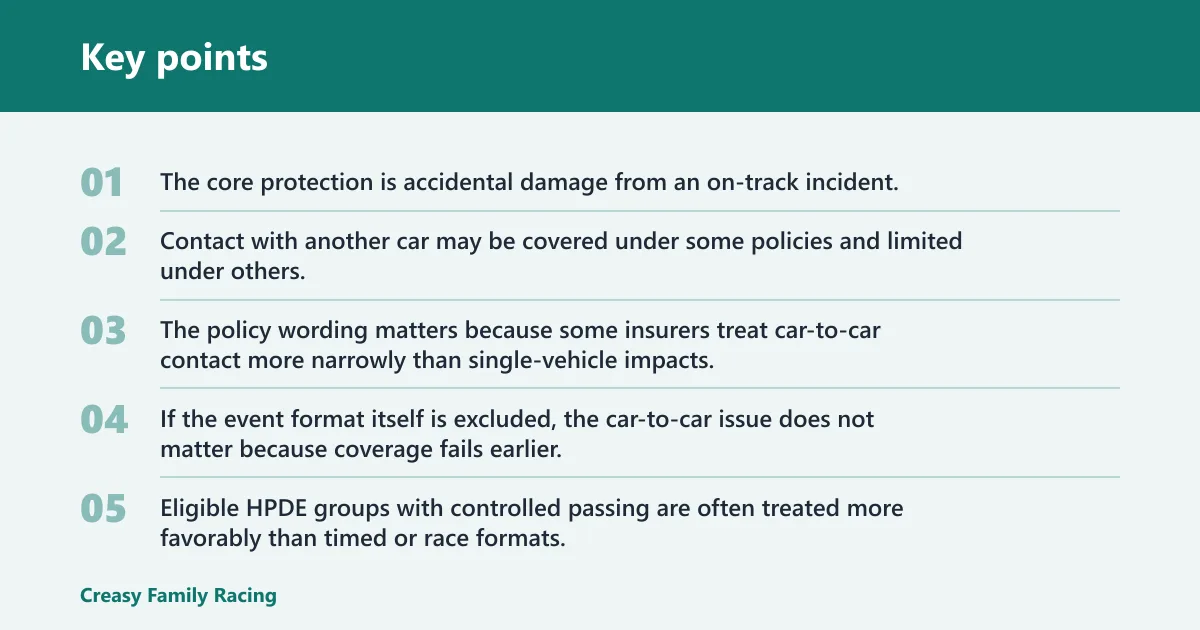
The core protection is accidental damage from an on-track incident. That usually includes hitting a tire wall, Armco, concrete barrier, or another covered object, as well as damage from a rollover after a spin or off-track excursion.
Contact with another car may be covered under some policies and limited under others. The policy wording matters because some insurers treat car-to-car contact more narrowly than single-vehicle impacts. If the event format itself is excluded, the car-to-car issue does not matter because coverage fails earlier.
Fire and other covered physical damage
Fire can be covered when it follows a covered incident or starts during covered event activity in a way the policy accepts. For example, a fuel-fed fire after barrier impact is a very different claim from an engine fire tied only to a mechanical failure the policy excludes.
Some policies also cover direct physical damage in paddock or staging areas during the event period, but that is not automatic. A windshield broken by track debris while circulating may fit as collision-related damage, while glass damage found later without a clear incident record can be much harder to prove.
When contact with another car is covered
Eligible HPDE groups with controlled passing are often treated more favorably than timed or race formats. Insurers want to see an instructional or non-competitive structure because that changes expected claim frequency and severity.
Suppose two cars in an advanced HPDE session touch mirrors while one attempts a point-by pass, and one car then backs into a barrier. A policy may still respond if that session format is covered and the incident report confirms the sequence. The same facts in a wheel-to-wheel race would usually be excluded.
What does track day insurance not cover?
Track day insurance usually excludes mechanical breakdown, wear-related failures, overheating, and damage that happens outside the covered event window or event format. In plain terms, most policies will not pay for a blown engine, worn-out brakes, a denied timed session, or damage in the paddock or parking area unless those uses and locations are specifically included.
Mechanical failure, wear, and maintenance-related damage
This is where many denied claims begin. A spun rod bearing, broken differential, cooked clutch, overheat event, or engine failure with no covered collision is typically excluded as mechanical breakdown or wear and tear.
The line can get sharp after a crash. If the car strikes a barrier and the radiator ruptures, resulting overheating damage may be tied to the covered collision. If the engine overheats first, drops coolant, and then stops with no impact, that usually stays an uncovered mechanical loss.
Picture a curb strike that bends a wheel and cuts a tire, then the driver continues and the engine later overheats after a coolant hose pulls loose. The wheel and tire damage may fit the covered impact. The later engine damage may be disputed unless the repair record shows it directly flowed from the insured incident.
Excluded driving behavior and illegal use
Policies often exclude intentional acts, fraud, alcohol- or drug-related losses, and use in violation of event rules or law. If the organizer black-flags a driver for passing under yellow and the loss occurs during that conduct, the claim can become much harder to support.
Insurance also is not permission to ignore trackworthiness requirements. Bald tires, loose battery hold-downs, active fluid leaks, or failed brakes can support an argument that the loss came from maintenance neglect rather than an accidental covered event.
Off-event, off-policy, and off-track gaps
Coverage usually starts and ends on the policy schedule, at the named venue, for the accepted event type. Damage while loading the car onto a trailer at home, a theft from the tow rig overnight, or a parking-lot dent at a restaurant after the event is usually a separate insurance issue.
Off-track areas inside the facility can go either way. Some policies cover the paddock during event operations, while others are much narrower. If a golf cart backs into your quarter panel in the paddock, the answer depends on the wording, not simply on the fact that it happened at the track.
Track day insurance matrix
Coverage and out-of-pocket examples
The table below maps common scenarios to likely outcomes under a typical event-day physical-damage policy. Use it to identify the main decision points: what triggers coverage, which exclusion often controls the result, and how the deductible and non-covered items affect what you actually pay.
| Scenario | Likely coverage status | Likely exclusion or decision point | Deductible and out-of-pocket impact |
|---|---|---|---|
| Barrier contact in HPDE | Often covered if the event and session are listed | Denied if the event format is excluded or the driver was in an excluded timed session | On a $40,000 agreed-value policy with a 10% deductible, the first $4,000 is your responsibility; the premium is a sunk cost. |
| Spin with no impact | Usually not payable | No direct physical damage, so no covered loss to adjust | $0 insurance payment; tire flat-spotting or heat damage stays with you |
| Curb strike bending a wheel | Often covered as impact damage | Related alignment wear, old tire condition, or later mechanical issues may be excluded | If repair is $2,200 and deductible is $4,000, the claim may pay nothing and still count as a loss notice |
| Off-track excursion into grass, then barrier | Usually covered if the barrier impact causes damage during a covered session | Surface damage from dirt ingestion or overheating after continuing to drive may be disputed | You pay the deductible plus any engine damage the insurer ties to mechanical failure rather than collision |
| Fire after crash | Often covered when the fire follows a covered impact or rollover | Engine-bay fire from pure mechanical failure may be excluded | Total-loss payment is reduced by the deductible and by valuation terms if the policy is not true agreed value |
| Tow after mechanical failure | Often not covered under physical-damage only forms | Mechanical breakdown and related transport are commonly excluded unless towing is added | You may pay the full tow bill plus all repairs, even though the incident happened during the event |
| Windshield damage from debris on track | Sometimes covered, sometimes limited | Glass may require a documented incident; pitting and wear are excluded | Small glass claims often fall below a percentage deductible, making insurance poor value for this loss alone |
| Parking-lot damage at the venue | Mixed; depends on whether paddock and parking are included in covered premises and time | May be outside the event-use trigger or left to another policy | Even if covered, a 10% deductible can exceed a minor dent repair, so the check may be $0 |
How much is track day insurance?
Track day insurance pricing usually moves most on insured vehicle value, event type, track, deductible, and driver profile. One-day policies can range from a relatively modest premium for a lower-value street car in a standard HPDE to a much steeper premium for a high-value or heavily modified car in an open-lapping or timed format.
What changes the premium the most
Insurers generally start with the car and the event. Year, make, model, insured value, modifications, and replacement-cost exposure all affect the rate. So do the organizer, track, event duration, and whether the format is novice HPDE, open lapping, time trial, or racing.
Driver inputs matter too. Prior track-day count, competition history, claims history, and experience level can all affect whether a quote is even offered. A novice in a 600-horsepower build at a fast, high-consequence circuit is a different risk from an intermediate driver in a stock coupe at a slower venue.
What one-day coverage usually reflects
The premium buys a narrow form of first-party damage protection for one event, not a year of broad auto coverage. That is why a one-day quote can feel expensive in dollars while still carrying a percentage deductible that leaves meaningful exposure on the table.
A common rule of thumb is that moving from a 15% deductible to a 10% deductible raises premium while reducing out-of-pocket cost after a covered crash. On a $50,000 insured value, the deductible difference is $2,500. That is the gap you are effectively paying extra premium to reduce.
Why the same car can quote differently at different events
Event structure changes expected losses. A cleanly run HPDE with point-bys and separated groups is easier to rate than an open format with broad passing zones. Timed events usually push pricing higher or make the car ineligible because the pace and incentives change.
Say your $35,000 Camaro gets one quote for a one-day novice HPDE and a much higher quote for an open-lapping evening at the same track. The car did not change. The passing rules, traffic mix, and the insurer’s expected claim frequency did.
How deductible and car value change the payout
Common deductible structures and premium tradeoffs
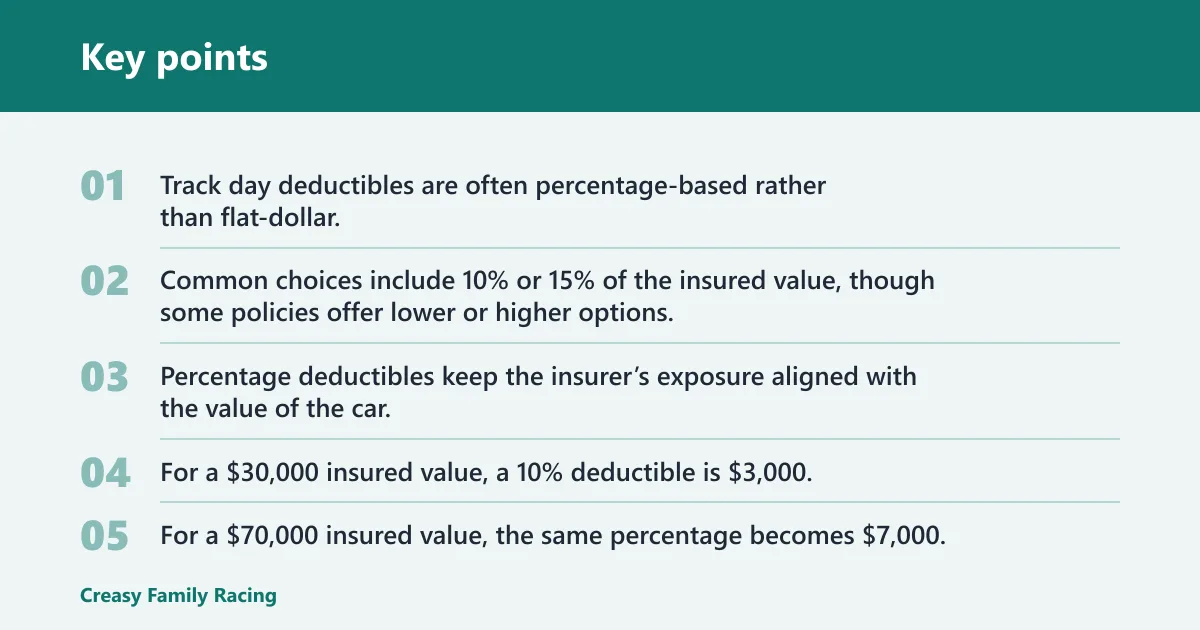
Track day deductibles are often percentage-based rather than flat-dollar. Common choices include 10% or 15% of the insured value, though some policies offer lower or higher options. Percentage deductibles keep the insurer’s exposure aligned with the value of the car.
For a $30,000 insured value, a 10% deductible is $3,000. For a $70,000 insured value, the same percentage becomes $7,000. That is why lower-value cars can make more sense to insure with a higher deductible, while expensive cars may justify more premium to reduce a very large out-of-pocket hit.
A lower deductible tends to make more sense when repair costs are likely to land in the middle ground between cosmetic damage and a total loss. A high-consequence track, a car with expensive carbon or aero parts, or a car with hard-to-source body panels can change that math fast.
Agreed value versus stated value
Agreed value means the insurer and insured settle on a value before the event, and that figure becomes the base for a total-loss payout, less the deductible and any applicable salvage terms. That setup is especially useful for modified cars or cars whose market value is hard to pin down from generic guides.
Stated value can look similar on a quote form but may not produce the same check. Some stated-value policies reserve the right to pay the lesser of the stated amount, actual cash value, or repair cost. When that wording appears, depreciation and market evidence can still reduce the payout.
For example, if a track car is insured at $28,000 on an agreed-value basis and suffers a covered total loss, a 10% deductible would put the starting settlement at about $25,200 before any other contract adjustments. If the policy is stated value with actual cash value language, the insurer may argue the car was worth less than $28,000 despite the figure on the declarations page.
Repairable loss versus total-loss settlement
For a repairable loss, the insurer usually pays the approved repair cost minus the deductible, subject to policy terms and any parts or labor limits. If repair cost plus salvage factors push the car beyond the carrier’s total-loss threshold under the contract, the claim shifts to a value-based settlement.
Your real cost is broader than the deductible alone. It includes premium paid, plus deductible, plus anything excluded, plus any gap between loan balance and settlement if the car is financed and the lender is owed more than the policy pays.
Which cars and events are eligible?
Eligibility depends on both the car and the event. Standard street cars in organized HPDE usually have the best chance of approval, while heavily modified builds, very high-value cars, timed formats, and wheel-to-wheel racing face tighter limits, exclusions, or outright declinations.
HPDE, open lapping, time trial, and racing differences
HPDE is often the most insurable because it is framed as education and skill development, usually with run groups and conduct rules. Open lapping can still qualify, but less structure may push pricing higher.
Time trial and similar timed formats are commonly restricted because the event goal shifts from instruction to setting a fastest lap. Wheel-to-wheel racing is usually excluded from consumer track day policies altogether and falls into a different insurance market, if it is insurable at all.
Street cars, modified cars, and value or age limits
Insurers often ask whether the car is street legal, whether it has a salvage title, what safety equipment is installed, and what modifications affect power, braking, aero, or suspension. A caged street car may be acceptable to one carrier and declined by another. Some carriers also set maximum insured values, minimum values, or age limits.
Trackworthiness matters. Recent brake fluid, secure seats and harnesses where used, and no known leaks are basic expectations. The policy is not a maintenance plan for a car that should have failed tech inspection.
Financed or leased cars
Financed and leased cars need extra care before you book the event, because the insurance policy and the finance contract solve different problems. A track day policy may allow the car, but the lender or lessor may still restrict track use.
If there is a loss, the lienholder is typically paid according to its interest. That can leave the driver short if the settlement after deductible is lower than the payoff amount. Leased vehicles are often the hardest fit because the lease may prohibit track use entirely, even in non-competitive HPDE.
How do you compare quotes before booking?
Compare quotes by lining up the event format, insured value method, deductible, covered premises, and exclusions before looking at premium. The cheapest quote can be the weakest if it shifts from agreed value to stated value, excludes paddock losses, or quietly declines the exact session type you plan to run.
The inputs insurers use
Expect to provide the car year, make, model, VIN, modifications, insured value, event date, track, organizer, session format, and driver background. If the car has expensive wheels, aero, data gear, or race seats, ask whether those parts are included in the insured value or treated differently.
Quote red flags that change the real protection
- Valuation is unclear, or the quote uses stated value without spelling out whether actual cash value can cap payment.
- The declarations page lists an event organizer or format that does not exactly match your registration.
- Paddock, pit lane, staging, or parking areas are not mentioned anywhere in the covered-use wording.
- Mechanical-fire scenarios are not separated from impact-related fire losses.
- The deductible is a percentage you did not convert into dollars before buying.
When a lower deductible is worth the extra premium
A lower deductible is easier to justify when your car value is high enough that a percentage deductible becomes painful in real dollars, or when the event is at a fast circuit where barrier damage can get expensive quickly. It also matters if you are financing the car and cannot easily cover both deductible and any settlement shortfall.
A common first-timer mistake is comparing only the premium and missing that a 15% deductible on a $60,000 car is $9,000. Saving a few hundred dollars up front can leave a five-figure bill after a moderate crash.
How does a track day insurance claim work after a crash?
After a track crash, the claim usually starts with prompt notice, scene documentation, and organizer paperwork, then moves to inspection, repair estimating, and settlement under the policy’s valuation and deductible terms. Fast, accurate reporting matters because delays can make cause-of-loss disputes harder to resolve, especially when mechanical damage follows an impact.
What to document at the track
- Get safe first. Follow corner-worker and organizer instructions, exit the car if directed, and stop any avoidable further damage. If the car can roll, do not restart or continue driving after a major impact when fluids, cooling, or suspension may be compromised.
- Photograph the scene. Take wide shots of the car position, barrier marks, runoff area, and any fluid trail, then close-ups of all visible damage. Include wheel, tire, glass, underbody, and interior safety equipment damage because those details help separate impact loss from pre-existing wear.
- Collect event records. Ask for the organizer incident form, session assignment, and any flagging or steward notes. If another car was involved, record the car number, driver name if available, and a short factual sequence without arguing fault at the track.
- Preserve data carefully. Save lap timer files, in-car video, and photos exactly as recorded. Data can help show whether the loss began with contact, a spin, or a pure mechanical issue, which is often the key coverage question.
Reporting deadlines and inspection steps
- Report the loss. Notify the carrier as soon as the policy requires, often the same day or within a short stated window. Give the date, track, event name, session, and a plain account of what happened.
- Submit documents. Send photos, the event incident report, registration confirmation, and any video or data the adjuster requests. Missing paperwork slows the claim and can create avoidable disputes over whether the event itself was covered.
- Arrange inspection. The insurer may inspect at the track, at a storage yard, or at a repair shop. If the car is not drivable, ask before authorizing major tear-down work beyond what is needed to prevent further damage.
- Review the estimate. Compare the repair estimate with the policy deductible in dollars, not percentages alone. If hidden damage appears after disassembly, the shop usually submits supplements, and the carrier decides whether the claim remains repairable or becomes a total loss.
How settlement and repairs are handled
Once coverage is confirmed, the carrier settles according to the policy form. Repairable losses are paid on approved repair cost minus deductible. Total losses are paid according to agreed value or the contract’s stated-value and actual-cash-value language.
If the car is financed, the lender may appear on the payment. If there is salvage, the policy may explain whether the carrier takes the car or whether owner-retained salvage changes the check amount. Read the full policy wording before you buy so you know how valuation, deductible, paddock coverage, fire exclusions, and salvage terms actually work before a crash forces the issue.
Frequently asked questions
How much does track day insurance cost for one day?
One-day cost depends mainly on the car’s insured value, the event format, the track, and the deductible. A standard HPDE for a lower-value street car can price far below the same day for a high-value or modified car, and timed events often quote much higher or are declined.
Do I need track day insurance for HPDE events?
If a total loss, large repair, or loan balance would be hard to absorb, HPDE coverage is worth serious consideration because personal auto policies commonly exclude track-facility use. If you can comfortably self-insure the full car value and accept that risk, you may decide to skip it.
Can I get track day insurance on a financed or leased car?
Sometimes, but policy eligibility is only half the issue. The lender or lessor may restrict track use, and a covered claim still may not pay enough to clear the payoff after the deductible. Leased cars are often the most difficult because lease contracts can ban any track use.
What deductible should I choose for track day insurance?
Choose a deductible you can actually pay in dollars, not just a percentage that looks manageable on paper. A 10% deductible is common, but on a $60,000 car that means $6,000 out of pocket before excluded damage, so a lower option can make sense if premium stays reasonable.
How is track day insurance different from regular car insurance?
Regular car insurance is built for public-road driving and often excludes racing facilities, track days, timed events, and similar use. Track day insurance is event-specific physical-damage coverage for the insured car during a named track event, usually with narrower triggers and higher percentage deductibles.
What is track insurance?
Track insurance is a short-term policy built around a specific motorsport or driver-education event and a specific car. For most buyers, it means physical-damage coverage for that car during the event, with exclusions for mechanical breakdown, maintenance issues, and non-approved event formats.