Track Tech Inspection: What It Is and How to Pass
Track tech inspection is a pre-session safety check of your car, helmet, and paperwork; to pass on the first try, every must-fix item has to meet the event’s posted rules before you reach grid. Miss it, and you can lose track time, entry fees, and the chance to drive until defects are corrected. This guide explains what inspectors check, what commonly fails, and a pre-check workflow that separates hard no-go issues from borderline fixes.
What track-day tech checks and why rules vary

A track tech inspection is an organizer-run safety review done before on-track driving, using that event’s rules rather than one universal standard. It is meant to catch defects that can put fluid, parts, glass, or an uncontrolled car on track, and it also checks that your helmet, clothing, and paperwork match the day’s requirements.
What tech is meant to catch
The point is simple: stop safety-critical cars and drivers before first session. Inspectors are looking for faults that can turn into lost braking, tire failure, steering looseness, fluid on the racing line, poor visibility, or a driver who lacks the required gear or signed forms.
That is different from a state roadworthiness sticker and different again from race scrutineering. A state inspection may care about emissions or registration details that a track-day organizer does not. A race series may care about cage design, fire systems, harness dates, and class rules that a novice lapping day never checks.
Why organizer rules control the final call
Track-day tech is not a government inspection. The organizer’s form, supplemental rules, and driver packet control final decisions, especially for helmets, convertibles, battery mounting, tow hooks, loose cabin items, and modified cars. If the event says Snell SA or M with a specific year range, that event-year acceptance rule matters more than general internet advice.
For contrast, commercial vehicle inspections do have fixed regulatory standards: annual DOT inspections are required at least once every 12 months, and the inspection standards live in Appendix A to Part 396. Track-day tech does not have a single national Appendix A equivalent, so reading the event sheet matters.
How strict is track tech inspection?
Track tech is strict on anything that can cause immediate danger and flexible on some borderline items that depend on the organizer, your run group, and the car’s setup. A soft brake pedal, exposed tire cords, or an active fluid leak often leads to a failed inspection; an old check-engine light or a small windshield chip may depend on the rules and the inspector’s judgment.
Hard fails versus borderline calls
Think in two buckets. Must-fix items are the ones that can fail on track in a way that affects control, braking, containment of fluids, or driver protection. Borderline items are defects that may be allowed, monitored, or rejected depending on where they are, how severe they are, and what the event says.
In inspection systems generally, brake problems consistently top out-of-service violations, out-of-adjustment brakes are described as the single most cited item, tires are a dominant inspection failure category, and lights are called one of the easiest violations to prevent. Track-day tech follows the same pattern in practice: brakes, tires, leaks, and dead bulbs get checked fast.
Why stock and modified cars are judged differently
A stock street car often has fewer variables. Factory seats, stock belts, stock suspension, and unmodified battery mounting reduce the number of things an inspector has to question. But stock does not mean automatic pass. Street pads overheated last month, old brake fluid, a cracked windshield in the driver’s view, or a tire with a shoulder cord can still stop the day.
Modified cars get more scrutiny because each change creates another fail point: coilover lock rings, ride-height clearance, wheel-stud engagement, race seats with stock belts, catch-can routing, power steering seepage, and battery relocation are all common examples. Novice groups may also be inspected more conservatively because the organizer has less information about driver pace and habits.
What do they check at tech?
Inspectors work through the same safety systems on most cars: brake pad and rotor condition, pedal feel, tire shoulders and sidewalls, lug security, wheel-bearing play, leaks, battery hold-downs, windshield damage, loose cabin items, driver gear, and required documents. The exact form varies, but the pass/fail logic stays centered on safety-critical items, visible damage, loose hardware, and whether the driver has the required gear and documents.
Brakes, tires, and wheels
Brakes get first attention for good reason. Inspectors will check pad thickness, rotor faces for cracks or deep scoring, calipers and hoses for fluid, and pedal firmness under pressure. Fluid age matters because old fluid boils more easily after repeated high-speed stops, even if the brakes feel normal in the paddock.
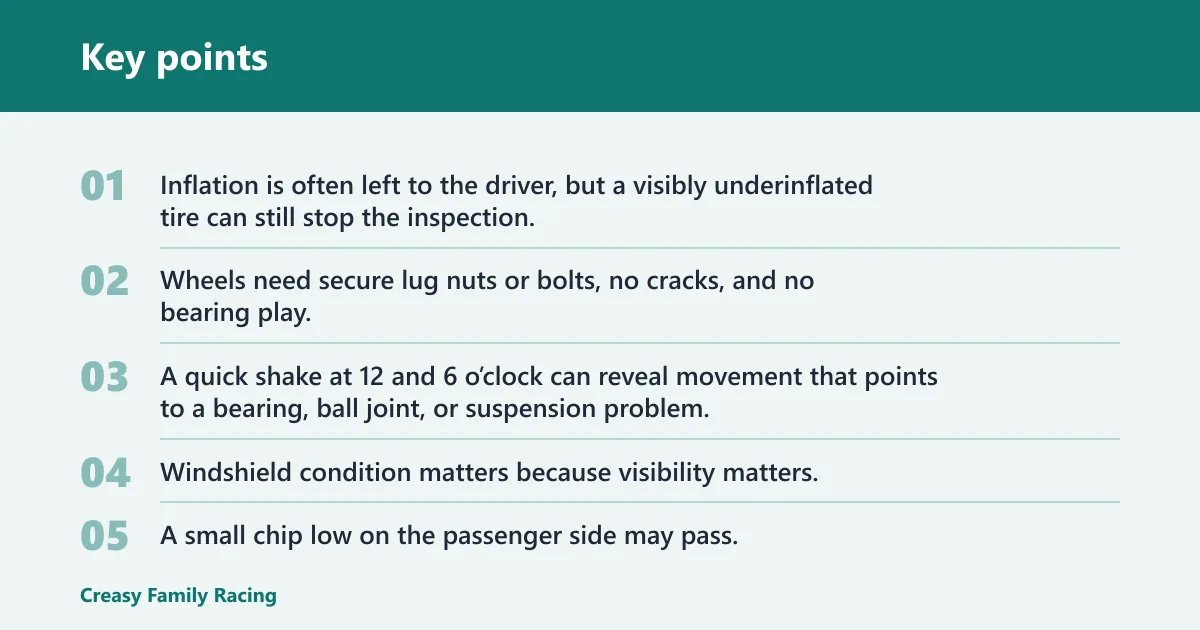
Tires are checked at the tread surface, inner and outer shoulders, and both sidewalls for low tread, exposed cords, cuts, bubbles, bulges, puncture repairs, and visible age cracking. A plug in the tread may be rejected by one organizer and allowed by another; a plug near the shoulder, exposed cords, or sidewall damage is much closer to an immediate fail. Inflation is often left to the driver, but a visibly underinflated tire can still stop the inspection.
Wheels need secure lug nuts or bolts, no cracks, and no bearing play. A quick shake at 12 and 6 o’clock can reveal movement that points to a bearing, ball joint, or suspension problem.
Suspension, steering, and chassis hardware
Expect checks for leaking dampers, cracked springs, loose coilover perches, torn bushings, and fasteners that look backed out or missing. Steering checks usually focus on free play at the wheel, tie rods, ball joints, rack boots, rack leaks, and power steering leaks where fitted.
If the wheel moves before the tires do, if the front end clunks over bumps, or if the car wanders under braking, tech may look harder at tie rods, lower ball joints, top mounts, and rack hardware. Any crack in a suspension arm, any unsecured sway-bar link, or any obvious metal-to-metal bushing failure belongs in the must-fix bucket.
Glass, lights, fluids, battery, and cabin
Windshield condition matters because visibility matters. A small chip low on the passenger side may pass. A crack spreading through the driver’s line of sight may not. Loose mirrors, film or stickers that block view, and side glass rules can also affect the answer.
Lights and signals vary by organizer, but many events want working brake lights and at least basic front lighting or secure taped-over lenses. Broken or loose lenses can fail if they can shed pieces on track. Fluids are checked for active leaks, loose caps, and overflow. The battery needs a proper tie-down. The cabin needs to be free of floor mats, tools, bottles, and any loose object that can become a projectile.
Helmet, clothing, and paperwork
Helmet approval is one of the most common administrative stops. The organizer may accept Snell SA, Snell M, or an equivalent standard, and the accepted year range can vary by event. Long sleeves and pants, closed-toe shoes, and restraint or HANS requirements for some cars belong on the same checklist.
Paperwork failures are less dramatic than a brake leak, but they still stop the day. Bring a driver license, the tech sheet if the event uses one, car number if assigned, and registration or insurance if the organizer asks for them. Many events also gate access with a waiver and wristband process before the car even reaches inspection.
How to prep before tech
The fastest way to pass is to check the car at home in one short workflow that starts with the event form, then moves through must-fix systems, then ends with driver gear and paperwork. Do the hard checks before loading the car, because trackside tech usually identifies problems; it rarely gives you time, parts, and labor to solve major ones.
Pre-check workflow
- Read the event sheet. Confirm helmet standard, accepted model years, convertible rules, battery requirements, tow-hook rules, and any special rules for taped lights or numbers. This is where self-tech, shop sign-off, and on-site requirements are spelled out.
- Check brakes cold. Look through the wheel or remove it if needed to confirm usable pad thickness, inspect rotors for cracks and deep scoring, and check the pedal with the engine running. If the pedal is soft, long, or sinks, treat that as a no-go until the cause is found.
- Check tires closely. Turn the steering full lock and inspect the full shoulder and sidewall on the front tires, then repeat at the rear. Look for cords, cuts, bubbles, puncture repairs, and mismatched tire types across an axle.
- Shake wheels and steering. With the car safely supported as needed, check for wheel-bearing play and obvious tie-rod or ball-joint movement. Any knock, visible looseness, or fluid at the rack or power steering system deserves repair before the event.
- Look for active leaks. Check under the engine, transmission, differential, brake hydraulic system, and dampers. A slight film may be judged differently from a fresh drip, but anything that leaves drops on the floor should be treated as must-fix.
- Secure battery and cabin. Confirm the battery is clamped down, terminals are protected where required, and nothing loose is left in the interior or trunk. Remove floor mats, tire pumps, torque wrenches, water bottles, phone mounts, and spare change.
- Test lights and glass. Verify brake lights, headlights if required, and turn signals if the form asks for them. Check the windshield from the driver’s seat, not from outside, because line-of-sight cracks are judged from the seat that matters.
- Lay out gear and papers. Put helmet, long sleeves, pants, shoes, license, signed tech sheet, and any registration or insurance card in one bag. Bring a tire gauge, torque wrench, pump, and basic hand tools, but do not rely on those to solve major failures in the paddock.
Say your brake pedal feels firm in the driveway, but the fluid is two seasons old and the event is at a fast track with repeated heavy braking. That is a classic pass-now, fail-later setup. The car may clear a visual check, then boil fluid by session two. Fresh fluid before loading up is the better call.
Self-tech, shop-tech, or on-site tech?
These are three different workflows, not interchangeable labels. Self-tech means you inspect the car and sign the form yourself if the organizer allows it; shop-tech means a repair shop signs off; on-site tech means the organizer checks the car at the event. What you must bring, and what gets trusted, changes with each path.
When self-tech is enough
Self-tech works best for a well-maintained stock or lightly modified car when the organizer permits driver sign-off. It still requires reading the form line by line and doing real checks rather than a quick walk-around. If the form asks about pedal feel, leaks, and wheel-bearing play, those items need direct confirmation.
When a shop sign-off makes sense
A shop sign-off is smart when the car has recent changes, known weak points, or you do not have a safe way to check the underside. Coilovers, race pads, brake-fluid changes, alignment hardware, wheel studs, and suspension noise are good reasons to get another set of eyes on the car.
Commercial inspection practice separates visual inspections from more automated systems; one rail discussion describes visual inspections as using the human eye and handheld tools, while automated inspections use lasers and cameras mounted on locomotives or rail cars and can inspect track as the train travels across the network. Track-day tech is firmly in the visual-and-handheld category, so the quality of the person doing that check matters.
What on-site tech can and cannot fix
On-site tech can confirm a pass, reject a car, and often recheck a correction. It usually cannot solve major brake work, replace a windshield, diagnose a steering rack, or source the right helmet. It may allow quick fixes such as removing loose items, replacing a dead bulb, tightening a battery hold-down, or taping a lens if the rules allow it.
Picture a stock hatchback that arrives with a signed self-tech sheet, good pads, and fresh tires, but the battery clamp is missing because a stereo install left it loose. That is often fixable in the paddock if the right hardware is available. A wet front caliper is not the same kind of problem.
Pre-tech matrix

Use this matrix at home before loading up. Each line gives the inspector’s target, the failure pattern that usually matters, and one check you can do in under two minutes.
Pass/fail matrix
| System and item | What the inspector checks | What usually fails | What you can verify at home in under 2 minutes |
|---|---|---|---|
| Brakes: pad thickness | Enough friction material remains | Pads near backing plates or uneven wear side to side | Look through wheel spokes or remove one wheel and compare inner and outer pads |
| Brakes: fluid age | Recent high-temp fluid or at least known service history | Unknown-age fluid after prior hard use | Check maintenance notes and fluid color in the reservoir |
| Brakes: leaks | Dry calipers, hoses, and fittings | Wet hose crimp, seep at bleeder, fresh fluid on caliper | Wipe suspect areas with a paper towel and recheck for fresh moisture |
| Brakes: pedal feel | Firm pedal with normal travel | Soft pedal, sinking pedal, long travel | Press and hold the pedal for 10 seconds with engine running |
| Brakes: rotor condition | No major cracks or heavy scoring | Heat cracks to edge, deep grooves, broken rotor edge | Look at both rotor faces with a flashlight through the wheel |
| Tires: tread and cords | Usable tread and no exposed belts | Cords on shoulder, bald inner edge | Turn front wheels full lock and inspect both shoulders by hand and eye |
| Tires: sidewall damage | No cuts, bubbles, or bulges | Bubble from impact, slice, cord showing at sidewall | Run a hand around each sidewall and look for raised spots |
| Tires: plugs and patches | Repair location and type meet organizer comfort level | Plug near shoulder, multiple repairs, unknown tire repair | Mark repaired tires beforehand and inspect repair location |
| Tires: inflation | Reasonable cold pressure and no obvious low tire | Very low tire, large side-to-side mismatch | Set and record cold pressures before loading |
| Tires: age and mismatch | No visibly aged, cracked, or badly mismatched set | Dry rot, mixed compounds across axle, old spare-style tire | Compare sidewalls and tread patterns on each axle |
| Wheels: lug security | All lugs present and seated correctly | Missing lug, wrong-seat nut, loose wheel bolt | Torque lugs to the wheel maker or vehicle maker spec |
| Wheel bearings | No play or grinding | Movement at 12 and 6 o’clock, rumble when spun | Shake each corner for free play with the car safely supported as needed |
| Suspension: dampers | No leaking shocks or struts | Wet shock body, oil running down strut | Look behind each wheel for fresh oil on the damper body |
| Suspension: bushings and joints | No torn or separated mounts | Split bushings, visible ball-joint play | Use a flashlight to inspect obvious tears or metal contact |
| Suspension: springs and perches | Springs seated and hardware locked | Broken coil, loose perch collar, missing spring isolator | Look for shifted spring ends and loose lock rings |
| Steering: free play | Immediate response at steering wheel | Steering wheel moves before tires do | Rock wheel lightly while watching front tires |
| Steering: tie rods and rack | Secure ends, no obvious leak | Torn boot with play, wet rack, loose jam nut | Check boots, jam nuts, and any fluid around the rack |
| Glass: windshield | Clear line of sight and secure glass | Crack across driver view, spreading chip | Sit in the driver seat and scan the whole windshield |
| Glass: mirrors | Rearview and side mirrors secure if required | Loose mirror, blocked view | Push each mirror lightly to confirm it stays fixed |
| Lights: brake lights | Bulbs illuminate reliably | No brake lights or intermittent function | Back up to a wall or have someone confirm lamp operation |
| Lights: headlights and lenses | Working lamps or secure covered lenses where allowed | Broken lens, dangling housing, dead bulb | Switch on lights and inspect lens security by hand |
| Fluids: engine and cooling | No active leaks, caps secure | Fresh oil drip, coolant spray, loose cap | Check under the parked car and confirm cap tightness |
| Battery mounting | Battery firmly clamped | Loose battery, improvised tie-down | Try to move the battery by hand; it should not shift |
| Helmet and clothing | Helmet standard and year accepted; proper clothing present | Expired helmet for that event, shorts, open shoes | Read helmet label and set gear out the night before |
| Paperwork | License, tech sheet, waiver, number, and any required registration or insurance | Unsigned form, missing license, no waiver, no assigned number displayed | Put every document in one folder and check it against the event email |
What usually fails tech inspection?
The biggest failures are the obvious ones: bad brakes, unsafe tires, active leaks, loose batteries, steering or suspension play, broken glass in the driver’s view, and missing gear or paperwork. Borderline issues exist, but the items that waste the most track time are the simple hard fails drivers could have caught at home.
Hard fails that stop you immediately
Exposed tire cords, sidewall bubbles, an active brake-fluid leak, a soft pedal, wheel-bearing play, tie-rod looseness, a battery that moves by hand, and a windshield crack across the driver’s sightline all belong here. So do unsecured seats, loose items in the cabin, and a helmet that does not meet the event’s stated standard.
Borderline items that depend on organizer judgment
Check-engine lights are a classic gray area. A CEL for an evaporative-emissions code may pass at some events if the car runs cleanly and has no related safety issue. A CEL tied to misfire, throttle, cooling, ABS, or stability systems may trigger more questions or a rejection.
Old brake fluid is similar. It may not fail a visual check, but if the service history is unknown and the pedal feel is marginal, expect a hard conversation. Tire plugs in the center tread, small windshield chips outside the sightline, taped lenses, and minor oil misting from an old engine also fall into this judgment zone.
Common misses on stock street cars
A common first-timer mistake is assuming a stock car is ready because it passes state inspection. The usual misses are old fluid, nearly worn pads, dead brake-light bulbs, a battery hold-down left loose after service, floor mats still in place, and tires that look fine from outside but show cord on the inside shoulder.
What happens if your car fails tech?
If your car fails, the organizer usually marks the failed item, tells you what must be corrected, and sends you to fix it before recheck. Minor items may be cleared quickly in the paddock; major items can cost several sessions or end the day if parts, labor, or enough certainty are not available.
Fix-and-recheck workflow
The event may use a fail tag, a note on your form, or a verbal hold. Read exactly what was failed. If the issue is specific, only that correction may need reinspection. If the failure points to a broader problem, the inspector may recheck related systems as well.
Suppose the car fails for a right-front tire showing cords on the inner shoulder. Replacing only that tire may not be enough if the opposite front matches the wear pattern. Expect the inspector to look again at alignment wear, the other tire on the axle, and whether the replacement is the same general type.
What can be corrected in the paddock?
Loose battery clamps, missing numbers, dead bulbs, loose cargo, floor mats, taped lenses where allowed, and some paperwork problems are often recoverable. Brake bleeding, pad swaps, and wheel changes can be recoverable if you brought parts, tools, and the rules allow the fix to be rechecked on time.
When the day is effectively over
A failed caliper, cracked rotor, major steering play, active coolant leak, failed wheel bearing, broken windshield in the sightline, or noncompliant helmet with no replacement nearby can end the event. That is why prep at home matters more than hoping the paddock can rescue the day.
Frequently asked questions
Can a stock street car pass track tech inspection?
Yes, many stock street cars pass without drama, especially when they are current on maintenance and the driver follows the event form closely. The common misses are worn pads, old brake fluid, dead lights, loose battery hardware, cabin clutter, and tires with hidden shoulder wear or age cracking.
What paperwork do you need for track day tech inspection?
Most events want a driver license, the signed tech form if the organizer uses one, and a completed waiver or wristband process. Some also ask for registration, proof of insurance, or a displayed car number. Check the event email and pack every document in one folder before you leave home.
Will a check engine light fail track tech inspection?
Sometimes, not always. A harmless emissions-related code may be allowed at one event and rejected at another, while a light tied to misfire, overheating, throttle, ABS, or stability systems gets harder scrutiny. Read the event rules, scan the code before arrival, and be ready to explain the fault clearly.
Can cracked windshields or broken lights fail track tech?
Yes. A windshield crack in the driver’s line of sight, a spreading chip, or loose glass can fail immediately because visibility and containment matter. Broken lights may also fail if the lens is loose, sharp, or able to shed pieces. Some organizers allow taped lenses; others want intact working lamps.
Will tire cords, plugs, or sidewall damage fail tech inspection?
Exposed cords and sidewall cuts or bubbles are near-certain fails because they point to imminent tire failure. Plugs are more variable: some organizers reject any repaired tire, others focus on repair location and severity. A center-tread repair may pass; a shoulder-area repair is much harder to clear.
How do I pass track tech inspection the first time?
Start with the event rules, then inspect brakes, tires, leaks, steering play, battery security, lights, glass, helmet, clothing, and paperwork at home before loading up. Treat soft pedals, active leaks, cords, sidewall damage, and steering looseness as no-go items. Borderline issues should be clarified with the organizer before event day.