What Does Track Day Insurance Cover?
Track day insurance usually covers damage from an on-track incident during a defined HPDE event, but only when the policy and event classification match. Most plans exclude mechanical failure, wear, routine track abuse, and off-track driving. Miss those exclusions and you can pay for bodywork, suspension, or a total loss out of pocket. This guide breaks coverage down by event zone and loss type, then lists the items you should confirm before buying.
What track day policies typically include
Track day insurance may be a single-event or per-event policy bought before the event. The core promise is physical damage coverage for the insured car during a covered track activity, not routine street use. Some policies are written for HPDE events only, and terms can change with event type, vehicle value, and driver details.
Single-event and per-event policies
Many buyers purchase coverage for one event at a time. TrackDayCompare says policies are often bought per event, and it says they typically last one to four days. That structure matters because the policy usually follows the event dates, not a month of general driving.
Physical damage, not routine auto coverage
Physical damage coverage is the main reason drivers buy these policies. RLI says track day insurance covers your personal car during HPDE participation, applies on track and in the paddock, and protects physical damage only. That differs from ordinary auto coverage, which often excludes track use altogether.
How it differs from standard car insurance
Your regular auto policy may cover commuting, errands, and street driving, but you should not assume it covers a closed-course event. Track day insurance is built around event-specific risk, and the quote usually depends on vehicle value, event details, and driver experience. If those details do not match the policy wording, the claim can be denied.
What events are eligible?
HPDE and other educational track days are commonly eligible, but wheel-to-wheel racing is a different category. Coverage is often tied to the event being non-competitive or instructional, so the sanctioning body’s wording matters. Time trials, club days, and motorcycle events may be treated very differently by different providers.
HPDE and educational track days
HPDE means High Performance Driver’s Education, and it is generally the type most track day policies are written around. The same source says the policy is for HPDE events only. If the event is described as educational, instructional, or driver development, that is usually a better fit than a race format. (Wikipedia)
Club days, time trials, and racing
Club days may be eligible if they are non-competitive and the provider accepts the event structure. Time trials are often treated differently because speed is still being measured, even if cars are not door-to-door. Racing is usually excluded, especially any wheel-to-wheel format.
Say your event is a beginner HPDE with classroom sessions, point-by passing, and no timed results. That setup is the kind of event many policies are designed around. Now change one variable: if the same weekend adds official lap timing and awards, you need to verify the policy still applies.
Motorcycles and other vehicle types
Motorcycles are not covered by some providers. The same source says motorcycles are not offered coverage. If the vehicle is not a passenger car, verify eligibility before buying, because a policy written for cars may not accept bikes, track-prepped special vehicles, or modified vehicles with unusual titles.
Track day coverage matrix
The table below maps common loss scenarios to the coverage buckets buyers ask about most. Use it as a screening tool, not as a substitute for the policy wording. The actual answer depends on event classification, provider rules, and whether the loss happened on track, in the paddock, or somewhere else.
| Loss scenario | Usually covered | Usually excluded | Verify with provider | One-line note |
|---|---|---|---|---|
| On-track collision | Physical damage to the insured car during a covered HPDE | Wheel-to-wheel racing damage and off-event use | Event type, deductible, agreed value, impact contact rules | This is the core claim type many track day policies are built around. |
| Spin into barrier | Impact damage from a covered track incident | Damage during excluded timed sessions or racing | Whether barrier strikes are covered on that event format | Spin-related impacts are often treated like other collision damage. |
| Paddock damage | Some policies extend physical damage coverage to the paddock | Not universal; many policies limit coverage to track activity only | Whether the paddock is included in writing | RLI says coverage can apply in the paddock, but that is not standard across all providers. |
| Instructor driving the car | Only if the policy and event rules allow it | Any driving by an unapproved person | Named driver rules and instructor coverage language | Some policies care who is in the seat at the time of loss. |
| Towing after an incident | Sometimes covered or reimbursable under separate towing terms | Routine towing not tied to a covered loss | Whether towing is included and any dollar cap | Do not assume a collision claim automatically includes tow service. |
| Mechanical failure | Impact-related damage sometimes treated differently | Wear, pre-existing issues, and routine breakdowns | Failure cause, diagnostics, and excluded wear items | Cause matters more than the symptom. |
| Tire or brake wear | Rarely covered as a wear item | Normal wear from track use | Wear-item exclusions and any consumable limits | TrackDayCompare lists tires and brakes among common exclusions. |
| Damage to another car | Only if liability coverage is included or purchased separately | Many policies do not include liability at all | Third-party liability wording and limits | Physical damage to your car is not the same as liability for someone else’s loss. |
| Timed-event exclusion | Sometimes available as optional coverage in special policies | Commonly excluded from standard track day insurance | Whether the event counts as time trial, competition, or instruction | Timed events can move the policy outside its normal HPDE lane. |
Does track day insurance cover liability?
Usually, no, not by default. Liability coverage is separate from physical damage coverage, and many track day policies either exclude it or offer it only in a different form. If your event involves possible damage to other cars, barriers, or property, you need to confirm whether any third-party liability protection is included.
Damage to other cars or property
XINSURANCE says liability protection may be available, and it says general liability can cover third-party injuries and property damage. That is a different promise from paying to repair your own car. If another car is hit, or if property damage is possible, you need to check whether the policy addresses that exposure at all.
When liability is separate
The same source says liability insurance is not included. That is a strong warning sign for buyers who assume one policy handles everything. The safer approach is to treat physical damage and liability as separate buckets unless the provider states otherwise in the quote or declarations.
What the event waiver does and does not change
An event waiver is not insurance. It may govern your permission to enter the venue and accept certain risks, but it does not automatically create liability coverage or physical damage coverage. Track rules, organizer waivers, and an insurance policy each solve a different problem.
What is usually excluded?
Standard exclusions are where many claims fail. Racing and drifting are commonly excluded, wear items are often excluded, and timed events can fall outside the policy’s event definition. Mechanical problems are another common issue, especially when the problem comes from heat, wear, or a pre-existing condition rather than a collision.
Racing and drifting
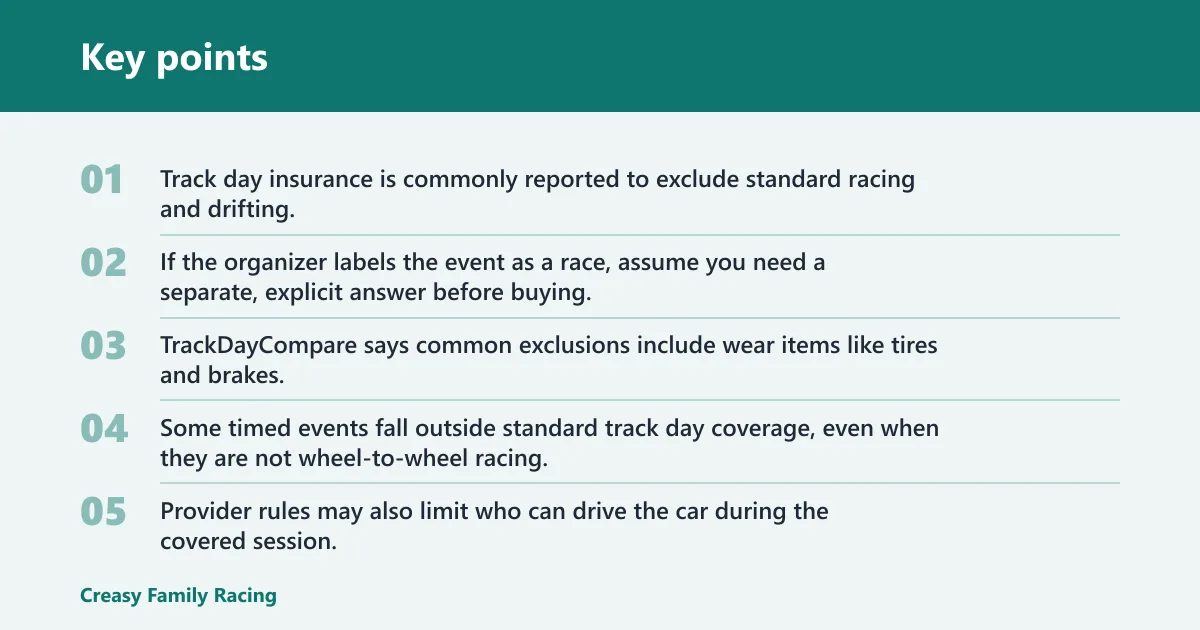
Track day insurance is commonly reported to exclude standard racing and drifting. That exclusion is broad enough to cover wheel-to-wheel competition, some timed formats, and other sessions the provider views as higher risk. If the organizer labels the event as a race, assume you need a separate, explicit answer before buying.
Mechanical wear and consumables
The same source says common exclusions include wear items like tires and brakes. That fits the normal logic of these policies: they are designed for accidental damage, not predictable consumption. A blown tire from age or a worn pad from repeated laps is usually treated differently from a suspension arm bent in a spin.
If a rod bearing fails after a missed shift, the claim can turn on whether the damage was impact-related, wear-related, or simply a breakdown from pre-existing weakness. That is why the cause needs to be documented.
Timed-event exclusions and instructor rules
Some timed events fall outside standard track day coverage, even when they are not wheel-to-wheel racing. Provider rules may also limit who can drive the car during the covered session. If an instructor, coach, or another named driver is behind the wheel, confirm whether that person is covered under the same policy.
Do you need track day insurance?
You may need it when the car has meaningful agreed value, when the event sits close to an exclusion, or when a repair bill would be hard to absorb. The same source says coverage is often based on agreed value, so the decision is usually about how much loss you can accept if the car is damaged, totaled, or stuck with a major repair.
When an agreed-value car is at risk
If the vehicle is worth more than you want to self-insure, a track day policy can limit the financial hit from a covered incident. This is especially relevant when body panels, suspension, cooling systems, or a safety cage increase repair cost. Agreed value matters because actual repair costs can exceed what a standard insurer would accept for track damage.
When your event is outside policy limits
If the event is a time trial, racing weekend, drifting session, or anything else outside the provider’s HPDE lane, you should assume the policy may not apply. The same caution applies when the car is a motorcycle or another vehicle type that the provider does not cover. Eligibility has to be checked before the purchase, not after the incident.
When a quote is worth getting
-
Confirm the event type.
Check whether the organizer calls it HPDE, a club day, a time trial, or racing. That label drives eligibility more than the venue name does. -
List the car details.
Gather the vehicle’s value, year, make, model, and any major modifications. Providers use those details to price physical damage coverage and determine whether the car fits their rules. -
Match the driver profile.
Have the driver experience and intended driver list ready. Some providers ask about that because event risk changes with skill level and who will drive. -
Ask about excluded zones.
Confirm whether the paddock, towing, instructor driving, and liability are included. Those are the first places where a claim can fall outside the policy.
What to confirm before you buy
Before you pay for a quote, read the event wording and the policy wording side by side. The main questions are simple: is the event eligible, is physical damage covered, does liability exist separately, and do paddock or towing losses count? If any answer is unclear, treat it as a gap.
Event type and eligibility wording
Verify that the policy is written for the exact event type. The same source says its coverage is for HPDE events only, while other providers may allow different formats. Do not assume a “track day” label covers everything that happens on a closed course.
Deductible, limits, and agreed value
Ask how the policy values the car and how the deductible works. The same source says coverage is often based on agreed value, which means the amount you select matters if the car is totaled. A lower deductible usually costs more, but it can reduce the claim bill later.
Paddock, towing, and instructor coverage
Check three details in writing: whether the paddock is included, whether towing after an incident is included, and whether an instructor or coach driving the car is covered. These are all common gray areas, and they are exactly where an assumption can turn into an uncovered loss.
Frequently asked questions
What does track day insurance cover?
Track day insurance usually covers physical damage to the insured car from a covered track incident during an eligible event, often an HPDE. It may also include paddock damage or towing, but those are not universal. Liability, racing, drifting, and wear items are commonly handled separately or excluded.
Does track day insurance cover damage in the paddock?
Sometimes, but not always. The same source says coverage can apply on track and in the paddock, which shows that paddock protection is possible. Still, many policies limit coverage to the actual driving session, so you should verify the paddock language before buying.
Does track day insurance include liability coverage?
Often no. The same source says liability insurance is not included, while XINSURANCE says liability protection may be available. That means you need to check whether third-party injuries or property damage are covered, and if so, under what separate terms and limits.
Does track day insurance cover racing?
Usually not. Standard track day policies are built for HPDE and similar educational events, not wheel-to-wheel racing or most competitive formats. If the event has timed results, side-by-side competition, or race rules, assume it may fall outside the policy unless the provider says otherwise.
Does track day insurance cover mechanical failure?
Usually only in narrow cases. Wear, pre-existing problems, tires, and brakes are commonly excluded, and TrackDayCompare lists tires and brakes among common exclusions. If a mechanical problem follows an impact, the cause may be treated differently, so the claim outcome depends on what actually broke first.
Will my regular auto insurance cover a track day?
Do not assume it will. Standard auto insurance often excludes track use, which is why track day insurance exists in the first place. Before an event, check your own policy wording and ask whether closed-course driving is excluded, because the answer often changes at the track gate.
What events are eligible for track day insurance?
HPDE is the cleanest fit, especially when the event is educational and non-competitive. Some club days may qualify if they follow the same structure, while racing, drifting, and certain timed events usually do not. The exact event classification controls eligibility more than the venue name does.
Does track day insurance cover motorcycles?
Not always. The same source says motorcycles are not offered coverage, so motorcycle riders should not assume a car-focused policy will apply. If the vehicle is a bike, check the provider’s accepted vehicle types before you buy, because eligibility can be denied outright.
What is the difference between track day insurance and regular car insurance?
Regular car insurance is built for street use, while track day insurance is built for event-specific physical damage. The regular policy often excludes track activity, and the track-day policy often excludes liability, racing, or wear items. They solve different problems and should be reviewed separately.
What does track day insurance cover: it usually covers physical damage?
It usually covers physical damage to your car during an eligible HPDE or similar event. Depending on the provider, it may also cover paddock damage or towing, but it usually does not cover racing, drifting, wear items, or standard liability for other vehicles and property.
What does hagerty track day insurance cover?
Coverage depends on the exact product and event wording, so the policy details matter more than the brand name. As with other track day policies, you should check whether it covers physical damage only, whether liability is separate, and whether HPDE is the eligible event type.