What Dry and Wet Boiling Points Do You Need for Track Days?
For most track days, choose brake fluid with at least 280°C dry boiling point and 180°C wet; frequent track use is better at 300°C dry and 200°C wet. Too-low wet boiling point leads to a soft pedal, longer stopping distances, and fluid vaporization after heat cycles and moisture absorption. This guide gives practical targets by use case and explains why the wet number usually matters more than the headline dry rating.
How brake fluid boiling points differ
Dry boiling point is the boiling point of new, uncontaminated fluid. Wet boiling point is the boiling point after the fluid has absorbed moisture in service. For track-day braking, both matter, but they answer different questions: peak heat resistance on fresh fluid versus usable heat resistance after time in the system.
What dry boiling point measures
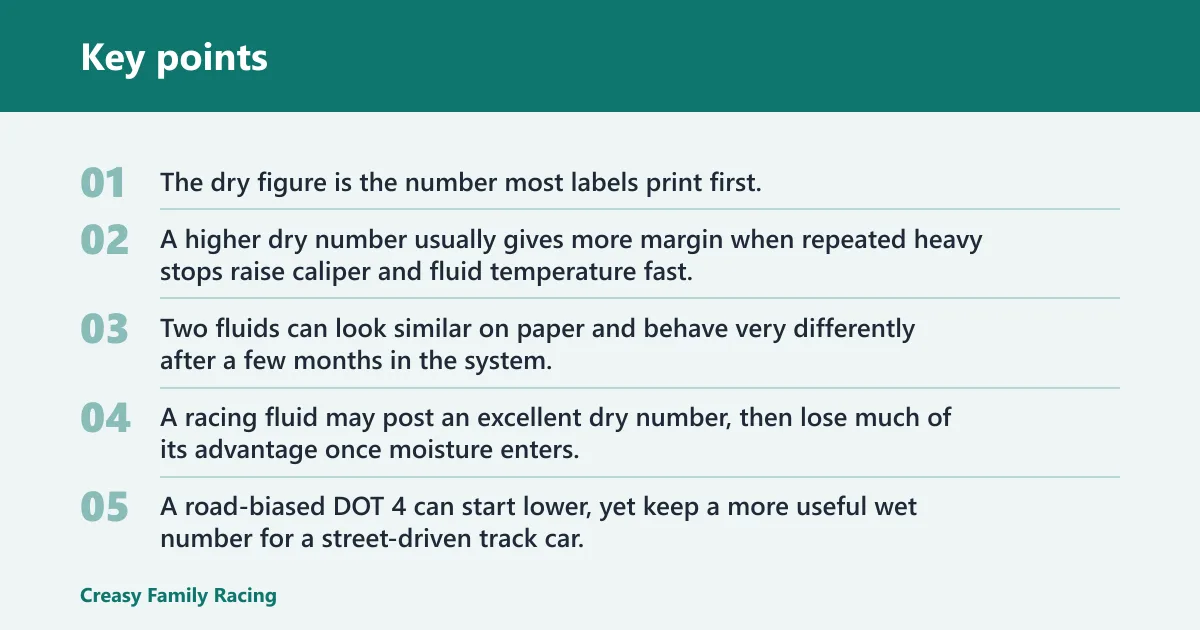
The dry figure is the number most labels print first. It tells you how much heat a fresh fill can tolerate before vapor forms, which is most relevant for the first hard session after a bleed or full flush. A higher dry number usually gives more margin when repeated heavy stops raise caliper and fluid temperature fast.
What wet boiling point measures
The wet figure is the more practical number for a car that sees road miles, sits between events, or goes more than a few weekends between flushes. Brake fluid moisture absorption lowers boiling point over time, and humidity, open caps, and repeated bleeding cycles speed that process. That is why a fluid with a strong dry rating can still become a weak choice in service.
Why the two numbers are not interchangeable
Two fluids can look similar on paper and behave very differently after a few months in the system. A racing fluid may post an excellent dry number, then lose much of its advantage once moisture enters. A road-biased DOT 4 can start lower, yet keep a more useful wet number for a street-driven track car. The right choice depends on how often the car sees heat and how often the fluid gets changed.
What boiling point do you need?
For occasional track days, aim for at least 280°C dry and 180°C wet. For frequent track use, move to 300°C dry and 200°C wet or better. If the car is street-driven and the fluid stays in service for months, the wet number should drive the decision more than the headline dry rating.
Occasional track-day target
An occasional-event car usually benefits from a strong DOT 4 with a wet boiling point around 180°C or higher. That level is a practical floor for mixed road and track use when the fluid is changed on a normal maintenance schedule. It gives enough margin for a hard session without forcing the car into a racing-fluid service interval.
Frequent track-day target
Cars that see repeated events, longer sessions, sticky tires, or heavier braking loads should move toward 300°C dry and 200°C wet. That target better fits sustained heat and short cooldown windows. If the car is heavy, runs high-grip tires, or uses ABS heavily, the higher target is worth more than a small gain in peak dry number.
When the headline number is not the right priority
The dry rating is not the main number when fluid stays in the car for long periods. A fluid with 330°C dry and a poor wet figure can be less useful than a 300°C dry fluid with a stronger wet rating. For road-driven cars, the usable number after moisture absorption often decides pedal feel at the end of the season, not the first lap.
Boiling point targets table
| Use case | Minimum dry target | Minimum wet target | Fluid type to start with |
|---|---|---|---|
| Street-driven car, 1 to 2 track days per season | 280°C | 180°C | DOT 4 |
| Street-driven car, several track days per season | 300°C | 200°C | High-performance DOT 4 or DOT 5.1 |
| Frequent track car, monthly or more | 300°C+ | 200°C+ | DOT 5.1 or racing brake fluid |
| Heavier car, sticky tires, long sessions | 300°C+ | 200°C+ | DOT 5.1 or racing brake fluid |
These are minimums, not bragging rights. A car with larger rotors, stronger cooling, and short sessions may cope with less, while a heavy car on high-grip tires can need more even if the fluid label looks impressive. The point is to match the fluid to the actual heat load.
Why wet boiling point often matters more
Wet boiling point often matters more for track cars that also see the road. Moisture absorption over time lowers boiling point, and the drop can be large enough to turn a good dry number into a marginal wet number. If the car is not flushed before every event, the wet figure is the one that protects the last laps of the day.
Moisture absorption over time
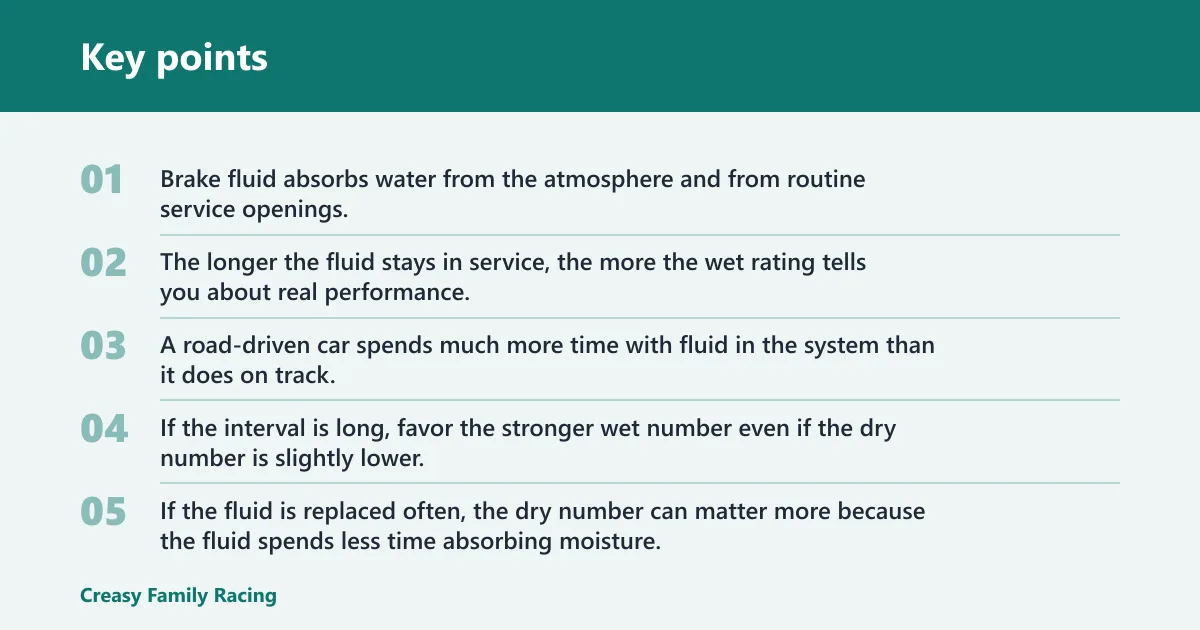
Brake fluid absorbs water from the atmosphere and from routine service openings. That moisture does two things: it lowers boiling point and it increases the chance of vapor forming when heat builds in the calipers and lines. The longer the fluid stays in service, the more the wet rating tells you about real performance.
Why road use changes the equation
A road-driven car spends much more time with fluid in the system than it does on track. That means the fluid’s in-service condition matters more than its fresh-fill label. A car that does one event and then commutes for months needs a higher wet boiling point than a car that is bled before every weekend and maintained on a tight schedule.
How maintenance interval changes the target
If the interval is long, favor the stronger wet number even if the dry number is slightly lower. If the fluid is replaced often, the dry number can matter more because the fluid spends less time absorbing moisture. That is the real tradeoff: peak heat resistance versus how quickly the fluid loses that advantage.
Say your hatchback sees two track days a year, then commutes all winter. A fluid with 330°C dry and 160°C wet may look strong on the bottle, but a 300°C dry and 200°C wet fluid is the safer pick because the car will spend most of its life in the wet condition.
Should you choose DOT 4 or DOT 5.1?
For most street-driven track cars, DOT 4 is the baseline. DOT 5.1 is the better choice when you want more heat margin and lower viscosity for ABS-equipped road systems, provided the vehicle manual allows it. Racing fluids make sense only when maintenance is short and the car sees frequent track heat.
DOT 4 as the baseline
DOT 4 brake fluid is the common starting point for track-day use, and it fits many road cars that need a balanced compromise between temperature resistance, availability, and service life. FMVSS 116 is the U.S. standard used to classify brake fluids, so the DOT label gives you a common way to compare minimum requirements across products.
DOT 5.1 for higher heat and lower viscosity
DOT 5.1 is glycol-based like DOT 3 and DOT 4. It is not silicone DOT 5, which is a different fluid and generally not the right choice for track use. DOT 5.1 often offers higher performance than typical DOT 4 and lower viscosity than many DOT 4 fluids, which can matter for ABS and modern road systems when the car maker approves it.
What FMVSS 116 tells you
FMVSS 116 sets the classification framework, but it does not tell you how a fluid will behave after months of moisture absorption in a real car. A label may meet a category minimum and still be a poor fit for infrequent maintenance or humid climates. Use the standard to compare types, then use the wet boiling point to decide between them.
Check the service pattern. If the car is street-driven and sees only a few events, start with a strong DOT 4 or DOT 5.1 that meets the manufacturer’s spec. If the car sees frequent track days, move up only if you can also shorten the service interval.
Match the wet number first. For road use and infrequent flushes, prioritize wet boiling point before chasing a huge dry figure. That choice protects the car after moisture has entered the system and heat cycles have done their work.
Confirm compatibility. Follow the vehicle manufacturer’s brake fluid requirements, especially for ABS and stability systems. A fluid that meets the wrong standard can create more problems than it solves.
When racing brake fluid makes sense
Racing brake fluid makes sense when the car sees frequent track use, the fluid is changed often, and the owner is willing to accept a shorter service interval. It is chosen for high dry boiling point, but some racing fluids have weaker wet performance than road-focused alternatives. That tradeoff is acceptable only when maintenance stays frequent.
Frequent track use
A car that runs repeated sessions, long stints, or high-speed circuits benefits from the extra dry margin of racing fluid. The advantage shows up when caliper temperatures stay high lap after lap and cooldown time is short. In that case, peak heat resistance can matter more than a long wet-life figure.
Short maintenance intervals
Racing fluid is a poor fit if the system will sit for months between flushes. Moisture absorption can erase the advantage of a very high dry number. If the fluid is changed before many events and bled on schedule, that downside becomes less important.
A common first-timer mistake is choosing the highest dry number on the shelf for a daily-driven coupe, then leaving it in the car for a year. The pedal may feel fine at first, then soften after enough humidity and heat cycles have lowered the wet boiling point.
Why a high dry number can hide a weak wet number
Very high dry performance can create a false sense of security. The bottle may look ideal, but the wet figure is what matters once the fluid is older. That is why racing fluid belongs in a maintenance plan, not just in a shopping cart.
How do you tell if your brake fluid boiled?
Brake fluid boiling usually shows up as a pedal that goes long, soft, or inconsistent after repeated hard stops. That is different from pad fade, which comes from overheated friction material and usually changes the car’s bite and stopping feel without the same spongy hydraulic response. The timing matters: fluid fade often appears late in a session.
Pedal feel after repeated stops
If the pedal starts firm and then becomes longer or soft after several laps, suspect fluid fade first. If the pedal feel changes when the brakes are hot but recovers after cooling, that is another clue. A sinking pedal under repeated load is more consistent with vapor in the hydraulic system than with pad fade alone.
What to check after a session
After the car cools, inspect the reservoir level, look for dark or discolored fluid, and check for signs of leakage at calipers, hoses, and the master cylinder. Bleed the system if the pedal was affected, and inspect pads and rotors too. A brake problem can involve more than one part.
When to inspect pads, fluid, and system health
If the car ran heavy tire grip, long sessions, or a circuit with repeated high-energy stops, do not assume the fluid alone caused the issue. Pad fade and fluid fade can happen together. The correct fix may be a better pad compound, more cooling, a higher wet boiling point, or all three.
Frequently asked questions
What dry boiling point do you need for track days?
A practical minimum is about 280°C dry for occasional track days and about 300°C dry for frequent use. Heavier cars, sticky tires, long sessions, and repeated hard braking justify the higher target. The dry number protects the first hard session, but it should be paired with a wet figure that fits the maintenance interval.
What wet boiling point do you need for track days?
For occasional track use, about 180°C wet is a sensible floor. For frequent track days or longer service intervals, about 200°C wet is a better target. Wet boiling point matters most when the fluid stays in the car through humidity, road miles, and time between flushes.
Is a higher dry boiling point always better for track use?
No. A very high dry number can hide poor wet performance, which is a problem for street-driven cars and infrequent maintenance. The better choice is the highest wet number that still fits the car’s service pattern, with enough dry margin for the hardest session.
How much wet boiling point matters if I change fluid often?
If the fluid is changed before many events, wet boiling point matters less than it does for a long-service road car. Even then, it still matters because moisture can enter between flushes. The shorter the interval, the more weight you can give to dry performance.
What brake fluid temperature does a track day car need to survive?
There is no single temperature that fits every car. A heavy car on sticky tires with short cooldowns needs more margin than a light car on street tires. That is why the useful answer is a boiling-point target, not a guessed caliper temperature.
Should I choose DOT 4, DOT 5.1, or racing brake fluid?
Choose DOT 4 for a typical street-driven track car, DOT 5.1 when you want higher performance and the vehicle allows it, and racing fluid for frequent track use with short maintenance intervals. DOT 5 silicone is different from DOT 5.1 and is generally not the right track choice.
Can brake fluid with a lower wet boiling point still be good for track days?
Yes, if the car is flushed often and sees frequent track use. A lower wet number can be acceptable when the fluid spends little time in service. For street-driven cars, though, a lower wet figure is usually the wrong tradeoff because moisture absorption lowers the usable boiling point over time.
How do I know if my brake fluid has boiled on track?
Look for a pedal that goes soft, long, or inconsistent after repeated hard stops, especially late in a session. That points to fluid fade. If the pedal feel changes without that spongy hydraulic effect, inspect for pad fade, overheated hardware, or another brake-system issue.