Brake Fluid for Track Days: Choose and Change
For track days, use fresh high-boiling DOT 4 or DOT 5.1 once hard laps overheat street fluid; a common rule of thumb is to flush before the event if the fluid is over about 12 months old or the pedal has softened. Get this wrong and boiling fluid can leave you with long pedal travel, fade, or an off-track moment at the end of a session.
This guide covers spec choice, boiling-point margins, service intervals, and the steps for a proper pre-event flush.
Track prep changes the question from “is the fluid due?” to “will it stay liquid for a full session?” That comes down to heat load, how much moisture the fluid has absorbed since the last change, and whether your ABS unit can be fully purged without a model-specific bleed function.
Why track use raises fluid demands
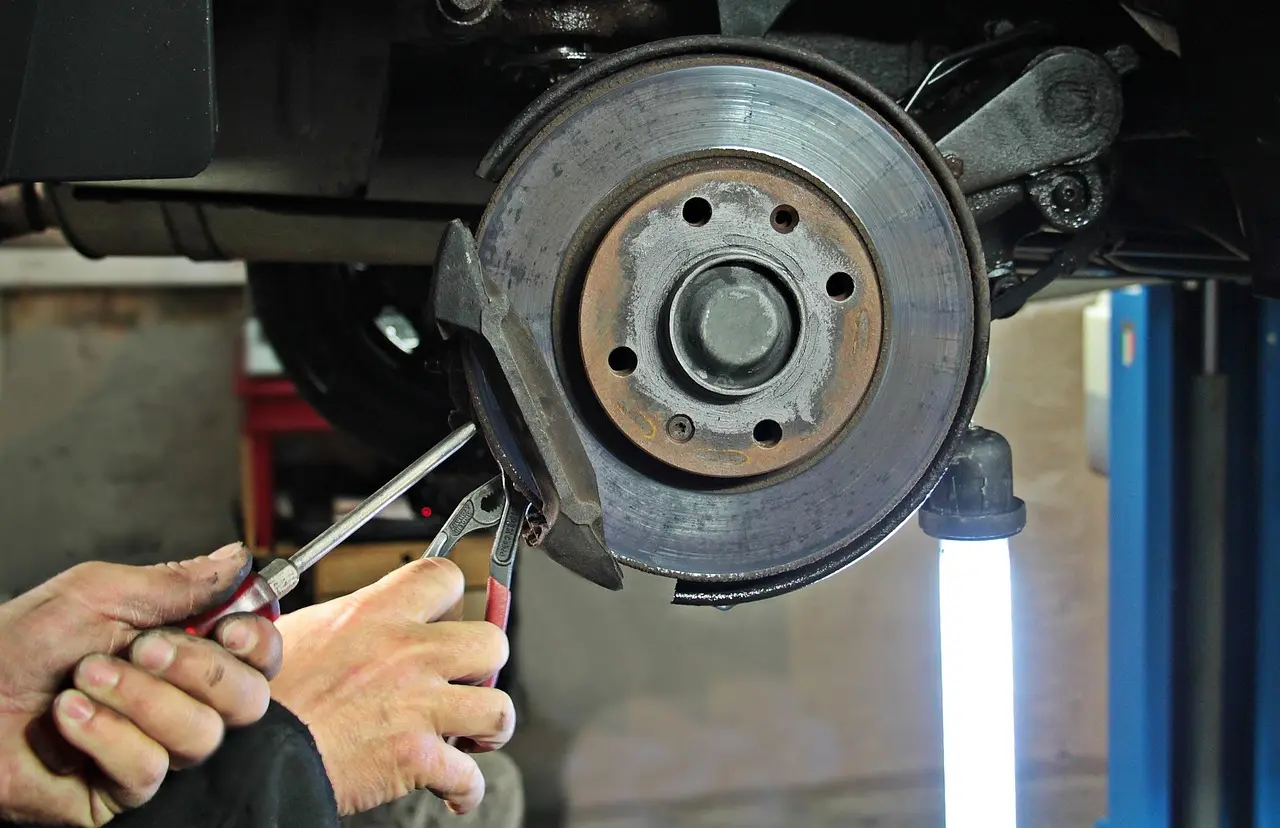
Repeated hard braking changes the job
On the road, brakes usually see short, spaced-out applications. On track, the system may go from high speed to threshold braking every lap, with less time for the calipers and fluid to cool between zones.
Brake fluid transfers pedal force through the hydraulic system to the calipers. For track use, the key point is simple: it must stay liquid under repeated heat. Once fluid boils, vapour bubbles form, and vapour compresses far more than liquid. That is when pedal travel grows and confidence drops.
Heat load comes from more than speed
Later braking points, heavier vehicles, sticky tires, and aggressive pad compounds all raise fluid demand. A heavy sedan on 200-treadwear tires can work fluid harder than a lighter car on modest tires, even if both drivers are in the same run group.
Pad choice matters too. A pad with higher torque can shorten stopping distances, but it can also drive more heat into the caliper during repeated heavy use. Fluid choice should follow the whole setup, not the DOT mark on the bottle.
Picture a 1,600 kg car at a fast circuit with two long straights and a novice driver who gets more confident after lunch. The only change was braking later and harder. Fluid that felt fine in session one can start showing longer pedal travel by session three.
How do dry and wet boiling points affect pedal feel?
Dry boiling point tells you the thermal margin of fresh fluid; wet boiling point tells you how much margin remains after the fluid has absorbed moisture in service. For track use, wet boiling point matters more than many drivers expect, because repeated heat cycles and air exposure steadily reduce the real safety margin.
Dry boiling point is the fresh-fluid margin
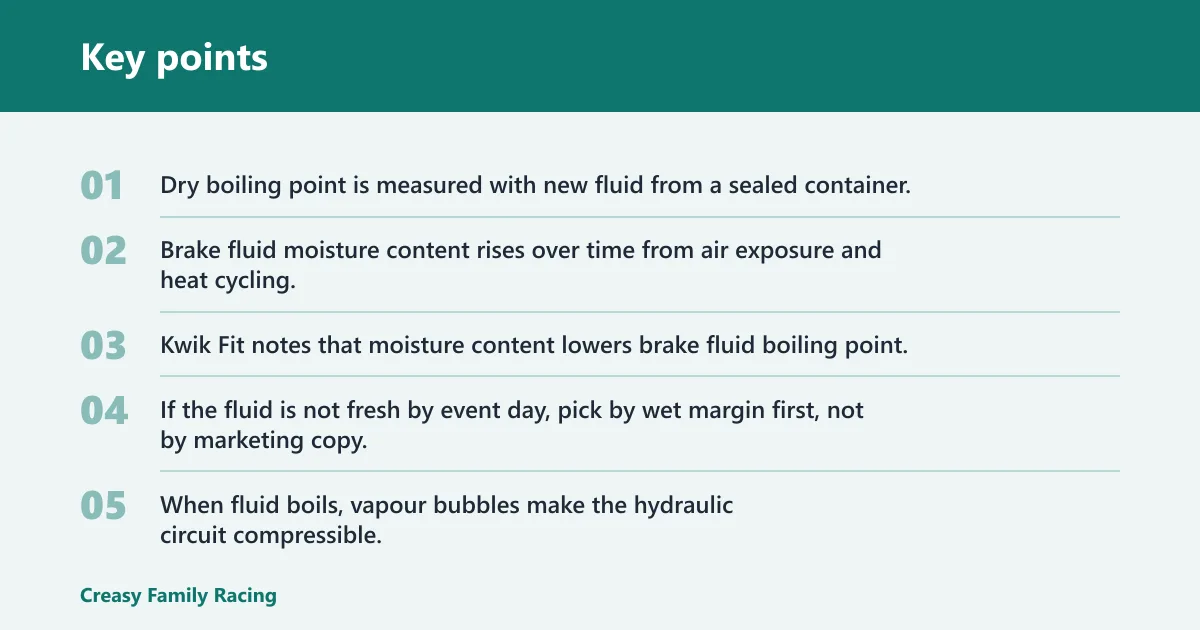
Dry boiling point is measured with new fluid from a sealed container. It is the number that matters most right after a complete flush, especially if the flush happens just before an event.
That figure matters because track use can overwhelm ordinary street fluid quickly. Hard stops raise caliper and line temperatures well beyond commuting conditions, so a higher dry boiling point gives you more margin in the first sessions of the day.
Wet boiling point is the in-service margin
Brake fluid moisture content rises over time from air exposure and heat cycling. Kwik Fit notes that moisture content lowers brake fluid boiling point. That is why an older fill can feel acceptable on the road, yet start to fade after several hot laps.
Wet boiling point matters most when fluid has been in the car for months, the reservoir has seen repeated heating and cooling, or the car sits between events. If the fluid is not fresh by event day, pick by wet margin first, not by marketing copy.
How boiling changes the pedal
When fluid boils, vapour bubbles make the hydraulic circuit compressible. The pedal may go soft or spongy, sink closer to the floor, or feel normal at pit-out and worse by the end of the session. Air in the system can create similar symptoms, which is why a flush is not the only possible fix.
Can old brake fluid cause a soft pedal on track? Yes, but so can pad knockback, overheated pads, hose problems, or leaks. The pattern matters. If feel degrades after repeated heavy braking and then partly recovers on a cooldown lap, fluid boiling is high on the list.
Which brake fluid type should you choose for track use?
Choose the fluid type your vehicle manufacturer allows first, then compare actual dry and wet boiling points within that approved category. For most track-day cars that means glycol-based DOT 4 or DOT 5.1. DOT 5 silicone fluid is a separate category and should not be treated as interchangeable with them.
What the DOT label does and does not tell you
DOT 3, DOT 4, and DOT 5.1 are commonly described as glycol-based brake fluids. They are broadly compatible by chemistry, but you still need to confirm the specified type in the owner’s manual or service information for the exact car.
The DOT number sets a minimum standard, not track suitability by itself. A basic DOT 4 may post lower boiling points than a premium DOT 5.1, but a premium DOT 4 may beat a basic DOT 5.1 on the data sheet. Track suitability depends on the published dry and wet boiling points, plus vehicle compatibility.
DOT 5 is different
DOT 5 is silicone-based and is not the same thing as DOT 5.1. It should not be assumed compatible with systems designed for glycol fluid, and it is not the default answer for track use.
Compatibility comes before boiling point
The wrong fluid can create ABS and ESC problems even if the bottle advertises a higher boiling point. Contamination and poor bleeding can also upset hydraulic control units, and old contaminated fluid may damage components over time. Before you chase a bigger number on the label, confirm the required fluid spec for the car and whether the system needs a specific bleed procedure.
Suppose your car calls for glycol-based fluid and has a complex ABS module with a service bleed routine. The right move is not simply buying the highest-boiling bottle on the shelf. It is buying a compatible fluid and making sure the flush method reaches the hydraulic unit.
What boiling-point range do you need for your track days?
The right range depends on heat input, not ego or run-group label. A light car on moderate pads at an occasional event can get by with lower targets than a heavy, fast car doing repeated hot laps on sticky tires. Treat the numbers below as practical minimum targets, then move up when heat, pace, or fluid age increases.
Use heat load to pick a target
For occasional novice sessions and lighter heat load, a practical starting target is at least 260-280°C dry and 165-180°C wet. For intermediate pace, heavier cars, or repeated hot laps, move to 280-310°C dry and 180-200°C wet.
Advanced pace, high-energy braking tracks, sticky tires, or aggressive pads justify a higher starting point: 310-325°C dry and 200-210°C wet. If the car sees endurance-style sessions, extreme ambient heat, or very heavy repeated stops, look for 325°C+ dry and 210°C+ wet, if compatible with the car.
When premium fluid is the cheaper choice
Premium fluid often costs more per bottle, but that does not automatically make it expensive. If a standard street fill leads to early fade, extra bleeds, or a missed afternoon session, the lower shelf price stops mattering.
A common first-timer mistake is matching fluid to commuting use while upgrading pads and tires for the event. That can leave the system with more brake torque and grip, but the same old wet-boiling margin.
Brake fluid decision table
| Use case | Recommended minimum dry / wet boiling point range | Change interval | Bleed method | Red-flag symptoms |
|---|---|---|---|---|
| Occasional novice track day, lighter car, modest pad and tire setup | 260-280°C dry / 165-180°C wet | Fresh fluid if over 12 months old before the event; full flush if history is uncertain | Full flush preferred; manual or pressure bleed can work if the car does not require a special ABS routine | Pedal gets longer after 3-5 hard laps, reservoir fluid looks dark or cloudy, uncertain service age |
| Intermediate pace, heavier car, faster track, or repeated hot laps | 280-310°C dry / 180-200°C wet | Flush before the event if last full change was earlier in the season or fluid has seen multiple events | Pressure bleed preferred; confirm model-specific sequence and whether ABS bleed activation is needed | Soft pedal near session end, pedal recovers partly on cooldown, fluid older than one season |
| Advanced group pace, sticky tires, high-torque pads, high-energy braking zones | 310-325°C dry / 200-210°C wet | Fresh fill for key events; bleed or flush cadence tied to event frequency and measured condition | Pressure bleed with factory procedure; scan-tool or diagnostic activation may be required for ABS/ESC units | Pedal firmness changes lap to lap, ABS unit cannot be confirmed fully bled, any hint of vapour fade |
| Endurance-style sessions, extreme heat, very heavy repeated stops, aggressive pad compounds | 325°C+ dry / 210°C+ wet | Plan frequent changes based on sessions run, storage time, and moisture checks rather than a generic street interval | Full flush only; factory service information is mandatory for sequence and hydraulic unit procedure | Sinking pedal, repeated boil-over symptoms, discolored fluid after recent events, inconsistent pedal at pit-out |
How often should you change brake fluid for track days?
Track-day cadence should be based on event frequency, heat load, storage time, and fluid condition, not a commuting schedule alone. Road-car guidance is often every 2 years, but track use shortens the useful interval. A pre-event bleed may be enough for recently flushed fluid; an older or uncertain fill usually deserves a full flush.
Street intervals are the floor, not the plan
Brake fluid change intervals are often every 2 years. The same source says manufacturers recommend changing brake fluid every two years, and Halfords says most manufacturers recommend 24 months or 24,000 miles. FixMyCar says brake fluid is recommended roughly every 2 years or 24,000 miles.
Those figures are useful as normal-service references, not track-day promises. Hard laps create a different heat cycle, so a driver doing regular events should think in seasons, event count, and measured condition.
When a bleed is enough
A simple bleed can be enough when the fluid is compatible, recently flushed, and still in good condition, but the pedal has lost a little crispness from minor air entry or localized heating. It is a touch-up, not a reset.
If the fluid is over 12 months old, the car has done several events, or the boiling-point margin is unknown, a full flush is the safer move before a serious track day. That is especially true when the pedal feel has changed under heat, not just in the paddock.
Service time depends on system complexity
Brake fluid replacement often takes 30 to 90 minutes. The same source says a brake fluid change can take up to 1 hour and 30 minutes. Basic systems are quicker; ABS and ESC systems can take longer when special bleed functions are required.
How do you know if brake fluid is old or contaminated?
Start with age, service history, reservoir level, visible condition, and pedal feel under heat. Dark or cloudy fluid can be an ageing clue, but colour alone does not measure water content. For track prep, combine a visual check with moisture testing or a professional inspection, then judge the result against your expected heat load.
Check the reservoir without overreading colour
The reservoir is usually a translucent container near the firewall on the driver side on many cars. Use the MIN and MAX marks as a basic check. A low level can point to normal pad wear, but it can also suggest a leak that needs inspection before any event.
Bosch says dark or cloudy brake fluid can indicate ageing or contamination. Treat that as a warning sign, not a final diagnosis. Fresh-looking fluid can still have absorbed enough moisture to lose boiling margin.
Moisture testing and copper testing are different
Moisture content rises over time as glycol fluid absorbs water from air exposure. Test strips or specialist equipment can estimate moisture content, which is the useful number for boiling-point risk. Copper-content strips, by contrast, indicate corrosion-related contamination and fluid degradation markers; they are not a direct water-content reading.
Do not treat those tests as interchangeable. If the question is “will this fluid still resist boiling on track?”, moisture condition matters most.
Pedal feel is part of the diagnosis
If the pedal is firm in the paddock but goes long after several hard laps, suspect heat-related boiling or moisture-loaded fluid. If the pedal is soft immediately after a flush, suspect air left in the system. If the pedal slowly sinks under steady pressure, the cause may be more serious and should be diagnosed before the car goes on track.
Can you flush brake fluid at home before a track day?
You can flush brake fluid at home if you use the exact approved fluid type, keep the process clean, and follow the factory bleed sequence for your model. The limit is ABS and ESC complexity. Some cars retain old fluid in the hydraulic unit and need a scan tool or model-specific bleed function to finish the job properly.
What a home flush can do well
A careful DIY flush can replace old fluid in the lines and calipers, remove some trapped air, and restore pedal firmness before an event. Pressure bleeding is common in professional service; Kwik Fit uses a pressure bleeder for the service.
What a home flush cannot assume is complete coverage on every car. Some ABS units hold fluid in internal passages that are not fully purged by a basic two-person bleed.
Why ABS procedure matters
The same source notes ABS controller bleed functions may be required. That is the key track-day issue. If old fluid stays inside the hydraulic unit, the system may still contain the lowest-boiling fluid in the circuit even after a good-looking caliper bleed.
Never invent a bleed order and never rely on a generic “furthest wheel first” rule if factory service information says otherwise. Sequence varies by model and ABS design.
Home flush steps
- Confirm the fluid spec. Check the owner’s manual or service information for the exact approved type, then compare dry and wet boiling points within that category. Do not substitute DOT 5 silicone fluid for a glycol-based system.
- Check service history. If fluid age is unknown, the car has done several events, or the pedal has changed under heat, plan a full flush instead of a quick bleed. Track prep rewards certainty.
- Inspect the reservoir. Verify level between MIN and MAX and look for dark or cloudy fluid. Low level can reflect pad wear, but if the drop is unexplained, inspect for leaks before opening the system.
- Use a sealed bottle. Open fresh fluid only when ready to fill. Brake fluid absorbs moisture from air, so an old opened bottle is poor track prep even if the cap was tightened.
- Follow factory sequence. Use the exact model-specific bleed order and any required ignition, scan-tool, or ABS service mode instructions. This prevents trapped air and helps purge old fluid from the right parts of the system.
- Bleed cleanly and steadily. Keep the reservoir from running low, avoid spills and contamination, and continue until clean fresh fluid appears at each corner. Pressure bleeding often gives more consistent results than improvised methods.
- Finish with a pedal check. The pedal should be firm before the car leaves the garage. If it is soft, spongy, or inconsistent, there may still be air in the system or the ABS unit may need a special bleed routine.
Pre-event brake fluid checklist
| Check | What to confirm | Track-day standard | If it fails |
|---|---|---|---|
| Compatibility | Fluid type matches the manufacturer-approved spec for the exact car | Confirmed in owner’s manual or service information | Do not mix in an unapproved type; correct the fluid choice first |
| Fluid age | When the last full flush was done and how many events the fluid has seen | Fresh for hard-use events; flush if over 12 months old or history is uncertain | Schedule a full flush before loading the car |
| Boiling-point margin | Dry and wet figures from the fluid data sheet versus expected heat load | Matches the use-case range in the decision table | Move to a higher-margin compatible fluid |
| Reservoir level | Level between MIN and MAX | Stable, with no unexplained drop | Inspect pad wear and check for leaks before driving |
| Visible condition | Fluid is not dark or cloudy | No obvious ageing clue | Treat as a warning sign and inspect or replace as needed |
| Moisture condition | Moisture test result or recent professional check | Acceptable for the event heat load | Flush the system; do not rely on colour alone |
| ABS procedure | Whether the car needs scan-tool activation or a special bleed function | Procedure confirmed before bleeding | Use the proper tool or book the job with a capable shop |
| Pedal feel | Pedal is firm with engine off and consistent after a short road test where legal | No sponginess, no sinking, no unexplained extra travel | Do not go on track until the cause is fixed |
Frequently asked questions
What brake fluid is best for track days?
The best choice is a manufacturer-compatible glycol-based fluid with enough dry and wet boiling-point margin for your heat load. For most track-day cars, that means fresh high-boiling DOT 4 or DOT 5.1. Pick by actual published boiling points and ABS compatibility, not by the DOT label alone.
How do I choose brake fluid for track use?
Start with the approved fluid type in the owner’s manual, then match boiling-point margin to car weight, braking style, tire grip, pad aggressiveness, and session length. If the car is heavy, fast, or repeatedly overheats street fluid, move up in boiling-point range and shorten the service cadence.
How often should I change brake fluid if I do track days?
Normal road guidance is often every 2 years, but track use can shorten that sharply. Use event count, fluid age, moisture condition, and pedal feel to set cadence. If fluid is over 12 months old before a track event or has seen several hot days, a flush is usually smarter than waiting.
What boiling point do I need for track day brake fluid?
There is no universal threshold.
How much does a brake fluid change cost?
Cost depends on fluid choice and system complexity. In the UK, FixMyCar gives an average brake fluid change price of £58.21 and National lists £59.99, generally for standard service work. Premium high-boiling fluid costs more, but it may reduce fade risk or the need for extra pre-event changes.