How to Practice Burnout Technique at the Strip
At the strip, stop the burnout when the tire leaves a thin, even haze and the car no longer feels sticky on the dry hop. For many drag radials, about 3–6 seconds is often enough. Heat beyond that burns tread, cuts grip, and can slow the next pass. This guide shows how to match burnout time to compound and track conditions so you stop at traction gain, not smoke.
Why do you burn out at the strip?
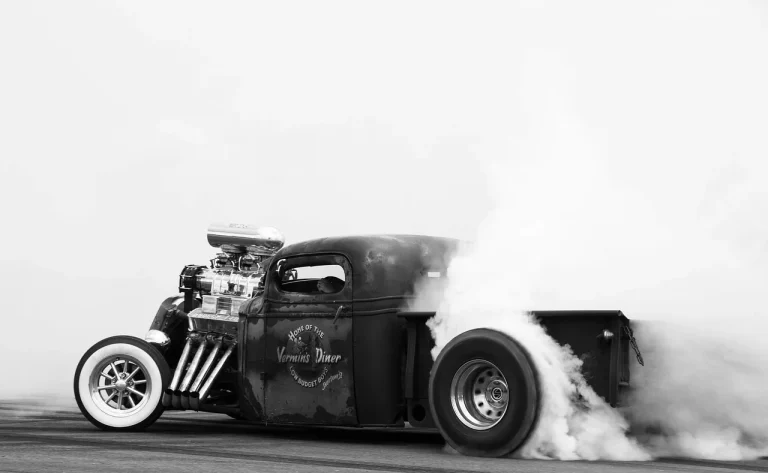
A burnout has two jobs: clean the tread surface and build usable tire temperature. That helps the tire bite harder on the launch, but only up to a point. Once the rubber gets too hot, grip drops and wear rises fast, especially on street tires.
For drag strip burnout use, the goal is not a cloud for its own sake. The goal is a tire that has shed loose debris, reached the right temperature window, and is ready for the surface you are about to race on.
What heat does to the tread surface
Heat softens the top layer of rubber and helps it conform to the track. A proper burnout can also remove dust, rubber crumbs, and water left on the tread. That helps only if the heat stays in the useful range for that compound.
Street tires are commonly described as needing only a short cleanup burnout. Drag radials and slicks can usually accept more heat than street tires, but they can still go past the point where extra spin helps. Too much temperature can make the tire greasy and slow to recover.
Why too much heat cuts grip
Excess heat changes the tire from ready to run into too soft and slippery. The first sign may be a tire that feels less crisp on the dry hop, even if the burnout looked dramatic. Smoke volume alone does not tell you that the tire is ready.
If the tire keeps smoking heavily after the tread has already cleaned up, the burnout has likely moved past the useful point. That wastes tread and can leave the tire too hot for the launch.
How do you choose the right burnout?
The right burnout depends on tire compound, track prep, and drivetrain. Street tires usually want the shortest useful cleanup. Drag radials generally need more heat than street tires, while slicks can tolerate more still. The track surface matters because a sprayed lane, a dry lane, and a heavily prepped lane do not ask for the same amount of tire heat.
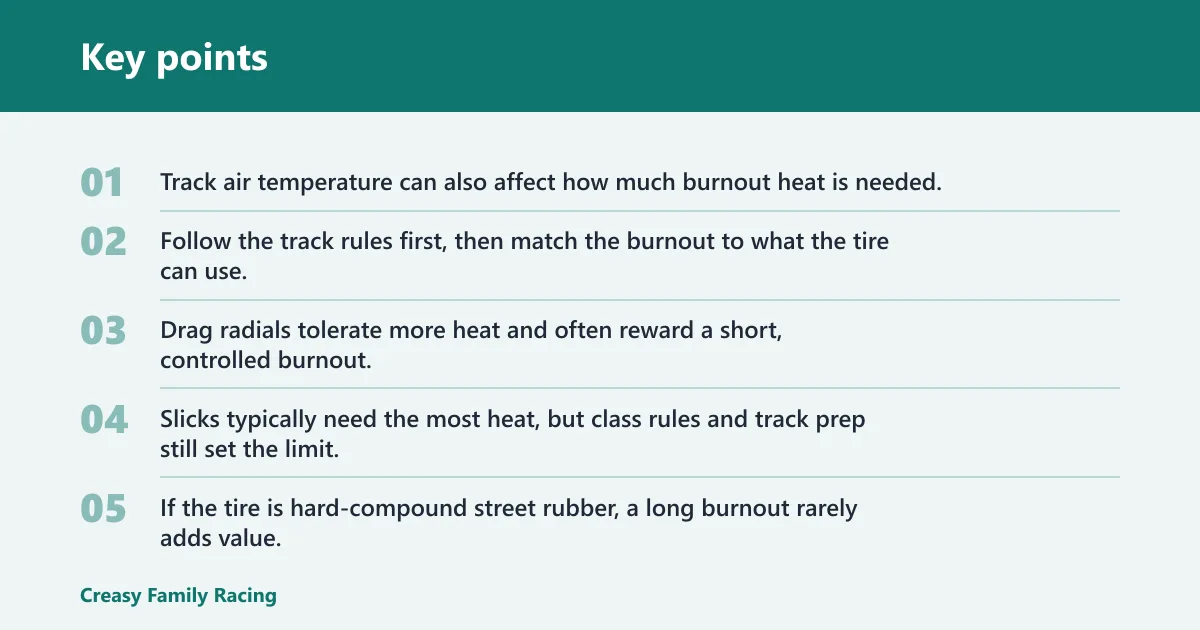
Track air temperature can also affect how much burnout heat is needed. Cooler air and a colder tire usually call for a little more heat work, while a hot track can make a long burnout counterproductive. Follow the track rules first, then match the burnout to what the tire can use.
Street tires, drag radials, and slicks
Street tires are the easiest to overheat. They usually need only a brief cleanup, often on the dry side of the water box or outside it, depending on track procedure. Drag radials tolerate more heat and often reward a short, controlled burnout. Slicks typically need the most heat, but class rules and track prep still set the limit.
If the tire is hard-compound street rubber, a long burnout rarely adds value. If the tire is a drag radial with a softer compound, a short period of controlled spin can help. The useful point is reached before the tire starts looking cooked.
Track prep and air temperature
A well-prepped track can reduce the amount of tire work needed at the starting line. On a sticky surface, too much burnout can overheat the tire before the launch. On a marginal surface, a short cleanup may still help, but it should stay within the tire’s range.
On a cooler night, a drag radial may need a little more heat than it would on a warm track. On a hot afternoon, the same tire may need less. The best stop point is the first one that gives a clean, dry, warm tire without making it greasy.
Should you use the water box?
The water box helps start tire spin, but it is not a universal rule for every car or tire. Street tires often do better with less water or no water at all, because water can remain in the tread and hurt traction. Drag radials and slicks are more likely to use the water box, depending on class rules and the track’s direction.
Do not assume the water box is mandatory. Use it only if the tire type, class, and track procedure call for it.
When the water box helps
The water box can help a rear-tire burnout get started cleanly, especially with drag radials or slicks that need a controlled spin cycle. It also helps when the track wants the burnout done in the water box. In that case, follow the lane official’s direction and the car’s manual or burnout procedure.
When to stay dry
Street tires often should stay dry or use only the least amount of water needed by the track’s procedure. A tire that leaves the water box with moisture in the tread can lose grip on the launch. If the car is on a street tire and the track allows a dry hop or dry cleanup, that is often the safer choice.
Say your car has 275-section street tires and the surface is already well prepped. A short dry hop can clean the tread without soaking it. If the same car rolls through standing water first, the next pass may feel slick instead of sharper.
Burnout technique by drivetrain
Burnout technique changes with drivetrain. Rear-wheel-drive cars are the most common burnout candidates at the drag strip. Front-wheel-drive cars may use a different procedure, and all-wheel-drive or four-wheel-drive cars often have limits or special rules that make a burnout unnecessary or undesirable. Always follow track rules and the vehicle manual.
If the car has traction control or launch aids, check the car-specific procedure before the run. Some systems can interfere with wheel spin or with the way the car releases power after the burnout.
Rear-wheel-drive cars with line lock
Line lock is common on street/strip cars because it holds the front brakes so the rear tires can spin without the car rolling away. That makes it easier to control burnout duration and position. It does not replace judgment; it only gives you cleaner control of the burnout.
- Confirm the lane procedure. Check the track’s burnout rules and the vehicle manual before you stage. Keep the car in the prescribed area, and do not improvise if the track asks for a different method.
- Set up the tires. If the tire type calls for the water box, move into it only as directed. If not, stay dry and aim for a brief cleanup spin so water does not stay in the tread.
- Apply the line lock. Use the system exactly as the vehicle manufacturer describes. That keeps the front brakes holding while the rear tires spin, which helps the driver control the burnout length.
- Build spin briefly. Feed enough throttle to start a clean rotation, then hold only long enough to reach the useful heat window. For many drag radials, that is often in the 3–6 second range, but tire type and prep still decide the final stop point.
- Release and roll out. Stop when the tire haze turns thin and even, then let the car roll forward under control. If the tire still looks wet, sticky, or visibly overcooked, the burnout went too far.
Front-wheel-drive cars
Front-wheel-drive burnout needs are different because the driven tires are at the front. Some tracks and classes expect little or no burnout on FWD cars, and some drivers focus on a short cleanup rather than a full spin. Follow the event rules first, because FWD burnout style varies more by class than many readers expect.
On a street tire, a FWD driver may need little more than a dry hop. On a drag tire setup, the procedure can change again, but the same rule still applies: stop when the tire has reached useful temperature, not when smoke becomes heavy.
All-wheel-drive and four-wheel-drive cars
All-wheel-drive and four-wheel-drive cars often have less need for a traditional burnout, and some tracks or drivetrains do not want one at all. Too much wheel speed can create driveline stress and does not always translate into better launch grip. Check the manual and the class rules before trying to spin all four tires.
Traction control and launch aids
Traction control can interfere with a burnout by cutting power or changing wheel speed when the tires start to spin. That can make the burnout uneven or stop it before the tire reaches the right temperature. Many cars need traction control off for burnout and launch prep, but the override method varies by model.
Follow the vehicle manual for the exact setting or button sequence. Never guess on a system that affects power, brakes, or launch behavior.
How long should a burnout last?
Burnout time is a guide, not the rule. The better stop signals are tire feel, car behavior, and the look of the tire after the spin. For many drag radials, 3–6 seconds is enough. Street tires often need less. Slicks may need more, but the right point still arrives before the tire starts to overheat.
Smoke volume is a poor single measure. A tire can make a lot of smoke and still be too hot, or make very little smoke and still be ready. The useful question is whether the tire has reached the right temperature without losing bite.
Stop signals that matter more than smoke
Look for a thin, even haze, not a heavy cloud that keeps growing. On the dry hop, the car should stop feeling grabby or sticky and start feeling smoother as the tire cleans up. If the tire starts sounding soft, looks shiny, or keeps spinning with no added feel, the burnout is done.
A common first-timer mistake is chasing a bigger smoke show on street tires. That often heats the tread past the useful point and leaves the next pass slower, even if the burnout looked dramatic from the outside.
When the tire is hot enough
The tire is hot enough when the cleanup is complete and the added spin stops changing the result. On a drag radial, that may happen in a few seconds. On a street tire, the window can be very short. The right stop point is the first one that gives useful grip without cooking the rubber.
Suppose a 26-inch drag radial starts clean, then the smoke thins after a short spin and the car rolls out without the tire feeling greasy. That is the point to stop. If the burnout keeps going after that, the next pass is more likely to lose grip than gain it.
Burnout decision table
This one-page table gives a practical stop point by tire type, track surface, and start method. Use it as a decision aid, not a substitute for the track’s rules or the car’s manual.
| Tire type | Surface condition | Start method | Recommended burnout goal | Likely overheat warning signs | Skip the burnout? |
|---|---|---|---|---|---|
| Street tire | Dry | Rolling | A street tire rolling burnout is usually described as a short cleanup, often about 1–3 seconds if track rules allow it. | Heavy smoke, shiny tread, greasy feel on the dry hop | Often yes, if the lane is already clean and the track allows a dry hop |
| Street tire | Sprayed water box | Stationary | Use only if required by the track; keep spin brief and exit water quickly | Water still in the tread, hazy but slick launch feel, longer spin that adds no bite | Usually no water-based burnout unless the event or official directs it |
| Street tire | Prepped track | Rolling | Very short cleanup or none at all | Rapid haze buildup, soft feel, reduced grip after the spin | Often yes, especially if the tire already feels clean |
| Drag radial | Dry | Rolling | A drag radial on a dry rolling surface is often said to need a short heat cycle to a thin haze, often about 3–6 seconds total. | Persistent heavy smoke, greasy feel, slower recovery after the spin | No, if the tire is cold and the track allows a burnout |
| Drag radial | Sprayed water box | Stationary | Controlled spin to clean and warm the tread, then stop at even haze | Smoke that continues after the tread is already clean, loss of feel on the dry hop | Sometimes, if the track prefers a dry burnout or the lane prep is strong |
| Drag radial | Prepped track | Rolling | Shorter heat cycle than on a marginal surface; stop at first useful bite point | Overheated tread, shiny surface, less launch consistency | Maybe, if the tire already has working temperature from the lane and ambient heat |
| Slick | Dry | Stationary | Use the event’s procedure; build temperature without extending the spin past the useful point | Very soft feel, long smoke after cleanup, loss of forward bite | Depends on class rules and lane prep |
| Slick | Sprayed water box | Stationary | Follow class and track direction; use the water only as directed | Water carryover, greasy launch, tire that looks hot but does not bite | Depends on rule set and driver setup |
| Slick | Prepped track | Stationary | Shorter heat cycle than on a cold or marginal lane | Excess softness, reduced response, burnout that lasts longer than needed | Sometimes, if the surface and tire are already in the right range |
What mistakes waste tires?
The biggest tire-wasting errors are wheel hop, overheating street tires, and spinning past the cleanup point. Each one can cost grip on the current pass and shorten tire life for the next one. A bad burnout may also hide a setup issue that should be fixed before the car goes back to the lane.
Wheel hop
Wheel hop is a violent tire oscillation that can damage parts and ruin tire prep. It can happen during the burnout or at staging if the suspension or tire setup cannot control the load. When the tire bounces instead of spinning smoothly, stop and address the cause before the next pass.
Wheel hop is not a signal to add more throttle. It is a signal that the car’s rear suspension, tire pressure, or track interaction needs attention.
Overheating street tires
Street tires are easy to overheat and easy to haze. Once that happens, the tire may look dramatic but launch worse than a cooler one. If the burnout leaves the tread shiny or the car feels loose on the dry hop, the tire likely went past the useful point.
That matters in pass count, too. A street tire that loses grip after a bad burnout can waste more than one run because it may never recover the same consistency later in the day.
Spinning past the cleanup point
Once the tire is clean and warm, extra spin usually adds wear faster than grip. A rolling burnout that stays short can be enough for many street-strip setups. A long, loud burnout may feel productive, but the next launch can prove otherwise.
Frequently asked questions
How do I do a burnout at the strip without burning up my tires?
Use the shortest burnout that gives a clean, warm tire. For many drag radials, that means a brief 3–6 second spin, then stop at a thin haze. Street tires usually need less. If the tire gets shiny, greasy, or keeps smoking hard, the burnout went too far.
How long should a burnout last on street tires?
Street tires usually need only a short cleanup burnout, and many do best with very little time on the tire. The exact window depends on the track surface and whether the lane is dry. If the tire starts to haze quickly, stop right away instead of chasing more smoke.
Do I need to do a burnout on street tires at the drag strip?
Often no, or only a very short cleanup. Many street tires are harder compounds and can lose grip if overheated. If the track is prepped and the tire is already clean, a dry hop or no burnout at all may be the better call, subject to the event rules.
Should I use the water box or stay dry before a burnout?
Street tires often do better staying dry, because water can stay in the tread and hurt traction. Drag radials and slicks are more likely to use the water box when the rules call for it. The right choice depends on tire type, class, and the official procedure.
How much smoke should a burnout make for good traction?
Smoke is not a reliable target by itself. A thin, even haze after the tire cleans up is more useful than a big cloud. The better signs are tire feel, the car’s behavior on the dry hop, and whether the burnout stopped at the first point of useful grip gain.
Can a burnout overheat drag radials or street tires?
Yes. Both can be overheated, and street tires are easier to damage in this way. Drag radials can also lose traction if they go past the useful heat window. If the tire looks shiny, feels greasy, or keeps smoking after cleanup, it is likely too hot.
Should traction control be off before doing a burnout?
Usually yes, but the exact procedure is vehicle-specific. Traction control can cut power or change wheel speed during the burnout, which can shorten or uneven the spin. Follow the manual for the proper override method and do not assume every car disables the same way.
What is the difference between a rolling burnout and a stationary burnout?
A rolling burnout starts with the car moving and then spinning the tires, while a stationary burnout starts from a fixed spot. Rolling burnouts are common for many street/strip cars because they can be easier to control. Stationary burnouts are more common when the class rules or setup call for them.
Why does my car wheel hop during a burnout?
Wheel hop usually means the tire and suspension are fighting each other instead of spinning smoothly. That can come from tire pressure, suspension setup, or too much load too quickly. It is hard on parts and bad for tire prep, so the fix is mechanical, not more throttle.
What tire prep should I use if I only have street tires?
Start with the least aggressive burnout that still cleans the tread. On many street tires, that means a short dry cleanup or no burnout if the track is already well prepped. Avoid the water box unless the event requires it, because street tires can lose grip if they carry water into the launch.