Burnout Basics for Beginner Drag Racers
Do a short burnout only on tires that need heat: street radials usually need none or about a 1- to 3-second clean-off, while drag radials and slicks usually want light, even smoke before you stop. Get it wrong and you can make street tires greasy, shock parts, move water toward the line, or lose elapsed time and consistency. This guide explains how tire type, transmission, drivetrain, and track conditions change the right burnout and the right stopping point.
What a burnout actually changes
Cleaning the tread versus adding heat
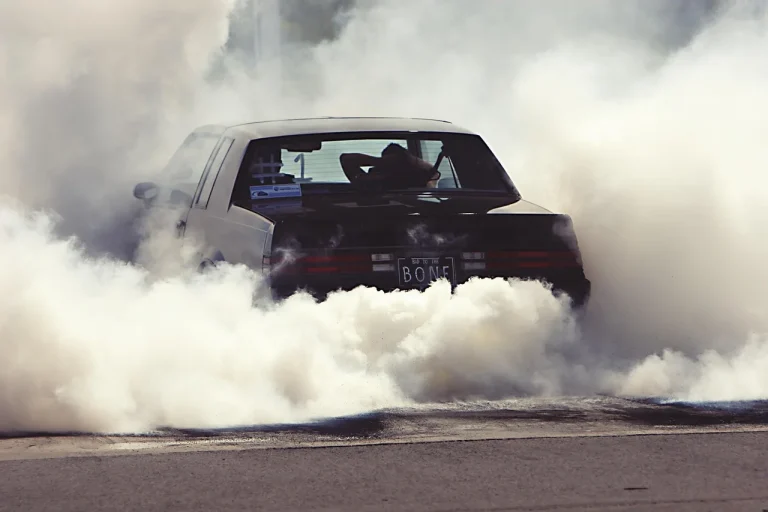
A burnout changes two things. It clears dust, pebbles, and moisture from the rear tread, and on some drag tires it adds enough heat to bring the compound into a better range for the launch.
Those jobs are separate. A street tire may need only a brief dry spin or about a very short clean-off after the rear tires touch water. A slick often wants more time because its construction and compound respond to deliberate heat.
Why the target changes with tire construction
Street tires, drag radials, and slicks do not want the same routine. Street tires use tread blocks and road compounds, so extra heat can make them slick and inconsistent. Drag radials usually like a controlled burnout with visible but limited smoke. Slicks usually want the most heat and the most deliberate routine of the three.
That is why smoke alone is a poor guide. The same smoke level can mean “ready” on one tire and “overdone” on another.
What a burnout cannot fix
A burnout will not cure bad launch rpm, poor clutch release, a traction-control setting that is still active, or a lane with less prep than the other side. It also will not fix wheel hop. If the rear differential chatters, one tire spins harder than the other, or the engine cuts power, diagnose the cause instead of adding throttle.
Suppose a street car on 245-width summer tires leaves the line worse after a longer burnout than after a short clean-off. That points to an overheated tire, not a need for more smoke.
Do you need a burnout at all?
Usually, no for plain street tires, maybe for drag radials, and yes for slicks. Start with tire type, then adjust for lane prep, weather, and how the car reacts. Beginners usually gain more from the same short procedure every pass than from copying a long burnout built for a different tire.
Street tires on a true street car
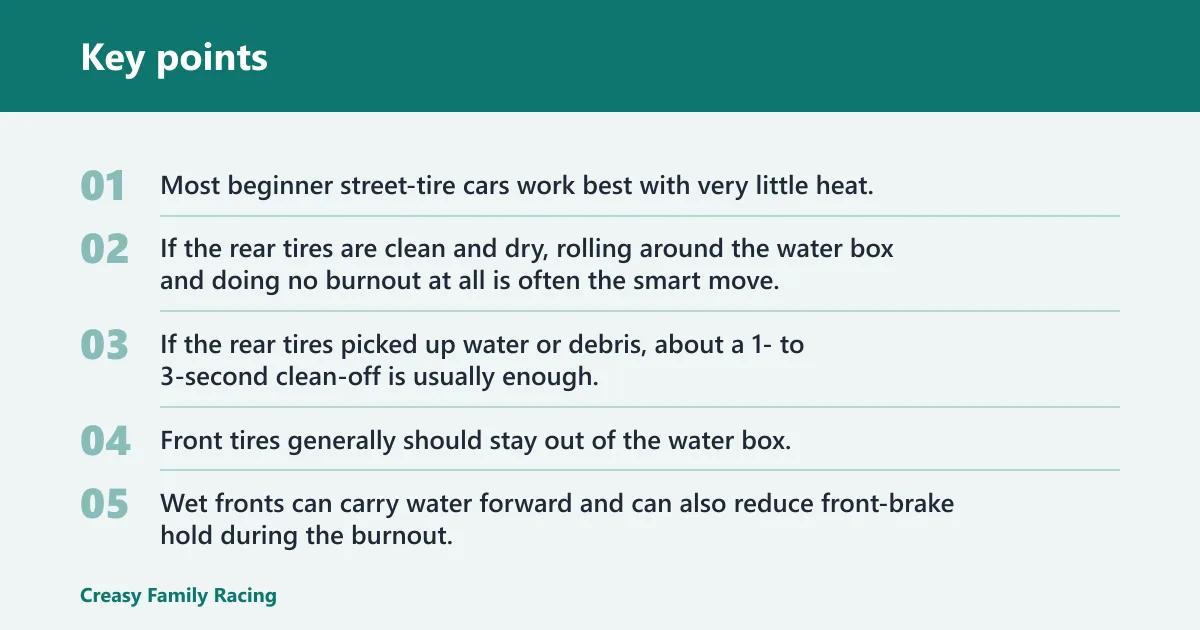
Most beginner street-tire cars work best with very little heat. If the rear tires are clean and dry, rolling around the water box and doing no burnout at all is often the smart move. If the rear tires picked up water or debris, about a 1- to 3-second clean-off is usually enough.
Front tires generally should stay out of the water box. Wet fronts can carry water forward and can also reduce front-brake hold during the burnout.
Drag radials on a street-strip setup
Drag radials usually want more than a street tire but less than a slick. A short, controlled burnout that cleans the tread and builds some heat is typical. The goal is even tire speed and light, steady smoke, not a long display.
Lane prep matters here. On a well-prepped lane, many drag radials respond well to a modest burnout. On a marginal lane or in cool weather, they may want a little more time, but the stop cue is still tire behavior, not crowd reaction.
Slicks on a dedicated drag setup
Slicks generally need the most deliberate burnout because they respond strongly to heat and tread cleaning. The routine is still about consistency. Roll the rear tires through the water, begin the burnout in the same spot each pass, and stop once the tires are clean and producing steady smoke.
For beginners, more is not automatically better even on slicks. A car that starts to wander, chatter, or hit the limiter is telling you the routine has stopped helping.
How lane prep and weather change the call
Track prep changes the recommendation, especially for beginner street cars. A hot day and a sticky lane can make street tires greasy in a hurry. A cool evening and a dusty return road can make a short clean-off more useful than usual.
Picture a bracket-style street-strip car on drag radials during a cool night session. A short dry spin may leave dust on the tread, while a controlled burnout after wetting only the rear tires can give a cleaner, more repeatable launch.
Water box positioning
Where the rear tires should enter the water
The water box is the wet prepped area used before a burnout. Rear-tire placement matters because the water is there to wet the drive tires, not to soak the whole car. Roll forward so the rear tires enter the water box, then stop before the front tires do if the layout allows.
Why the front tires usually stay dry
Keeping the front tires out of the water cuts two common problems. First, dry front tires hold the car better when you apply the brakes or line lock. Second, dry fronts are less likely to drag water toward the starting line, which can hurt the launch.
Where to start and where to stop rolling
You need the same sequence every pass. Wet the rear tires, then roll out of the deepest water before starting the burnout so the tires clean and heat on drier pavement instead of spraying water through the whole spin.
Track rules and starter instructions matter here. Some tracks want the burnout to start in the box, some want it just past the box, and some are strict about where you stop. Follow track staff direction every time.
How do you do a burnout in an automatic car?
Use the brakes or line lock to hold the front, bring the engine up smoothly, let the converter flash enough to start rear-tire spin, then keep the burnout short and even. Automatics are usually easier for beginners because the converter cushions some shock, but too much brake, too much time, or traction control left on will spoil it.
Without line lock
- Disable traction control. Many cars need more than one button press or a menu setting to fully disable power reduction and brake intervention. If the system is partly active, it may cut throttle or brake a spinning rear wheel.
- Stage the rear tires. Put only the rear tires into the water box, then roll forward to the chosen burnout spot. Keep the front tires dry if possible.
- Hold firm brake pressure. Use the left foot to hold the car with the front brakes while selecting the gear that normally starts the burnout cleanly, often first gear or the transmission’s low range if the car allows it. Too much brake can bog the engine before the rear tires start to spin.
- Feed in throttle. Increase throttle smoothly until the rear tires break free. Once they spin, maintain enough rpm for even tire speed rather than stabbing the pedal and shocking the driveline.
- Stop and roll out. End the burnout once the tire type’s stop cue appears: brief clean-off for street tires, light even smoke for many drag radials, steadier smoke for slicks. Release the throttle, ease off the brake, and roll forward without dragging the brakes.
With line lock
- Set the line lock. Line lock is a front-brake holding device that keeps pressure on the front brakes while freeing the rear brakes. On a street/drag car, it makes the burnout easier and reduces heat in the rear brakes.
- Wet only the rears. Enter the water box far enough to wet the rear tires, then roll to the burnout spot. Starting on less standing water helps the tires clean faster.
- Bring up rpm smoothly. Apply throttle until the rear tires spin cleanly. Because the rear brakes are not dragging, the car usually starts the burnout with less throttle than a foot-brake attempt.
- Watch the cues. Keep the burnout even and short for the tire in use. The useful sign is stable spin and the right amount of smoke, not a long count for every car.
- Release and drive out. Lift off the throttle, release line lock, and let the car roll forward under control. Do not stab the brakes at the end, which can upset the rear tire surface you just prepared.
Converter behavior and gear choice
An automatic’s torque converter can help start tire spin because it multiplies torque during the initial hit. If the engine bogs before the tires turn, the brakes may be overpowering the converter, the wrong gear may be selected, or the tire has too much bite for the available torque.
A common beginner drag-racing mistake is staying in the water box too long and overheating the tires during the burnout. If the engine lugs and the tires never cleanly spin, go back to the lower gear the car uses for launch-side torque multiplication.
How do you do a burnout in a manual car?
Use the clutch only long enough to start the spin, then get fully off it and let the tires do the work. Manual cars see more driveline shock than automatics, so the key is a clean release, moderate rpm, and an immediate abort if the car hops, chatters, or smells the clutch instead of spinning the tires.
Clutch release and throttle timing
- Disable the nannies. Traction control and stability systems can cut power during the spin or apply a brake to one wheel. Confirm the car is in its most permissive setting before entering the water box.
- Place the rear tires. Wet the rear tires, then roll to the burnout spot with the fronts still dry if possible. That gives better brake hold and keeps water off the line.
- Select a suitable gear. First gear is common, though some combinations behave better in second because the tire speed comes in smoother. The right choice is the one that starts spin without a violent hit.
- Release the clutch cleanly. Bring the engine to a moderate rpm, begin the release, and once the rear tires spin, get the clutch fully engaged. Riding the clutch through the whole burnout adds heat and wear fast.
- Abort at the wrong signs. If the car chatters, wheel hops, or the engine flares while the tires do not spin cleanly, stop. Continuing through hop or clutch slip is how parts get hurt.
Why manual cars see more driveline shock
A manual links the engine to the driveline more directly during the burnout. A sudden clutch release can shock the rear differential, axles, driveshaft, and transmission input parts. That risk goes up if the tire grabs hard, then unloads, which is exactly what wheel hop does.
Manual cars therefore reward clean, repeatable inputs more than aggression. If the car needs a heroic clutch dump to spin the tires, the routine is already off track.
When to abort to save the clutch and driveline
Stop if the clutch smell gets stronger than the tire smell, if the car lunges without spinning, or if one tire snaps in and out of traction. Uneven spin can hint at rear differential behavior, surface difference across the lane, or a setup issue that more throttle will only hide for a moment.
When street tires make a burnout worthwhile
On street tires, a burnout is usually a short, situational tool—not a requirement. The main reasons to do one are simple: the tires are cold, damp, dusty, or sitting on a track surface that needs a little cleanup before the launch. If the tires already have clean grip, skipping it is often the safer choice because extra heat can reduce traction, stress parts, and make the car less predictable.
The supporting article on street tire burnouts breaks down when a brief burnout helps, how drivetrain layout changes the decision, and how long is “enough” without overdoing it. That matters because the right call depends on both tire condition and car setup, not just habit.
Burnout decision table
Beginner tire guide
| Tire type | Drivetrain | Do a burnout? | Stop cues / failure signs |
|---|---|---|---|
| Street tire | Automatic RWD | Usually skip it, or do a 1- to 3-second clean-off only if the rears touched water or picked up debris. | Stop as soon as the tires clean and spin evenly. Failure signs: greasy feel, rpm flares with poor acceleration, smoke keeps building with no gain. |
| Street tire | Manual RWD | Usually skip it. If needed, keep it extremely short to avoid clutch heat and tire overheating. | Stop almost immediately after clean spin begins. Failure signs: clutch smell, chatter, hop, or the car surging instead of spinning cleanly. |
| Drag radial | Automatic RWD | Yes, usually a controlled short burnout after wetting only the rear tires. | Stop at light, even smoke and stable spin. Failure signs: abrupt power cut, the car pulling sideways, or smoke increasing after the tire is already clean. |
| Drag radial | Manual RWD | Yes, but keep clutch slip brief and avoid a harsh hit. | Stop when smoke is even and the spin is smooth. Failure signs: wheel hop, clutch slip, one-tire chatter, or bogging before spin starts. |
| Slick | Automatic RWD | Yes, usually the most deliberate burnout in this group. | Stop when the tires are fully cleaned and producing steady smoke with stable engine speed. Failure signs: wandering, limiter contact, or vibration through the driveline. |
| Slick | Manual RWD | Yes, but only with a clean engagement and no hop. | Stop at steady smoke and smooth spin. Failure signs: repeated clutch slip, wheel hop, or drivetrain bang on engagement. |
Troubleshooting checklist
- Check traction control. If the car will not spin in the water box or cuts power abruptly, confirm traction control and stability control are fully disabled. Some cars need a long press, a separate track mode, or both.
- Review water-box placement. If the tires never clean up, the rear tires may still be sitting in standing water or the fronts may have carried water forward. Wet the rears, then start the burnout on the drier patch beyond.
- Change the starting load. For no-spin, reduce brake pressure slightly in an automatic or use a cleaner clutch release in a manual. If the engine bogs, the tire may be biting too hard for the torque available at that moment.
- Stop at wheel hop. Hop is rapid tire and chassis oscillation. It can point to suspension movement, tire pressure, clutch release, surface grip, or shock control, and continuing through it is hard on the rear differential, axles, and driveshaft.
- Shorten the burnout. If traction gets worse after a smoky burnout on street tires, the tires are likely overcooked. Cut the burnout back to a brief clean-off or skip it next pass.
When should you stop the burnout?
Stop when the tire has done its job, not when the smoke looks dramatic. For street tires, that usually means almost immediately after a clean spin begins. For drag radials and slicks, stop once the smoke is light and even and the tire speed is stable. If the car starts hopping, wandering, or feeling greasy, you already went too far.
Ready cues on street tires
Street tires are ready once they are clean and dry enough for the launch. That may be no burnout at all, a quick dry chirp, or a 1- to 3-second spin after touching water. More time usually adds heat without adding grip.
Ready cues on drag radials and slicks
Drag radials usually like a shorter burnout than slicks. Look for consistent engine note, even tire speed, and light, steady smoke. Slicks often tolerate and want a bit more, but the same rule applies: once the tire is clean and the heat is there, stop and roll out.
Signs the tires are overcooked
On street tires, the classic sign is a greasy feel on the launch. The car spins sooner and feels less settled. On drag radials, too much heat can also make the car inconsistent. On any tire, if the burnout gets longer while the tire behavior gets less stable, the extra heat is not helping.
What can go wrong during a burnout?
No-spin, wheel hop, uneven spin, and abrupt power cut are the main beginner problems. Each points to a different cause: electronics still active, wrong placement in the water box, poor brake-throttle or clutch timing, or a traction and setup issue. The fix is to identify the pattern quickly and stop forcing the car through it.
No tire spin in the water box
If the car will not spin, check traction control first. Then look at brake pressure, gear choice, and water-box position. Too much brake in an automatic can hold the car so hard the engine bogs. In a manual, too gentle a release slips the clutch instead of spinning the tires.
Say your automatic street car on drag radials is in the water, traction control is off, and the engine only noses over against the brakes. Roll out of deeper water, reduce brake pressure slightly, and try again where the tires can clean instead of hydroplaning.
Wheel hop and chatter
Wheel hop is a rapid grab-release cycle of the tire and chassis. It is bad news during a burnout or a launch because the shock loads bounce through the rear differential, axles, driveshaft, and transmission. Do not drive through it. Stop, cool down, and look at tire pressure, shock settings if adjustable, clutch release, and lane condition.
Uneven spin, bogging, or abrupt power cut
Uneven spin can hint at surface differences left to right, an issue in how the rear differential is transferring torque, or one tire carrying more load. Bogging usually points to too much brake, too high a gear, or too much bite. Abrupt power cut often means traction control is still stepping in.
Can a burnout damage your car?
Yes, especially when it includes clutch slip, wheel hop, abrupt tire shake, or long periods of heat. Manuals risk clutch and gearbox shock. Automatics can build heat and shock the driveline if the tires hook and release violently. The rear differential, axles, and driveshaft are all at risk when the burnout is aggressive or badly controlled.
Clutch and manual-transmission risk
A manual burnout can burn the clutch quickly if the driver rides it instead of getting fully engaged once the tires spin. The transmission also sees sharp torque reversals if the tires grab and unload. That is why a short, clean engagement matters more than chasing smoke.
Automatic-transmission heat and shock
Automatics avoid clutch wear, but they are not immune. Holding the car against the brakes for too long builds heat, and a hard tire shake can still hit the transmission, converter, and driveshaft. Line lock helps because it lets the rear tires spin without dragging the rear brakes.
Rear differential, axle, and driveshaft stress
The rear differential transfers torque to the rear wheels. If the burnout shows chatter, snapping engagement, or one wheel behaving differently from the other, take it as a clue. Something in the surface, setup, tire pressure, or differential action may be off. Repeating the same violent burnout only increases the load on the diff, axles, and driveshaft.
Frequently asked questions
Why do drag racers do a burnout?
They do it to clean the rear tread and, on drag tires, to add useful heat before the launch. That improves consistency when the tire type wants it. It is not automatic for every car, though. Many street-tire cars lose grip if the burnout is long.
Do you need to do a burnout on street tires?
Usually no, or only a very short clean-off if the rear tires touched water or picked up debris. Street tires often work best with minimal heat because long burnouts can make them greasy. For a beginner street car, skipping the burnout is often the better baseline.
How long should a burnout last on street tires?
On street tires, a common beginner window is none at all or about 1 to 3 seconds of clean spin if needed. The stop cue is clean, even tire rotation, not a big cloud of smoke. If traction gets worse afterward, the tire was likely overheated.
Should you use line lock for a burnout in a street car?
It helps, but it is not required for every beginner. Line lock holds the front brakes only, which makes the burnout easier and reduces rear-brake drag and heat. Without it, a foot-brake burnout can still work, but brake-throttle balance becomes more sensitive.
Why won’t my car spin the tires in the water box?
Common causes are traction control still active, too much brake pressure, the wrong gear, weak clutch or throttle timing, or trying to spin while still sitting in deep water. Roll to a drier spot, confirm the electronics are off, and use a cleaner, more deliberate input.
Why does my car wheel hop during a burnout?
Wheel hop comes from the tire grabbing and releasing in a fast cycle, often tied to suspension movement, tire pressure, clutch release, or a patchy surface. Stop immediately if it happens. Continuing through hop puts sharp shock loads into the differential, axles, driveshaft, and transmission.