Driving Gloves for Track Days and Autocross
For track days and autocross, choose non-FIA driving gloves with external seams and a thin palm; if sessions run past about 20 minutes or your hands sweat, it is often sensible to prioritize breathable backs and tackier suede or silicone-grip palms. Get it wrong and you give up steering feel, invite hot spots, let the wheel slip, and add wear to Alcantara or leather. This guide breaks down palm materials, seam layouts, cuff styles, cooling, sizing, and phone-friendly options by wheel type and session length.
That advice matters because autocross and lapping days stress your hands in different ways. Autocross packs in quick hand-over-hand inputs, lock changes, and heat soak between short runs. HPDE keeps your hands on the wheel much longer, so seam pressure, sweat buildup, and small fit errors have time to turn into blisters or numb fingertips.
These are track tools, not race gloves and not fashion pieces. The goal is better wheel contact, cleaner steering inputs, less sweat on the rim, and less hand irritation without moving into full racing gear such as the Sparco Arrow Evo Rg-7, which The Drive identifies as racing-oriented, FIA-compliant, and SFI-compliant.
When gloves help and when they don’t
Yes, if your hands sweat, your sessions stack up, or your wheel surface is sensitive to oils. They matter less for casual short use with stable grip and a smooth leather wheel. The biggest gain is usually consistency: the same steering feel on run one and later in the day, with less wheel contamination.
Where they help most
Autocross rewards quick transitions. A glove with a thin palm and a clean seam layout can keep the wheel from shifting in your hand during rapid left-right inputs, especially when the wheel needs a lot of rotation. Fingerless designs can feel airy, but they also leave parts of the thumb base and upper fingers exposed where the wheel slides most.
HPDE asks different questions. A format such as Chin Track Days uses only three run groups, and sessions rotate every 30 minutes. That cadence brings repeated heat, sweat, and wheel pressure through the day, so ventilation and seam comfort move ahead of style or touchscreen tricks.
When they add little
If your local use is one or two mild, short runs with dry hands and a plain leather wheel, gloves may not change much. The value drops more when the glove is too thick, too loose, or built with interior seams that bunch under the palm. In those cases, bare hands can give better feedback.
A common first-timer mistake is buying a soft street glove because it looks minimal, then using it for repeated hard steering on a cone course. The palm twists, the fingertip seams bite, and the glove feels worse on the third run than it did in the paddock.
📊 The Drive says decent driving gloves can cost $60-$90. Source: Best Driving Gloves (Review & Buying Guide).
Event glove decision table
| Event type | Wheel material | Hand condition | Recommended glove attributes |
|---|---|---|---|
| Autocross | Leather | Dry | Thin leather or thin synthetic; light finger perforation; external or reverse seams; short cuff; budget to midrange |
| Autocross | Leather | Sweaty | Synthetic or perforated leather; perforated fingers and back of hand; external seams; short cuff with easy entry; midrange |
| Autocross | Alcantara | Blister-prone | Clean, low-nap palm surface; minimal reinforcements; external seams; short cuff; midrange to premium |
| HPDE | Leather | Dry | Soft leather palm with controlled stretch; moderate perforation on fingers/back; external seams; short cuff or elastic entry; midrange |
| HPDE | Leather | Sweaty | Synthetic or mixed-material glove; palm grip zones for sweat; strong back-of-hand ventilation; external seams; short cuff; midrange |
| HPDE | Alcantara | Sweaty | Clean synthetic or smooth leather palm with no oily finish; finger and back perforation; low-bulk seams; short cuff; premium if used often |
| Hot-track day | Leather | Sweaty | Synthetic-first construction; maximum back/finger perforation; external seams; easy on-off cuff; midrange |
| Hot-track day | Alcantara | Sweaty | Breathable glove with clean palm finish and low lint; avoid heavy suede patches; external seams; short cuff; premium |
| Cool-weather lapping | Leather | Dry | Leather glove with fewer perforations; thin palm; external seams; elastic or snap entry; budget to midrange |
| Cool-weather lapping | Alcantara | Dry | Smooth, clean palm material; limited perforation; low-profile seams; short cuff; midrange |
Which material works best for your use?
Leather gives the closest, least filtered steering feel and the most direct contact with the wheel, synthetic handles heat and sweat better over a full event day, and fingerless gloves fit only narrow use cases. For repeated performance driving, the right answer depends on wheel surface, hand moisture, and whether you need all-day comfort more than a traditional glove feel.
Leather
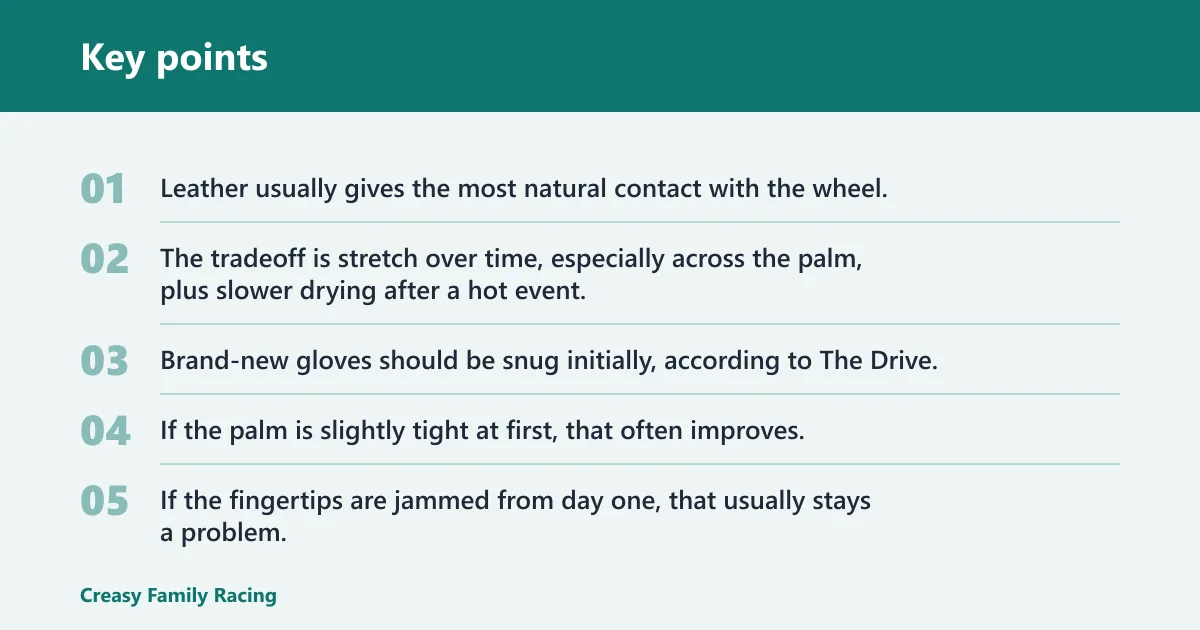
Leather usually gives the most natural contact with the wheel. A well-cut leather palm stays thin across the contact patch, slides predictably during hand shuffles, and suits standard leather rims especially well. The tradeoff is stretch over time, especially across the palm, plus slower drying after a hot event.
Brand-new gloves should be snug initially, according to The Drive. That matters most with leather because it usually relaxes in width sooner than it gives up finger length. If the palm is slightly tight at first, that often improves. If the fingertips are jammed from day one, that usually stays a problem.
Synthetic
Synthetic gloves usually move sweat and heat better through long sessions, dry faster between runs, and cost less to replace once the palm gets slick or worn. They also tend to hold shape better after repeated damp sessions. For drivers in hot climates or drivers who run monthly HPDE, that can matter more than the softer feel of leather.
Synthetic palms vary a lot. Some use tacky silicone zones that help on smooth leather wheels with sweaty hands. Others use coarse anti-slip textures that can feel grippy at first but mute steering feedback or drag oddly on Alcantara.
Fingerless
Fingerless gloves reduce heat and leave the fingertips free for phone use, zippers, and small paddock tasks. The Drive says Triton gloves are fingerless. That style can work for short autocross use with dry hands, but it is a compromise once steering loads rise.
The missing fabric at the fingers can expose contact points where the wheel rubs during fast shuffling. Fingerless cuts can also leave a seam edge near the knuckles or thumb webbing, which is exactly where a long session turns mild rubbing into a hot spot.
How should driving gloves fit?
They should feel snug at first, with no loose palm folds, no fingertip compression, and no seam pressure when you close your hand around a wheel. If you are between sizes, The Drive recommends buying the smaller size, but that only works when finger length is still correct.
Palm width versus finger length
Palm width is easier to fix than finger length. A slightly snug palm can settle in, especially with leather. Fingers that are too long leave extra material at the tips, which blunts wheel feel; fingers that are too short press the nails and can numb the hand under load.
Suppose a medium fits your palm but leaves extra length past the index and middle fingertips. That extra fabric will bunch first in autocross transitions, because the wheel moves quickly through the fingers. A smaller size may solve it only if the thumb crotch and palm seam do not become tight enough to pinch.
Seam bite is part of sizing
Fit is not only circumference. Close your hand as if gripping the wheel and feel where seams land across the fingertips, along the outside of the pinky, and across the base of the thumb. Those pressure lines predict blisters better than a size chart does.
How to buy the right fit on the first order
- Check the size chart. Start with the maker’s chart, then compare that result with your usual glove size. Use the chart to narrow the range, not to settle the decision, because palm width and finger length often scale differently.
- Bias smaller carefully. If you fall between sizes, use the smaller size only when the fingertips still lie flat and the glove closes without pulling hard across the thumb web. The Drive recommends buying the smaller size between sizes, but fingertip crush is a stop sign.
- Simulate wheel grip. Close both hands firmly several times, then twist the wrists as if unwinding a slide or crossing hands in a slalom. Watch for palm wrinkles, fingertip pressure, and any seam that shifts into the contact patch.
- Prioritize finger length. Reject gloves with extra fingertip fabric or short, nail-pressing fingers even if the palm seems fixable. Finger-length mismatch is harder to solve than mild palm tightness, especially on leather models that loosen through the palm first.
- Consider your sweat level. Sweaty hands usually do better with a close synthetic fit that does not bag out after damp use. Dry hands can live more easily with leather that starts snug and softens with break-in.
What glove details matter most under load?
Seam placement, perforation zones, palm texture, and cuff design matter more than branding once the wheel is working your hands hard. Under repeated steering load, poor seams create hot spots, poor ventilation traps sweat, and the wrong grip texture either slides on leather or drags on Alcantara.
Palm stitching and reverse seams
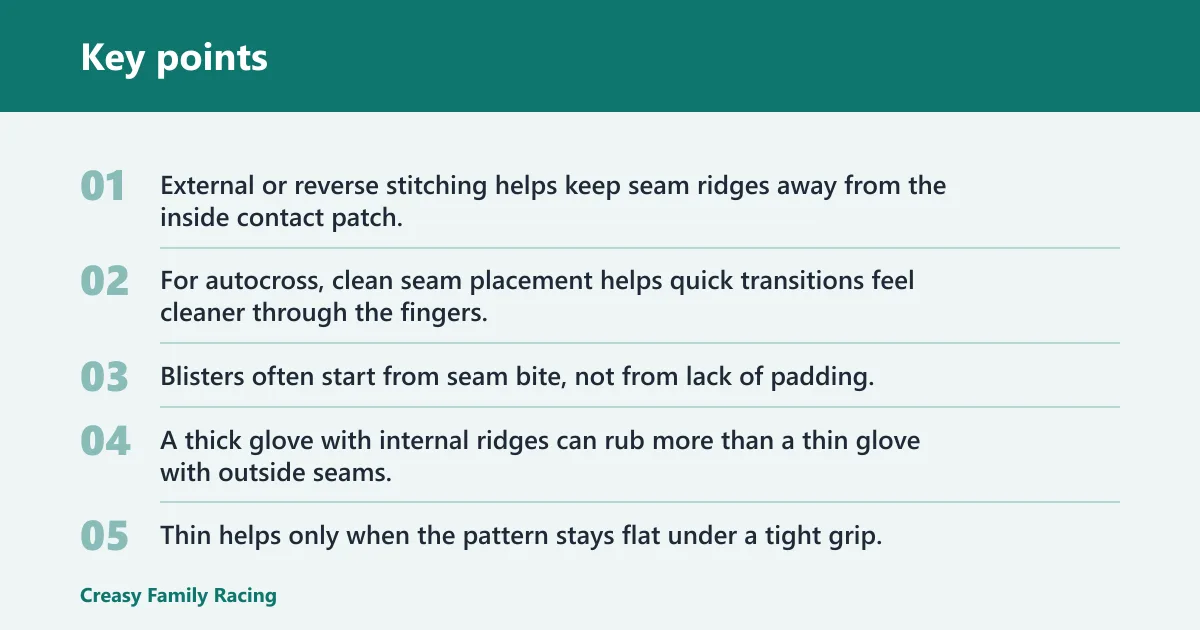
External or reverse stitching helps keep seam ridges away from the inside contact patch. That is a big plus for longer sessions, because interior seams compress harder the longer the hand stays wrapped around the wheel. For autocross, clean seam placement helps quick transitions feel cleaner through the fingers.
Blisters often start from seam bite, not from lack of padding. A thick glove with internal ridges can rub more than a thin glove with outside seams. Thin helps only when the pattern stays flat under a tight grip.
Perforation and ventilation
Finger perforations help vent the area that sweats and flexes the most. Back-of-hand perforation sheds heat with less effect on grip. Palm perforation is useful only when it does not remove too much contact patch or place holes right where the wheel loads the skin.
For hot weather, look first at the back of the hand and finger sides. Those zones cool better without weakening the palm. Heavy palm perforation can feel airy in the paddock but reduce stability once sweat makes the wheel slick.
Grip texture and reinforcement
Suede-like palm finishes, silicone grips, and reinforced patches all solve different problems. Suede and light anti-slip textures can help on smooth leather wheels with damp hands. Large reinforcement patches can add durability, but if the patch edge sits across the wheel contact line, feedback gets fuzzy.
For sweaty hands, grip should come from surface control, not bulk. A tacky palm with a thin base layer usually works better than a heavily padded glove. Padding can trap heat and increase palm movement inside the glove.
Cuff and closure choices
Short cuffs are usually the practical choice here. They go on fast, clear watches and sleeves, and avoid catching on jacket cuffs when getting belted in. Snap tabs, hook-and-loop straps, and elastic entries all work, but none should be mistaken for real wrist support.
The Drive says Dents Silverstone gloves have elasticized wrists. That style makes quick on-off easy in the paddock. The tradeoff is less adjustability than a strap closure, which matters if your hands swell in heat or if you want the glove to stay put while pulling it on with damp skin.
What should you use with a leather or Alcantara wheel?
Use smooth, clean palms on leather wheels and especially on Alcantara wheels. Leather rims generally tolerate more glove variation, while Alcantara is less forgiving of oily, dirty, or overly abrasive palm materials. The wrong glove can reduce grip on suede-like covers and load the surface with grime faster.
Leather wheels
Standard leather wheels respond well to thin leather or synthetic palms. The main risks are sweat slickness and oil transfer from bare hands. A glove helps most here when the wheel gets slippery after several runs or when the rim finish is smooth enough that a damp palm starts to skate.
Alcantara wheels
Alcantara changes the equation. Dirty leather gloves can transfer oils and grime into the nap, and rough, fuzzy palm materials can abrade the surface or make it feel draggy rather than secure. A cleaner, smoother palm usually works better than a very tacky or hairy one.
Picture an Alcantara wheel late in summer after repeated sessions. A glove with a grimy leather palm may feel sticky in one corner and slick in the next because the surface loads with sweat and dirt. Cleaning the glove often matters as much as the original material choice.
When gloves reduce grip
Gloves can make things worse on suede-like wheel covers when the palm finish is too coarse, too fuzzy, or contaminated. Instead of sliding smoothly through a hand transition, the wheel catches, then releases. That is bad for autocross timing and annoying on track, where tiny corrections should feel even.
What should you spend on track-use gloves?
Spend by event frequency and wheel sensitivity, not by marketing tier alone. Budget gloves can suit occasional autocross, midrange can suit regular HPDE or hotter climates, and premium can make sense when fit precision, seam quality, or an Alcantara wheel raises the cost of getting it wrong.
Budget
Entry-level track-use gloves are best for occasional autocross and first HPDE days. Expect simpler seam work, fewer ventilation zones, and less durable palms once they get soaked with sweat repeatedly. They can still work fine if your use is limited and your wheel is standard leather.
Midrange
The Drive says decent driving gloves can cost $60-$90. This is the sweet spot for many drivers. Here, fit gets more precise, perforation layouts improve, and palm materials usually do a better job balancing grip with steering feel.
Premium
The Drive says premium gloves can run $100-$250. At this level, the gains should be specific: better seam placement, cleaner finger patterning, more stable materials, and better comfort across repeated events. Premium is easier to justify if you run monthly, drive in heat, or want to protect an Alcantara wheel.
The Drive says Forzieri gloves include a two-year warranty. Warranty length is not a grip metric, but it can matter if you use one pair for mixed street and track duty and want some protection against early wear.
Touchscreen convenience
Touchscreen tips are useful in the paddock, not on course. The Drive says Riparo gloves are touchscreen-compatible. Conductive thumb and index fingertips save time with phones and timing apps, but they can slightly change fingertip feel and sometimes add a seam or panel right where precise feedback matters most.
How to buy the right pair without overbuying
Match the glove to your actual event use
- Define your event pattern. Decide whether the glove will see short autocross runs, repeated lapping sessions, or both. Autocross favors quick transitions and low bulk, while lapping favors seam comfort and sweat control over a longer continuous stint.
- Start with the wheel surface. If your wheel is leather, you have more material freedom. If it is Alcantara, stay away from dirty palms, coarse grip patches, and gloves that shed lint or carry oily conditioners.
- Choose the base material. Pick leather for the closest feel on a standard wheel, synthetic for hotter conditions and easier cleanup, and fingerless only for short-run use where exposed contact points will not become the main rubbing zone.
- Screen the seam layout. Favor external seams or low-profile seam placement, then inspect the thumb base and fingertip ends. Those spots show up as hot spots first when steering input is heavy.
- Buy for the climate. In heat, put money into ventilation before decorative details. For cool-weather lapping, fewer perforations can be fine if the palm stays thin and the glove still closes cleanly around the wheel.
- Plan cleaning frequency. Track-only gloves can be cleaned after event weekends or whenever sweat salt and dirt are obvious. Gloves used often on the street need more frequent care because they load up faster and then transfer that grime back to the wheel.
Care tied to use, not vanity
Leather gloves should be kept clean and dry because sweat salts stiffen the palm and can dirty the wheel. Synthetic gloves are usually easier to maintain and recover faster between events. Alcantara-wheel owners should be stricter about glove cleanliness, since contamination shows up on the wheel sooner and grip can fall off before the glove itself looks worn out.
Frequently asked questions
What are driving gloves?
For this use, they are non-race gloves meant to improve wheel contact, manage sweat, and reduce hand irritation during performance driving. They sit between casual street gloves and certified racing gloves, with more focus on thin palms, seam comfort, and wheel protection than on fashion or fire certification.
How do I get the right size driving gloves?
Start with the maker’s chart, then judge the glove by palm tension, fingertip length, and seam pressure with your hand closed. The Drive says brand-new gloves should be snug initially, and The Drive recommends buying the smaller size if you are between sizes, but only if finger length still fits cleanly.
What driving gloves work best for sweaty hands
Synthetic or mixed-material gloves with strong back-of-hand and finger ventilation usually work best. Add external seams and a thin tacky palm, ideally suede-like or light silicone grip, so the hand stays planted without thick padding. Avoid bulky leather with weak ventilation if your sessions or climate run hot.
What driving gloves should I use with an Alcantara wheel?
Use a clean glove with a smooth, low-bulk palm and minimal abrasive patches. Synthetic or smooth leather can work, but dirty palms and coarse grip finishes can contaminate the surface or create uneven drag. On Alcantara, glove cleanliness matters almost as much as the original material choice.
Can driving gloves stop blisters on long track sessions?
Yes, but only when fit and seam layout are right. External seams, a snug palm, and stable material can cut rubbing a lot during longer stints. They fail when fingertips are too short, palms bunch under load, or seam ridges land on the thumb base and finger contact points.
What should I spend on driving gloves for track use?
For occasional use, keep spending modest and prioritize fit over extras. The Drive says decent driving gloves can cost $60-$90, which is a solid middle ground. The Drive says premium gloves can run $100-$250; that makes more sense for frequent events, hotter conditions, or an Alcantara wheel.