How to Keep a Simple Autocross Notebook for Faster Runs
Keep two notebook layers: one line for every run, and one change log for each setup adjustment, so you can compare runs against a single variable. Without that split, notes turn into a memory dump, and you cannot tell whether a faster lap came from driving or a setup change. This guide shows the exact fields to record, how to track tire pressures and alignment changes, and how to turn each event into a test plan.
This guide is part of our First autocross: how to start with a street car series.
What you’ll need
- A small paper notebook or a notes app with offline access
- A pen that writes quickly and clearly
- Tire pressure gauge
- Paint marker or masking tape for tire labels
- Phone stopwatch or the event time sheet, if available
- A simple way to note the course, such as a sketch page or a photographed map
Autocross notebook template
The best template is short enough to finish between runs and strict enough to compare across events. Use exactly the same fields every time, so your notebook becomes a record of patterns instead of a pile of reminders.
-
Fill the event header.
Record the event name, car/class, and date at the top of the page. Add driver seat time if the event offers it, because two sessions with about 60 minutes of seat time are not the same as a 4-run local test day. -
Log run data.
Write the run number, raw time, and whether the run was clean, had cones, or was a DNF/lost-time run. That gives you the core comparison data before memory fades. -
Note setup and pressures.
Record cold tire pressure, hot tire pressure, and front/rear split, plus any alignment, shock, sway bar, traction control, or driver-aid setting already on the car. If a pressure changed between runs, write the exact amount. -
Capture the course and inputs.
Write the slowest corner, the key slaloms, the main braking zone, the biggest offset, and one driver-input note such as brake point, shift point, hand position, or throttle pickup. Those are the details that explain why a run changed. -
End with one test item.
Add one change tested, what felt different, and the next-event action item. Keep that next action item specific, such as “start 1 psi lower in front” or “hold third gear longer in the offset.”
| Field | What to write | Example |
|---|---|---|
| Event | Event name and date | July local autocross, 2026-08-12 |
| Car/class | Make, model, class | 2018 Mazda MX-5, SCCA STR |
| Weather | Ambient temp, surface, wind or rain, time of day | 82°F, dry concrete, light wind, late morning |
| Setup | Alignment, shocks, bar, aids | -2.8° front camber, sport dampers, TC on |
| Tire pressures | Cold, hot, front/rear split, changes between runs | Cold 34/32, hot 38/36, +1 psi rear after run 2 |
| Run log | Run number, raw time, cones/DNF | Run 3, 62.418, clean |
| Course memory | Slaloms, offsets, braking zones, slow corner | Late brake into the left sweeper; tight slalom on exit |
| Driver inputs | Brake points, shift points, hand position, throttle pickup | Earlier brake release, hands moved one inch lower, smoother pickup |
| Change tested | One change at a time | Front pressure dropped 1 psi |
| Next action | One specific step for next event | Start front tires 1 psi lower next event |
One-event autocross notebook template
event:
car/class:
weather:
setup:
tire pressures:
run-by-run times:
cone/DNF notes:
one change tested:
what felt different:
next-event action item:
Sample filled-in entry
event: Spring parking-lot autocross, 2026-05-17
car/class: 2020 Subaru BRZ, SCCA CAM T
weather: 74°F, dry asphalt, light breeze, afternoon
setup: -2.2° front camber, rear bar on middle hole, stability control off
tire pressures: cold 35/33, hot 39/37, front/rear split 2 psi
run-by-run times: Run 1 about 58.204, clean; Run 2 about 57.611, +1 cone; Run 3 about 57.420, clean
cone/DNF notes: one cone in slalom on run 2, no DNF
one change tested: rear pressure dropped 1 psi after run 1
what felt different: rear took a touch longer to rotate in the offset, but exit traction improved
next-event action item: start rear 1 psi lower and keep brake release earlier into the slalom
| Event | Clean runs | Best raw time | Change tested | Useful takeaway |
|---|---|---|---|---|
| Event 1 | 2 of 4 | 61.104 | No setup change | Brake point was early in the slowest corner |
| Event 2 | 3 of 4 | 60.512 | Front pressure -1 psi | Front grip improved on turn-in |
| Event 3 | 4 of 4 | 60.498 | Different line through slalom | Time gain came from cleaner driving, not setup |
What should you write down after each run?
Write the run number, raw time, cone or clean status, and any DNF or lost-time note before you forget the order. Add one sentence on the course section that mattered most, because about a 0.4-second loss in the slowest corner can mean more than a vague “felt off” note.
Run log essentials
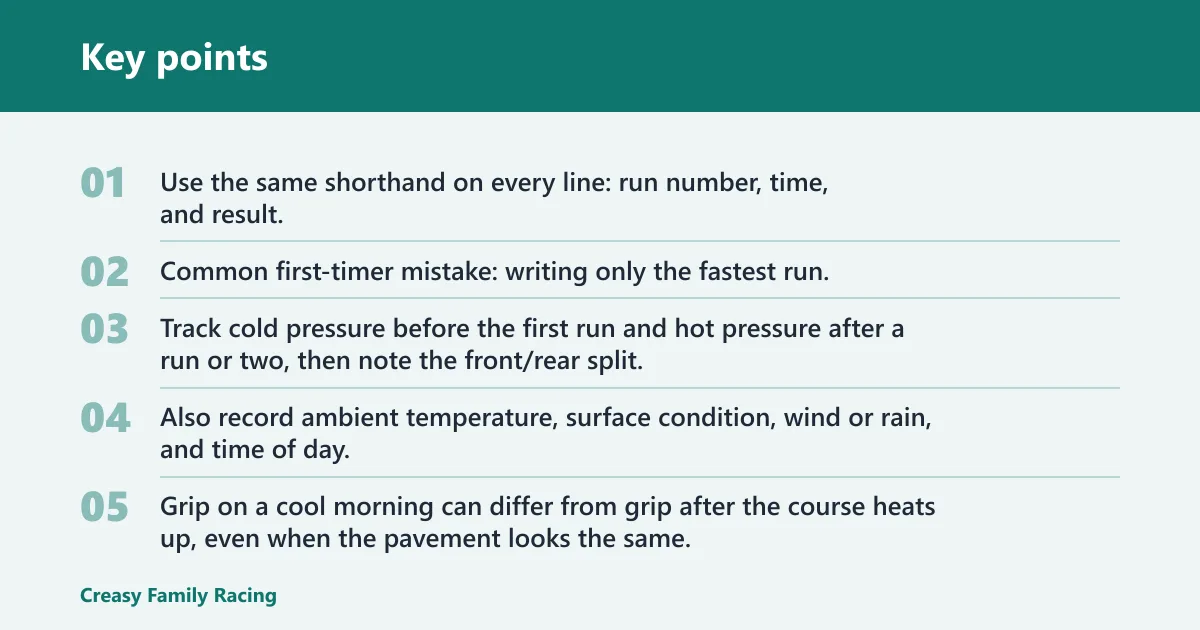
Use the same shorthand on every line: run number, time, and result. A clean 61.842 is far more useful than “pretty good,” because it can be compared with the next event, the same driver, and the same tire pressure.
Common first-timer mistake: writing only the fastest run. That hides the pattern of how the car and driver improved, and it makes it hard to tell whether a later mistake came from speed or from a different line.
Tire pressure and conditions
Track cold pressure before the first run and hot pressure after a run or two, then note the front/rear split. If the front starts at 34 psi cold and comes off at 38 psi hot while the rear stays at 36 psi, that split may explain a push or a loose exit.
Also record ambient temperature, surface condition, wind or rain, and time of day. Grip on a cool morning can differ from grip after the course heats up, even when the pavement looks the same.
Course memory and driver inputs
Mark the key slaloms, offsets, braking zones, and the slowest corner. Add one driver-input note such as “brake 10 feet later,” “short-shifted to second,” or “hands were high in the slalom,” because those details separate execution from setup.
Suppose a run is faster after a later brake point but the pressures and alignment did not change. That points to driver learning, not a setup shift, and the notebook should say so plainly.
How do you track changes without confusing the results?
Test one change at a time, and write down what you changed before the next run. If two things change together, the notebook cannot tell you which one moved the time, which means the next event starts with a guess instead of a plan.
-
Change one variable.
Adjust only one thing between runs: pressure, shock setting, bar position, traction control, or driving line. One change gives you one result. -
Record the expected effect.
Write what you expect before the run, such as “more front bite on turn-in” or “better rear traction on exit.” That keeps the note focused on a question, not a feeling. -
Compare against the same metric.
Use clean runs first, then look at the best raw time within similar conditions. A cone-heavy run can hide a real gain, while a clean run shows what changed.
For setup notes, include alignment settings, shock settings, stabilizer bar settings, and any traction-control or stability-control setting. If the car has adjustable dampers, write the click number or position. If the bar moves, note the hole. If the aid changes, write the exact mode.
When the result does not match the expectation, write that too. A softer rear may feel calmer but cost rotation in the slowest corner. That mismatch is useful data, because it tells you what to test next.
How do you spot patterns across events?
Look for repeated notes on the same course segment, the same tire-pressure window, or the same driver mistake. One event can be noise. Three events with the same slalom note or the same front-pressure trend can start to look like a pattern.
Compare clean runs first
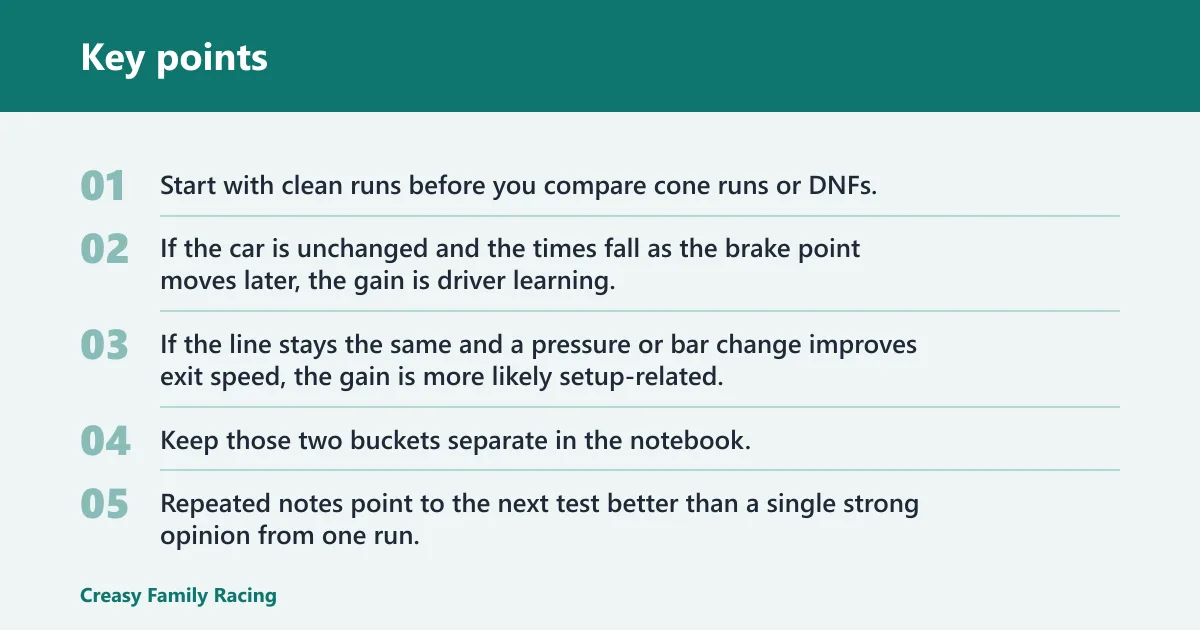
Start with clean runs before you compare cone runs or DNFs. A clean 61.4 against another clean 61.2 tells you more than a 60.9 with a cone, because lost-time penalties can hide the real pace.
Separate driver gains from setup gains
If the car is unchanged and the times fall as the brake point moves later, the gain is driver learning. If the line stays the same and a pressure or bar change improves exit speed, the gain is more likely setup-related. Keep those two buckets separate in the notebook.
A common beginner mistake is assuming a quicker lap after moving tire pressures means the change caused the improvement, when wind, traffic, or a cleaner line may have been the real reason. A later brake point, a cleaner hand movement, or a less rushed shift can produce the same time drop with no hardware change at all.
Find the repeat offenders
Circle the same complaint if it appears more than once: push mid-corner, loose on exit, hesitation in the slalom, or braking too early into the sweep. Repeated notes point to the next test better than a single strong opinion from one run.
That is where the notebook pays off. It turns the next event into a short, controlled test instead of a fresh guess.
Common mistakes
The biggest mistake is over-noting without structure. A page full of adjectives and no run numbers cannot help at the next event, and neither can a page with times but no context.
- Writing vague impressions. “Felt better” is weak unless it includes a run number, a change, and the part of the course that changed.
- Changing too many variables. If pressure, shocks, and driving line all change at once, the result is not readable.
- Skipping cold and hot pressure. A single pressure number hides the real split and makes future tuning less precise.
- Ignoring the course map. Slaloms and braking zones are often where time is won or lost, so leave space for them.
- Using notes that cannot be acted on. “Car was bad” is not a test plan. “Front pressure down 1 psi, then recheck hot” is.
Paper or phone both work. Paper is faster with gloves, dirt, and brief pauses between runs; a phone is better for search and backups. For most beginners, paper wins at the event and a phone photo of the page backs it up later.
Frequently asked questions
What should I write down after each autocross run?
Record the run number, raw time, clean or cone status, and any DNF or lost-time note. Add one short line on the key corner, slalom, or brake point that changed the run. That keeps the note short enough to finish before grid moves on.
How do I keep an autocross notebook that actually helps me get faster?
Use the same fields every event and split the page into run notes and change notes. The run notes show pace, while the change notes show cause and effect. That structure makes it possible to compare events without guessing which part of the page matters.
What tire pressure notes should I track at autocross?
Write cold pressure, hot pressure, front/rear split, and any pressure change between runs. Include the run number next to the change. Without all four items, the notebook cannot tell you whether a handling change came from heat, balance, or a pressure adjustment.
How do I know which changes made me faster at autocross?
Test one change at a time and compare clean runs under similar conditions. If the time drops right after a single pressure or setup change and the same driving notes repeat, that change likely mattered. If the brake point or shift point changed too, separate driver gain from setup gain.
What should I record about course conditions at an autocross event?
Note ambient temperature, surface condition, wind or rain, and time of day. Add one line for the slowest corner or the section that changed grip most. Those details explain why the same car can feel different from one run to the next.
Should I use a paper notebook or phone notes for autocross?
Use the faster tool at the event, which is usually paper. It is easier to scribble a run number, pressure change, and cone note in a few seconds. A phone works well for backup photos and later sorting, but it can be slower when the grid is moving.
How many runs should I log before I see a pattern?
Three events is a practical minimum for a real pattern, especially if one event had heat, rain, or many cones. Within a single event, two or three clean runs can still show a short-term trend. Across events, repeated notes matter more than one standout lap.
What mistakes make autocross notes useless?
Notes become hard to use when they are vague, incomplete, or overloaded. Skip one-word impressions, keep to one change at a time, and always include run numbers and conditions. A note that cannot be tied to a run or setup change is hard to act on later.
How do I turn autocross notes into a test plan for the next event?
Pick the most repeated issue, choose one change, and write the expected effect before the next run group. For example, “start front at 34 psi cold, expect better turn-in.” That gives the next event a clear goal and a single point to check afterward.