Why Do Track Tires Lose Grip After Too Many Heat Cycles?
Heat-cycled track tires lose grip because the compound ages, not because the tread disappears. Tread depth can still look legal while the rubber hardens, pressure behavior changes, and lap times fall off. The top signs are greasy mid-session feel, slower warm-up, and heat checking or glazing that shows the tire has gone past its fast window.
How repeated heating changes grip
A heat cycle is one full heat-up and cool-down. Repeated thermal exposure is a known aging mechanism: the rubber compound changes with use, and the tire can lose pace while the tread still looks serviceable.
That matters because tread depth and treadwear indicators only tell you part of the story. They help with legality and water evacuation, but they do not show how many heat cycles the compound has already absorbed. A tire can still have usable grooves and still be past its fast window if the rubber has changed from repeated heating and cooling.
One full cycle, track by track
On a track day, a cycle starts when the tire warms through cornering, braking, and drive off corner exit. It ends after the tire cools back near ambient temperature. Short sessions with long cool-down gaps can create more distinct cycles than one long stint, even if total track time is similar. That distinction is why cycle count is not the same thing as minutes on track.
Heat cycling matters because tire compound is a chemical system. Softer compounds usually give more initial grip, but they give up some life. Harder compounds tend to last longer, yet they often deliver less peak bite. Repeated heat drives change in the rubber, and that change can make a tire feel stale before the tread is gone.
Some tire service pages group sport and track tires together for a reason. Mounting, balancing, and wheel inspection all matter, and the same page may note that sport and supersport rubber needs correct mounting, precise balance, and matched pressures. That is a service reminder, not a fix for aged compound. It also makes the 200TW versus R-compound decision easier to frame when the tire is already losing its fast window.
Why do track tires lose grip after too many heat cycles?
Track tires lose grip after too many heat cycles because the rubber compound ages. Each full heat-up and cool-down can stiffen the tread surface, reduce compliance, and narrow the tire’s useful temperature window. The result is less bite on turn-in, less traction on exit, and a greasy feel before the tire looks worn out. That progression is consistent with race-tire guidance: heat affects the compound first, then the feel, then the stopwatch.
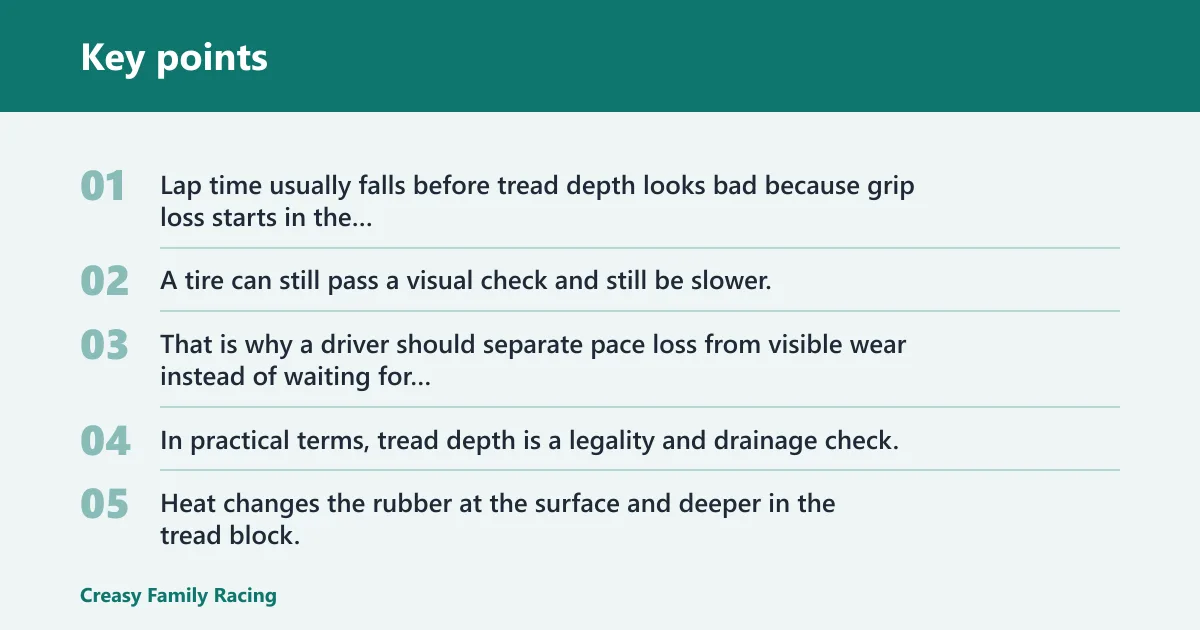
Lap time usually falls before tread depth looks bad because grip loss starts in the compound, not the grooves. A tire can still pass a visual check and still be slower. That is why a driver should separate pace loss from visible wear instead of waiting for cords or bald spots. In practical terms, tread depth is a legality and drainage check, while heat-cycle aging is a performance check.
How repeated heating hardens the compound
Heat changes the rubber at the surface and deeper in the tread block. The tire can become less compliant, which reduces the way it conforms to the pavement. That shows up as less mechanical grip, more slide, and a narrower operating band where the tire feels alive.
Suppose a 200TW tire starts a session crisp at cold pressures, then feels vague after three hard laps and a brief pit stop. If the next session feels worse even at the same starting pressures, the issue may be compound aging rather than a setup change. The key clue is that the loss repeats even after pressures are corrected.
Why lap time drops before tread looks worn
Track pace depends on the tire’s peak grip, not only on how much tread remains. A tire can keep legal depth and still lose the key last few percent of grip that matter in braking zones and fast corners. That is why the stopwatch often shows the problem before the eye does.
A common first-timer mistake is treating treadwear indicators as the only replacement trigger. Those bars only show minimum legal depth. They do not tell you whether the compound has already aged out for the pace you want. For road legality, the minimum tread-depth requirement depends on your jurisdiction and class rules; for track pace, the better question is whether the tire still delivers consistent grip.
200TW tires versus R-compound tires
200TW tires are street-legal track tires with a treadwear rating commonly used for autocross and track days. They are built to handle real street mileage and still work on track, but repeated heat cycles still pull grip down. R-compound tires are more track-focused and usually start with more bite, yet they can age out faster from cycling. If you want a practical comparison of how that plays out in use, the sport and track tires page is the right reference point for the broader category split.
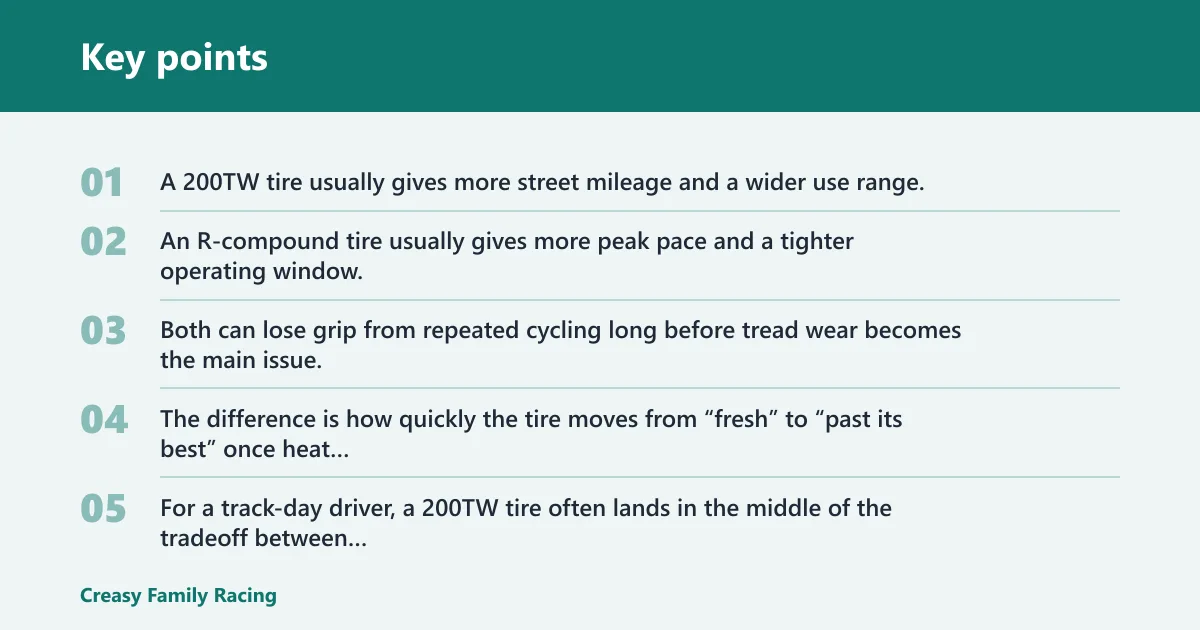
The split is simple. A 200TW tire usually gives more street mileage and a wider use range. An R-compound tire usually gives more peak pace and a tighter operating window. Both can lose grip from repeated cycling long before tread wear becomes the main issue. The difference is how quickly the tire moves from “fresh” to “past its best” once heat cycling starts to stack up.
Where 200TW tires usually land on the grip-life tradeoff
For a track-day driver, a 200TW tire often lands in the middle of the tradeoff between pace and life. It is meant for use on track days and still sees the street. The softer the compound, the more initial grip you usually get, and the sooner you should expect cycling effects to show up. In practice, that means the tire may stay usable for commuting long after it is no longer the best choice for fast sessions.
200TW framework: watch for the first signs of aging in turn-in precision, mid-corner support, and repeatability from session to session. If the tire still warms evenly, holds pressure, and only shows mild surface checking, it may still be fine for street use or low-stress lapping. If it starts to feel greasy earlier each session, loses consistency after a full cool-down, or needs more pressure compensation to feel normal, demote it to practice days or short sessions before retiring it from pace work.
Why R-compound tires can age out faster from cycling
R-compound tires are built for track work, so they often start with sharper response and more peak grip. That also means they may be more sensitive to repeated heat cycles, especially if sessions are long, temperatures are high, or pressures climb too far above target. The first thing that changes is not the tread depth; it is the way the tire comes in, holds peak grip, and comes back after cool-down.
R-compound framework: if the tire stops delivering its original bite, takes longer to “switch on,” or shows persistent heat checking after only a few hard events, move it out of competitive use sooner rather than later. R-compound tires are often the ones that should be demoted first to test days, coaching sessions, or low-consequence lapping when the compound has clearly stepped back from its best grip.
Heat cycle symptom table
| Symptom | Likely cause | How it feels on track | What to do next |
|---|---|---|---|
| Greasy mid-session feel | Compound has overheated or aged through repeated cycles | Car slides sooner, steering feels vague, rear traction falls off | Check pressures, reduce heat load, and inspect for cycling-related aging |
| Slower warm-up | Compound has hardened and needs more time to come alive | Less grip in the first laps, dull response on initial load | Verify starting pressure and note whether the tire is near the end of its fast window |
| Reduced peak grip despite good tread | Compound aging, not tread wear | Brake points move forward, apex speed drops, lap times rise | Compare age and cycle count against remaining tread depth before assuming the tire is fine |
| Heat checking | Surface has started to craze from repeated heat | Grip can feel inconsistent, especially after several hard laps | Inspect the tire closely; if cracks deepen or spread, retire it from track use |
| Pressure spikes | Starting pressure too high, too much heat, or both | Center of the contact patch can feel slick, car may skate on corner exit | Reset cold pressure and confirm hot pressure stays in the tire’s working range |
How to tell tread wear from compound aging
Tread wear changes what you can legally and safely run. Compound aging changes how the tire grips. You need both checks. If tread depth is low, the tire may be done for legal road use. If tread still looks healthy but lap time falls off, the compound may be the real problem. That is the core decision split: tread answers “is it legal?” while heat cycling answers “is it still fast?”
Tread depth and treadwear indicators
Treadwear indicators matter because they show minimum remaining depth. They do not tell you whether the tire still has track pace left. A tire can still be above the legal minimum tread depth and still feel slow, greasy, or inconsistent after enough cycles. Road-legal minimums vary by region, but in U.S. practice the commonly cited minimum is 2/32 inch for passenger tires; racing and event classes can have separate rules, so the rulebook matters as much as the tread gauge.
That is why tread depth is not the only wear indicator. Use it to judge legality and water evacuation, then add cycle count, age, and feel. Track use accelerates wear compared with street use, so a tire that looks acceptable after a few street miles may age faster in repeated sessions.
Heat checking, glazing, and other visual cues
Heat checking looks like surface cracking or fine crazing. It is an inspection cue that the rubber has been through repeated thermal stress. Glazing can also point to a tire that has run too hot or too hard for its current condition.
Picture a 200TW tire with 4/32 inch of tread left. The tread still looks usable, but the shoulder shows small cracks and the car starts sliding sooner in long corners. That tire may still be okay for a calm street drive, yet already slow for track pace. If the same tire also needs more pressure to feel normal, the compound is likely moving out of its best window.
What tire pressure changes can tell you
Pressure changes tell you how hard the tire is working and whether the compound is still in its window. Cold pressure sets the starting point. Hot pressure shows the result after a session. If hot pressure climbs too far, grip can fall even when the tire is otherwise healthy.
A tire that comes in with a large pressure rise may be overworked, underinflated to start, or running in too much heat. A tire that barely comes up to target hot pressure may not be loading enough to reach its best grip. Both can feel wrong on track. When the pressure pattern changes as the tire ages, it often shows up before visible wear becomes dramatic.
Hot versus cold pressure
Cold pressure is the number you set before going out. Hot pressure is the number after the tire has been loaded for a session. The gap between them matters because it shows how much heat the tire picked up and whether the pressure target is helping or hurting grip.
Pressures also change how the tire feels. Too much hot pressure can shrink the contact patch and make the tire skate. Too little can make the sidewall lazy and the response slow. Either one can be mistaken for a heat-cycled tire if you do not compare the pressure change against the feel.
Pressure rise, grip feel, and setup clues
If a tire starts the day within target but the hot pressure keeps climbing session after session, the compound may be heating harder than before. That can happen with longer runs, hotter ambient conditions, or a tire that has already lost some of its useful window. Watch the pattern, not one number. A repeatable rise paired with repeatable loss of feel is much more informative than a single hot reading.
Track-day session length matters here. Short, hard stints can make the tire reach its working temperature quickly, while longer runs with brief lane returns can create a different pressure pattern. Fewer minutes on track does not always mean less heat exposure. In other words, pressure interpretation should be tied to session structure, not just elapsed time.
Can you keep driving on heat-cycled tires?
Heat-cycled tires can still be safe to drive home on if they have enough tread, no cords, no bulges, and no deep cracks. Safety for street use is separate from pace on track. A tire can be too slow for competitive laps and still fine for a careful drive back from the circuit.
The limit comes when heat checking gets deep, the sidewall shows damage, tread is near minimum, or the tire has obvious structural issues. At that point, do not assume it is fit for a long road trip. Visual inspection and basic pressure checks matter here. If the carcass is compromised, retire it regardless of remaining tread depth.
When they may still be safe for street use
If the tire still has legal tread depth, the carcass is intact, and the cracking is only superficial, it may still be okay for the road. Keep speed moderate, monitor pressure, and inspect again before the next event. Street safe does not mean track fast. This is the right point to demote a tire from event use while keeping it for commuting or light road duty.
When the tire has likely aged out for track pace
When grip loss is obvious across multiple sessions, warm-up slows, and the tire feels greasy even at correct pressure, the tire has likely aged out for pace work. If the sidewalls also show heavy checking or the shoulders look tired, replacement is the clean answer for track use. For 200TW tires, that often means demote to practice first; for R-compound tires, it often means retire from competition sooner once the fast window clearly closes.
Quick decision tree
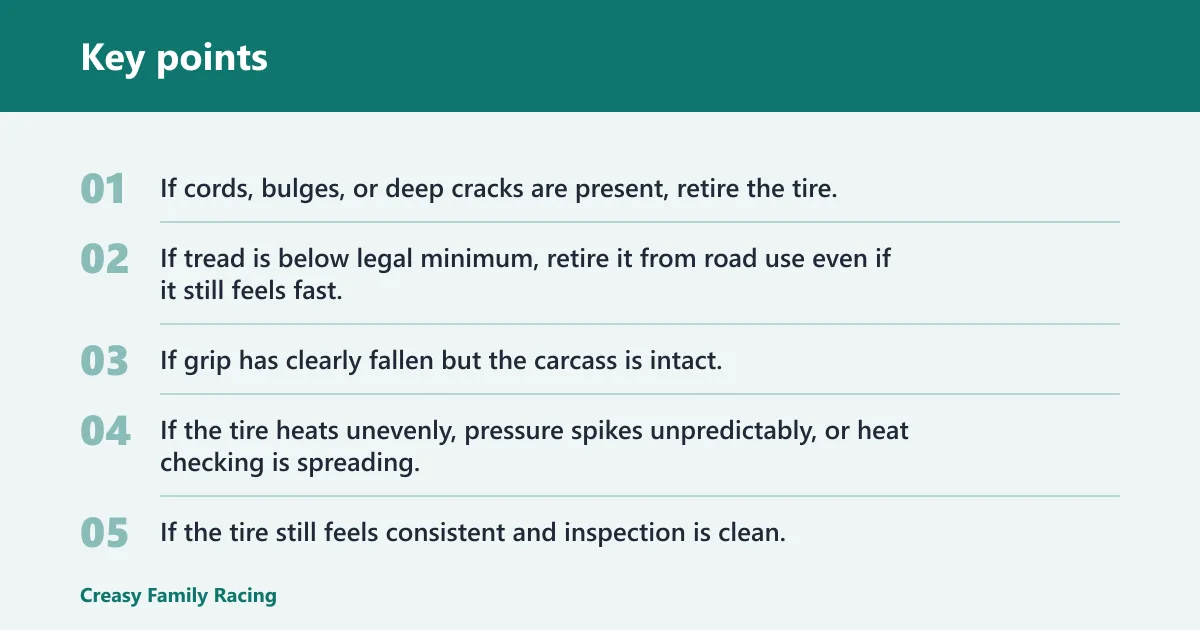
- If cords, bulges, or deep cracks are present, retire the tire.
- If tread is below legal minimum, retire it from road use even if it still feels fast.
- If grip has clearly fallen but the carcass is intact, demote it to practice or street use depending on tire type.
Then use this inspection sequence:
- If the tire heats unevenly, pressure spikes unpredictably, or heat checking is spreading, plan replacement soon.
- If the tire still feels consistent and inspection is clean, keep using it and track cycle count.
- Check tread depth and look for cords, bulges, or deep cracks.
- Read hot and cold pressures from the last session.
- Compare lap-time feel against the last known good session.
- Inspect shoulders and tread blocks for heat checking or glazing.
- Decide whether the tire is still fit for street use, track use, or neither.
Frequently asked questions
What is a heat cycle for track tires?
A heat cycle is one full warm-up and cool-down of the tire. On track, that means the tire goes from ambient temperature into its operating range, then cools back down after the session. Each cycle can change the compound and reduce grip even if tread depth still looks good.
How many heat cycles can a 200tw tire take before it slows down?
The exact point depends on compound, session length, temperature, and pressure control. The useful answer is that grip often fades gradually rather than all at once, so watch for the first repeatable drop in feel and pace instead of relying on a fixed count. Short, repeated sessions with full cool-downs can age the tire faster than fewer, longer runs with careful pressure management.
How many heat cycles can an R-compound tire take?
An R-compound tire can age out faster than a 200TW tire because it is usually more track-focused and more sensitive to heat cycling. There is no single universal count. Watch for earlier grip loss, slower warm-up, and heat checking, especially if the tire sees long or hot sessions.
Can you reset or recover grip from heat-cycled track tires?
You may recover a little feel by correcting pressure, camber, or driving style, but you cannot reliably reset an aged compound. Once the rubber has hardened through repeated cycling, the lost peak grip usually does not return in a simple or guaranteed way. Pressure tuning can improve how the tire is used; it cannot reverse compound aging.
How do heat cycles affect lap times more than tread depth?
Lap times depend on peak grip, turn-in response, and how the tire supports load in braking and cornering. Those traits can fall as the compound ages, even while tread depth still looks fine. That is why pace loss can show up before the treadwear bars become the main concern. The tread can still be legal while the rubber is no longer optimal for fast laps.
Can heat-cycled tires still be safe to drive home on?
Yes, if the tire still has usable tread, no cords, no bulges, and only superficial checking, it can still be safe for a careful drive home. That is a different question from track pace. A tire may be slow on circuit and still acceptable for street speeds. If the cracking is deep or the sidewall is compromised, do not treat it as roadworthy.
How do you know a tire is heat-cycled out?
Look for a mix of signs: slower warm-up, greasy feel, reduced peak grip, heat checking, and a loss of pace even when pressures are right. If the tire still looks healthy but the stopwatch and feel both say it has gone off, the compound has likely aged beyond its fast window. For decision-making, combine cycle count, inspection, and performance trend instead of relying on tread alone.