Track Tires vs Street Tires: What Changes on Track?
On track, street tires usually give softer turn-in, longer braking zones, and more heat-related fade. For most HPDE drivers, a good 200TW tire is the common step up before true slicks, especially if the car still sees street use. Ignore the difference and you can overheat the tread, chase pressure changes, and wear the outer shoulders fast. This guide compares feel, braking, heat, wet behavior, wear, and streetability when you move from street tires to track tires.
| Decision factor | Track tires | street tires | Winner |
|---|---|---|---|
| Dry grip on track | Higher peak grip once up to temperature | Lower peak grip, but more forgiving when cold | Track tires |
| Turn-in and steering response | Sharper response from stiffer sidewalls and less tread movement | Softer initial response, more tread squirm | Track tires |
| Wet-road confidence | Weak in standing water; poor when rain is heavy | Better water evacuation and hydroplaning resistance | street tires |
| Heat management | Needs correct operating temperature and pressure control | Wider operating range, less sensitive to short stints | street tires |
| Wear and tread life | Shorter life, faster shoulder wear, heat-cycle aging | Longer tread life for road use | street tires |
Track tires vs street tires at a glance
The short answer is simple: track tires trade comfort, wet-weather safety, and tread life for sharper response and more dry grip at speed. Street tires are the better all-rounder for daily use, while 200TW and true track tires make sense when dry lap time and consistency matter more. For background on the street side of that tradeoff, see driving track tires on the street.
Street tire, 200TW, and track tire roles
Street tires split into all-season and summer types. All-seasons give the broadest cold-weather tolerance, and street performance tires balance grip with tread life, ride comfort, and low noise. Summer tires usually respond better on dry pavement, but both street types keep deeper grooves that help channel water and reduce hydroplaning. Tire makers and test sources consistently note that tread depth and groove design are a major part of wet performance, especially in standing water and at speed.
200TW tires sit between those buckets. They are street legal, widely used by HPDE drivers, and common in club racing and time-trial rules where a 200-treadwear minimum is specified. The treadwear number is not a direct measure of grip, but it does place the tire in a streetable motorsport category that sits above most regular summer tires and below purpose-built race slicks. A Bridgestone RE-71RS is one example in that lane. True track tires move beyond that compromise, with DOT-legal and non-DOT variants aimed at road-course grip rather than daily commuting.
At the far end are slick tires, which have zero or near-zero tread and the highest dry grip. They need heat to work properly and are poor in rain. Wet tires and intermediates are the separate rain-focused answer, with grooved tread for water evacuation and motorsport use in wet conditions.
Feel: turn-in, steering response, and mid-corner support
Track tires change the first things a driver feels in the steering wheel and brake pedal. They usually shorten braking zones, reduce delay on turn-in, and hold the car flatter in the middle of a corner, but only when the tire is in its operating temperature window and the pressures are correct.
Street tires
Street tires usually feel softer on initial input because the sidewalls are tuned for compliance, noise control, and everyday ride quality. That extra compliance can make the first degrees of steering feel slower and can add tread movement when the car is loaded hard. On a street car, that is often acceptable; on track, it can feel vague as speeds rise.
200TW tires
200TW tires are the middle ground: they keep the street-legal format and wet-road usability of a normal tire, but they sharpen steering response and lateral support enough to suit track days and autocross. Compared with regular street rubber, they often feel more immediate on entry and more stable in long corners, especially after the tires have come up to temperature. Their fit for a given car still depends on size, compound, alignment, and how hard the driver leans on the front axle.
True track tires
True track tires tend to deliver the most direct feel because their carcasses and sidewalls are built around sustained lateral load. The payoff is a more immediate nose, firmer brake platform, and less tread squirm as the car transitions. The tradeoff is that they can feel less composed when cold and less forgiving when the session is short or the surface is cold.
Braking: stopping distance, stability, and release
More grip under braking is one of the earliest gains. With track tires, the car usually stays calmer as weight transfers forward, so the driver can brake later and release more cleanly into the corner. Street tires can still work well, but they tend to give up earlier when heat builds and the tread starts to move around.
Street tires: street tires generally give
Street tires generally give the longest braking distances of the group on track, particularly after a few hard stops. They can still be predictable and forgiving, but once the tire heats up beyond its comfort zone, braking feel can get softer and the nose can feel less settled.
200TW tires: 200TW tires often improve braking
200TW tires often improve braking confidence significantly over normal street rubber, especially in repeated laps where a street tire would start to feel vague. The car usually accepts later braking and cleaner release, but that benefit still depends on keeping the tire in a usable pressure and temperature window. This is where a 200TW gauge setup matters: pressure that is too low can make the tire roll over, while pressure that is too high can shrink the contact patch and reduce bite.
True track tires: true track tires
True track tires are the strongest option for stable braking once hot. They are designed to handle repeated high-load stops, so the platform usually stays more consistent from lap to lap. That said, a track tire that is outside its window can still feel greasy or slidey, which is why hot pressure and session length matter as much as compound choice.
Heat: operating window, fade, and heat cycles
Heat is where many drivers first notice the split between street tires and track tires. A street tire has a wider operating range, but it can go greasy after repeated hard laps. A track tire is designed for a narrower operating-temperature range, so it may feel dull when cold and greasy when overheated. Tire manufacturers and motorsport tech references consistently describe this temperature sensitivity as a core difference between road and race-focused tires.
Street tires: street tires are usually
Street tires are usually the most tolerant when the session is short, the pavement is cooler, or the car is still being driven to and from the event. They do not need a narrow temperature band to be usable. Even so, repeated hard laps can push them into heat-related fade, where the compound feels less crisp and the shoulder starts to overwork.
200TW tires: 200TW tires typically tolerate heat
200TW tires typically tolerate heat better than a normal street tire, but they still respond to overheating, especially on heavier cars or long sessions. They can feel excellent in the first part of a run and then fall off if the pressure climbs too much or the tire spends too long at sustained high load. That is one reason 200TW tires are popular for HPDE: they are a bridge between normal street use and track-only grip, but they still need setup discipline.
True track tires: true track tires often need
True track tires often need more heat than street tires to reach their best grip, and they can lose performance if they are pushed beyond that range. The result is a narrower sweet spot: great when the tire is warm and the pressure is right, but noticeably worse if the compound is too cold at pit-out or too hot by the end of a long session.
Heat cycling also matters. Repeated heat-and-cool cycles can age a tire and reduce grip before the tread is fully gone. That is why a tire can still look usable while feeling less sharp on corner entry or less consistent over a session. Industry and motorsport tire guidance commonly treats heat cycling as a performance-aging factor, especially on softer compounds.
Hot pressure management with a tire gauge
Pressure changes matter more than many new drivers expect. A track tire that is a few psi too high can feel greasy and overheated, even if the compound is right for the session. A track-day tire pressure gauge should be accurate enough to read small changes cleanly in the paddock, then let you compare hot readings run to run.
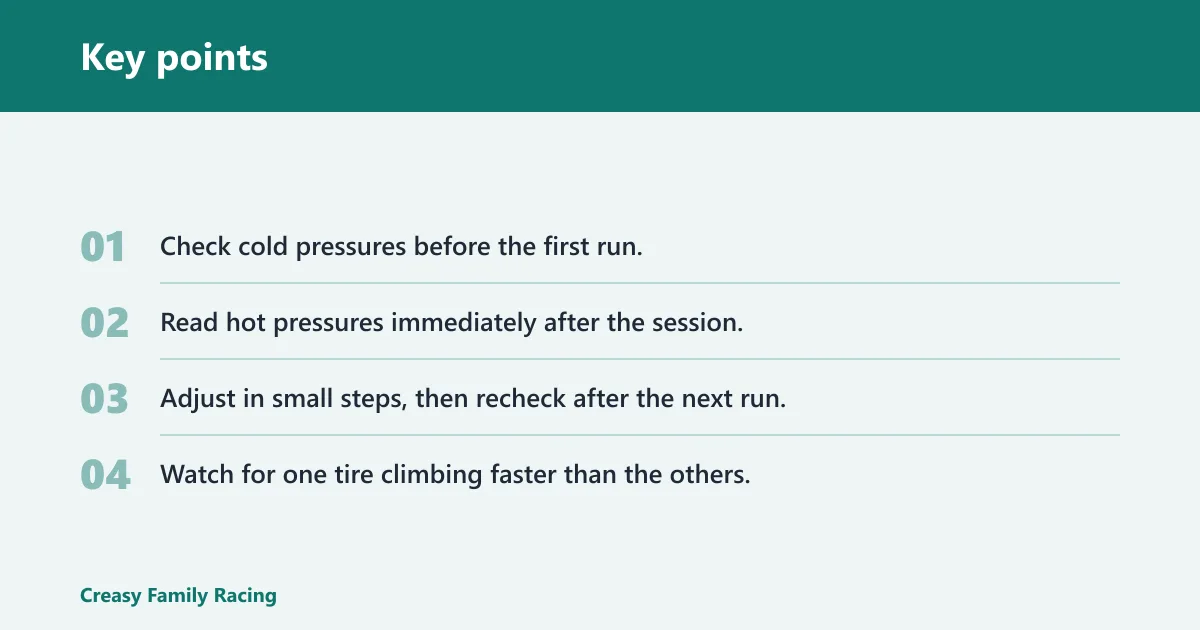
- Check cold pressures before the first run.
- Read hot pressures immediately after the session.
- Adjust in small steps, then recheck after the next run.
- Watch for one tire climbing faster than the others.
That last step matters. If the outside front gains pressure faster than the rest, the car may be overworking that corner, or the setup may be loading it too hard under braking and turn-in. Pressure can hide or reveal a setup problem.
Wet: hydroplaning, standing water, and tire type
Wet weather changes the ranking fast. Street tires usually keep the advantage because their grooves evacuate water better, while track tires can lose confidence quickly in standing water. Slick tires are the worst choice in heavy rain. Wet tires and intermediates exist for exactly that gap.
Street tires: street tires are the best
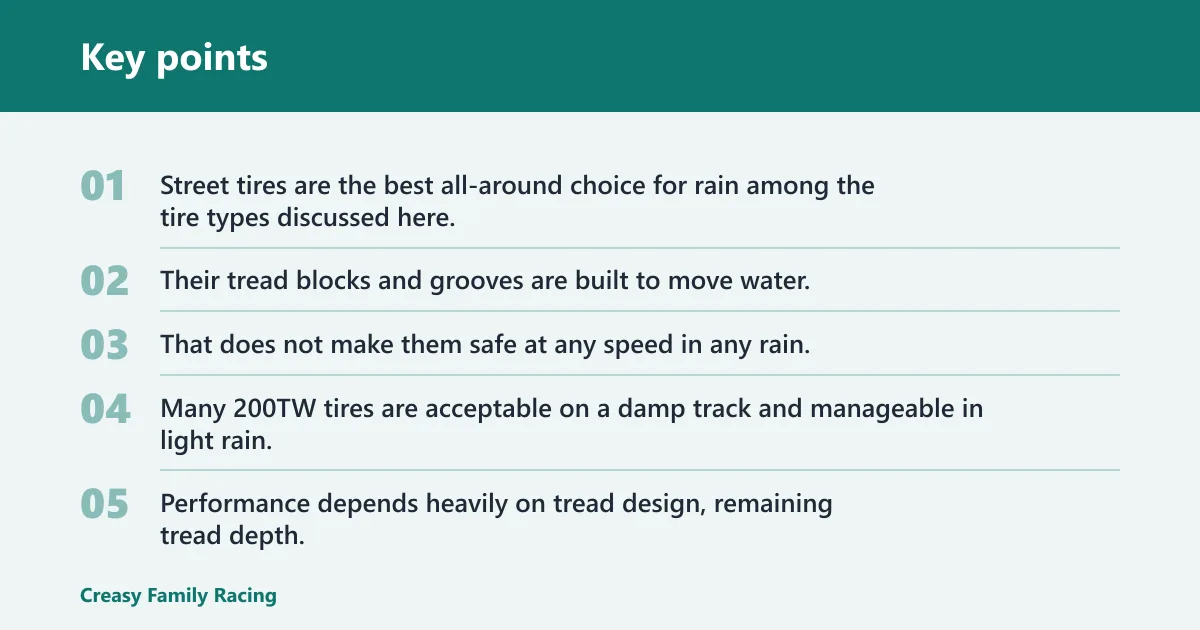
Street tires are the best all-around choice for rain among the tire types discussed here. Their tread blocks and grooves are built to move water, which helps with hydroplaning resistance and general wet-road confidence. That does not make them safe at any speed in any rain, but it does make them the most usable choice for the street and for mixed-weather driving.
200TW tires: many 200TW tires are acceptable
Many 200TW tires are acceptable on a damp track and manageable in light rain, but they are still not a dedicated rain tire. Performance depends heavily on tread design, remaining tread depth, and how deep the water is. In lighter wet conditions, they can feel fine; in standing water, they can lose confidence quickly compared with a normal street tire.
True track tires, slicks, and wet tires
True track tires can still be fine in a damp paddock or a drying line, but they are not built for daily commuting. Slicks need heat and dry pavement. Wet tires and intermediates use grooved tread for water evacuation and are the proper motorsport answer when the track stays wet enough to matter. That is also why some race organizations require rain-specific tires in obvious wet conditions.
Hydroplaning risk depends on how well the tire can move water out of the contact patch. The U.S. National Highway Traffic Safety Administration notes that hydroplaning risk rises when speed is high and water cannot be cleared quickly enough, which is why tread depth, tire design, and speed all matter in standing water.
Wear: tread life, shoulders, and heat-cycle aging
Track tires wear faster because they are built for grip, not long road mileage. That shorter tread life is part of the trade. The other part is heat cycling, which can reduce performance even before the tread is fully gone.
Street tires: street tires are designed
Street tires are designed to last longer in commuting and highway use. Their tread compounds and patterns are built for broader use, so they usually wear more slowly than track-oriented tires. On track, though, the outer shoulders can still scrub quickly if the car is under-cambered, under-pressured, or driven very hard in long corners.
200TW tires: 200TW tires usually wear faster
200TW tires usually wear faster than ordinary street rubber because they trade some longevity for grip. They are still street legal, but their shoulder wear can become obvious after repeated track sessions, especially on heavier cars or cars that are not aligned for the extra load. Heat cycling can also make them feel softer or less consistent even before the tread is gone.
True track tires: true track tires generally have
True track tires generally have the shortest life in this group. They are designed around road-course use, so shoulder wear, chunking, and tread degradation can appear sooner than many street drivers expect. Once a track tire starts to heat-cycle out, it may still have tread but no longer deliver the same feel or balance.
If outer shoulders start chunking after a couple of sessions, that is usually a setup clue, not just a tire problem. Alignment, pressure, and sustained cornering load all matter. For many drivers, the fix is not “more tire,” but less heat, better camber, or more careful hot-pressure control.
Streetability: comfort, noise, and all-weather use
The right tire depends on how often the car sees hot laps versus normal roads. Track tires are the better pick when dry lap time matters most and the car spends real time on road courses. Street tires are the better pick when the same car still needs comfort, rain safety, and longer tread life for daily use.
Street tires: street tires are the most
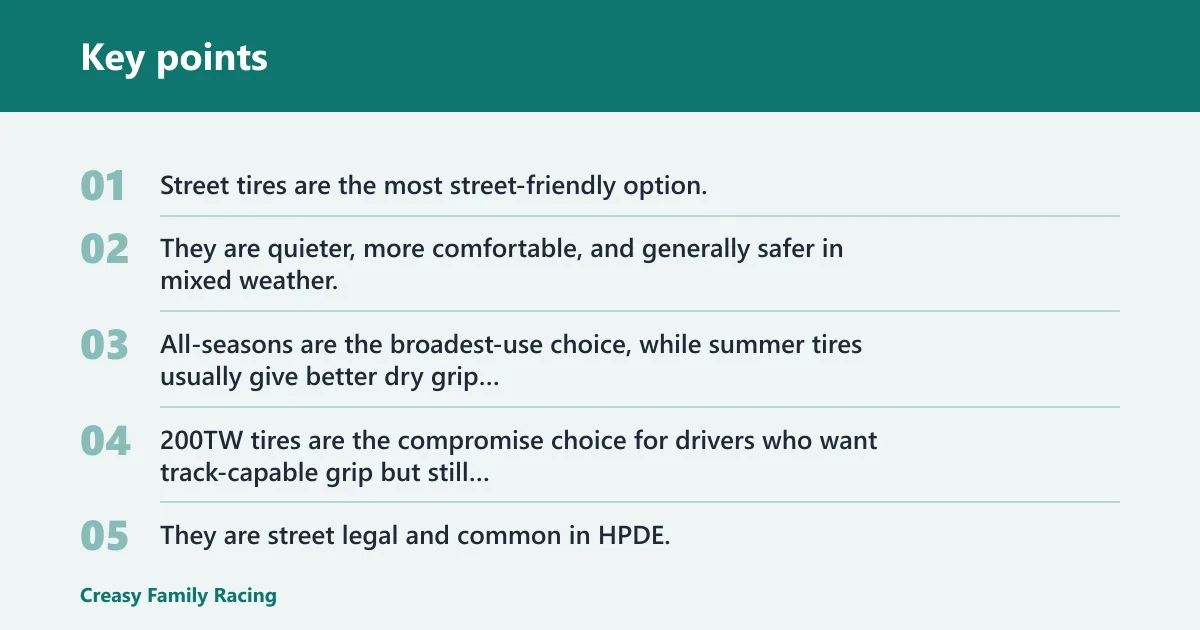
Street tires are the most street-friendly option. They are quieter, more comfortable, and generally safer in mixed weather. All-seasons are the broadest-use choice, while summer tires usually give better dry grip without giving up as much everyday usability as a track tire would.
200TW tires: 200TW tires are the compromise
200TW tires are the compromise choice for drivers who want track-capable grip but still drive on public roads. They are street legal and common in HPDE, and they can also fit classing rules in some competition formats. They are not as comfortable or as rain-friendly as a normal street tire, but they avoid the full commitment of a slick or true race tire.
True track tires: true track tires
True track tires are the least street-friendly of the group. They can be loud, wear quickly, and behave poorly in rain. Their job is to maximize dry-road-course performance, not to make the car pleasant in traffic or reliable in a downpour.
| Symptom | Street all-season | Street summer | 200TW | True track tire | If you feel X, check Y |
|---|---|---|---|---|---|
| Cold grip | Broad but muted | Better dry grip than all-season | Acceptable on the street | Often below ideal until warm | Cold tire pressure, surface temp, and whether the tire is in its operating window |
| First-lap bite | Soft | Moderate | Strong for a street-legal tire | Strong only after heat builds | Driver input, brake release, and whether the tire needs more temp |
| Braking stability | Least stable under repeated hard braking | Better than all-season | Good for HPDE pace | Best when hot pressure is right | Hot pressure and front alignment |
| Turn-in sharpness | Slowest | Sharper | Very sharp | Sharpest | Sidewall support, pressure, and excessive tread rollover |
| Rollover risk | Highest | Moderate | Lower | Lowest | Camber, pressure, and loaded shoulder wear |
| Heat fade | Fast after repeated hard laps | Moderate | Better than street rubber | Depends on staying in the target window | Overheating, hot pressure, and session length |
| Wet confidence | Best of the four | Good | Mixed | Weak | Standing water depth and tread depth left on the tire |
| Wear pattern | Even on the street, outer edges can still scrub on track | Outer shoulder wear shows first on track | Shoulder and center wear both matter | Fast shoulder wear and heat-cycle decline | Alignment, pressure, and repeated heat cycles |
Choose Track tires if… / Choose street tires if…
Track tires are the better pick when dry lap time matters most and the car spends real time on road courses. Street tires are the better pick when the same car still needs comfort, rain safety, and longer tread life for daily use. The right answer depends on how often the car sees hot laps versus normal roads.
Choose Track tires if…
- You run frequent HPDE or track days and want stronger dry grip after the tire comes up to temperature.
- You want sharper turn-in, firmer braking stability, and less rollover in long corners.
- You are prepared to manage hot pressure, camber, and tread wear after each session.
- You can live with weak rain behavior and shorter tread life.
Choose street tires if…
- The car is driven on the street most of the time.
- You need better wet grip and more confidence in standing water.
- You want quieter operation, more ride comfort, and longer tread life.
- You only attend occasional track days and are still learning setup, pressure, and driving technique.
For many drivers, 200TW tires are the middle ground. They are street legal, commonly used by most HPDE drivers, and many Time Trial and competition classes commonly require a 200TW minimum. That makes them the practical bridge between a street setup and a full track-focused tire.
Troubleshooting checklist
If the tire does not feel right, the fix is usually in the setup first and the compound second.
- If the car feels greasy, check hot pressure before you blame the tire.
- If the outside shoulder is scrubbing, look at camber and front load first.
- If the first lap is vague, confirm the tire is in its operating window.
- If the car feels nervous in the wet, reduce speed and remember that tread depth matters.
- If wear is uneven across the tread, inspect alignment, pressure, and driving line.
Frequently asked questions
What actually changes when you put track tires on a car for the track?
The first changes are sharper turn-in, shorter braking zones, and better mid-corner support once the tire reaches its operating temperature. The car usually feels less vague on initial input and more stable under load. Wet-road tolerance and tread life usually get worse.
Do track tires really grip better than street tires on track?
Yes, in dry conditions. Track tires win outright once up to temperature because they are built for road-course grip, not daily commuting. The gain shows up first in braking and turn-in, then in steady corner support. Street tires still win in comfort and wet-weather tolerance.
How do track tires behave in the wet compared with street tires?
Track tires are weaker in the wet because they have so little tread to move water out of the contact patch. Street tires have grooves that help channel water and reduce hydroplaning, so they are better in wet grip. Heavy rain is where the difference becomes most obvious.
Do track tires need heat to work properly?
Yes. Track tires are built for a race operating temperature window, so they can feel dull when cold and then come alive after heat builds. Slicks are even more dependent on heat. If the tire feels greasy, it may be too hot or too highly inflated.
Why do street tires get greasy on track?
Street tires can go greasy after repeated hard laps because the tread and compound heat up beyond their comfortable range. Depending on the tire and conditions, this can happen in only a few hard laps. The tire may still have tread left, but the steering goes vague and braking loses bite.
How much faster do track tires wear than street tires?
Track tires usually wear much faster because they trade tread life for dry grip. Shoulder wear often shows first, and heat cycles can reduce performance before the tire is fully worn out. Street tires last longer, especially for commuting and highway use, but they give up dry lap time.