Can You Drive Track Tires on the Street Safely?
Some track tires are street-legal, but only if the tire carries the right road-use markings and the tread depth, wear, and weather conditions still make sense; many full slicks are not legal on public roads at all. Choose badly, and you can get hydroplaning, overheating, fast wear, weak wet grip, and more risk during emergency braking. Here’s how to tell which tires are acceptable, which are a bad idea, and what to check before you drive on the street. NHTSA/DOT tire labeling rules, state inspection standards, and tire-maker guidance all matter here because a tire can be marked for road use and still be a poor fit for your weather, route, and vehicle load.
Track tire decision checklist
This is the quickest way to separate a usable street tire from a track-only tire. Treat it as a pass/fail screen, not a wish list.
Legality checks
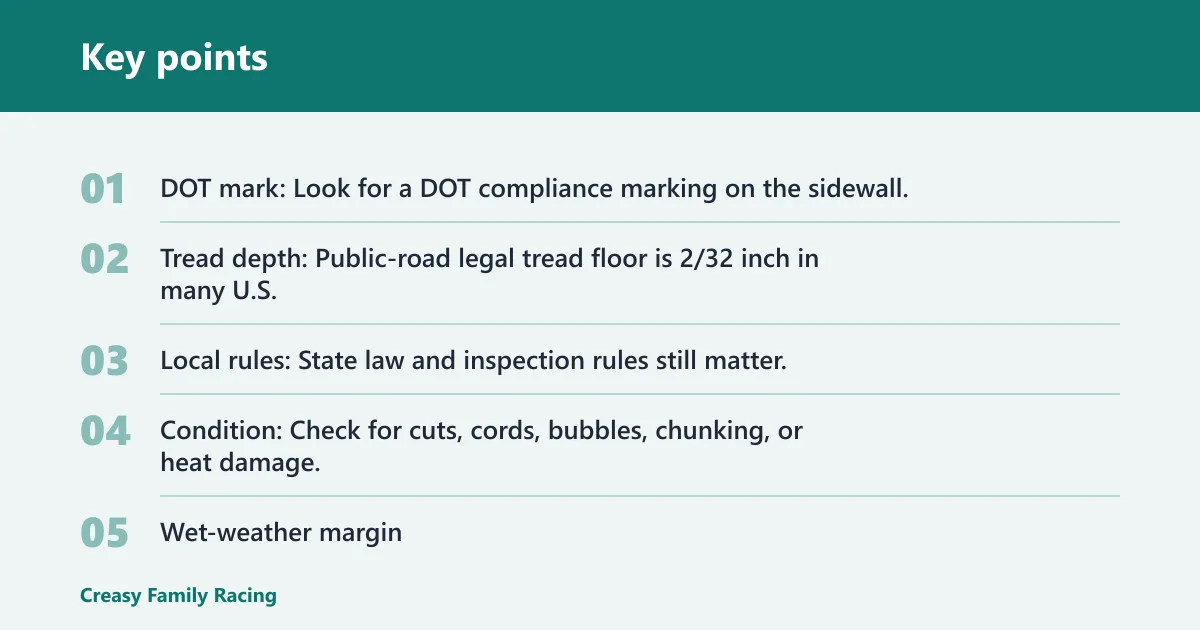
- DOT mark: Look for a DOT compliance marking on the sidewall. Some racing tires can be street legal if they carry it. NHTSA’s tire standards and DOT marking rules are the baseline for road-use identification.
- Tread depth: Public-road legal tread floor is 2/32 inch in many U.S. states, though inspection examples vary and some states check for wear indicators or shallower practical limits in certain conditions. A tire can feel unsafe before it reaches that limit. State inspection examples commonly treat 2/32 inch as the legal minimum for passenger tires.
- Local rules: State law and inspection rules still matter. A DOT-marked tire can still fail inspection or run afoul of local equipment rules.
- Condition: Check for cuts, cords, bubbles, chunking, or heat damage. A marked tire in poor condition is not a good street tire.
Safety checks
- Wet-weather margin: Shallow grooves move less water, so wet grip drops fast. If the tire has minimal tread, standing water becomes the main hazard. Tire maker guidance commonly warns that performance declines as grooves get shallow because water evacuation becomes limited.
- Cold use: Track tires are built around high temperatures near 180°F or higher. Short trips and gentle commuting may keep them below that range. Manufacturers commonly note that competition compounds need heat to deliver intended grip.
- Visible damage: Any sidewall injury, exposed cord, or severe uneven wear is a stop sign for street use.
- Used tire history: Used race tires can be compromised by heat cycles and may grip less than the tread suggests.
Ownership fit checks
- Daily commute frequency: If you drive in mixed weather most days, a track tire is usually the wrong fit.
- Second wheel set: A separate set is the cleanest way to keep track tires off the street most of the time.
- Inspection readiness: If your area inspects tires closely, a track tire that is technically marked may still be a headache.
- Load and speed match: Confirm the load index and speed rating match the vehicle’s needs. Do not assume a used set is automatically correct. Load index and speed rating are manufacturer-coded limits, not suggestions.
| Result | What it means | Typical use case |
|---|---|---|
| Okay for occasional street use | DOT-marked, legal in your area, tread above 2/32 inch, no damage, correct load index and speed rating | Drive to events, brief dry commutes, infrequent road use |
| Street use only in dry conditions | DOT-marked and legal, but shallow tread, weak wet margin, or cold behavior makes rain a poor bet | Short fair-weather drives, careful route planning, no surprise storms |
| Track-only | Full slick, non-DOT tire, or tire with damage, legal issues, or unsafe wet and cold behavior | Trailered track car, closed-course use only |
| Scorecard item | Pass points | Fail points |
|---|---|---|
| Legality | DOT-marked; passes local/state inspection rules; tread at or above legal minimum | Non-DOT slick; fails inspection rules; tread below legal minimum |
| Safety | No cuts, bubbles, cords, cracking, or major uneven wear; acceptable wet margin; usable cold behavior | Damage, exposed cord, severe wear, shallow grooves that leave little wet margin, or known cold-grip weakness |
| Ownership fit | Rare street use, fair-weather driving, second wheel set available, correct load index and speed rating | Daily commuting, frequent rain, winter/cold starts, load mismatch, or no practical way to avoid bad conditions |
| Total score | 3 passes = okay for occasional street use | 2 passes = street use only in dry conditions; 0-1 passes = track-only |
- Check the sidewall for a DOT mark and any other tire identifiers.
- Measure tread depth across the tire. If it is near 2/32 inch, treat the wet-road margin as poor even if it still passes a basic legal floor.
- Inspect the tire for cuts, bubbles, cords, cracking, and heat damage.
- Confirm load index and speed rating match the vehicle’s needs.
- Ask whether you can avoid rain, cold starts, and long highway runs. If not, choose a street tire instead.
- Decide whether a second wheel set makes more sense than forcing one tire to do both jobs.
Can you drive track tires on the street safely?
Yes, sometimes. The safe answer depends on the tire type, its condition, the weather, and whether your state allows it. A DOT-marked competition tire in good shape can be acceptable for limited street use, but a full slick is generally not legal or safe on public roads.
When the answer is yes
The answer leans yes when the tire is DOT-marked, your state and inspection rules allow it, tread depth is still above 2/32 inch, and the forecast is dry. Even then, the tire should match the vehicle’s load index and speed rating, and it should not show damage or uneven wear. That is the practical “pass” case for occasional street use.
When the answer is no
The answer is no for full slicks, for tires with visible damage, and for tires that have become too worn to evacuate water. It is also no if the car sees regular commuting in cold weather or surprise rain. Legal does not mean safe in those conditions. If any single major check fails, the tire should be treated as track-only.
Where the risk changes fast
Risk rises quickly on standing water, early-morning cold pavement, and heavy stop-and-go driving. A tire that feels fine on a warm dry road can behave very differently when the surface is wet or the carcass never reaches its working window.
If a car wears 265/35R18 DOT competition tires with shallow grooves, and the route home includes a storm drain and a few puddles, that setup can make the drive more vulnerable to standing water. The tire may still be legal on paper, but that shallow tread gives away water margin fast, so the trip becomes a dry-weather-only decision.
What makes a tire street legal?
A tire is street legal only when its markings and construction meet the rules that apply in your area. A DOT mark is the starting point, not the finish line. State standards, inspection rules, equipment rules, tread depth, and condition all still matter. NHTSA and DOT tire-marking guidance focus on identifying tires built to meet federal requirements, while state inspection examples commonly add minimum tread and condition checks.
DOT mark and sidewall markings
Some racing tires can be street legal if they carry a DOT mark. That marking shows the tire was built to meet certain federal standards, but it does not guarantee approval everywhere. Track-focused tires may still be street legal if marked and in good condition. The DOT code also helps identify the tire for compliance, recall, and specification purposes.
State inspection and local rules
Street legality can depend on federal and state tire standards. In practice, that means one state may pass a tire another state would reject. Inspection stations may also care about wear, cracking, or tread depth beyond the bare minimum. Common state inspection guidance uses 2/32 inch as the legal tread threshold for passenger tires, but wet-road safety can fall off well before that.
Load index and speed rating
Used or second-hand track tires need the same rating checks as any other tire. The load index must support the vehicle, and the speed rating must fit the car’s expected use. Tire manufacturers publish load-index and speed-symbol tables so buyers can match the tire to the vehicle; they also warn that speed rating is tied to tested capability, not guaranteed real-world performance in every condition.
Which track tires are street legal?
DOT-marked competition tires and some R-compound tires can be street legal, but full slick tires generally are not. The label does not decide the whole case. Tread, condition, temperature behavior, and local rules still determine whether the tire is a decent street choice.
| Tire type | Legality | UTQG | Tread depth | Wet-road risk | Cold-start behavior | Wear rate | Comfort | Daily-use suitability |
|---|---|---|---|---|---|---|---|---|
| Full slick | Not street legal | Typically no practical street UTQG use | No usable tread grooves | Very high | Poor until hot; not designed for road use | Very fast on street surfaces | Harsh | Not suitable |
| DOT-marked competition tire | Can be street legal if local rules allow | Often low or limited UTQG relevance | Shallow | High in rain or standing water | Weak when cold; needs heat | Fast | Harsh to firm | Occasional use only |
| R-compound | Some are street legal | Usually lower than normal street tires | Shallow to moderate | Moderate to high | Needs heat, can feel vague cold | Faster than street tires | Firm | Limited street use |
| 200TW street performance tire | Street legal | Commonly 200 | Moderate | Moderate; better than slick-like tires | Usually better cold behavior than competition rubber | Moderate | Better | Best daily-driver compromise |
DOT-marked competition tires
These sit closest to the street-legal side of the line. Some DOT competition tires are legal but still harsh for daily use. They may be legal and still poor in rain and cold, especially when the grooves are shallow and the tire never gets hot enough to work well. UTQG may be present on some tires, but a low UTQG number does not make the tire unsafe or safe by itself; it mainly signals relative treadwear, traction, and temperature ratings for consumer comparison.
R-compound tires
R-compound tires are a common bridge between street and track. Some are DOT-approved, and many are built to work best when hot. They can suit occasional street use, but they still bring more noise, vibration, faster wear, and less rain margin than a normal street tire. In other words, they can pass the legality screen while still failing the ownership-fit screen.
Full slick tires
Full slicks have no tread and are not street-legal. They are generally not legal or safe for public-road use. In normal road driving, they are a bad choice because they cannot clear water well and they are built for closed-course use. NHTSA/DOT tire-marking rules are not a substitute for tread where road water evacuation is needed.
Why wet roads are the main problem
Wet pavement is where track tires usually fall apart as a street choice. Shallow grooves move less water, so hydroplaning risk rises quickly once standing water builds. Legal tread depth is not the same thing as good wet grip. Tire makers consistently warn that reduced tread depth reduces water evacuation and wet traction.
Tread depth and water evacuation
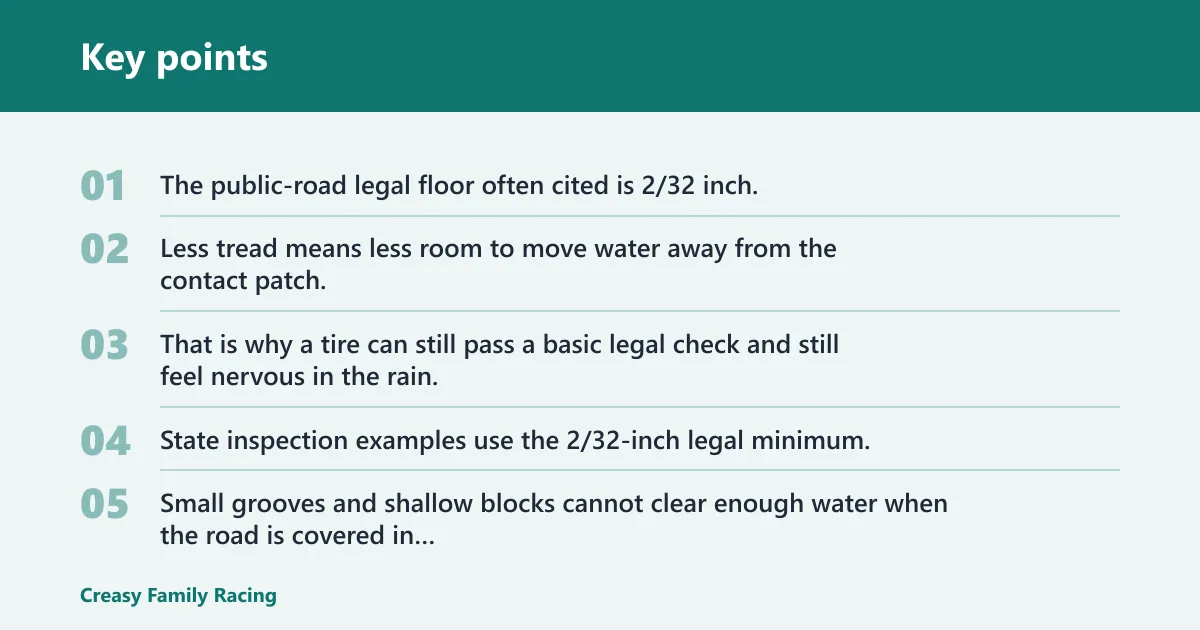
The public-road legal floor often cited is 2/32 inch, but a near-slick can become unsafe before it reaches that limit. Less tread means less room to move water away from the contact patch. That is why a tire can still pass a basic legal check and still feel nervous in the rain. State inspection examples use the 2/32-inch legal minimum, but wet performance usually degrades sooner.
Hydroplaning risk in standing water
Standing water is the main danger. Small grooves and shallow blocks cannot clear enough water when the road is covered in puddles or ruts. The result can be floating, longer braking distances, and a steering feel that changes without much warning.
Suppose the route is short and familiar, then a sudden shower hits on the way home. A near-slick that felt stable in the dry can lose margin very quickly in the first deep puddle.
Rain versus dry-only use
If you can avoid rain, a DOT-marked track tire may be acceptable for occasional street use. If you cannot avoid rain, use a street tire instead. “Legal” and “safe” split apart fast once the road is wet.
Cold tires and street driving
Track tires need heat to work properly. Many are built for high temperatures near 180°F or higher, so a short, slow street drive can leave them below their intended operating window. Cold tires can feel vague, grip unpredictably, or take too long to respond. Tire maker guidance for competition products often places the best working range well above normal street start-up temperatures.
Cold operating window
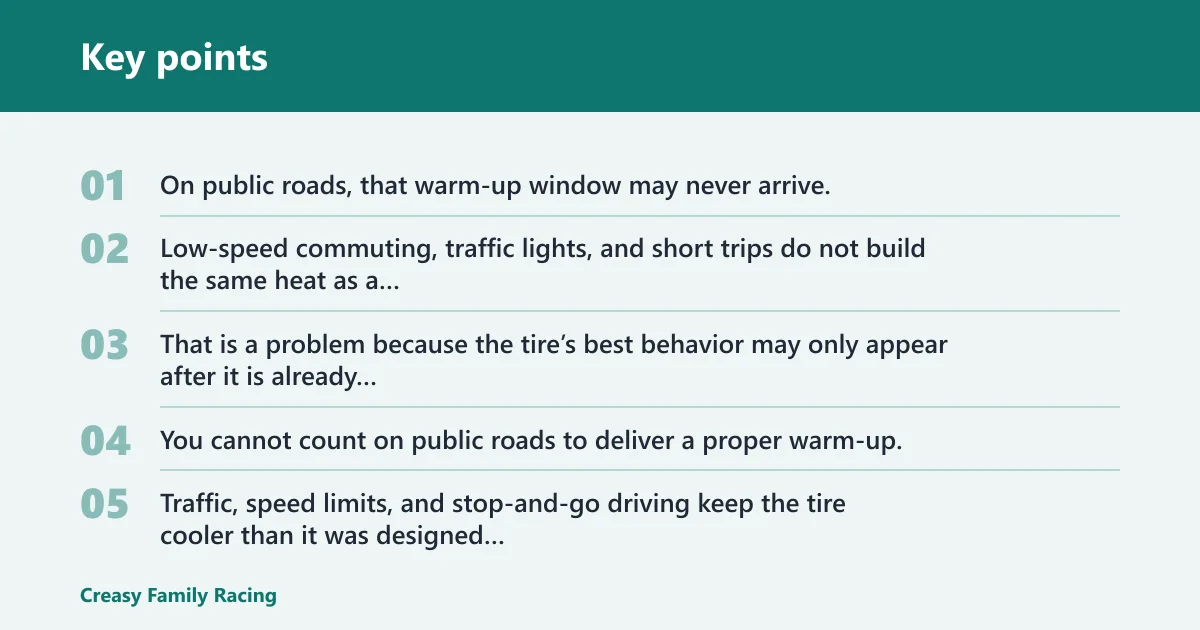
On public roads, that warm-up window may never arrive. Low-speed commuting, traffic lights, and short trips do not build the same heat as a track session. That is a problem because the tire’s best behavior may only appear after it is already too late to use safely.
Warm-up limits on public roads
You cannot count on public roads to deliver a proper warm-up. Traffic, speed limits, and stop-and-go driving keep the tire cooler than it was designed to be. That is one reason DOT-approved track tires can be poor daily drivers even when the weather is dry.
Picture a commuter car on 200-treadwear street performance tires versus a DOT competition tire on the same route. The street tire reaches usable grip quickly. The track tire may still be below its target temperature, so the first hard stop or lane change can feel less predictable.
Do track tires wear faster on the street?
Yes. Track tires usually wear faster on the street because they are built to trade longevity for grip, and street driving often keeps them outside their ideal operating range. Stop-and-go traffic, highway heat soak, potholes, and repeated cold starts can all accelerate wear or uneven wear. If the tire is already near its practical wet-weather limit, wear becomes a safety issue as much as a cost issue.
The clearest failure cases are frequent commuting, hot summer pavement, mixed rain and dry use, and running the tire when it is too cold to work well. In those cases, the tire can lose tread quickly and still never deliver the grip you paid for.
What is the difference between a slick and a DOT track tire?
A slick has no tread and is intended for closed-course use only. A DOT track tire has enough markings and construction to qualify for road use under federal labeling rules, even though it may still be very aggressive, noisy, and poor in the wet. The key difference is that the DOT tire is built to pass road-use marking requirements, while a slick is not. That does not mean the DOT tire is a good all-weather street tire; it usually just means it clears the legal-marking hurdle.
For a street decision, the practical test is simple: if the tire needs a dry track surface, heat, and careful setup to work, it belongs on the “dry only” or “track-only” side even if the sidewall says DOT.
Frequently asked questions
Are racing tires street legal in the United States?
Some racing tires are street legal in the United States if they carry a DOT mark, but street legality can still depend on federal and state tire standards as well as inspection rules. A DOT mark is not a blanket approval, and a tire can still fail local requirements. NHTSA’s DOT tire identification system is only part of the answer.
What makes a tire DOT legal for street use?
A DOT mark on the sidewall is the key starting point. The tire also has to be in acceptable condition, meet local inspection and equipment rules, and still provide enough tread and structural integrity for road use. The mark alone does not guarantee that every state will approve it.
Will track tires be dangerous in the rain?
They can be. Shallow grooves evacuate water poorly, and standing water raises hydroplaning risk fast. Some DOT competition tires are legal but still poor in wet conditions. If rain is a regular part of your commute, a track tire is usually the wrong street choice.
Can I daily drive on DOT-approved track tires?
Only if the trade-offs fit your use case. DOT-approved track tires can be used to drive to and from the track, but they often wear quickly on the street, need heat to perform well, and can be harsh in daily use. Frequent commuting usually points to a street tire instead.
Should I buy a second wheel set for track tires?
Yes, if you want track performance without regular street compromise. A second wheel set lets you keep track tires for events and swap to street tires for commuting, rain, and cold weather. It also reduces wear on the track set and makes inspection and tire swaps easier.
How do I know if my track tires are too worn for street use?
Measure tread depth, inspect the whole tire, and check for cracking, chunking, cords, bubbles, and uneven wear. If the tire is near 2/32 inch or already acts like a near-slick, treat it as poor in wet weather even if it still looks serviceable in dry conditions.
Sources
NHTSA tire marking and identification guidance; U.S. DOT tire standards and sidewall labeling requirements; state inspection examples using 2/32-inch minimum tread depth; tire manufacturer fitment guidance on wet traction, tread depth, operating temperature, load index, speed rating, and competition-tire use.