Do You Need a Head and Neck Restraint for Track Days?
If the event, seat, and belt setup call for it, a head and neck restraint is usually advised with a 4-, 5-, or 6-point belt system, and some organisers may require it. Skip it or fit it wrong, and you risk neck injury, poor belt geometry, or being turned away at scrutineering. This guide breaks the choice into a simple decision tree by rules, belts, seat type, speed, and helmet hardware.
When it’s required and when it’s optional
The short answer is: sometimes no, sometimes recommended, and sometimes yes. For many beginner HPDE days in a street car with a stock three-point belt, it is often optional unless the organiser says otherwise; with a multi-point belt, racing seat, or higher-speed event, the answer often shifts toward advised or required. The rulebook decides first.
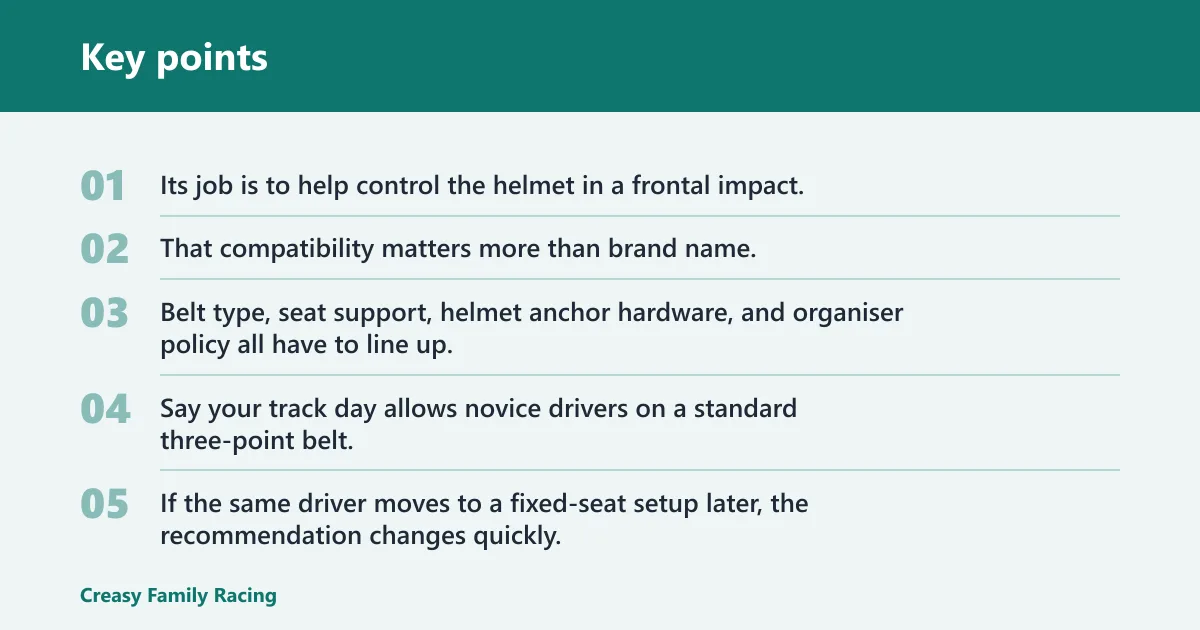
A head and neck restraint is safety gear. Its job is to help control the helmet in a frontal impact, which can reduce head and neck loading when the rest of the setup is compatible. That compatibility matters more than brand name. Belt type, seat support, helmet anchor hardware, and organiser policy all have to line up.
Head and neck restraint decision matrix
| Belt type | Organiser rule | Seat / head support | Helmet compatibility | Recommendation |
|---|---|---|---|---|
| 3-point seat belt | No HNR rule stated | Street seat, no fixed head containment | Helmet and tether hardware match the device | Optional only if the manufacturer allows that use |
| 3-point seat belt | HNR required by organiser | Street seat, no fixed head containment | Helmet and tether hardware match the device | Required if you want to run the event |
| 4-, 5-, or 6-point harness | No specific rule stated | Supportive seat with proper belt routing | Racing helmet with the right anchor hardware | Recommended |
| 4-, 5-, or 6-point harness | HNR required by organiser | Seat and belts compatible with the restraint | Helmet anchors and tethers fit the device | Required |
| Any belt type | Rulebook bans the setup you have | Seat or helmet setup does not match | Compatibility not confirmed | Do not assume it is acceptable |
Say your track day allows novice drivers on a standard three-point belt, but the event notes say “HNR permitted, not required.” In that case, a restraint is optional only if the product maker approves that belt use. If the same driver moves to a fixed-seat setup later, the recommendation changes quickly.
What a head and neck restraint does
A head and neck restraint helps control forward head motion in a frontal impact. It is not comfort gear and it is not a substitute for a proper seat, belt, or helmet. The usual designs connect to the helmet with tethers or hardware, then load against the body at the collarbone area.
That collarbone contact is part of fit. If the device sits too high, too low, or too far from the helmet, the load path changes. Tether length matters too. Too much slack can let the helmet move farther than intended; too little can make the device sit wrong before you even strap in.
Helmet anchor tethers need to match both the helmet and the restraint. A device with the wrong anchor hardware, or a helmet that does not accept that hardware, is not a valid setup. Use the manufacturer’s listing for your model, and replace any tether hardware that has reached its service limit or expiry date.
Will a track day organiser require a head and neck restraint?
Yes, some will. Track-day organiser rules vary by circuit, club, and provider, and those rules can be stricter than general street-car assumptions. If the rulebook says HNR required for your class, car type, or belt setup, that policy overrides personal preference. Check before booking, not in the paddock.
Published event rules are the deciding source. Insurance guidance, internet advice, and even manufacturer recommendations do not replace the organiser’s written requirements. A beginner day may allow a stock seat and three-point belt with no restraint, while a faster open-lapping day or advanced group may require one.
How to read the event rulebook
Look for exact phrases such as “HNR required,” “FHR required,” “approved head and neck restraint,” or “racing harness required with approved restraint.” Also check for class-based rules. Some organisers set one rule for novice HPDE and a tighter one for time attack, wheel-to-wheel prep, or open passing sessions.
A rule can also fail you indirectly. If the event allows multi-point belts only with an approved seat and restraint, that belt by itself may not be enough. If the organiser wants FIA 8858 or SFI 38.1 on the label, a device without that marking may be rejected even if the brand is well known.
Examples of rule types to look
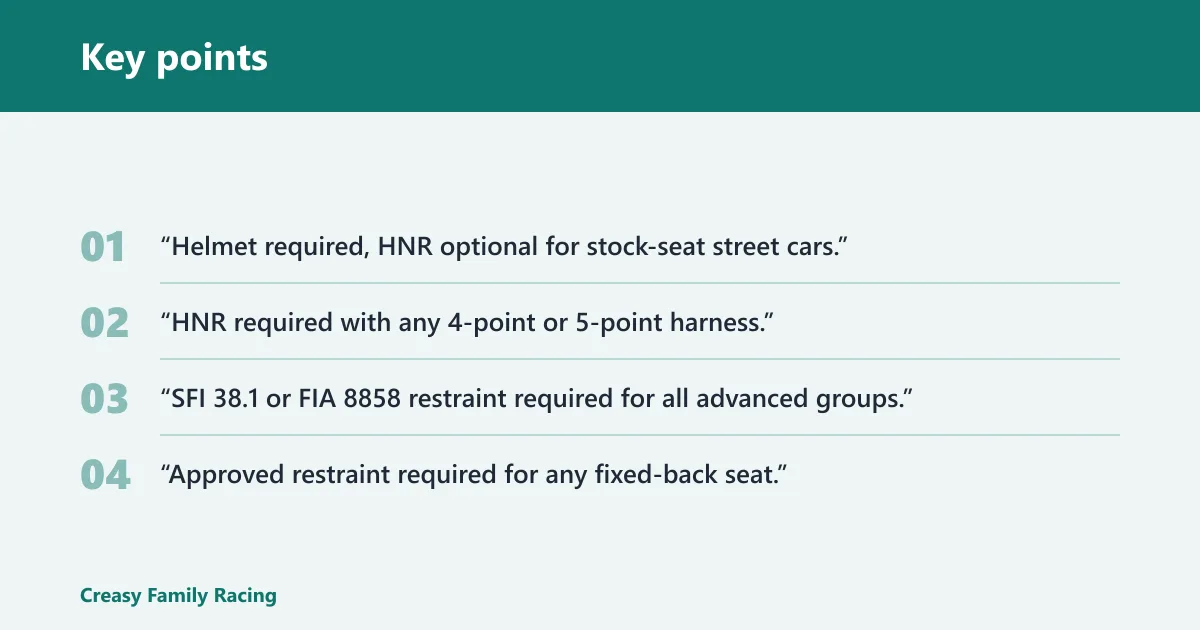
- “Helmet required, HNR optional for stock-seat street cars.”
- “HNR required with any 4-point or 5-point harness.”
- “SFI 38.1 or FIA 8858 restraint required for all advanced groups.”
- “Approved restraint required for any fixed-back seat.”
Suppose the rulebook says a restraint is required only with multi-point belts. A driver on a stock seat and three-point belt can usually attend without one, while the same driver moving to a bucket seat and 6-point harness should treat the restraint as part of the event setup, not an add-on.
Can you do a beginner track day without a HANS or similar device?
Often yes, if the organiser allows it and you are still on a stock three-point belt in a street-car class. That said, beginner does not automatically mean low risk, and the answer changes as soon as the seat, belt, or event rules change. “Beginner” is not the same as “no restraint ever needed.”
Many first-track-day guides cover what HPDE is, what you need for your first track day, and include a first-day checklist. They also include a buyer guide for head and neck restraints, which is a sign that this is part of the decision, not a side note. If the event is faster or the seating position is more fixed, the case for a restraint gets stronger.
When the answer is no, maybe, or yes
- No: organiser rules do not require one, you are on a standard three-point belt, and the device maker does not approve that use.
- Maybe: the event allows either setup, but you are considering a restraint for added protection and the helmet compatibility checks out.
- Yes: the organiser requires one, or your harness and seat package is built around an approved restraint.
Will your helmet and seat work with it?
They have to. A restraint only makes sense when the helmet anchor hardware matches the device and the seat gives the body enough support to keep belt loads where they belong. A seat with poor shoulder support, or a helmet that cannot accept the right tether hardware, can break the chain even if the device itself is certified.
Some restraints are not intended for 3-point belts unless the manufacturer explicitly says they are. That warning matters. A head and neck restraint designed around a harness and a fixed driving position can fit badly, or work outside its intended range, with a loose street-belt setup.
Helmet anchor hardware
Check the helmet side first. The restraint may use posts, clips, tether anchors, or other hardware that must be approved for that helmet and model. The wrong anchor can make the helmet incompatible even if the shell is otherwise suitable. Do not guess from photos or brand familiarity.
Also check tether condition. Tether expiry or replacement rules are part of many buying guides and should be part of your packing check. If the tether is due for replacement, the restraint may no longer be acceptable for the event, even if the shell and label are fine.
Seat support and head containment
A supportive seat helps the restraint work as intended. A fixed-back seat can hold the torso more consistently than a soft street seat, but the event rulebook still controls what is allowed. If your seat, belt, and restraint do not work together as a system, do not assume the HNR fixes the rest.
Track-day acceptance depends on organiser rules. A setup that is acceptable for one provider may fail scrutineering at another. Keep the rulebook in one hand and the product listing in the other.
What standards should a head and neck restraint have?
For shopping, the two labels most people should check are SFI 38.1 and FIA 8858. Those are common certification standards for head and neck restraints, and they matter because organisers may ask for one of them or both. The label on the device, not the box, is what counts on event day.
SFI 38.1 is a certification label to check when buying or using a restraint. FIA 8858 is another common label, and it can matter for organiser acceptance and product selection. If the event says one standard only, buy to that rule. If the event says either is fine, choose a model that fits your helmet and seat best.
Common restraint types by name
- HANS device: the most widely referenced frontal-impact head restraint style in track-day gear guides.
- Simpson Hybrid: an alternative design that appears in buyer guides.
- NecksGen: another alternative design used in buyer guides.
The buyer guide ecosystem also commonly compares Schroth Flex, Stand 21, and Zamp. Those names are useful for shopping, but the practical test is still the same: organiser approval, belt type, seat support, helmet hardware, and the label on the restraint itself.
Which head and neck restraint is best for track days?
There is no single best choice for every driver. For many harnessed track cars, a HANS device is the benchmark starting point because it is the most familiar shape in this category. Simpson Hybrid and NecksGen are valid comparison points when you need to judge comfort, head movement, and compatibility against your helmet and seat.
Start with the rulebook. Then check the belt system. Then check helmet hardware. A restraint that fits badly or fails the event policy is the wrong pick, no matter how popular it is.
Booking day checklist
Use this before you pay the entry fee. It keeps the decision practical and helps prevent a paddock surprise later. If any answer is “no,” pause and fix that item first.
- Read the event rulebook and find the exact HNR requirement for your group.
- Confirm whether your belt setup is a stock three-point belt or a 4-, 5-, or 6-point harness.
- Check whether your seat and head support match the restraint type the organiser allows.
- Verify that your helmet accepts the restraint’s anchor hardware.
- Check the restraint label for SFI 38.1 or FIA 8858 if the organiser asks for a standard.
- Confirm tether condition, replacement rules, and any expiry limits before packing the gear.
- Make sure the restraint is approved by the manufacturer for your belt type.
Keep items out of airbag zones and the driver’s view, and check local laws. Follow the vehicle and product manual, never work under a vehicle held only by a jack, never exceed the vehicle’s rated roof, hitch, or tow limit, and do not use a restraint in a way the manufacturer forbids.
Final yes/no checklist for the paddock
- Yes: the organiser requires a restraint and your setup matches the rule.
- Yes: you have a harnessed seat setup with a compatible restraint and helmet hardware.
- No: the restraint is not approved for your belt type.
- No: the helmet anchors, tether, or label do not match the event rule.
Frequently asked questions
Do you need a head and neck restraint for track days?
Not always. On many beginner HPDE days with a stock three-point belt, it is often optional unless the organiser says otherwise. With a harness, a fixed seat, or a faster event format, the answer shifts toward recommended or required. The rulebook and the product’s approved use still control the final call.
What kinds of helmets work with a head and neck restraint?
Helmets that accept the restraint’s anchor hardware, and that fit the tether system correctly, are the ones to look for. The shell alone is not enough. Check the helmet maker’s listing and the restraint maker’s fit notes, then confirm that the anchors, tether length, and replacement rules all line up.