Track Tires: How to Choose the Right Set
Choose track tires by matching treadwear and width to heat load: 200TW extreme-performance tires are commonly used for novice and intermediate track days, and wider sizes only help when wheel width, camber, and load rating also match. Miss that match and you get greasy laps, corded shoulders, longer braking, and money spent on tires your car cannot actually use. This guide covers compound choice, sizing, wheel fitment, pressures, temperature management, alignment, and the point where street-friendly compromises stop paying off.
What makes a tire a track tire?
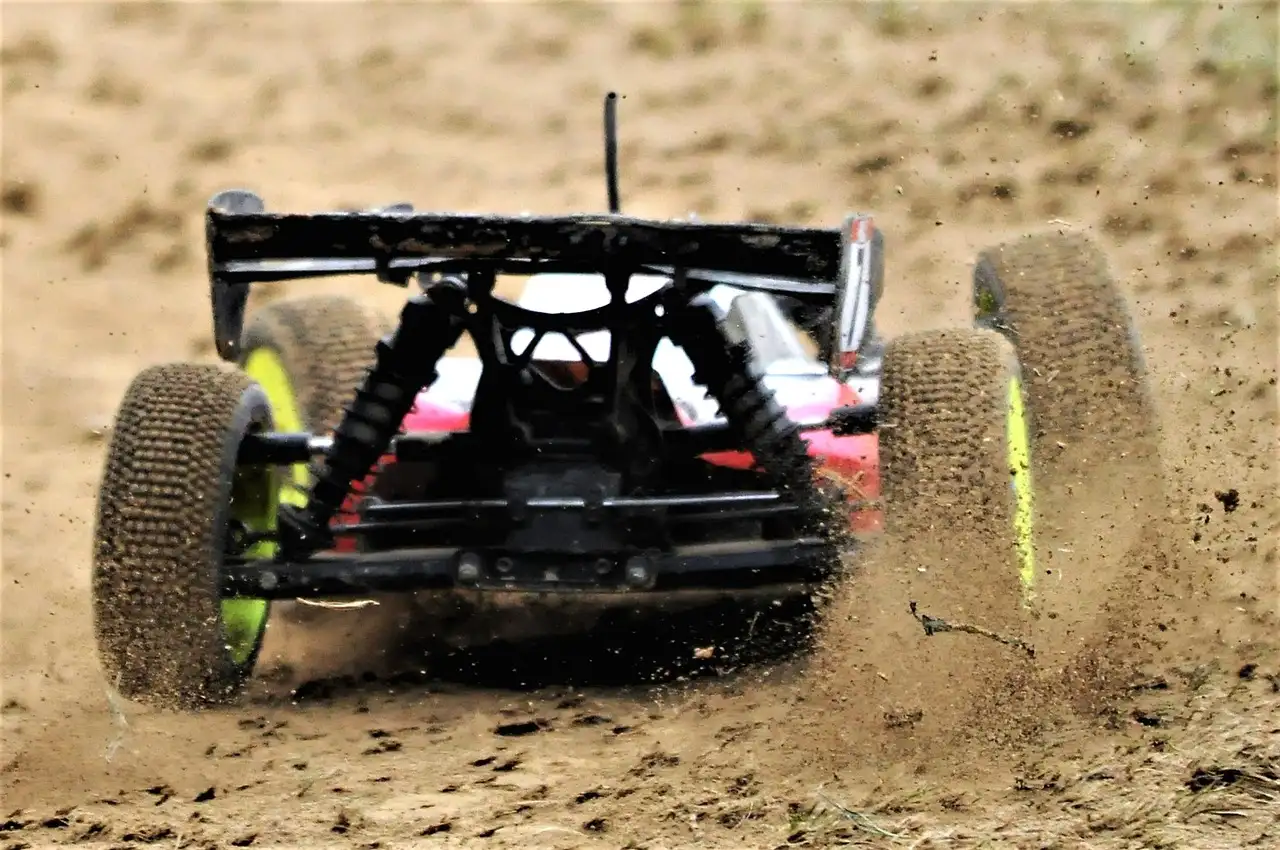
A track tire is built to stay predictable through repeated braking zones, long corners, and session-length heat buildup, not merely one quick lap. The real question is whether the tire can keep its grip and structure after several heat cycles without going greasy, tearing up its shoulders, or giving away braking support.
Session consistency matters more than one peak lap
On track, the tire has to survive repeated heat input from braking, acceleration, and lateral load. A tire that feels sharp for two laps but fades by minute eight is a poor fit for most track-day drivers, even if its first lap looks strong.
That is why tire choice should start with function, not appearance. BFGoodrich states that plainly, and the point applies here too: tread pattern and sidewall branding do not tell you how long the tire stays in its working window.
Where 200TW street-legal track tires fit
For first serious track sets, the sweet spot is often the broad 200TW extreme-performance summer category. In practice, these tires usually give enough dry grip for novice and intermediate pace, enough heat tolerance for full sessions on many cars, and enough rain ability to keep every damp event from turning into a swap day.
That said, 200TW is a category marker, not a universal performance scale. One brand’s 200TW tire can handle heat better than another brand’s 200TW tire, and wet behavior can vary a lot.
When a track tire is the wrong tool
Summer UHP tires are not meant for cold weather and will not grip in snow or ice. That matters twice for track drivers: cold-road commuting on the way to an event, and garage storage through winter. If the car often sees low temperatures or standing water, a heavily track-biased summer compound may ask for more compromise than it gives back.
A common first-timer mistake is buying the most aggressive street-legal tire available, then finding out it hates cold mornings, grooves badly on the highway, and never really comes in during short autocross-style runs.
Which tire category fits your track-day use?
The right category depends on event frequency, rain likelihood, street miles, and how much heat your car puts into the tire. Most beginners are better served by a forgiving 200TW tire than by a near-slick, because communication and repeatability matter more than peak grip they cannot yet use.
Beginner-friendly 200TW options
A broad-window 200TW tire usually suits drivers doing a few events per year, driving to the track, and learning pressure and alignment basics. The traits that matter are steady breakaway, decent wet traction, and a slower performance drop as the session builds heat.
Those traits also make diagnosis easier. If lap times fade, you can sort out pressure rise, alignment, or driving line instead of blaming a tire that only works in a narrow temperature band.
Track-focused street tires versus near-slick categories
Track-focused street tires sit between daily-driver max-performance summers and true competition rubber. They often give up some wet margin and tread life for more dry support and better heat tolerance. Near-slick or R-compound options usually need more heat, more discipline with pressures, and better weather planning.
Higher-power cars, heavier sedans, and some EVs can justify moving up a category because they can hit the carcass and shoulder harder. A light car used six times a year often cannot.
Street miles, rain risk, and storage temperature
Street miles age the tire through heat cycles and abrasion before the next event even starts. If the set must also handle commutes, wet sessions, and cool mornings, a broad-window tire is usually the smarter buy than a stickier option that only works in a tight band.
Picture a car that drives 80 highway miles to each event and gets caught in afternoon rain twice a season. A wet-capable 200TW tire may be faster over the year than a near-slick that can force a cautious drive there, a nervous wet session, and earlier replacement from street wear.
How do compound and UTQG ratings guide the choice?
Compound choice should sort four things first: dry grip, heat tolerance, wet grip, and cold limits. UTQG markings help, but they are only partial clues because treadwear is manufacturer-assigned, and equal numbers across brands do not guarantee equal pace, equal longevity, or equal heat resistance.
Compound tradeoffs that matter on track
Stickier compounds usually offer more dry grip and shorter warm-up, but they can also overheat faster on heavy or under-cambered cars. Harder compounds may give up peak grip yet run longer before going greasy and survive more events with fewer shoulder problems.
For a first serious set, broad operating range usually beats maximum advertised grip. Predictable breakaway and stable braking let a driver learn more, and they often keep the tire alive longer.
How to read UTQG without overreading it
UTQG has three parts: treadwear, traction, and temperature. Treadwear is the number track drivers mention most, especially the 200TW threshold common in street-legal performance classes. Traction and temperature also matter, but they still do not give a complete track picture.
The limit is comparability. UTQG is useful inside a brand family and as a rough category marker, but it is weak as a direct cross-brand stopwatch. A 200TW from one maker is not automatically equal to another 200TW in grip, rain behavior, or heat tolerance.
Heat cycling and shoulder wear change the buying decision
Some tires lose their best feel more from heat cycles than from tread depth. Others keep pace well until outer shoulder wear takes them away. That is why alignment and pressure belong in the buying decision, not as afterthoughts.
Say your front-heavy hatchback arrives on factory camber and a sticky tire with soft shoulders. Even if tread depth still looks healthy after two events, the outer front blocks may feather and smear from rollover, leaving slower turn-in and longer braking before the tire is technically worn out.
How should you choose track tire size and width?
Choose size and width by reading the sidewall correctly, then matching the tire to wheel width, clearance, and chassis balance. Wider is only better when the wheel supports it, the body clears it, and the alignment can keep the contact patch flat under braking and cornering.
Reading section width, aspect ratio, and wheel diameter
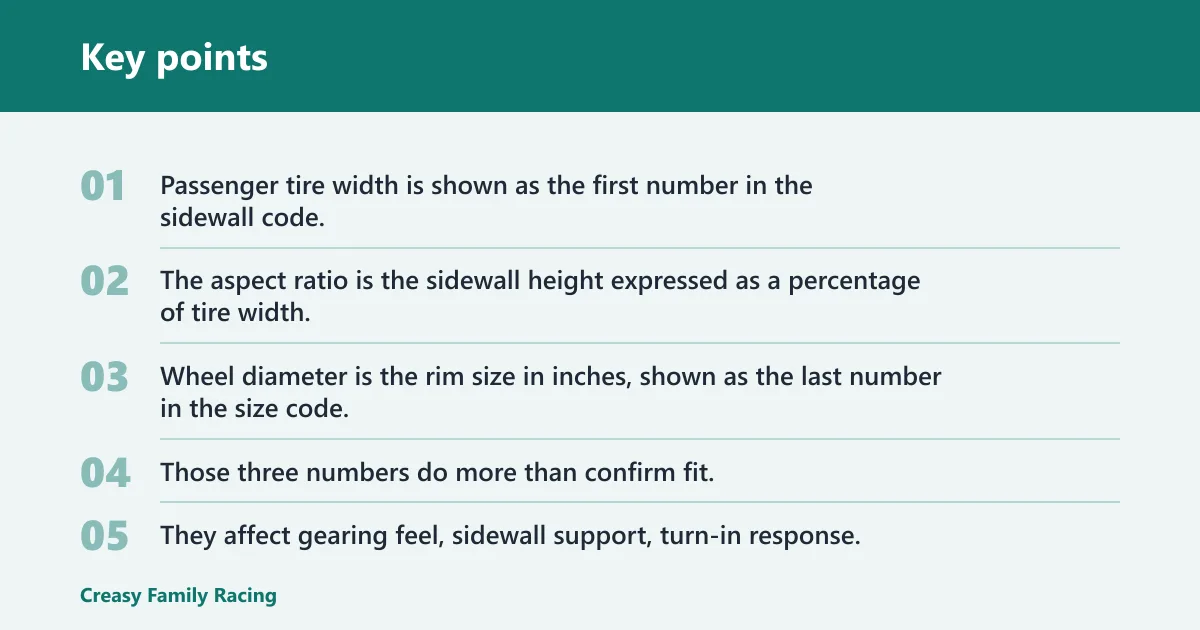
Passenger tire width is shown as the first number in the sidewall code, such as 235 millimeters. The aspect ratio is the sidewall height expressed as a percentage of tire width, such as 65 percent. Wheel diameter is the rim size in inches, shown as the last number in the size code.
Those three numbers do more than confirm fit. They affect gearing feel, sidewall support, turn-in response, and whether there is enough room at the strut, spring perch, inner liner, and fender lip.
What width changes on track
More section width can increase grip and reduce heat load per square inch, but it also changes steering weight, yaw response, and water evacuation. At track speeds in standing water, a wider tire can hydroplane sooner if the tread design and compound are weak in the wet.
Width also changes balance. More front tire can calm understeer. More rear tire can improve power-down but may dull rotation. A square setup often gives simpler rotation and more neutral tuning, while staggered setups can lock in factory balance.
Wheel width support and plus-sizing limits
A tire can be technically mountable on a wheel and still be poorly supported for track work. When the wheel is too narrow for the chosen section width, the sidewall pinches, response slows, and the shoulder works too hard. That often shows up as vague turn-in and outer-edge abuse.
Plus-sizing needs discipline. Larger-than-stock tires often require aftermarket modifications like a lift kit on trucks, BFGoodrich warns, and on cars the parallel issue is fender, liner, and strut clearance. Track use adds another problem: the tire can clear statically and still rub under compression and steering lock.
Fitment checks before buying
Start with the owner’s manual and door-jamb placard as the baseline. Then check wheel width range, offset, fender room, inner clearance, and brake package. Bigger brakes can create barrel and spoke-clearance problems even when the diameter looks correct on paper.
Suppose a car moves from 245/40R18 to 265/35R18 on the same wheel because “more front tire” sounds appealing. If the wheel is narrow and camber is limited, the result can be slower initial response, hot outer shoulders, and rubbing at the liner before any real lap-time gain appears.
Why load index and speed rating matter on track
Load index basics
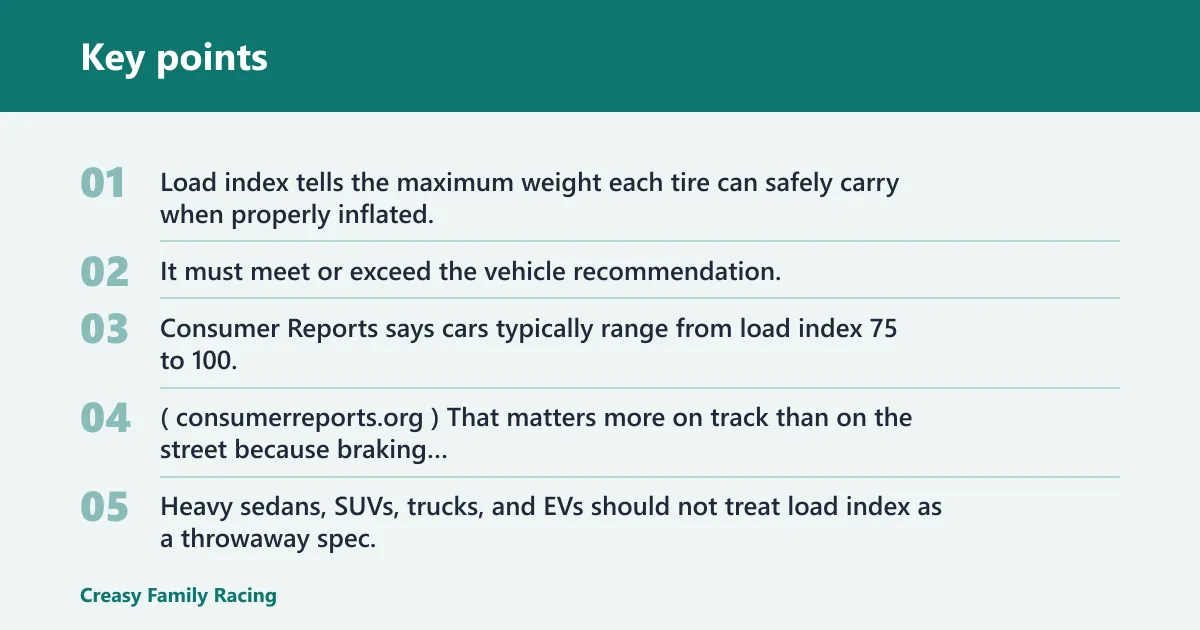
Load index tells the maximum weight each tire can safely carry when properly inflated. It must meet or exceed the vehicle recommendation. Consumer Reports says cars typically range from load index 75 to 100, and a load index of 94 corresponds to 1,477 pounds per tire. (Consumerreports)
That matters more on track than on the street because braking and cornering raise the tire’s effective workload. Heavy sedans, SUVs, trucks, and EVs should not treat load index as a throwaway spec.
Why heavier cars and EVs need margin
Mass and torque stress tires differently. A heavy car builds more heat in the carcass and shoulder under repeated braking. An EV adds strong low-end torque and often more curb weight, which can punish marginal load ratings and weak sidewall support.
If a heavier car keeps overheating front tires, the answer may be more heat capacity or a category step-up, not simply another pound of pressure.
Speed rating in context
Ultra-high-performance tires use speed ratings like ZR, W, and Y. Common street letters also include H and V. The rating is tied to operation under rated load, so it is not a simple top-speed brag number and should never be used to justify a load-index downgrade.
For track use, the minimum safe rule is simple: meet or exceed the vehicle’s recommended speed rating and load index. Then choose category and compound based on heat management, not on the biggest letter alone.
What setup changes affect tire choice most?
The tire only works as well as the alignment and pressure let it work. Camber, toe, and hot-pressure behavior decide whether the tire uses its full tread, overheats the shoulders, or stays stable in braking zones. If the setup cannot support a tire, buy for the setup you have.
Camber and toe
Negative camber helps keep the outside tire upright in a corner, which protects the outer shoulder and usually sharpens front-end grip. Too little camber on a sticky tire often creates shoulder damage before the center tread is meaningfully worn.
Toe changes behavior fast. More toe-out can sharpen turn-in but adds scrub and heat. Excess toe-in can improve straight-line calmness yet hurt response and increase wear. For drivers still learning, stable settings often beat aggressive ones.
Cold pressure versus hot pressure
Cold pressure is only the starting point. Hot pressure tells you where the tire actually worked after several laps. If the tire ends up too high, the contact patch can crown and reduce grip; too low, and the carcass rolls onto the shoulders, building heat and chewing the edges.
No single hot number fits every car. Use the manufacturer’s guidance where available, log cold-to-hot growth after full sessions, and adjust in about 1 to 2 psi steps while reading wear across the tread and noting how the tire behaves in braking and long corners.
Reading wear patterns
Outer shoulder destruction usually points to insufficient camber, too little wheel support, or too low a working pressure. Center wear can point to too much pressure. Feathering can point to toe issues. A greasy feel after several laps often means the tire or setup has moved outside its heat window.
When alignment range is limited, buy accordingly. A car stuck near factory camber may live longer and run more consistently on a slightly less aggressive tire with stronger tolerance for shoulder load.
Wheel package choices
Single set versus second wheel set
A single wheel-and-tire set makes sense for drivers doing only a handful of events, especially when the chosen tire handles street miles and rain reasonably well. A second set starts making sense when event cadence rises, wet flexibility matters, or street miles are wearing out expensive track rubber.
Swap speed and wet-day flexibility
The practical gain from a second set is time and control. Street tires can stay on for daily use and bad-weather drives, while the track set comes out only when heat and pace justify it. That also reduces heat cycles and road wear on the expensive set.
Brake clearance and package checks
Brake-caliper clearance is more than wheel diameter. Barrel shape and spoke profile matter, especially after brake upgrades. Confirm the wheel clears the caliper and that the tire size still clears the liner and fender at compression.
Staggered setups may preserve factory traction balance. Square setups often simplify rotation, inventory, and front-tire wear management. For many track-day cars, that flexibility is worth more than the factory look.
Track tire scorecard
Track tire fitment and use-Case scorecard
| Car weight | Tire width | Treadwear target | Wet-use likelihood | Event frequency | Street miles | Brake clearance | Recommended tire category |
|---|---|---|---|---|---|---|---|
| 2,700-3,000 lb | 225-245 mm | 200TW | Moderate | 3-5 days/year | High | Stock brakes, easy fit | Broad-window 200TW extreme-performance summer |
| 3,100-3,500 lb | 245-265 mm | 200TW | Low to moderate | 6-10 days/year | Medium | Check inner barrel and spoke clearance | Heat-tolerant 200TW or track-focused street tire |
| 3,600-4,200 lb | 255-285 mm | 200TW to lower-TW track-focused street | Low | 8+ days/year | Low | Big-brake clearance likely issue | Higher-capacity track-focused street tire; consider second wheel set |
| 4,300+ lb | 265-305 mm | Heat capacity first | Low | Regular use | Low | Brake package must be verified carefully | Heavy-car-capable track tire with strong load index; separate street/wet plan |
Track tires checklist
- Yes/No: Does the size stay within known clearance at the fender, strut, spring perch, inner liner, and brake package?
- Yes/No: Does the load index meet or exceed the vehicle recommendation?
- Yes/No: Does the speed rating meet or exceed the vehicle recommendation?
- Yes/No: Is the wheel width appropriate for the chosen section width for track use, not merely street fitment?
- Yes/No: Can the car run enough camber to protect the shoulders of this compound?
- Yes/No: Is wet-session use likely enough that a broad-window 200TW tire makes more sense than a near-slick?
- Yes/No: Will the tires be stored and driven only in temperatures suitable for summer compounds?
- Yes/No: Is a second wheel set justified by event frequency, street-mile savings, or wet-day flexibility?
How to use the scorecard
Light cars with modest power can usually stay conservative on width and still get full-session performance from a good 200TW tire. Heavy, fast, front-weighted cars often need more width, more load capacity, or a category with better heat tolerance.
Street miles push the choice toward forgiving compounds. Low rain risk and frequent events push it toward more focused categories. If more than two checklist answers come back “No,” the current plan usually needs revision before purchase.
Common buying mistakes and failure cases
Too much tire
Too much tire shows up as slow warm-up, muted feedback, higher cost, and poor wet confidence. The driver chases a stickier label, but the car never puts enough heat into it, or the setup lacks the camber and wheel support to use it. The result is less trust, not more speed.
Too little tire
Too little tire overheats. The signs are greasy laps late in the session, tread blocks smearing, and braking feel going away as temperatures rise. On heavier cars, too little tire can also mean marginal load capacity and accelerated shoulder wear.
Wrong width or wrong wheel support
Too wide on too little wheel gives vague response and overloaded shoulders. Too narrow can overwork the carcass and sharpen heat buildup. Either mistake can mask itself at first with decent turn-in, then show up as poor wear and inconsistent laps once heat builds.
Ignoring load, speed, or clearance limits
Never buy below the vehicle’s recommended load index or speed rating. Check the placard first, then verify the new package against track realities. BFGoodrich warns that P-metric tires are not built for off-roading demands; the parallel lesson for track use is similar: do not ask a tire built for one duty cycle to absorb another without checking the specs that carry the load.
Truck owners should be especially careful. The same source describes all-terrain tires as better for highway comfort and quieter ride quality than mud-terrains, while mud-terrain tires are built for serious off-road traction with large tread blocks and wide voids. Neither description makes them a track-day answer. Trucks doing occasional performance driving still need load capacity, speed rating, and heat management checked against the actual use case.
Frequently asked questions
How to choose the right tire
Start with heat load, not hype. Match compound category, width, load index, and wheel support to the car’s weight, braking demand, alignment range, and number of events per year. For most first serious track sets, a forgiving 200TW tire is the safest place to begin.
How to know what tires to get
Use the car’s placard and manual as the floor, then add track needs: event frequency, rain risk, storage temperature, street miles, and whether the car is heavy or front-biased. If the car sees mixed use, broad-window 200TW tires usually make the most sense.
What are track tires?
They are for repeated heat cycles, hard braking, sustained cornering load, and predictable grip near the limit. The goal is not one hero lap. The goal is a tire that stays consistent across sessions, communicates clearly, and survives track use without destroying its shoulders.
How to choose tires for my truck
For any truck seeing performance driving, start with load index and speed rating, then verify width, wheel support, and brake clearance. Do not assume off-road tread types belong on track. Larger-than-stock tire plans also need extra fitment attention because modifications may be required.