What Is a Heat Cycle for Track Tires?
A heat cycle for a track tire is one full heat-up and cool-down event, from cold to operating temperature and back to cool. Each complete cycle can change the tread compound, and repeated cycles can harden the rubber, cut peak grip, and make the tire less consistent. Miss the signs and you can buy tires that look fine but are already slow, inconsistent, or close to unsafe. This guide explains how heat cycles differ from wear, and how to judge used tires by cracks, heat checking, tread depth, cords, and sidewall damage.
What is a heat cycle?
A heat cycle is one trip from cold to operating temperature and back to cold. Racers use the term in more than one way, though. Some mean a deliberate conditioning cycle before hard use. Others mean any session count that includes a full warm-up and cool-down. The effect on the compound depends on the tire, the compound, and the temperatures it reaches.
That is why two people can describe the same tire very differently. One may say a tire has three cycles because it has been heat-conditioned three times. Another may call it six cycles because it ran six sessions. The number matters less than the condition of the rubber and the symptoms it shows.
How a heat cycle differs from a single lap
A single lap may warm the tread, but a full heat cycle needs the tire to reach operating temperature and then return to cold. That full swing can change the tread compound. A quick out-lap and cool-down in the paddock is not the same as a full session that loads the tire enough to stabilize its heat.
That distinction matters when you buy used tires. A tire can look lightly worn and still have an aged compound. It can also have plenty of tread left and still be slow.
How heat cycles change grip
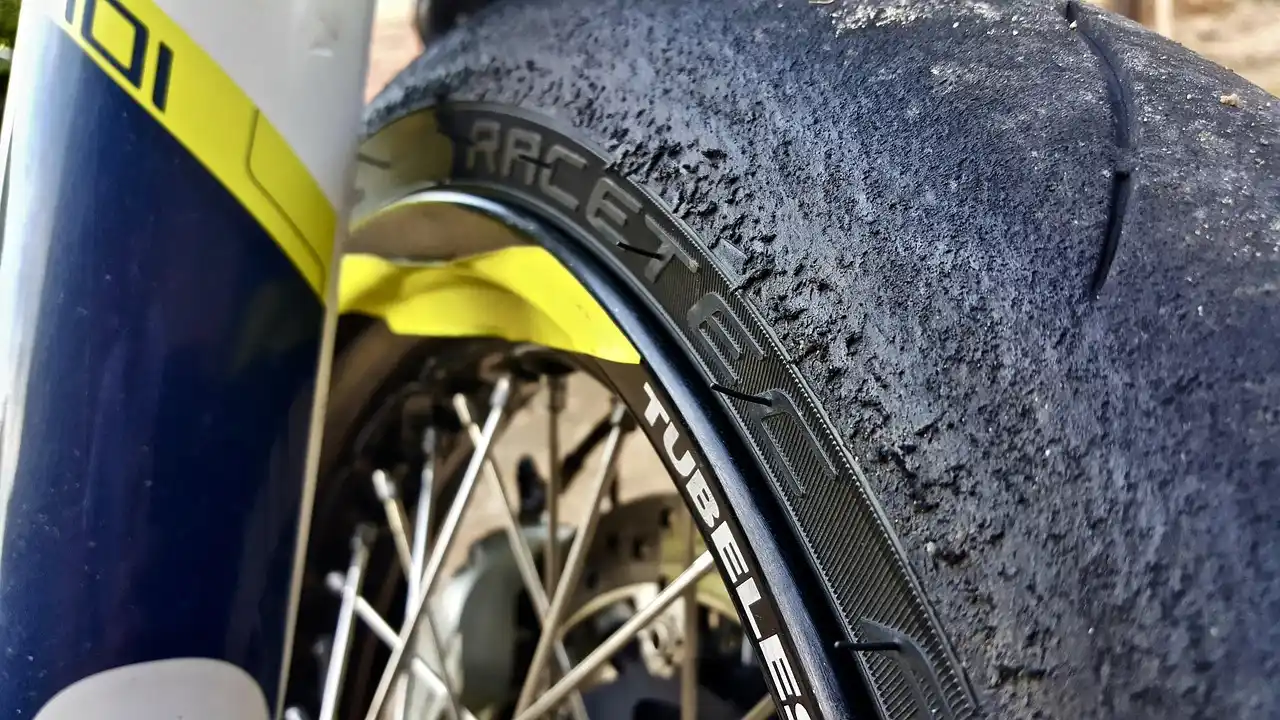
Heat cycles matter because tread compound controls grip more than tread depth does. Heat raises grip until the rubber gets too hot and starts tearing. After repeated cycles, the compound hardens, peak grip drops, and the tire may feel less predictable even if the tread still looks usable.
Tread compound matters more than depth
Soft compounds switch on quickly and usually have higher peak grip. Harder compounds need more heat before they start working. That is why a tire can lose lap time before it looks “used up” by tread depth alone.
Old tires can be slower even if they were never used. Age and cycles both matter. A tire that sat in storage may still have a stale compound, and a tire that has been heat-cycled repeatedly may feel harder and less responsive. Tire Rack’s competition heat-cycling service, for example, uses a controlled process instead of simply relying on tread depth or a seller’s guess about use history. Tire Rack heat cycling
Soft and hard compounds age differently
Soft compounds usually give more grip but wear faster. Harder compounds usually last longer but need more heat to work well. The effect shows up in different ways: a soft tire may lose outright pace sooner, while a harder tire may stay consistent longer but never feel as sharp. Manufacturer guidance commonly treats heat, age, and storage together because all three affect compound behavior. Michelin tire storage guidance
Picture a 200TW tire on a cool morning. It may feel fine after a warm-up lap, then go away if the surface temperature climbs and the rubber starts tearing. That is compound behavior, not just tread wear.
Does every tire age the same way?
No. A 200TW track tire, a super 200TW tire, and a slick do not age the same way in track use. The construction, heat range, and intended use all change how fast grip falls and what kind of damage appears first.
200TW endurance tires
Continental’s ExtremeContact Force is designed for track-day enthusiasts, club racers, and endurance racers, and is described as having consistent lap times. That kind of tire usually trades some peak pace for longer life and better repeatability. Continental ExtremeContact Force
For a used 200TW endurance tire, the question is often whether the rubber still works in its designed range. If the tread shows normal wear but the shoulders are intact and the surface is not heat-damaged, it may still make sense to buy.
Super 200TW tires
Super 200TW tires are often faster than endurance-oriented 200TW tires, but they usually have a shorter track life. They are common in time attack and autocross, where peak grip matters more and the tire may see harder thermal loading over shorter runs.
Those tires can fall off sooner even before the tread is low. A buyer should expect more sensitivity to heat history and a shorter useful window than a milder endurance tire.
Slicks and wet tires
A slick has maximum rubber on the ground for dry conditions. That is ideal for dry grip, but it also means the tire depends heavily on temperature control. If it overheats, it can tear, chunk, or blister quickly. Heat checking, blistering, and chunking are all common retirement signs in race-tire guidance. Hoosier race tire technology
Wet tires behave differently because tread channels water. In wet conditions, tread is there to move water away, not just to chase dry grip. Heat management changes with the surface and the temperature, so a wet tire that looks fine in the rain may be the wrong choice for hot dry sessions.
Heat-cycle behavior comparison
| Tire type | Typical heat-cycle behavior | What usually shows first | Best use case |
|---|---|---|---|
| Endurance 200TW | More consistent over more sessions, with slower grip fade | Gradual loss of sharpness, shoulder wear, mild surface checking | Track days, club racing, repeatable stints |
| Super 200TW | Faster initial grip, shorter heat-cycle window | Faster pace drop, glazing, chunking if overheated | Time attack, autocross, short sprint use |
| Slick | Most sensitive to temperature control and overuse | Blistering, tearing, chunking, rapid falloff when abused | Dry racing with controlled temps |
| Wet tire | Designed to work cold and evacuate water, not to chase dry pace | Tread wear, tearing, overheating if used in dry conditions | Rain and standing water |
How do you heat cycle tires?
Controlled heat cycling means bringing the tire to a target temperature, then letting it cool fully before hard use. Tire Rack’s competition heat-cycling service heats tires to 170-180°F and requires a minimum 24-hour rest. Tire Rack says the process does not scuff the tire. Tire Rack heat cycling
That is different from casual track sessions. A normal session may create heat, but it may not follow a controlled temperature target or a fixed cool-down period. Deliberate heat cycling is a planned process for tires that benefit from it, not a universal rule for every modern track tire. A random day at the track is not.
- Start with a clean tire and record its size, model, and date code.
- Bring the tread into a controlled operating range, not a random overheated state.
- Use a pyrometer to check tread temperature across the tire if you want to confirm the operating range.
- Let the tire cool fully before the next hard session.
- Repeat only if the tire type and use case call for it.
Why rest time matters
Rest time matters because the cycle is not complete until the tire returns to cold. A minimum 24-hour rest gives the compound time to settle after heating. That matters more than simply stacking back-to-back hot laps, which may add stress without giving you useful information about the tire’s operating range.
A pyrometer helps confirm where the tread is working. A durometer helps compare rubber hardness on a used tire versus a fresh one. Neither tool fixes a bad tire, but both can help separate “still in range” from “aged out.” Tire Rack’s service description explicitly uses heat and rest as a controlled process, and that is the model buyers should use when they ask how a tire was treated. Tire Rack heat cycling
Does a full cool-down between sessions extend heat-cycle life?
Yes, a real cool-down can help preserve consistency because it keeps the tire from living in a constantly overheated state. But it does not erase wear or restore lost grip. Full cool-down mainly reduces unnecessary thermal stress; it does not make an abused tire new again.
The benefit is strongest when the tire is kept within its intended temperature window and then allowed to cool fully before the next load. If the tire has already blistered, chunked, or heat-checked deeply, cooldowns do not reverse that damage. Hoosier race tire technology
Do heat cycles affect lap times more than tread depth?
Often, yes. Track tires usually lose pace from compound aging and heat history before tread depth becomes the main limiter. A tire can still measure “good” and be slower because the rubber is harder, less compliant, or more prone to sliding. That is why lap-time drop and driver feel can change before the tread looks spent.
Tread depth still matters for water evacuation, heat capacity, and wear life, but it is not the whole story. A buyer should treat grip loss, glazing, and chunking as performance warnings even if there is still meat on the tire.
How do wet and dry behavior change on aged compounds?
Aged compounds usually become less compliant in both wet and dry conditions, but the problem shows up differently. In the dry, the tire can lose bite and overheat sooner. In the wet, it may not conform as well to the surface, so traction can feel vague even if the tread is still deep enough to move water.
That is why a tire that is merely “okay” in the dry can feel especially poor in the wet once the compound hardens. Wet grip depends on tread channels and rubber compliance together, not tread depth alone.
Used tire inspection checklist
This checklist separates three outcomes: buy for track, okay for street/drive home only, and do not buy. Use it on the tire itself, not on a seller’s description. Tread depth matters, but it should not be the main decision point.
| Inspection item | Buy for track | Okay for street/drive home only | Do not buy |
|---|---|---|---|
| Tread look | Even wear, no major tearing, no cords showing | Rounded tread blocks, hard-feeling surface, but no structural damage | Exposed cords, severe scalloping, or missing chunks that reach deep into the tread |
| Shoulder condition | Shoulders worn evenly for the tire’s use | Light shoulder wear with heat checking only on the surface | Shoulder separation, deep cuts, or torn rubber at the edge |
| Heat blisters | None present | Small, shallow marks without swelling | Visible blisters, soft raised spots, or signs of overheating |
| Chunking | None present | Minor edge chipping only | Large chunks missing from tread blocks |
| Cracking | Fine surface lines only | Noticeable surface checking with no deep cracking | Deep cracks in tread or sidewall |
| Age | Recent date code and known storage | Older tire with clear history and no damage | Unknown age, very old date code, or weather-checked rubber |
| Session count | Seller can explain the sessions clearly | Count is high but history is consistent | Seller cannot say whether the tire was heat-cycled, overheated, or race-stressed |
| Date-code threshold | Recent enough for the intended use and storage history is credible | Older than ideal but still serviceable only if stored well and inspected cleanly | Very old, unknown, or missing clear storage history for track use |
| Verdict trigger | Uniform wear, intact carcass, no structural flags | Some fade, but no damage that threatens safety | Any cords, bulges, deep cracks, air loss, sidewall damage, or severe blistering |
Seller red-flag phrases
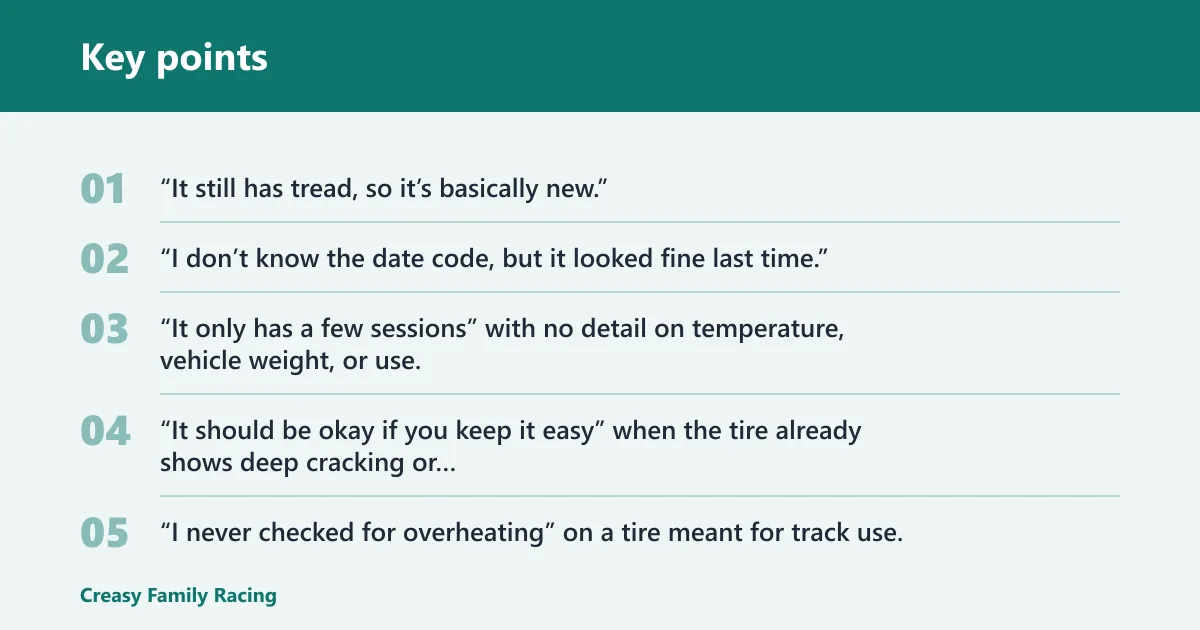
- “It still has tread, so it’s basically new.”
- “I don’t know the date code, but it looked fine last time.”
- “It only has a few sessions” with no detail on temperature, vehicle weight, or use.
- “It should be okay if you keep it easy” when the tire already shows deep cracking or blistering.
- “I never checked for overheating” on a tire meant for track use.
Simple decision flow
Buy for track: no cords, no bulges, no deep cracks, no sidewall damage, no severe blistering, and wear is even enough that the carcass still looks healthy.
Okay for street/drive home only: the tire holds air, has no structural damage, and only shows mild performance fade or light surface checking. Do not plan aggressive use.
Do not buy: any cords, bulges, deep cracks, air loss, sidewall damage, or severe blistering means replace immediately. That is a structural issue, not just a grip issue.
Buyer script for used tires
Ask the seller: “What do you mean by a heat cycle on this tire?” Then ask how many full heat-up and cool-down events the tire has seen, whether those were controlled cycles or track sessions, and whether the tire ever overheated or blistered. If the answer is vague, treat the tire as higher risk.
Say a seller lists a set of 315/30R18 200TW tires with about two heat cycles and plenty of tread. If the shoulders show chunking and the tread surface looks hard and glazed, the tire may be performance-faded even though it still appears thick. One number does not settle the sale.
How many cycles is too many?
There is no single universal number of heat cycles that is too many. Counting method varies by racer, shop, and tire type, so session count is not a universal rule. A tire can still be fine after many cycles if it has stayed in range, or it can be done sooner if it has been overheated or abused.
Session count questions to ask the seller
- How many full sessions did the tire see?
- Was it heat-cycled deliberately before use?
- Were the sessions dry, wet, or mixed?
- Did the tire run on a heavy car or a lighter car?
- Was it ever overinflated or overheated?
- Has it been sitting unused since its last event?
Age versus cycle count
Age and cycle count are different risks. A tire can be old and still structurally sound, but aged rubber may be slower. A tire can have fewer cycles and still be unsafe if it has blistering, cracking, or sidewall damage. Safety always outranks pace.
Manufacturer storage guidance also matters because heat, sunlight, ozone, and time all affect rubber even before the first session. That is why date code and storage history belong in the same conversation as lap count. Michelin tire storage guidance
Can heat-cycled tires still be safe?
Yes, if the tire is structurally sound and the damage is limited to normal wear or mild performance fade. Heat-cycled tires can still be safe to drive home on if the sidewalls are intact and there are no cords showing, along with no severe cracking, blistering, or separation. A tire can be slower without being unsafe.
Signs the tire is home-driveable
Look for even wear, shallow surface checking, and no exposed cords. Mild shoulder wear is acceptable if the carcass is intact. If the tire still holds air, has no bulges, and shows no deep cuts, it may be reasonable to drive home on after an event.
Signs the tire is done
Pass on the bargain if you see sidewall bubbles, deep cracks, severe chunking, blistered tread, or cords. Overheated tread can lead to chunking and blistering, and those are not signs of a tire you should keep pushing. If the seller cannot explain the tire’s history, that is another warning sign.
A common first-timer mistake is buying a set because the tread still measures deep. A 200TW tire with hard, heat-aged rubber and worn shoulders may look “full” and still be the wrong tire for a hard session weekend.
Frequently asked questions
What is a heat cycle for track tires?
A heat cycle is one full move from cold to operating temperature and back to cold. The compound can change with each cycle, depending on the tire. For track tires, that means the tire can lose grip or consistency even if the tread still looks fine.
Is heat cycling tires worth it?
It can be worth it for tires that benefit from controlled conditioning before use, especially if you want more predictable behavior. It is not a cure for damage or age. If a tire is already blistered, cracked, or chunking, heat cycling will not save it.
How many heat cycles can a track tire take?
There is no single number that fits every tire. Counting varies by racer, shop, and tire type. A tire’s condition, age, compound, and history matter more than a fixed cycle count. Inspect the tire instead of trusting a simple tally.
Do tires lose grip after every heat cycle?
Not always after every single cycle, but repeated cycles do permanently change the compound. Grip usually falls over time, especially if the tire runs too hot. The rate depends on compound, heat management, and how hard the tire is used.
Can heat-cycled tires still be safe to drive home on?
Yes, if they show normal wear only and no structural damage. Check for cords, sidewall bubbles, deep cracks, and heavy blistering. If those are absent, the tire may still be safe for a careful drive home. If not, replace it.