Racing Harnesses for Street and Track Cars
For many dual-use cars, a common safe setup is a 6-point FIA or SFI restraint paired with a fixed-back seat, proper submarine-belt geometry, and shoulder belts mounted about 0 to -20 degrees below shoulder height. If the angle is off, it can increase the chance of submarining under the lap belt, add spinal loading in a frontal crash, create tech inspection issues, and make street use or emergency exit harder. This guide shows how to choose by seat type, mounting points, roll-bar or belt-bar layout, daily-use practicality, and track-day rules.
That verdict cuts out many cosmetic installs. If the seat lacks proper belt pass-throughs, the shoulder-belt path is wrong, or the car has no sound mounting plan, the factory three-point belt is usually the better choice for street driving and often the safer choice overall.
Pros and cons
Pros
- Better body control under braking and cornering when the seat and belt geometry are correct.
- More repeatable driving position, which helps with steering, pedal modulation, and sight lines on track.
- Stronger retention in higher-load driving, especially with a fixed-back seat and properly routed lap belts.
- Event fitment options across 4-, 5-, and 6-point layouts, with FIA and SFI approvals available for sanctioned use.
Cons
- Poor match for many daily drivers, especially cars with factory seats, pretensioners, and airbag systems calibrated around the OEM belt.
- Slower ingress and egress than a three-point belt, particularly with anti-sub straps and deep side bolsters.
- Higher real cost once seat, mounts, belt bar or roll bar, hardware, and replacement intervals are included.
- Unsafe when shoulder angle, lap-belt routing, or anchor strength are wrong, even if the harness itself is certified.
Who it’s for
Best fit: purpose-built dual-use cars
This suits a car that already has a fixed-back race seat, correct belt pass-throughs, known mounting locations, and regular HPDE or time-trial use. In that context, a multi-point belt is one part of the restraint system, not a stand-alone add-on.
Maybe: occasional HPDE cars with the right seat and mounts
A weekend car that still sees street miles can make sense if the seat geometry is right and the organizer allows the restraint system being used. That usually means thinking through egress, visibility, and how often you want to clip in and adjust belts.
Poor fit: daily drivers on factory seats
If the goal is mainly appearance, skip it. If the car keeps stock seats with no proper shoulder pass-throughs and no sound anti-sub plan, a multi-point belt can create more problems than it solves.
Can you run racing harnesses in a street car and still use it on track?
Yes, sometimes, but only when the street car already supports correct seat and mounting geometry. Track acceptance and street legality are separate questions, and a setup that passes one organizer’s tech inspection may still be a poor daily-driver solution because entry, exit, rearward checks, and airbag integration all change.
Street use versus event use
Sube Sports states multi-point belts can be used in track days, autocross, rally, or professional motorsport. That does not make every street car a good candidate. Event organizers often focus on certification labels, mounting method, and seat compatibility. Road-law treatment varies by location and by whether the OEM restraint remains functional.
FIA or SFI approval helps with sanctioned-event compliance, as Sube Sports notes, but neither label guarantees acceptance everywhere. Some HPDE groups allow certain belt sets in cars with rollover protection requirements; others prefer factory belts unless the full seat-and-bar package is in place.
Daily-driving tradeoffs
Street use changes the ideal choice. A dual-use car needs quick entry, quick exit, enough torso movement to check mirrors and blind spots, and a buckle you can operate cleanly in a hurry. A harness can limit all of that, especially with deep-bolster seats and a center console that crowds lap-belt adjusters.
Picture a compact coupe with a fixed-back seat, tall door sills, and a wide console. The harness may hold the driver perfectly in Turn 1, but if the lap adjusters sit against the bolsters, daily tightening gets old fast and exit gets slower at every stop.
Why legality and acceptance are separate
Street legality is a local law question. Track approval is an organizer and rulebook question. Keep them separate when shopping, because a harness that has the right tag for an event may still be a poor road solution if it disrupts the factory restraint logic or limits the driver’s ability to move naturally in traffic.
What harness setup is safest for a street-and-track car?
The safest usable setup for most dual-purpose builds starts with a fixed-back seat, correct shoulder-belt angle, and proper lap and anti-sub routing; then it narrows to a 6-point harness with the release and adjusters that best match the car’s entry, exit, and event rules. Point count alone does not decide safety.
Start with the seat, not the belts
The seat is the first filter. A harness needs shoulder pass-throughs at the right height, lap-belt paths that keep the belt low on the pelvis, and a base that works with anti-sub routing if the harness uses a fifth or sixth point. The same source notes racing harnesses are compatible with most racing seats and roll cages, which is the key distinction: racing seats, not generic factory seats.
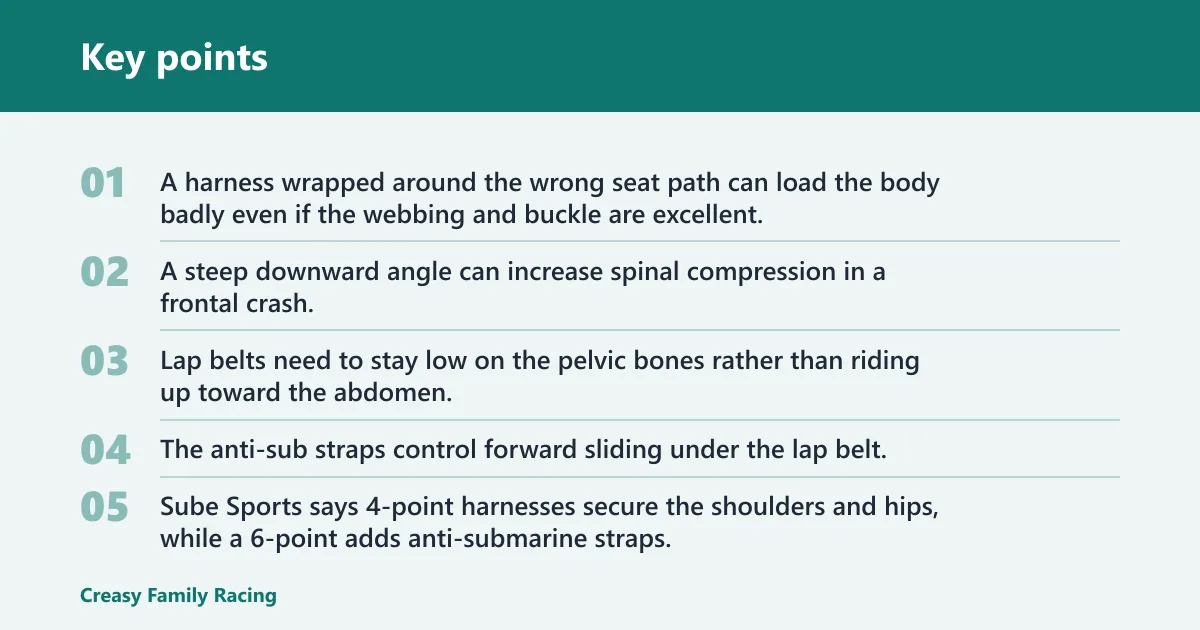
Many factory seats are a poor match because the shoulder belt exits too high, too low, or around soft seat structure rather than through reinforced openings. A harness wrapped around the wrong seat path can load the body badly even if the webbing and buckle are excellent.
Mounting points and shoulder-belt path
Shoulder straps should follow the seat openings cleanly to a proper anchor path and, for the setup covered here, sit within 0 to -20 degrees of shoulder height. A steep downward angle can increase spinal compression in a frontal crash. Lap belts need to stay low on the pelvic bones rather than riding up toward the abdomen.
The anti-sub straps control forward sliding under the lap belt. That is why 5-point and 6-point designs are treated differently from 4-point layouts. The same source says 4-point harnesses secure the shoulders and hips, while a 6-point adds anti-submarine straps.
Choosing 4-point, 5-point, or 6-point by use case
The same source says racing harness belts are available in 4-, 5-, and 6-point configurations. For a true street-and-track car, a 6-point is often the usual answer when the seat and floor or seat-base geometry support it. Two anti-sub straps generally make belt placement and comfort easier than a single center strap in many bucket-seat layouts.
A 4-point is the weakest fit for this use case because it lacks anti-sub control unless it uses a specific geometry and design accepted by the event. It may suit lower-demand use or a limited application, but it is rarely the first recommendation for a serious dual-use build.
A 5-point can work, but the single anti-sub strap often creates packaging compromises around seat openings and driver comfort. A 6-point usually gives a cleaner route around the body while helping keep the lap belt planted on the pelvis.
Say your car already has a fixed-back seat with dual anti-sub openings in the cushion and a proper shoulder-belt bar behind it. Moving from a 5-point to a 6-point changes only one variable: the anti-sub layout. In that case, the 6-point usually fits the seat better and is easier to tension evenly.
Camlock, latch-and-link, and adjuster style
Camlock and latch-and-link both work, but they suit different priorities. The same source lists camlock systems as quick-release designs for faster egress, which matters in a street-and-track car where you clip in and out often. Camlocks also tend to be easier with gloves once the tongue sequence is familiar.
Latch-and-link is common in track-oriented harnesses and stays popular because it is simple, mechanical, and familiar. Walmart lists an Impact Racing 5-point restraint system with latch and link and pull-down adjustment, and also lists an Impact Racing standard latch and link restraint system with pull-up adjust. That matters because adjuster direction changes real usability.
Pull-down lap adjusters usually make sense when the belt tails have room to move downward beside the hips. Pull-up adjusters can work better when the seat, door, or console blocks that movement. On some street interiors, the better buckle style matters less than whether the lap adjusters can actually be tightened after the driver shuts the door.
Ultraray Motorsports lists a GT2i Race 6 points Sedan Harness with 2-inch and 3-inch belt widths, a Lifeline Becketts 6pt FIA Harness with snap hook attachment, and a Lifeline Copse Blue 6pt FIA 8853-2016 Harness. Those examples show the variables that matter in shopping: width, attachment style, and approval label, not just brand name.
Do you need a harness bar, roll bar, or cage?
Usually yes, if the car does not already have correct shoulder-belt anchors at the proper height and strength. A harness bar can work in limited dual-use cases, but a roll bar or cage becomes the better answer when the seat, belt angles, event rules, or rollover expectations go beyond what a simple bar can support.
When a harness bar is appropriate
A harness bar is mainly about shoulder-belt mounting height and routing. It can be appropriate in a dual-use car with a fixed-back seat, suitable chassis attachment points, and organizer rules that allow the setup. It is not a fix for a bad seat or bad lap-belt geometry.
Good bars place the shoulder anchor path behind the seat without a steep drop. They also need hardware and attachment points that match the manufacturer instructions. A bar that only solves belt height but leaves the lap and anti-sub belts improvised is not a complete answer.
When a roll bar or cage becomes the better answer
Frequent track days, time trials, and many sanctioned racing classes push the car toward a roll bar or cage. The reason is not only belt anchoring. Once the car uses a fixed-back seat and multi-point harness seriously, the rest of the safety package usually matters more too, including rollover protection and mounting consistency side to side.
Factory anchors, clip-in points, and bolt-in limits
Factory threaded points can sometimes be used for lap belts or clip-in ends, but only when the harness maker allows it and the geometry works. Do not assume the rear seatbelt points or random floor locations are acceptable shoulder anchors. The anchor can be strong and still be in the wrong place.
A common first-timer mistake is bolting shoulder straps down to the rear floor because the holes are easy to reach. The belts look tidy, but the angle becomes too steep. That is how a clean install can still be a bad install.
Racing harnesses matrix

Street-and-Track harness fit check
| Seat type | Mounting point availability | Point count | Release style | Certification needed | Likely use case |
|---|---|---|---|---|---|
| Factory reclining seat without harness pass-throughs | OEM three-point anchors only | Stay with OEM belt | Factory buckle | Organizer dependent; harness usually poor fit | Daily driving, occasional novice event where stock belts are accepted |
| Sport seat with limited shoulder guides, no anti-sub opening | Harness bar available, lap points possible | 4-point only if event and manufacturer allow; otherwise no harness | Camlock preferred for street entry and exit | FIA or SFI if event requires it | Light dual-use, heavy fitment caution |
| Fixed-back seat with proper shoulder and anti-sub pass-throughs | Harness bar or roll bar plus proper lap and anti-sub anchors | 6-point | Camlock | FIA 8853-2016 or SFI 16.1 / 16.5 per event | Best match for HPDE and frequent track days |
| Fixed-back seat with proper pass-throughs | Roll bar or cage, clip-in or bolt-in hardware approved by maker | 5-point or 6-point | Latch-and-link or camlock | Series rulebook decides FIA or SFI | Time trial or club racing preparation |
| Full race seat package in dedicated competition car | Cage and purpose-built anchors | 6-point | Camlock or latch-and-link based on class preference | Exact sanctioning-body requirement | Sanctioned racing |
Racing harnesses checklist
- Check seat openings. If the seat lacks proper shoulder pass-throughs or anti-sub provision where the harness requires it, stop there. The harness and seat are already mismatched.
- Confirm shoulder path. The shoulder belts need a straight route from the driver’s shoulders to the anchor path within 0 to -20 degrees of shoulder height. A steep drop behind the seat is a no-go.
- Verify lap routing. Lap belts must sit low on the pelvis and tighten without riding onto the abdomen. If bolsters or the console force the belt upward, the fit is wrong.
- Match hardware types. Use the attachment hardware specified by the harness maker. Mixing eye bolts, snap hooks, wrap mounts, and random spacers from different systems can defeat the intended load path.
- Review restraint integration. If the car relies on factory pretensioners, airbags, and seat sensors, assume a harness changes that system interaction. Treat that as a design issue, not a small detail.
- Read event rules. Confirm whether the organizer wants FIA 8853-2016, SFI 16.1, or SFI 16.5 labels, and whether seat, bar, or rollover equipment is required with the harness.
When racing harnesses expire and how to verify the date
Racing harnesses do expire, but the rule depends on the standard printed on the label. This guide explains how FIA 8853-2016 and SFI 16.1 belts are treated differently, how to find the date tag, and how to work out the real end-of-life before tech inspection becomes a problem. If you are sorting out a seat-and-belt setup, knowing the date matters because an otherwise good-looking harness can still fail compliance and keep your car off track.
The article also walks through tag formats, recertification timing, and the situations where a belt should be retired early for safety. For a clear step-by-step breakdown, see racing harness date checks.
How do you verify FIA or SFI compliance and service life?
Check the sewn-in label on the harness, then check the event rulebook. For dual-use cars, the right answer is the harness that matches both the organizer’s approval standard and the car’s mounting package, because certification alone does not fix expired webbing, wrong geometry, or bad seat compatibility.
FIA 8853-2016 labels and event expectations
FIA 8853-2016 is the approval marking many global motorsport events recognize. The label should be present on the harness itself, not only on a box or product page. The same source lists a Lifeline Copse Blue 6pt FIA 8853-2016 Harness, which is the kind of wording buyers should expect to see repeated on the sewn tag.
FIA approval matters most when the event or series specifically asks for it. It is relevant globally, but acceptance still depends on that organizer’s rulebook and any date-limit rules attached to the label.
SFI 16.1 and 16.5 labels and sanctioning use
SFI 16.1 and SFI 16.5 are common U.S. sanctioning references. The same source states FIA and SFI certification helps ensure compliance for sanctioned events. Buyers should look for the exact SFI label on the belt set and verify whether the series accepts one standard, both, or one with a recertification schedule.
Expiration, recertification, and inspection points
The same source notes replacing harnesses every five years or sooner if worn or crashed. That is a practical baseline for buyers, but event rules may force earlier retirement based on the certifying body or the tag date. Always follow the stricter requirement between the harness maker and the organizer.
Do not use belts after a crash load, after visible cuts or fraying, or when the webbing has gone stiff, glossy, badly faded, or contaminated with fuel, oil, brake fluid, solvent, or battery acid. Check the stitched joints for pulled threads, inspect the camlock or latch for bent tabs and weak spring action, and look at eye bolts, snap hooks, and wrap points for corrosion or groove wear. A storage bag helps when belts are removed between events, and keeping webbing out of long sun exposure slows UV damage.
What does a complete harness setup really cost?
A complete street-and-track harness setup usually costs far more than the belt set alone because the seat, mounts, shoulder anchor solution, and hardware decide whether the harness is usable. Budget for the restraint package as a system, or the cheapest line item can force unsafe compromises everywhere else.
Harness-only pricing versus full-system pricing
Harness-only shopping hides the real bill. A buyer may price a 4-, 5-, or 6-point harness, then discover the safe path requires a fixed-back seat, side mounts, brackets, a harness bar or roll bar, eye bolts, snap hooks, and belt guides. That is why the correct buying sequence starts with the seat and anchors.
There is no honest universal figure here because prices vary sharply by seat shell, chassis, and bar solution. What can be said with confidence is that a “cheap harness on a stock seat” is often the most expensive mistake because it still leaves the car needing a seat and mounting redo.
Required parts: seats, mounts, hardware, and guides
- Harness in the needed point count and certification.
- Fixed-back seat with shoulder and anti-sub pass-throughs if using 5-point or 6-point belts.
- Seat mounts, side brackets, sliders if appropriate, and chassis-specific base hardware.
- Harness bar, roll bar, or cage solution that places shoulder belts correctly.
- Mounting hardware kits, including approved eye bolts, wrap hardware, or bolt-in ends.
- Seat-belt guides where needed to keep shoulder straps centered and clear of seat edges.
Useful accessories and replacement parts
Harness pads can improve comfort on longer drives and can reduce neck rub, though they should not interfere with belt positioning. Replacement camlock assemblies matter because a worn release mechanism is a retire-now issue, not a cosmetic flaw. Protective storage bags help when belts are removed or stored away from dirt and sunlight.
UV exposure matters more than many buyers expect. A dual-use car parked outside with belts left in direct sun ages webbing faster than a garage-stored weekend car. Accessories do not fix a poor install, but the right small parts keep a good system usable longer.
Frequently asked questions
What harness point count is best for a street and track car: 4, 5, or 6 point?
For most real dual-use builds, a 6-point is the safest target because it adds anti-submarine straps and usually works best with fixed-back seats. A 5-point can work. A 4-point is harder to justify unless the seat, geometry, harness design, and event rules clearly support it.
Will a racing harness work with factory seats and airbags?
Often no, at least not well. Many factory seats lack proper harness pass-throughs, and the car’s airbags, pretensioners, and seat sensors are tuned around the OEM three-point belt. A harness does not automatically integrate with that system, so stock-seat compatibility should be treated as the exception.
How long do racing harnesses last before replacement?
The same source says to replace harnesses every five years or sooner if worn or crashed. Use that as a baseline, then check the sewn label, the manufacturer’s instructions, and the event rulebook. Frayed webbing, UV damage, contamination, crash loading, or hardware wear can end service life earlier.
What harness features matter most for street use versus track use?
Street use puts more weight on easy ingress and egress, buckle speed, adjuster access, and enough movement for visibility. Track use puts more weight on seat compatibility, anti-sub control, shoulder-belt angle, and event certification. In dual-use cars, camlock buckles and workable lap adjusters usually matter more than brand prestige.
Are racing harnesses approved for track days and sanctioned events?
Sometimes, but approval depends on the organizer and rulebook. Tracks may also require matching seats, rollover equipment, current dates, and specific mounting methods before tech signoff.
Are racing harnesses street legal?
That depends on local law and the exact product and installation. Avoid blanket claims. A harness can be acceptable for some road use in some places, but road legality, inspection treatment, and insurance implications vary. Separate that question from whether a track organizer will allow the setup.
What is harness racing?
It is a different motorsport entirely: horse racing with a driver in a sulky. It has nothing to do with car restraint systems. Buyers searching for car harnesses should ignore that term and focus on seat compatibility, mounting geometry, certification labels, and event rules.