Tire Pressure for Track Days, Autocross, Drag Racing
Use the tire maker’s target when available; a common rule of thumb is about 34-38 psi hot for track days, about 36-40 psi hot for autocross, and about 16-22 psi cold for drag radials, then tune from wear and consistency. Get it wrong and you give away grip, overheat the tire, or make the car unstable. Here are cold starts, hot-check windows, and adjustment rules for track days, autocross, and drag racing, plus when pressure is not the real problem.
What changes between track days, autocross, and drag racing?
Track days care most about the hot reading after sustained laps, autocross often shows only a small pressure rise because runs are short, and drag racing can center on launch pressure before the pass. That is why one cold setting cannot cover all three formats, even on the same car and tire.
Cold tire pressure is the starting psi you set before the car rolls, before grid laps, paddock driving, or any heat gets into the carcass. It is your baseline, not the finish line. Ambient temperature shifts that baseline, so a morning setup may read low by midday even before the next run group.
Hot tire pressure is the reading after the tire has built heat from use. For road-course work, that is usually the number that matters most because repeated corners and braking zones raise carcass temperature and pressure together. For autocross, the hot reading matters less because the run is brief and the tire may only gain a small amount. For drag racing on drag radials, the cold or staging-lane reading often drives the decision because the pass is over before road-course-style heat growth tells you much.
The same tire can want different pressures in different formats because the job changes. A track day asks for stability over several laps, an autocross run asks for quick response in under a minute, and drag racing asks the rear tire to deal with launch grip first.
Grassroots Motorsports Challenge autocross classes use 200tw rated or higher tires, and alternate tires are allowed during the drag race. That alone shows why event format changes the pressure plan: the autocross setup and the drag setup may be intentionally different on the same weekend.
Pressure decision matrix
| Decision point | Track day | Autocross | Drag racing | Failure case if wrong |
|---|---|---|---|---|
| Cold start range | Street tires: 30-34 psi cold. 200tw tires: 28-32 psi cold. | Street tires: 34-38 psi cold. 200tw tires: 30-36 psi cold. | Street tires: 30-36 psi cold. Drag radials: 16-22 psi cold. | Too high: less contact patch, skittish balance, center wear. Too low: shoulder rollover, vague response, sidewall stress, extra heat. One setting for every surface usually misses the target. |
| Expected hot rise | Usually +4 to +8 psi after a full session. | Usually 0 to +2 psi across a single run or short set of runs. | Street tires often change little over one pass. Drag radials may move slightly, but launch behavior matters more than a big hot-rise number. | Chasing every 1 psi swing can create noise, not a pattern. Over-correcting after one reading often hurts the next run. |
| Check frequency | Before first session, immediately off track every session, then again after cool-down if changes were made. | Before first run, then between runs or every 2-3 runs depending on queue time and weather. | Check before each pass for drag radials. For street tires, check before the first pass and after changes in weather or burnout routine. | Checking too rarely hides a trend. Checking too often without notes leads to random changes. |
| Gauge range | 0-60 psi is the right range for most cars. | 0-60 psi is the right range for most cars. | 0-60 psi works for street tires. A 0-15 psi gauge matters when the tire is run in a very low-pressure window. | Using a wide-range gauge at very low pressures can make 0.5-1 psi decisions harder to read. |
| When to bleed | Bleed only if hot pressure is above the target after a representative session. Do not bleed a single overheated outlier lap and assume the next cold start will be right. | Bleed only when repeated runs show the tire settling above the desired window or rolling onto the shoulder. | Street tires: small changes only. Drag radials: adjust from launch result and repeatability, not from a road-course hot target. | Over-bleeding hot can leave the next cold start too low, causing push, rollover, or unstable launches. |
| Tire type differences | Street tires usually like the higher cold baseline. 200tw tires often start a bit lower and build more usefully with heat than a normal street tire. | Street tires may need more pressure for sidewall support. 200tw tires often tolerate a lower cold start while keeping response crisp. | Street tires need enough pressure for stability. Drag radials use a separate low-pressure logic and need low-range measurement. | Treating street tires, 200tw tires, and drag radials as interchangeable is a common setup error. |
What tire pressure should you run for a track day?
Start with a cold baseline that will land near the tire maker’s hot target after a full session. For many street tires that means about 30-34 psi cold, and for many 200tw tires about 28-32 psi cold, aiming to finish the session around 34-38 psi hot rather than reacting to the first paddock reading.
Street tires
Street tires usually need a slightly higher cold start because the sidewall is built for mixed road use, not only track heat. Start in the 30-34 psi cold range, go run a full session, then check immediately in pit lane or paddock while the tire is still hot.
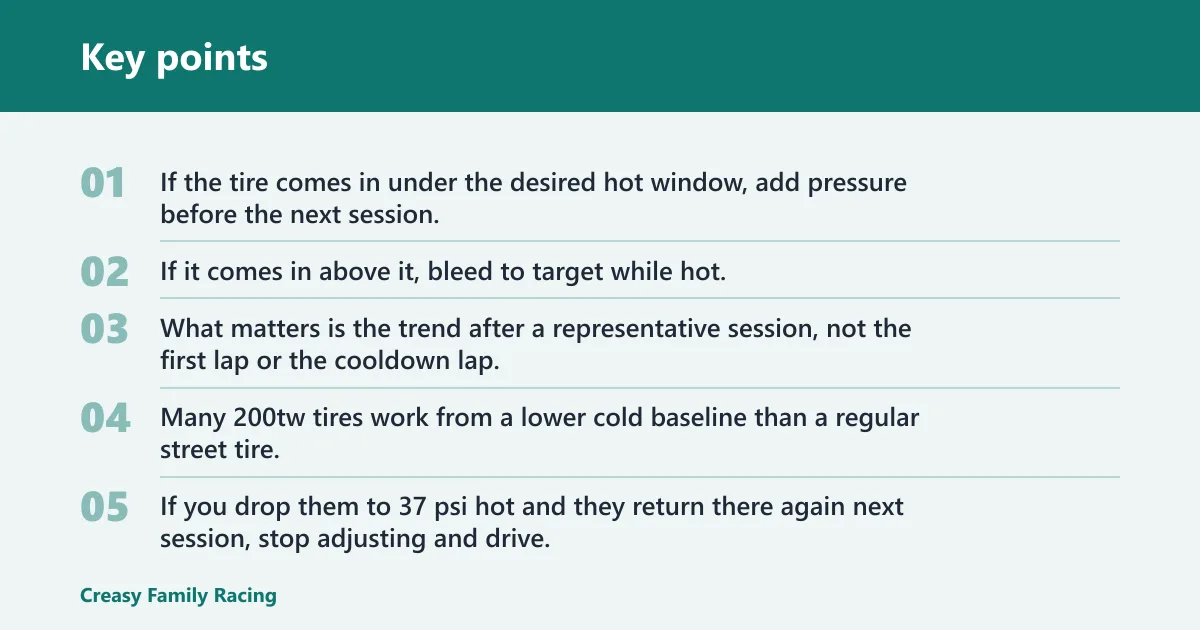
If the tire comes in under the desired hot window, add pressure before the next session. If it comes in above it, bleed to target while hot. What matters is the trend after a representative session, not the first lap or the cooldown lap.
200tw tires
Many 200tw tires work from a lower cold baseline than a regular street tire. Starting at 28-32 psi cold is a usable framework, with the same 34-38 psi hot target as the main anchor unless the tire maker lists something different for that model.
These tires can build pressure quickly over several laps, but behavior varies by carcass, wheel width, and car weight. That is why the page gives ranges and decision rules, not a fake universal number for every 200tw tire.
Say your front tires leave the paddock at 31 psi cold on a warm afternoon and return at 39 psi hot after a clean 20-minute session. That is a simple bleed-down case. If you drop them to 37 psi hot and they return there again next session, stop adjusting and drive.
When to stop changing track pressures
Stop chasing pressure when three things line up: hot readings repeat within about 1 psi, wear no longer shows fresh rollover or center scrub, and the car feels the same at the end of the session as it did mid-session. Past that point, driver input or alignment is often the bigger variable.
What tire pressure should you run for autocross?
Autocross usually starts higher than track-day cold pressure because the run is short and the tire may gain very little pressure. Autocross street tires often start around 34-38 psi cold, while 200tw tires often start around 30-36 psi cold, with many cars ending up around 36-40 psi after repeated runs rather than after one run.
Why autocross changes are small
The run is brief, often under a minute, with little sustained heat soak. You may see only 0 to +2 psi from the first run to the next check. That small move can be real, but it can also be masked by staging time, sun, cloud cover, or a delayed check.
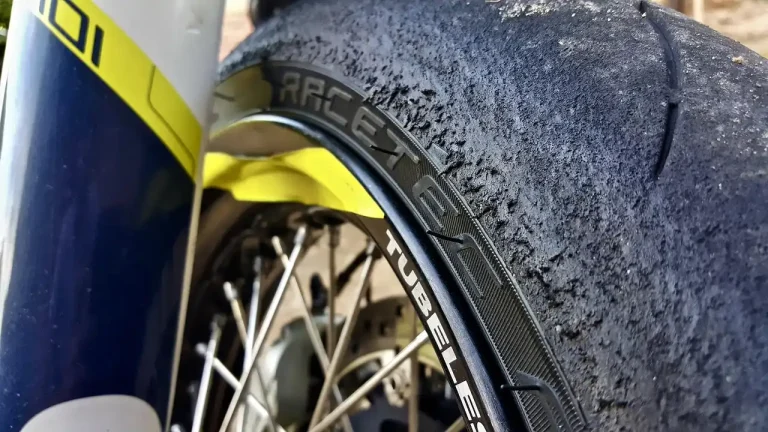
This is why autocross pressure tuning should lean on repeated patterns, shoulder wear, and rollover marks more than one quick “hot” reading. If the outside shoulder is rolling over, pressure may still be too low even if the gauge barely moved.
Street tires versus 200tw in autocross
Street tires often want the upper half of the range for support in transitions. A soft-sidewall street tire may be happier at 36-38 psi cold than at 34 psi if the car feels lazy on turn-in. Many 200tw tires respond well in the 30-36 psi cold range, depending on weight and wheel support.
Grassroots Motorsports Challenge autocross classes require 200tw rated or higher tires, which reflects a real split in how these tires behave versus true drag-focused rubber. That event also allows alternate tires for the drag race, a reminder that the right autocross setting may be the wrong launch setting later the same day.
Picture a front-wheel-drive car on 200tw tires starting at 32 psi cold. After two runs, the fronts read 33 psi and the chalk mark still shows rollover onto the shoulder. The next move is not to bleed. It is to add a small amount of pressure, rerun, and see whether response and shoulder support improve.
What tire pressure should you run for drag racing?
For drag racing, split the advice by tire type. Street tires are usually safer and more repeatable at 30-36 psi cold, while drag radials commonly start in the 16-22 psi cold range. Launch result matters more than a road-course hot target, and low-pressure tires demand a gauge that reads low pressure cleanly.
Street tires at the strip
Street tires need enough pressure to keep the car stable and the tread supported. Starting at 30-36 psi cold is a practical baseline for a street-driven car making passes on regular performance tires. Going much lower on a normal street tire can make the car feel vague and can hurt consistency.
Drag radials
Drag radials use a different logic. The starting range here is 16-22 psi cold, then adjustment follows launch traction and repeatability. Small pressure changes can matter, so gauge choice matters more than it does on a normal 35 psi street-tire setup.
A low-pressure drag gauge example measures 0-15 psi and has a 2-inch face diameter. That exact range will not cover every drag-radial setup, but it shows why narrow-range gauges exist: they make small low-pressure changes easier to see. That same low-pressure gauge uses a flexible hose plus angle and ball chuck, which helps reach awkward valve stems in the staging lanes.
Front tire pressure as a separate drag decision
Front tires at the drag strip can be a separate choice from rear drive-tire pressure. The exact number varies by tire and class rules, so check the manufacturer’s listing for your model and the event rules. The main point is simple: rear launch pressure and front rolling resistance pressure do not have to match.
How do you set cold pressure before the first run?
Set cold pressure by choosing the right baseline for the event format, then correcting for ambient conditions before the first run. Start with the discipline range on this page, measure before driving, and expect the same car to want a slightly different cold number in the morning than in midday heat.
- Pick the event baseline. Use 30-34 psi cold for track-day street tires, 28-32 psi for track-day 200tw tires, 34-38 psi for autocross street tires, 30-36 psi for autocross 200tw tires, 30-36 psi for drag-race street tires, and 16-22 psi for drag radials. Those are starting ranges, not finish-line answers.
- Measure before driving. Check pressures before the car leaves the paddock, not after circling to grid. Cold means before the tires have built heat from use, which keeps your baseline comparable from event to event.
- Account for ambient change. If the morning is cool and midday is much hotter, expect the same untouched tire to read higher later. Instead of forcing the old morning number back in, compare that reading to your notes and ask whether the tire still lands in the right hot window for the session format.
- Write all four numbers. Record LF, RF, LR, and RR separately. Side-to-side split can matter after a session, and a single average number hides useful information.
- Change one variable. Move pressure first before changing alignment, damping, or burnout routine. One clean adjustment teaches more than three stacked guesses.
When should you check hot pressure and bleed it down?
Check hot pressure at the point where the discipline actually creates useful heat. For track days, that means immediately after the session. For autocross, it usually means between runs or after a short set of runs. For drag racing, check before passes for low-pressure rear tires and bleed only when repeated results point the same way.
Track-day timing
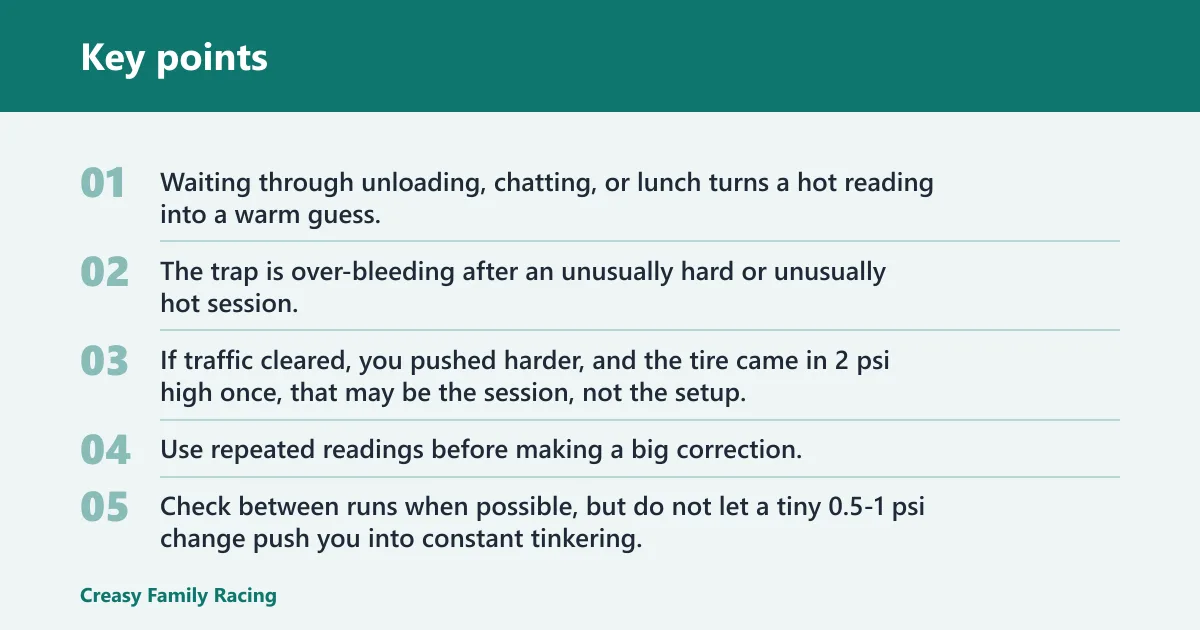
Come off track and measure right away. Waiting through unloading, chatting, or lunch turns a hot reading into a warm guess. If the tire is above the target after a representative session, bleed it while hot to that target, then recheck next session to confirm the pattern.
The trap is over-bleeding after an unusually hard or unusually hot session. If traffic cleared, you pushed harder, and the tire came in 2 psi high once, that may be the session, not the setup. Use repeated readings before making a big correction.
Autocross timing
Autocross gives a short adjustment window. Check between runs when possible, but do not let a tiny 0.5-1 psi change push you into constant tinkering. If the tire is behaving, leave it alone until you have at least a couple of runs showing the same issue.
A common first-timer mistake is bleeding a street tire after one cone-heavy run because it came back 1 psi higher than expected. The next run starts too low, the sidewall rolls over more, and the driver thinks grip fell off for no reason. The reason was the adjustment.
Drag-racing timing
For street tires, checks before the first pass and after weather changes are usually enough. For drag radials, check before each pass if you are near the low end of the pressure window. Adjust from launch feel, sixty-foot consistency, and tire behavior, not from a road-course style hot target.
Wet-condition adjustments
In wet conditions, start by moving up about 2-4 psi from a dry track-day or autocross setting on street and 200tw tires, then watch for standing water, ABS activity, and contact-patch feel. The reason is support and water evacuation, not extra heat control. Do not make the same wet adjustment to drag radials unless the tire maker and class practice support it.
What tire pressure gauge should you use?
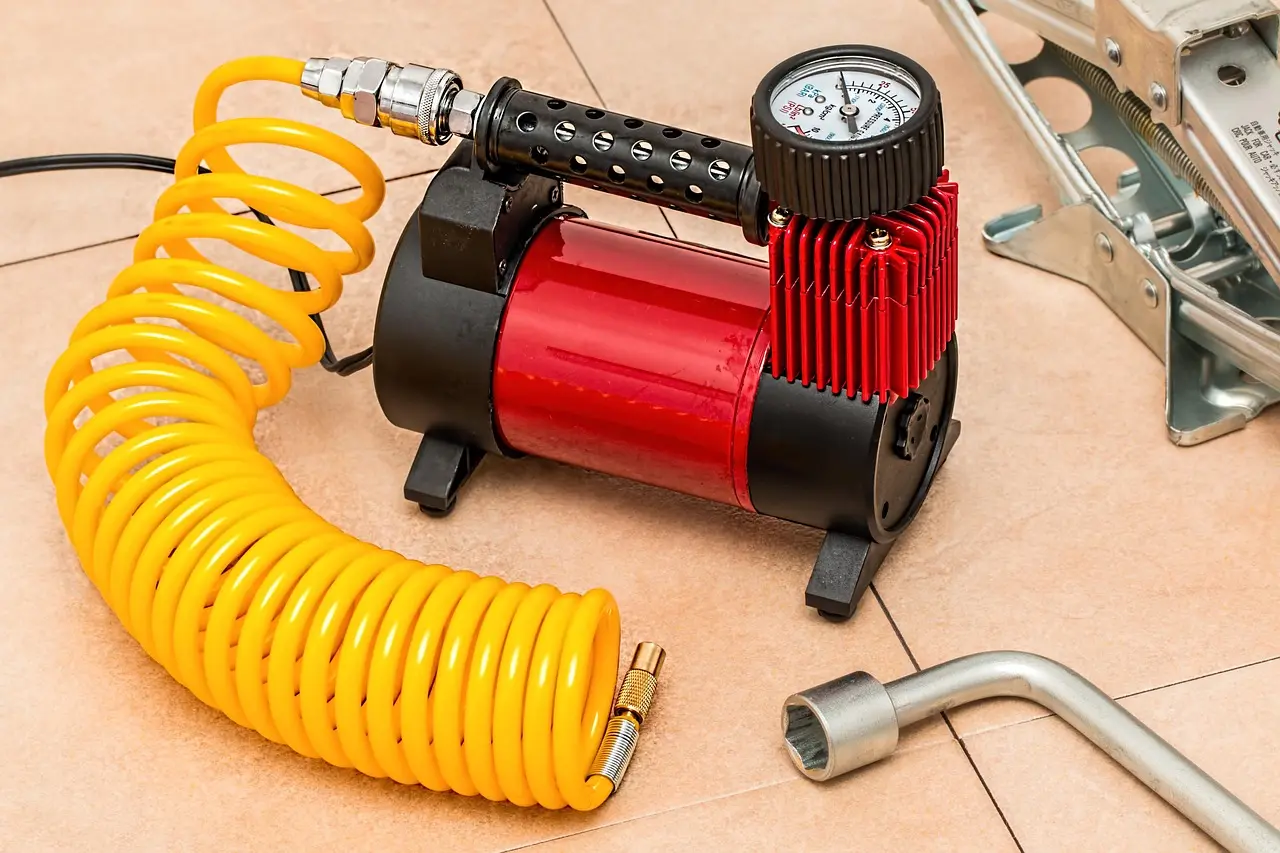
A 0-60 psi gauge covers most track-day and autocross work, while a low-range gauge matters when drag-tire pressure lives in the teens. The right gauge should be accurate, easy to read in dim paddocks, and fast to use, with a bleed button and chuck style that reaches awkward valves.
When a 0-60 psi gauge is the right tool
A digital drag-racing gauge example reads from 0-60 psi, which fits most street-tire, 200tw, and general track-day work. One recommended gauge claims accuracy within 2% of actual tire pressure. That range also covers many tow-vehicle and trailer checks, so it is the practical one-gauge choice for a lot of drivers.
The Longacre gauge includes a large, backlit digital screen, dual bleed buttons for faster adjustment, and an angle and ball chuck. Those are useful paddock features because they save time when the tire is hot and the valve stem is awkward to reach.
An analog example from Joes Racing uses a 0-60 PSI range, glow-in-the-dark markings, and 0.5 PSI graduation interval. That matters if you prefer an analog dial and still need readable marks after dusk.
When a 0-15 psi gauge is better
When the rear tire setup lives in the teens, a low-range gauge is easier to read precisely than a broad 0-60 psi unit. A 0-15 psi example exists for this reason. It will not cover every task in the trailer, but it is the better tool for very low-pressure drag setups.
Features worth paying
- Accuracy: check the maker’s listing and stay with one gauge so your baseline remains consistent.
- Bleed button: faster hot adjustments, especially after a track session.
- Hold-pressure feature: useful when the valve stem is hard to see and you need the reading retained after pulling the chuck.
- Backlit or glow display: easier reading in dim paddocks or night racing.
- Dual chuck or angle/ball chuck: easier access around brake ducts, wheel covers, or tight spoke openings.
Common mistakes that ruin tire-pressure tuning
The biggest mistakes are procedural. Drivers often use one pressure for every format, bleed hot tires too aggressively, or react to one odd reading instead of a repeatable pattern.
- Using one setup everywhere. A pressure that works for a 20-minute road-course session can be wrong for a 50-second autocross run or a drag launch.
- Confusing cold and hot logic. Cold pressure is the baseline. Hot pressure is the target for track work. Mixing those roles creates random changes.
- Over-bleeding in the paddock. Dropping a very hot tire too far can leave the next cold start low.
- Chasing tiny autocross swings. A 0 to +2 psi move may not justify a change unless wear and handling agree.
- Using the wrong gauge range. A broad-range gauge can be fine at 35 psi and clumsy at very low drag-radial pressures.
- Ignoring notes. Without a written record, it is hard to tell whether the tire changed or the weather did.
Frequently asked questions
What tire pressure should I run for drag racing on street tires?
A practical street-tire drag baseline is 30-36 psi cold. That range keeps the tire supported while you work on launch repeatability. Do not treat a normal street tire like a drag radial; much lower pressure can make the car vague and less consistent downtrack.
How do I set cold tire pressure before a track day?
Measure before driving, choose a starting range that matches the tire type, and write all four readings down. For many track-day cars, that means 30-34 psi cold on street tires or 28-32 psi on 200tw tires, then using the first full-session hot reading to refine the next setting.
What hot tire pressure should I target after a session?
Use the tire maker’s target first. As a broad working range, track days usually land around 34-38 psi hot and autocross around 36-40 psi hot after repeated runs, not necessarily after one pass. If the tire repeats there and wear looks stable, stop chasing small changes.
What tire pressure gauge is best for track day use?
For track days, a 0-60 psi gauge is usually the right choice because it covers common street-tire and 200tw pressures. Look for easy readability, a bleed button, and a chuck that fits tight wheels. Low-range 0-15 psi gauges make more sense for very low-pressure drag-tire setups.